Why Every Florida Business Needs Flood Protection
Flood insurance for businesses is specialized coverage that protects commercial properties from water damage caused by flooding events that standard business insurance policies exclude. Here’s what you need to know:
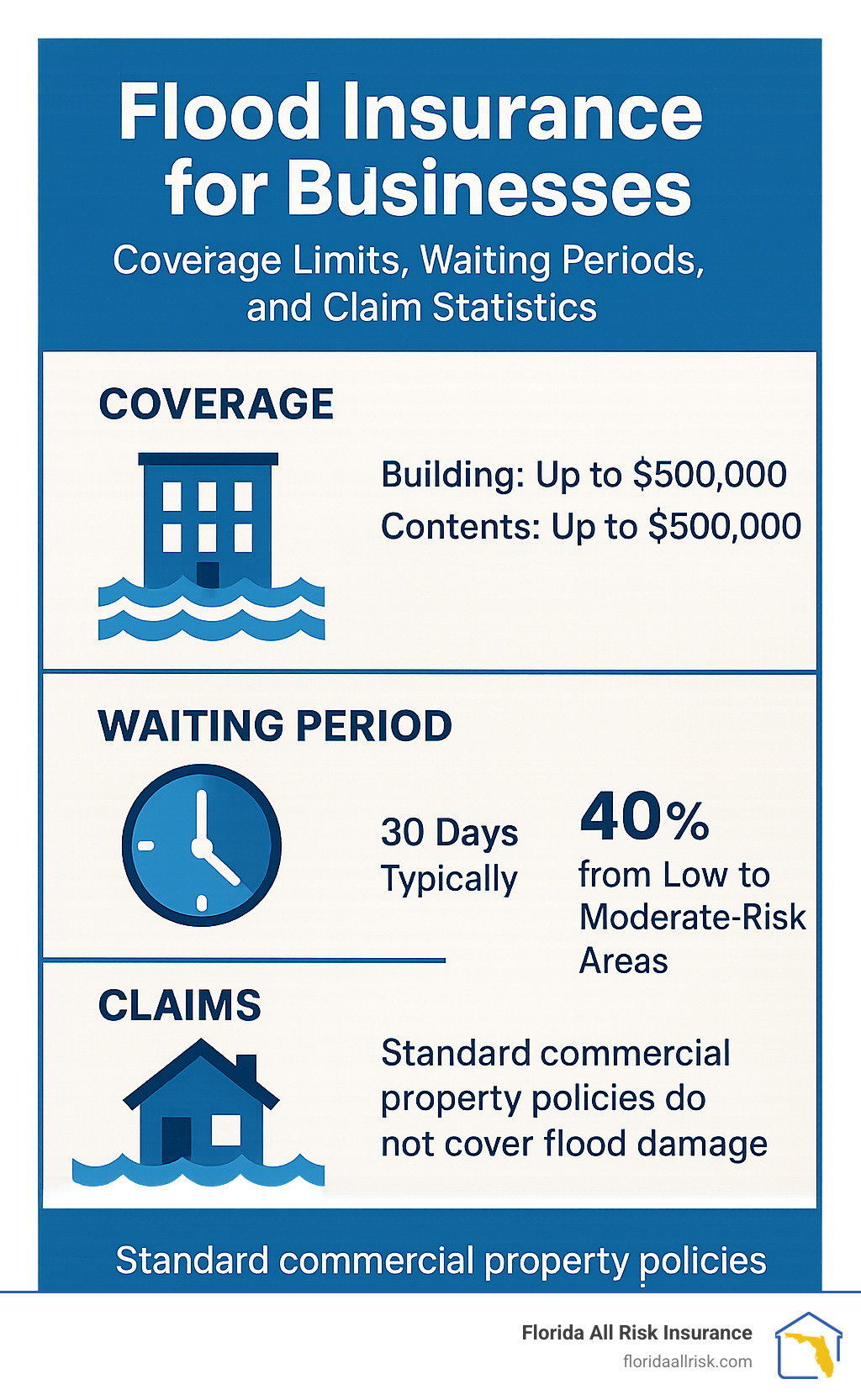
- Coverage: Protects building structures (up to $500,000) and contents (up to $500,000) through the National Flood Insurance Program (NFIP)
- Not Included: Standard commercial property policies DO NOT cover flood damage
- Waiting Period: Typically 30 days before coverage takes effect
- Required: Mandatory for businesses in high-risk flood zones with federally-backed mortgages
- Claims: 40% of flood claims come from properties in low to moderate-risk areas
Floods represent the most common and costly natural disaster in the United States. Just one inch of floodwater can cause up to $25,000 in damage to your business property. Without dedicated flood insurance, your business faces potentially devastating financial losses that could threaten its very survival.
The risk is real for Florida businesses. Since 1996, floods have affected 99% of U.S. counties, with an average commercial flood claim approaching $90,000 between 2011-2015. Even businesses located outside designated high-risk flood zones remain vulnerable, as over 20% of flood claims originate from these supposedly “safer” areas.
I’m Jason Miller, a second-generation insurance professional with over 20 years of experience helping Florida businesses secure appropriate flood insurance for businesses that protects their physical assets and financial future against rising waters.
Handy Flood insurance for businesses terms:
– fema flood zone map
– florida flooding
– does flood zone ae require flood insurance in florida
Flood Insurance for Businesses 101
When a storm hits and water starts rising around your business, knowing exactly what your insurance covers can mean the difference between a quick recovery and financial disaster. In insurance, not all water damage is created equal.
The National Flood Insurance Program (NFIP) specifically defines a flood as:
“A general and temporary condition of partial or complete inundation of two or more acres of normally dry land area or of two or more properties from overflow of inland or tidal waters, from unusual and rapid accumulation or runoff of surface waters from any source, or from mudflow.”
This definition matters because it draws a clear line between flood damage (which needs specialized coverage) and other types of water damage that your regular business insurance might handle.
Congress established the NFIP back in 1968 to give property owners access to affordable flood protection. Today, FEMA manages the program, working through over 50 private insurance companies to deliver coverage to businesses like yours.
Flood insurance for businesses through the NFIP comes with some important features you should understand. Your building coverage and contents coverage are actually separate policies, each with their own deductibles and limits. The maximum coverage available is $500,000 for your building and another $500,000 for what’s inside it.
And here’s something many business owners don’t realize – your policy includes damage from mudflows (literally “a river of liquid and flowing mud”). Just remember there’s typically a 30-day waiting period before your coverage kicks in, so planning ahead is essential.
As we often tell our clients at Florida All Risk Insurance, “Anywhere it can rain, it can flood.” This is especially true here in Florida, where our unique geography and weather patterns create flood risks in every corner of the state.
How Flood Insurance Differs from Standard Commercial Property Insurance
One of the biggest misconceptions I encounter when talking with business owners is the belief that their regular commercial property insurance covers flood damage. Let me be clear – it doesn’t.
Your standard commercial property policy typically protects you from fire damage, wind damage (though hurricane coverage might require additional protection), certain types of water damage like burst pipes, and problems like theft and vandalism. But it specifically excludes flood damage from rising waters, hurricane storm surge, overflowing lakes or rivers, and surface water runoff.
This creates a dangerous coverage gap for many Florida businesses. Here’s a simple way to think about it: if water comes from above (like rain through a damaged roof), your standard commercial policy typically applies. But if water rises from below (like storm surge or overflowing rivers), you need flood insurance for businesses.
Unlike your Business Owner’s Policy that bundles multiple coverages together, flood insurance focuses exclusively on flood damage. And while your standard commercial policy likely provides replacement cost coverage, flood policies generally pay claims based on Actual Cash Value, which factors in depreciation – meaning you’ll get less for older items.
When Flood Insurance for Businesses Becomes Mandatory
For some Florida business owners, flood insurance isn’t just a smart choice – it’s required.
Your business must have flood insurance when it’s located in a high-risk flood zone (areas marked with an A or V on FEMA flood maps) and you have a mortgage from a federally regulated or insured lender. You’ll also need it if you’ve received certain types of federal disaster assistance and want to remain eligible for future help.
Even when not legally required, many commercial lenders in Florida insist on flood coverage as a condition of their loans. They understand the significant flood risks throughout our state.
Not sure if your business sits in a high-risk zone? You can check your status using FEMA’s Flood Map Service Center. Just keep in mind that flood maps do get updated periodically, and your property’s designation can change.
The bottom line? In Florida, flood insurance for businesses isn’t just an optional add-on – it’s a critical component of your complete business protection plan.
Coverage & Key Exclusions
Understanding what is and isn’t covered by flood insurance for businesses is essential for making informed decisions about your risk management strategy.
Building Coverage Details
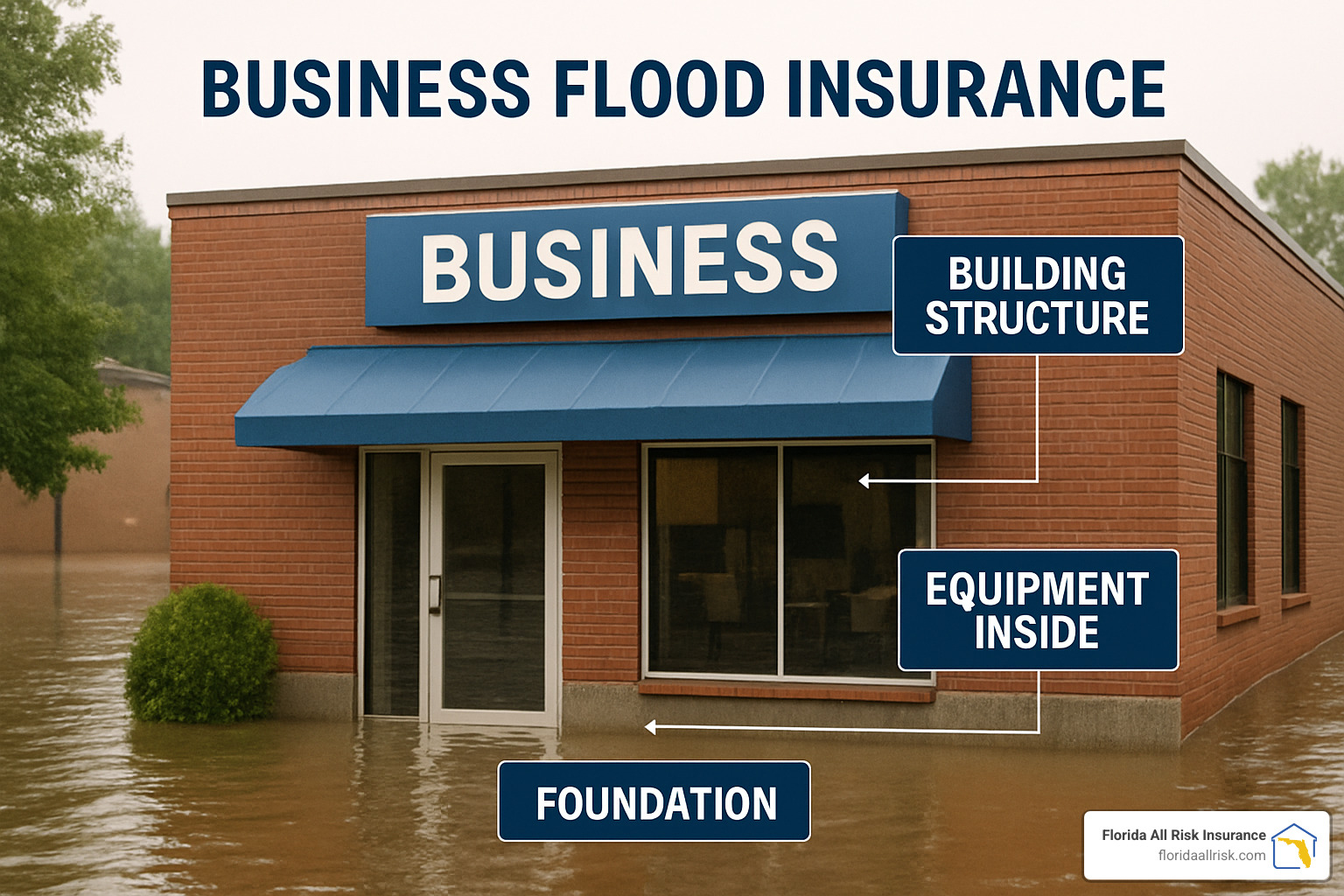
When floodwaters rise, your building’s physical structure becomes your first line of defense—and potentially your biggest financial vulnerability. NFIP commercial flood policies protect this investment by covering your building and its foundation, giving you peace of mind when storm clouds gather.
Your electrical and plumbing systems—the vital circulatory systems of your business—are fully covered, along with HVAC equipment including furnaces, water heaters, and air conditioners. Those permanently installed features that make your space uniquely yours—built-in appliances, permanently installed carpeting, cabinets, paneling, and bookcases—all fall under this protection umbrella.
I remember when a St. Petersburg restaurant client called us after a severe storm sent water rushing through their doors. The relief in the owner’s voice was palpable when we confirmed their NFIP building coverage would help pay for repairs to their damaged foundation, electrical systems, and built-in kitchen equipment. Even their window blinds, shutters, and detached storage garage (covered up to 10% of building coverage) were protected, along with debris removal costs.
Contents Coverage Details
While your building provides the shell, it’s what’s inside that truly makes your business function. Contents coverage—purchased separately from building coverage—protects these vital assets from flood damage.
Your furniture, fixtures, machinery, and equipment represent significant investments that contents coverage helps protect. For retail businesses, your merchandise stock is your lifeblood, and this coverage ensures a flood won’t wash away your inventory and livelihood in one fell swoop.
All other business personal property, from portable appliances to clothes washers and dryers, falls under this protection. Even food freezers and their contents won’t leave you with a total loss after floodwaters recede. Certain valuable items are covered up to $2,500, providing a safety net for more precious business assets.
Business tenants should note a particularly important detail: improvements you’ve made to your rented space are considered part of your contents coverage, but only up to 10% of your total contents amount.
“After our warehouse flooded, we were relieved to learn our inventory was covered by our contents policy,” shared a wholesale distributor client in Tampa. “Without that coverage, we would have been looking at over $150,000 in losses.”
What’s Not Covered & How to Fill Gaps
Even the most comprehensive flood insurance for businesses has limitations you need to understand. Perhaps the most significant gap is the absence of business interruption coverage. When floodwaters force your doors closed, your income stops—but your expenses don’t. Standard flood policies won’t replace this lost revenue or help with ongoing expenses like payroll while you rebuild.
Outdoor property also remains vulnerable. Your landscaping, septic systems, decks, patios, fences, and swimming pools all fall outside the protection of standard flood coverage. Similarly, currency, precious metals, and valuable papers like stock certificates and deeds aren’t covered, nor are most self-propelled vehicles, including their parts.
Basement areas present special challenges too. While structural elements and essential equipment may be covered, personal property stored in basements generally isn’t protected—a critical consideration if you use below-grade areas for inventory storage.
To truly protect your business, consider filling these gaps with complementary coverage options. Excess flood insurance from private carriers can provide protection beyond NFIP limits. Dedicated business interruption insurance can replace lost income during rebuilding—crucial since businesses closed by flooding often remain shuttered for weeks or months. Commercial umbrella policies offer additional liability protection, while specialized coverage can protect high-value equipment or inventory.
By understanding both what’s covered and what isn’t, you can create a comprehensive protection strategy that keeps your business afloat, even when the waters rise.
More info about Commercial Property Insurance
Cost, Limits & Buying Options
The cost of flood insurance for businesses isn’t one-size-fits-all. As a Florida business owner, you’re probably wondering what this essential coverage might cost you. Let’s break down what influences your premium and explore your options beyond the basics.
Premium Drivers & Savings Tips
When FEMA introduced their Risk Rating 2.0 pricing system in 2021, they changed how flood insurance gets priced. Now, your premium depends on a more personalized risk assessment that considers:
Your flood zone designation plays a major role – if you’re in high-risk A or V zones, you’ll typically pay more. But that’s just the starting point. Your building’s characteristics matter too – how it’s constructed, how many floors it has, and whether there’s a basement all factor in.
The elevation of your lowest floor compared to the base flood elevation can significantly impact your premium. One of our clients in Clearwater finded this firsthand: “After getting an elevation certificate and implementing several flood mitigation measures, we cut our annual premium by nearly 15%,” they told us.
Your building’s replacement cost and any prior claims at the property will influence pricing too. And don’t overlook your deductible choice – opting for a higher deductible generally means lower premium payments (though more out-of-pocket when a flood occurs).
Want to save money on your flood insurance? Here are some practical tips:
Lift your utilities and equipment above the base flood elevation – relocating electrical panels, HVAC systems, and water heaters can make a real difference in your premium.
Install proper flood openings or vents that allow water to flow through enclosed areas rather than pushing against your walls.
Get an elevation certificate to verify your building’s height relative to flood levels – it might show you’re at less risk than the maps indicate.
Check if your community participates in the Community Rating System (CRS) – many Florida communities do, and this can provide automatic discounts.
Consider higher deductibles if your business has the cash reserves to handle a larger out-of-pocket expense when filing a claim.
Beyond NFIP: Excess Flood & Business Interruption Add-Ons
The NFIP’s coverage caps at $500,000 for your building and another $500,000 for contents. For many Florida businesses, especially those with larger facilities or valuable equipment, this simply isn’t enough protection.
That’s where excess flood insurance comes in. These policies pick up where the NFIP leaves off, providing additional coverage that often includes benefits the federal program doesn’t offer:
- Coverage limits that can exceed $5 million for both building and contents
- Business interruption coverage (a crucial gap in standard flood policies)
- Replacement cost coverage for contents instead of actual cash value
- Shorter waiting periods – sometimes as little as 5-7 days compared to NFIP’s standard 30 days
The business interruption coverage deserves special attention. When your business can’t operate because of flood damage, the lost income and ongoing expenses can be devastating. Most businesses that close due to flooding remain shut down far longer than the repairs take – and without specific coverage for this interruption, you’re facing those losses on your own.
| Feature | NFIP Flood Insurance | Private/Excess Flood Insurance |
|---|---|---|
| Maximum Building Coverage | $500,000 | $5 million+ (varies by insurer) |
| Maximum Contents Coverage | $500,000 | $5 million+ (varies by insurer) |
| Business Interruption | Not covered | Available |
| Waiting Period | 30 days typically | As little as 5-7 days |
| Valuation Method | Actual Cash Value | Replacement Cost available |
| Coverage for Outdoor Property | Limited/None | More extensive options |
| Basement Contents | Limited to essential equipment | More comprehensive options |
At Florida All Risk Insurance, we often recommend a combination approach – using the NFIP policy as your foundation and adding private market coverage to fill the gaps. This strategy provides the stable backing of the federal program while addressing its limitations.
Flood Insurance Cost
FEMA flood map
Claims, Recovery & Risk Mitigation
When floodwaters recede, the real work for business owners begins. Navigating the claims process efficiently can mean the difference between a quick recovery and months of financial struggle.
Step-by-Step Flood Insurance Claim Process
The moments after a flood can feel overwhelming, but taking prompt action is crucial. Start by contacting your insurance agent or company immediately—don’t wait for things to dry out. The clock starts ticking as soon as the flood occurs.
Before you start cleanup, grab your smartphone and document everything. Take photos and videos from multiple angles showing water levels and all affected areas. Create a detailed inventory of damaged items and, if possible, keep samples of damaged materials like sections of carpet or drywall. These will be invaluable when the adjuster arrives.
Your insurance company will assign an adjuster who’ll visit your property to assess the damage. Think of them as your partner in this process—they’ll help you prepare the all-important Proof of Loss document.
“The adjuster who came after our office flooded was incredibly helpful,” shares Maria, a Florida All Risk client who owns a printing business in Tampa. “She walked me through exactly what documentation I needed and helped me understand the timeline.”
The Proof of Loss is a sworn statement that substantiates your claim and must be filed within 60 days of the flood. This critical document includes detailed damage information, repair estimates, and supporting documentation. Missing this deadline can jeopardize your entire claim, so mark it on your calendar.
Once your Proof of Loss is approved, payment will be issued. For substantial claims, you may qualify for advance payments to begin immediate repairs. Flood insurance typically pays based on Actual Cash Value (ACV), which factors in depreciation—meaning you might not receive enough to fully replace everything at current prices.
Reducing Risk to Lower Premiums
Smart flood mitigation not only protects your business but can also significantly reduce your insurance costs. Think of these measures as investments that pay dividends through both premium savings and reduced damage when floods occur.
Elevation is perhaps the most effective strategy—raising your building’s lowest floor above the Base Flood Elevation can dramatically reduce both risk and premiums. For existing structures, consider dry floodproofing techniques like waterproof coatings or impermeable membranes that make your building watertight below the flood level.
Many Florida businesses opt for wet floodproofing, which allows water to enter certain areas while protecting utilities and contents. Installing flood openings or vents in foundation walls and enclosures reduces hydrostatic pressure during floods, preventing structural damage.
“After spending $12,000 to lift our electrical systems and install flood vents, our annual premium dropped by nearly $3,000,” explains James, who owns a warehouse near the coast in St. Petersburg. “But the real payoff came during last year’s storm when neighboring businesses had extensive damage and we were back operating within days.”
Using flood-resistant materials in areas below the flood elevation level makes good sense too. These specially designed materials can withstand direct contact with floodwater for extended periods without significant damage.
Don’t overlook the importance of a well-crafted emergency response plan. Knowing exactly how you’ll move inventory, secure equipment, and evacuate when waters rise can dramatically reduce losses.
Many Florida communities participate in the Community Rating System (CRS), which provides flood insurance premium discounts based on community-wide floodplain management activities. Ask your agent if your business location qualifies for these discounts.
By implementing these strategies, you’re not just protecting your physical assets—you’re safeguarding your business’s financial future and operational continuity.
Commercial Property Insurance Risk
Frequently Asked Questions about Flood Insurance for Businesses
How long is the waiting period before coverage starts?
When you purchase flood insurance for businesses through the NFIP, you’ll need to plan ahead. There’s typically a 30-day waiting period before your coverage kicks in. This is why I always tell my clients not to wait until they see a hurricane forming in the Atlantic to think about flood protection!
There are a few situations where you might not have to wait the full 30 days:
* You’re getting a new mortgage and your lender requires flood insurance
* You’re adding coverage at your regular renewal time
* Your property is affected by flooding on recently burned federal land (if you buy within 60 days of the fire being contained)
The good news is that private flood insurance options sometimes offer much shorter waiting periods—often just 5 to 15 days. This can be a real lifesaver when you need protection quickly.
Does flood insurance cover business interruption losses?
Unfortunately, standard NFIP flood insurance for businesses does not cover business interruption losses. This is a crucial gap in coverage that catches many business owners by surprise.
Think about it—if flooding forces you to close your doors for repairs, your flood policy will help fix the building and replace damaged contents, but it won’t replace a single dollar of lost income during that downtime. And we’re not talking about just a day or two; businesses affected by flooding typically remain closed for 4-6 weeks on average.
During this closure, you’ll still need to pay your employees, make rent or mortgage payments, and handle other ongoing expenses—all without revenue coming in. To protect against this financial strain, you’ll need either a separate business interruption insurance policy or an excess flood policy from a private insurer that includes business interruption coverage.
Can I buy flood insurance if I’m outside a high-risk zone?
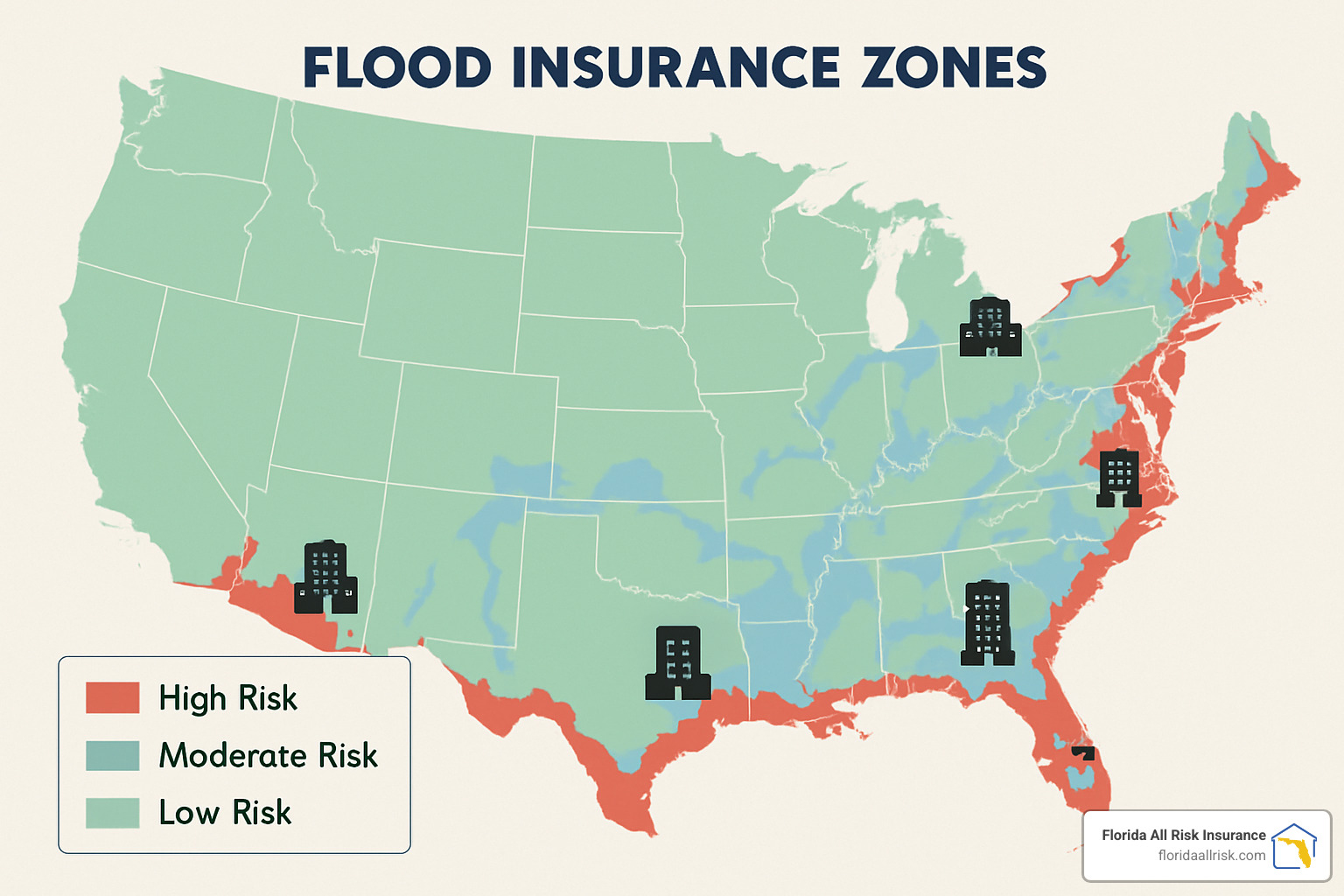
Absolutely—and it’s often a smart business decision! Being outside a high-risk zone doesn’t mean you’re outside all risk. In fact, over 20% of flood claims come from properties in areas considered low to moderate risk.
The silver lining is that flood insurance for businesses in these lower-risk areas typically costs significantly less. You get valuable protection at a fraction of what businesses in high-risk zones pay.
I remember a client in Pinellas County who initially questioned the need for flood coverage since their business wasn’t in a high-risk zone. “I thought it was unnecessary since we weren’t in a high-risk area,” they told me. “But after seeing neighboring businesses suffer uninsured losses from an unexpected flood, I realized the relatively small premium was worth the protection.” Their foresight paid off when their business later experienced minor flooding—the coverage saved them tens of thousands of dollars.
Flooding can happen anywhere it rains. Development changes, weather patterns shift, and what was once considered “safe” may not stay that way forever.
Conclusion & Next Steps
The waters are rising in Florida, and so are the risks to your business. Throughout this guide, we’ve seen why flood insurance for businesses isn’t just another line item in your budget—it’s essential protection against a threat that standard commercial policies simply don’t address.
Think of it this way: floods don’t discriminate between high-risk zones and “safer” areas. They don’t care if you’ve never had water issues before. And they certainly don’t wait until you’re financially prepared to handle a disaster.
Here’s what we’ve learned together:
Your standard commercial policy has a gaping hole where flood protection should be. Without dedicated flood coverage, you’re essentially gambling your business’s future on Florida’s unpredictable weather patterns.
NFIP policies form your first line of defense, offering up to $500,000 for your building and another $500,000 for contents. For many businesses, this foundation is essential but may not be enough—that’s where private excess coverage comes in to provide that extra layer of protection.
Critical 30-day waiting period. I’ve seen too many business owners scramble for coverage as a storm approaches, only to learn they’re already too late. Don’t be caught in that position.
Perhaps most importantly, business interruption coverage requires separate planning. The NFIP won’t replace your lost income while you’re rebuilding, which is often what ultimately determines whether businesses survive a flood event.
Smart mitigation measures aren’t just about reducing damage—they can significantly lower your premiums too. Those liftd electrical systems and flood vents might seem expensive today, but they’re investments that pay dividends with every premium notice and potential flood event.
At Florida All Risk Insurance, we’re your neighbors here in St. Petersburg. We’ve walked through flooded businesses with devastated owners, and we’ve celebrated with those who had the right coverage in place. The difference isn’t luck—it’s preparation.
As an independent agency, we don’t just offer one-size-fits-all solutions. We’ll work with you to assess your specific flood risks, explore your options across multiple carriers, and build a protection plan that makes sense for your business and budget.
Don’t wait for the forecast to turn ominous. The time to secure flood insurance for businesses is now, when the skies are clear and that 30-day waiting period won’t leave you vulnerable.
Give us a call today. Let’s make sure your business stays high and dry, no matter what storms come our way.