
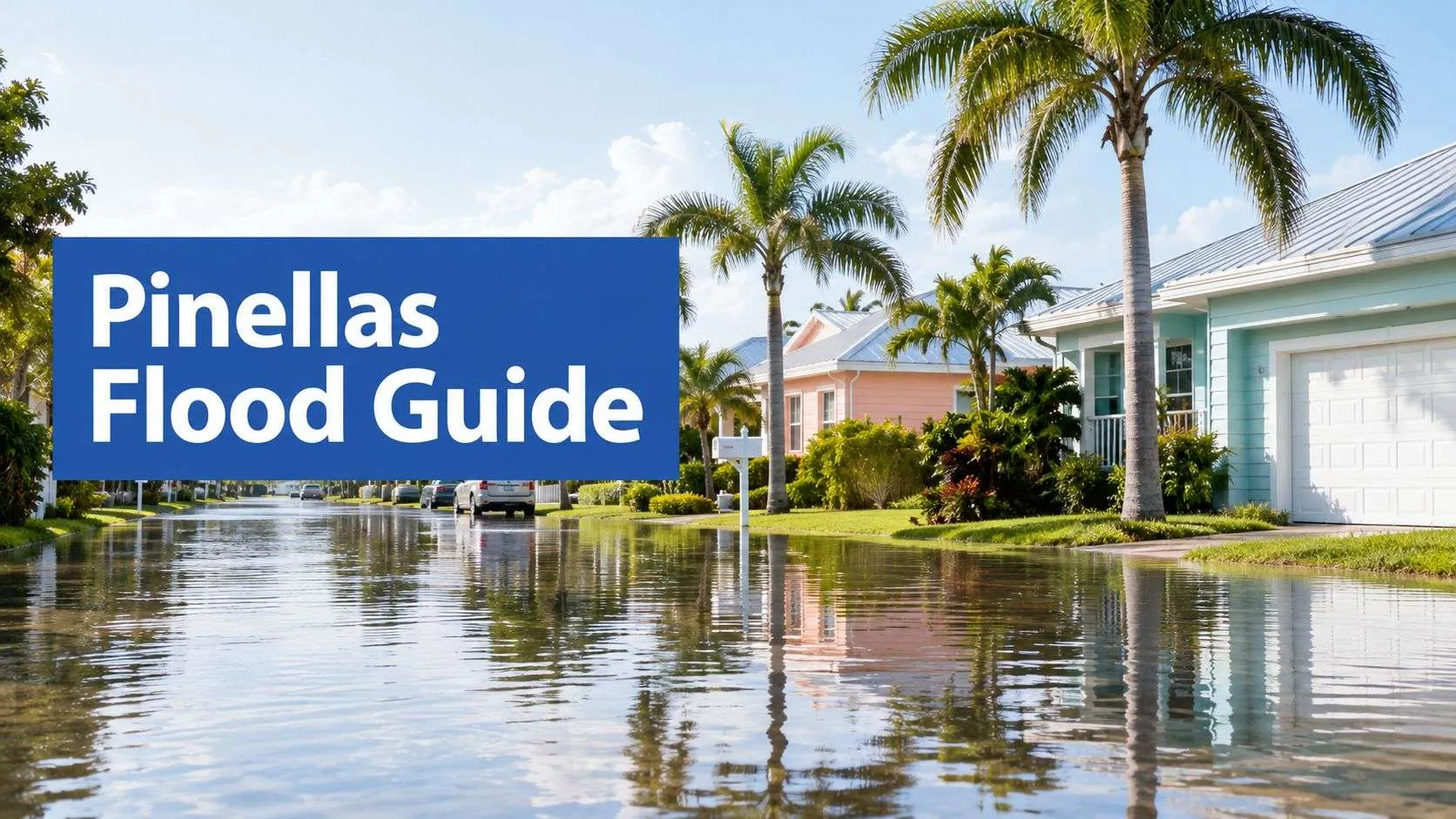
You're days away from closing on a home in St. Petersburg or Clearwater when the lender adds one more condition: flood insurance. The property may not look like it sits in a high-risk area, and the seller may say coverage was never required before. Suddenly, you're checking FEMA maps, requesting an elevation certificate, comparing policy options, and trying to keep the closing date intact.
That pressure creates expensive confusion. A lender's decision tells you whether insurance is required for the mortgage, not whether your home can flood. A FEMA zone helps establish mapped risk, but it doesn't capture every drainage problem, rainfall event, or storm-surge pathway. Your standard homeowners policy generally won't fill that gap, either.

This guide explains flood insurance in Pinellas County step by step, from coverage basics and FEMA map nuances to premiums, closing deadlines, and claims. If you're reviewing the rest of your property protection, you can also compare Pinellas County home insurance options before signing your final documents.
Table of Contents
- Understanding Flood Insurance Basics
- Comparing NFIP and Private Flood Policies
- Factors Affecting Premiums and How to Lower Them
- Lender Requirements and Purchase Process
- Filing Claims and Best Practices
- Why Work with a Local Independent Agency
- Conclusion and Contact
Understanding Flood Insurance Basics
Flood insurance is best understood as a separate protection layer for water entering your property from outside. Think of your homeowners policy as protection for many everyday household risks, while flood insurance works like a specialized plan for floodwater. Standard homeowners coverage generally excludes flooding caused by storm surge, heavy rainfall, overflowing water, or drainage failure.
That distinction matters in a coastal county. A home can suffer flood damage even when the water doesn't arrive through a river or directly from the Gulf. Rain can overwhelm drainage, surge can move inland, and water can enter through lower-level openings. A property outside a mandatory-purchase zone can still face a financially serious loss.
What a flood policy can cover
Flood coverage usually has two separate components:
- Building coverage: This addresses the insured structure and eligible permanently installed components, subject to the policy's terms, limits, exclusions, and deductible.
- Contents coverage: This protects eligible personal belongings, such as furniture, appliances, and other possessions, when contents coverage is selected.
- Deductible: You pay this portion of a covered loss before the policy responds. A higher deductible may affect the premium, but it also increases the amount you must fund after a flood.
- Waiting period: A newly purchased policy generally doesn't begin immediately. Pinellas County warns that buying coverage after a flood is forecast won't provide immediate protection for that event. Review the policy's effective-date rules and any exceptions in writing.
A condominium unit owner should ask different questions from a single-family homeowner. The association's master policy may address shared buildings or common areas, but it doesn't automatically protect your contents, improvements, loss-of-use expenses, or exposure to the association's deductible. Renters and business owners also need coverage designed for their own property and financial risks.
Who must carry it
FEMA's high-risk Special Flood Hazard Areas, generally Zones A, AE, V, and VE, represent at least a 1% annual probability of flooding. For a federally backed mortgage secured by a property in an SFHA, the lender generally requires flood insurance for the life of the loan. The required amount is generally the lesser of the outstanding loan balance, the building's value, or the maximum available NFIP limit.
That requirement is a financing rule, not a complete risk assessment. Pinellas County reports that more than 75% of NFIP claims are paid in SFHA zones, while nearly 20% of flood-insurance claims originate outside them. Review flood risk guidance for homeowners alongside the official FEMA map, local drainage information, and your property's elevation details.
For coverage choices and address-specific questions, review flood insurance options before your lender sets a final deadline.
Comparing NFIP and Private Flood Policies
The National Flood Insurance Program, or NFIP, provides a federally backed route to flood coverage in participating communities. A private flood policy is offered through the private market and may use different underwriting rules, limits, endorsements, deductibles, and eligibility standards.
Neither option is automatically right for every Pinellas County property. The useful comparison is not just “government versus private.” It's whether the policy matches the building, the belongings, the mortgage, and the financial consequences you'd face after a flood.

Where the NFIP may fit
The NFIP offers a standardized structure that many lenders and property owners recognize. It can be a practical choice when you want federally backed coverage and your property fits the program's rules. Its availability depends on community participation and the policy's eligibility requirements.
An NFIP quote should still receive close attention. Check the building and contents selections, deductible, exclusions, waiting period, and whether the limits fit the cost to repair or replace the property. A mortgage requirement may be satisfied while your personal belongings, temporary relocation costs, or improvements remain outside the protection you expected.
Where a private policy may fit
Private flood policies can differ substantially from NFIP policies. Depending on the property and underwriting decision, a private option may offer different limits, broader coverage terms, excess coverage, or policy features suited to a higher-value home. Recent renovations, unusual construction, or a large contents exposure may justify a closer private-market review.
A private policy isn't automatically broader or cheaper. The insurer may evaluate the property, location, construction, prior loss history, elevation, and other characteristics differently. Compare the actual wording, not just the premium.
| Decision point | NFIP policy | Private flood policy |
|---|---|---|
| Program structure | Federally backed and standardized | Market-based terms and underwriting |
| Limits | Program limits and eligibility rules apply | Limits may vary by property and policy |
| Pricing | Based on the program's rating approach | Varies by insurer and risk assessment |
| Coverage design | Review building, contents, exclusions, and deductible | Review building, contents, endorsements, and exclusions |
| Waiting period | Generally subject to the applicable waiting-period rules | Effective dates and waiting rules vary by policy |
| Lender acceptance | Commonly recognized when properly issued | Confirm the lender accepts the policy and required documentation |
Ask for both options when appropriate, then compare the declarations page and coverage forms line by line. The least expensive premium can become the most expensive choice if it leaves a major gap.
Factors Affecting Premiums and How to Lower Them
Flood premiums reflect the relationship between local flood exposure and the physical characteristics of your property. Two houses close to one another can receive different pricing because their elevations, foundations, construction, prior losses, or coverage needs differ.
The FEMA map is an important starting point. High-risk SFHAs, including Zones A, AE, V, and VE, carry at least a 1% annual flood probability, and more than 75% of Pinellas County NFIP claims come from these zones. See the Pinellas County FEMA flood map guidance for the distinction between the federal map used for lender requirements and local floodplain information.
The property factors underwriters examine
Flood zone and mapped hazard affect how the insurer evaluates exposure. AE and VE properties are inside the SFHA, but the specific zone, elevation information, and coastal characteristics still matter. Zone X properties aren't subject to the same federal mandatory-purchase rule, yet they aren't flood-proof.
Elevation is another major variable. The relationship between the lowest floor and the applicable flood elevation can influence the premium. An elevation certificate may document the structure's position and construction details, giving the insurer more reliable information than a rough map assumption.
Building age and construction type also shape the risk. Older structures may have been built before current floodplain practices were adopted. Masonry construction, raised foundations, compliant flood openings, and other resilient features can affect how water moves around or through the building.
Claims history provides another signal. A property with repeated prior losses may receive different underwriting treatment from a property without that history. Ask the seller for available loss information, and don't assume a quiet period means the structure has no underlying drainage or elevation issue.
Coverage selections influence what you pay and what you can recover. Building value, contents, deductible, exclusions, and the need for additional protection all belong in the same conversation. Cutting coverage without understanding the gap may reduce the bill while increasing your post-flood financial exposure.
Practical ways to reduce cost and damage
Start with evidence rather than assumptions:
- Confirm the current FEMA zone. Search the address on the official FEMA map and keep a copy of the result for your insurance file.
- Request an elevation certificate. Ask the seller, association, builder, local records office, or survey professional whether one exists. If it doesn't, ask an appropriately qualified professional whether obtaining one could clarify the rating.
- Inspect the lowest level. Identify utilities, storage, openings, finished areas, and belongings that could be affected by rising water.
- Review mitigation features. Flood vents, a structure built above base flood level, water-resistant materials, protected utilities, and effective drainage can reduce damage, although the insurer must confirm which features qualify for rating credit.
- Compare coverage designs. Request quotes using consistent building limits, contents selections, deductibles, and effective dates. Otherwise, a lower quote may provide less protection.
The county's CRS participation adds a community-level affordability benefit. Pinellas County has participated in the Community Rating System since 1993, and 22 of its 24 municipalities were participating as of April 1, 2023, according to the county's flood information and CRS guidance. In July 2023, the county announced that its unincorporated area had improved from CRS Class 3 to Class 2. That rating became effective April 1, 2024, increasing the maximum NFIP premium discount for eligible unincorporated-area policyholders from 35% to 40%, with estimated annual savings of more than $10 million.
Important distinction: The CRS discount applies to eligible NFIP policies in the unincorporated county. Municipal discounts and policy eligibility can vary by community and property characteristics.
The Class 2 rating reflects public information, mapping, warning systems, mitigation, and other floodplain-management activities. It isn't just a local price adjustment, and it doesn't mean every policy receives the same discount. Ask how the rating applies to your address and policy before using it in your budget.
Lender Requirements and Purchase Process
A mortgage lender's flood determination is one checkpoint in the purchase process. It doesn't replace your own review of flood exposure, coverage limits, or the policy's effective date.
The safest approach is to begin before the closing week.
Start with the address
Ask for the current FEMA FIRM result for the exact property address. Pay attention to the difference between the FEMA map and local floodplain or storm-surge information. A lender generally bases a mandatory-purchase decision on the FEMA FIRM, not solely on a county map.
If the property is in an SFHA and the loan is federally backed, the lender will generally require coverage for the life of the loan. The required amount is not necessarily the same as the amount you'd want to protect the structure and contents. Ask for the lender's required limit, then evaluate whether additional protection is appropriate.
Build a closing timeline
Use this sequence:
- Before making an offer: Check the FEMA zone, ask about prior flooding, and request any available elevation documentation.
- During contract review: Ask for flood quotes early, compare the policy forms, and understand the deductible and exclusions before waiving relevant contingencies.
- Before the lender deadline: Select a policy, confirm the named insured and property address, and provide the declarations page or binder the lender requests.
- Before closing: Verify the effective date in writing. Confirm whether the lender needs a mortgagee clause, proof of payment, or other evidence of coverage.
- After closing: Store the policy, elevation records, photos, inventories, and agent contacts in a digital folder.
A new flood policy generally has a 30-day waiting period before coverage begins. Pinellas County specifically warns that purchasing after a storm is forecast won't protect the property for that event. Exceptions and policy-specific effective-date rules can apply, so don't rely on a verbal assurance.
A condominium purchase adds another layer. Request the association's master-policy information, but don't treat it as a substitute for unit-owner coverage. Ask who covers the structure, improvements, contents, temporary relocation, and deductibles. If you're comparing coastal property costs in another market as a general budgeting exercise, you can compare Destin Pointe pricing, but Pinellas underwriting must be based on the specific address and policy.
What can delay closing
Common problems include an incorrect address, missing elevation information, a policy that doesn't meet the lender's requirements, an effective date after closing, and confusion over whether the quote covers the building, contents, or both. Resolve those issues while there's still time to revise the policy.
Filing Claims and Best Practices
Flood claims move more smoothly when you treat documentation as part of the recovery process, not as an afterthought. Your first priorities are safety, emergency mitigation, and preserving evidence.
The scale of historical insured losses explains why preparation matters. Since 1978, Pinellas County properties have generated more than 51,779 NFIP claims, with approximately $3.8 billion in payments. More than half of those claims were filed during the catastrophic 2024 season, according to Pinellas County NFIP claims data. These figures represent insured losses, not every property loss in the county.
What to do after the water recedes
- Protect people first. Don't enter an unsafe structure or operate electrical equipment in standing water.
- Notify the insurer promptly. Use the claims contact shown in your policy and record the date, time, representative, and claim number.
- Photograph before cleanup. Capture exterior water lines, damaged rooms, flooring, walls, appliances, furniture, and debris. Take wide shots and close-ups.
- Prevent further damage when safe. Follow reasonable emergency measures, keep receipts, and ask before discarding damaged items unless safety requires immediate disposal.
- Create an inventory. List the item, approximate age, condition, purchase information, and damage. A digital folder with photos, receipts, emails, and call notes helps keep the record organized.
- Cooperate with the adjuster. Provide access, documents, and a clear description of what happened.
A flood claim isn't the same as a roof claim. For broader property-claim context, review how roof insurance claims work, then follow the specific flood policy's reporting and proof-of-loss requirements.
Don't begin permanent repairs before understanding the insurer's process. Emergency mitigation may be necessary, but major work can make it harder to establish the original damage. Ask the adjuster or claims representative what documentation is required, and keep damaged materials when it's safe and practical.
If you carry a private policy, follow that policy's notice, adjustment, and proof-of-loss rules. The forms and deadlines may differ from an NFIP claim, so use the policy documents rather than assuming the process is identical.
Why Work with a Local Independent Agency
Flood decisions often involve several parties at once, including the buyer, seller, lender, condominium association, survey professional, and insurer. A local independent agency can help organize those moving parts around the property's actual address and closing date.
An agent can review the FEMA zone, ask for elevation information, compare available NFIP and private-market approaches, and explain the difference between lender-required coverage and financially sensible coverage. That's useful when a property sits outside an SFHA but still has rainfall, drainage, or storm-surge exposure.
Florida All Risk Insurance is an independent agency based in St. Petersburg that provides flood, homeowners, condominium, and commercial coverage. Its agents can coordinate quote information and lender documentation while helping you compare building coverage, contents coverage, deductibles, waiting periods, and policy limitations.
The agency's local perspective can also help identify questions a generic quote form won't answer, such as whether an association's master policy leaves a unit-owner gap or whether an elevation certificate could clarify the rating. Learn more about working with an independent insurance agency before choosing how to manage your coverage search.
Conclusion and Contact
Flood insurance in Pinellas County affects more than a closing checklist. A FEMA flood zone helps determine whether a federally backed lender generally requires coverage, while elevation, construction, prior losses, selected limits, and local conditions shape the broader risk.
Pinellas County's Community Rating System upgrade may affect eligible NFIP premiums by reflecting local floodplain management. FEMA map details also matter: a lender's “not required” decision does not establish that a property has little flood risk. Waiting periods create another timing issue, so buyers should arrange coverage before the final days of the transaction, not after a storm threat appears.
Start early. Request the FEMA zone, elevation information, prior-loss details, and condominium association policy documents. Compare policies using matching limits and deductibles, confirm the effective date, and provide the lender with required proof before closing. These steps can prevent an insurance question from becoming a closing delay.
Request a personalized flood insurance quote from Florida All Risk Insurance before waiving purchase contingencies or approaching the closing date. Schedule a consultation to review NFIP and private-market options, property-specific risks, coverage gaps, and lender documentation.
Florida All Risk Insurance offers flood, homeowners, condominium, and commercial insurance guidance for Florida property owners. Visit Florida All Risk Insurance to request a quote or schedule a consultation before your timeline becomes urgent.

