
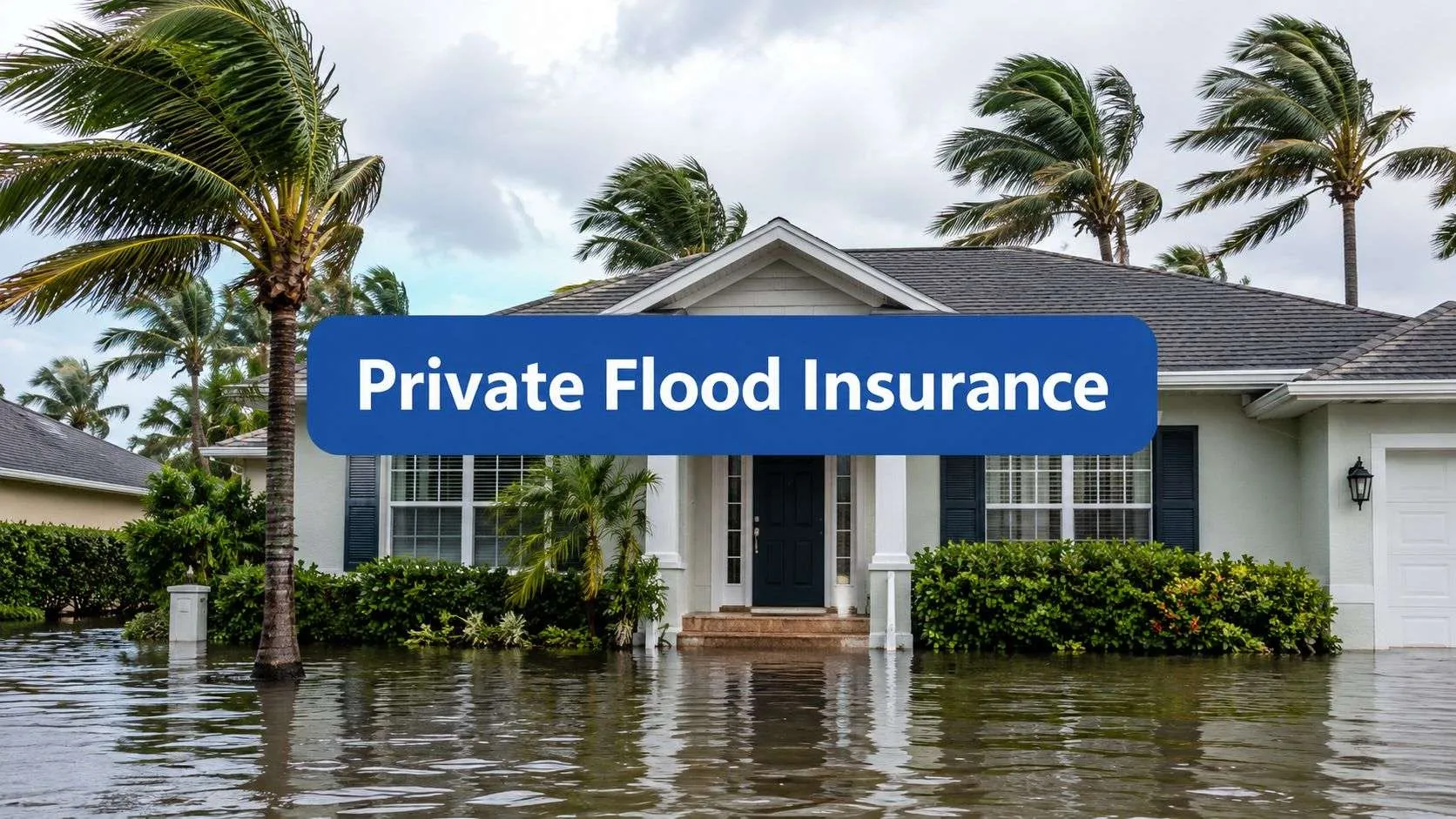
You've checked the forecast, moved patio furniture, and watched water collect where the yard usually drains. Then you call your insurance agent and learn that your standard homeowners policy generally doesn't cover flood damage. That realization often comes when a Florida homeowner is buying a property, preparing for storm season, or standing beside a flooded garage.
Private flood insurance in Florida can fill that gap, but the right policy isn't necessarily the one with the lowest premium. You need to compare limits, deductibles, valuation methods, waiting periods, lender requirements, renewal terms, and the way coverage coordinates with a condominium association's master policy. A policy that looks inexpensive on a quote can leave you paying for repairs, temporary housing, or uncovered building components yourself.
Table of Contents
- What Private Flood Insurance in Florida Actually Is
- NFIP vs Private Flood Insurance Side by Side
- Understanding Costs and What Drives Your Premium
- Florida-Specific Rules, Lender Requirements, and Condo Considerations
- How to Buy Private Flood Insurance in Florida Step by Step
- Common Mistakes That Leave Florida Homeowners Underprotected
- Frequently Asked Questions About Private Flood Insurance in Florida
- Can private flood insurance satisfy a Florida lender's requirements?
- Should a condo owner rely on the association's master policy?
- Does a Zone X property really need flood insurance?
- What happens if the lender rejects a private policy after it's bound?
- How long does it take to put private flood coverage in force?
- Can I buy coverage after a storm is approaching?
- Is private coverage always better than NFIP?
- What should a homeowner compare first?
- Should higher-value homes consider excess coverage?
- What information helps an agent quote accurately?
- Does the lowest premium provide the best value?
- Contact Us
What Private Flood Insurance in Florida Actually Is
Flood insurance is separate from standard homeowners coverage. A homeowners policy may address wind or certain forms of water damage, but rising water from storm surge, rainfall, drainage failure, or overflowing waterways generally requires a dedicated flood policy. Private flood insurance is offered by private insurers, either as a stand-alone policy or, in some cases, as an endorsement connected to another property policy.
Florida created a dedicated private-flood framework in 2014, allowing insurers to use catastrophe models when developing rates while requiring consumer safeguards. That framework helped Florida build the largest and most active private flood-insurance market in the United States. By July 2018, the state had 29 admitted insurers offering primary residential flood insurance, compared with 20 in December 2017 and 16 in an earlier reporting period, according to the National Association of Insurance Commissioners' private flood report.
The growth is meaningful, but private insurance hasn't replaced the federal program. In the same period, private policies represented only about 3% of all Florida flood policies, so the National Flood Insurance Program, or NFIP, remains dominant for many homeowners. Private coverage works either alongside NFIP protection, often as excess insurance, or instead of it when a private carrier offers a better fit.
The two carrier categories to understand
An admitted insurer is licensed and regulated in Florida under the state's standard insurance framework. A surplus-lines carrier provides coverage for risks that may not fit the standard admitted market. Surplus-lines coverage can create useful capacity for unusual, coastal, or higher-value properties, but the policy structure, financial protections, and documentation deserve careful review.
Private flood insurance gives homeowners more choices in a state where flood exposure varies sharply from one property to the next. A home can face storm surge near the coast, rainfall flooding inland, or drainage problems in a neighborhood that isn't mapped as high risk. If you're researching relocation options, a resource covering towns with lowest disaster risk can add useful context, but it shouldn't replace a property-specific flood review.

NFIP vs Private Flood Insurance Side by Side
At closing, the comparison should focus on what happens after a covered loss, not just what appears on the quote. The NFIP offers a defined federal structure, while private policies can vary considerably by insurer and form.
For a single-to-four-family residential structure, FEMA lists NFIP ceilings of $250,000 for building coverage and $100,000 for contents coverage. Buildings with five or more residential units may qualify for up to $500,000 in building coverage, with contents coverage listed at up to $100,000. Those are policy limits, not guaranteed settlement amounts. The declarations, deductible, valuation rules, exclusions, and proof-of-loss requirements still control payment. See FEMA's explanation of NFIP coverage limits.
Private policies may offer higher building and contents limits, broader additional-living-expense protection, and different treatment for detached structures, below-grade areas, and ordinance-or-law costs. Some use replacement-cost valuation, while others pay actual cash value for certain property. Those distinctions can matter more than the premium difference.
Comparison at the closing table
| Feature | NFIP | Private Flood Insurance |
|---|---|---|
| Building limits | Up to $250,000 for a single-to-four-family residential structure | Limits vary by carrier and property |
| Contents limits | Up to $100,000 for residential contents | Limits and sublimits vary |
| Valuation | Defined federal rules, with contents commonly subject to actual cash value | May offer replacement cost or actual cash value, depending on the contract |
| Additional living expenses | The standard structure is limited and generally doesn't provide the same broad temporary-housing benefit found in many private policies | May include broader temporary-housing or additional-living-expense coverage |
| Waiting period | Generally 30 days | Varies by carrier and circumstance |
| Policy structure | Standardized federal framework | Carrier-specific wording and underwriting |
| Excess coordination | Can serve as underlying coverage | May be primary or excess, but attachment points must align |
| Renewal | Federal program structure | Renewal and availability depend on the private carrier |
The NFIP generally imposes a 30-day waiting period. FEMA identifies exceptions, including a one-day waiting period when a revised flood map newly places a building in a Special Flood Hazard Area and the application and payment arrive during the first 13 months after the revision. No waiting period applies when the initial policy is purchased in connection with making, increasing, extending, or renewing a mortgage loan, with coverage effective at closing, as explained in FEMA's flood-insurance timing guidance.
Private carriers may offer different effective-date options, but never assume a quick quote means immediate protection. Before binding, compare the full contract through Florida flood insurance coverage options, then send the policy documents to the lender for approval.
Understanding Costs and What Drives Your Premium
A flood quote reflects the property's risk profile, not only its FEMA zone. Private underwriting may consider elevation, flood zone, distance to water, prior losses, foundation type, and modeled catastrophe risk. Two homes on the same street can receive different premiums because their elevations, construction details, contents values, or loss histories differ.
Florida reported 107,825 private flood policies statewide in 2022, a figure that reflects the state's extensive coastal exposure and demand for alternatives to NFIP coverage, according to the Florida Office of Insurance Regulation's flood insurance information. That market size doesn't make one price typical. It shows why insurers continue to evaluate Florida properties individually.
Read the quote beyond the premium
A lower monthly payment may hide a higher deductible, actual-cash-value settlement, narrower coverage for enclosed areas, or no meaningful protection for temporary housing. Compare:
- Replacement cost: Check whether the policy pays to repair or replace covered property without depreciation, subject to the contract.
- Actual cash value: Understand how age and depreciation reduce a claim payment.
- Deductible: Confirm whether the deductible is a flat amount, percentage, or separate amount for particular causes or locations.
- Coverage exclusions: Review storm surge, wave action, seepage, mold, detached structures, below-grade areas, and ordinance-or-law provisions.
- Limits: Match building and contents limits to realistic replacement costs and the value of the property you'd need to replace.
A private policy may be more competitive for a property with favorable elevation or newer construction. NFIP may remain attractive for basic coverage in a moderate-risk area, or for a property that private underwriting views as difficult. The useful comparison is not “Which quote is cheaper?” It's “Which policy transfers the risk I'm worried about?”
For a property-specific comparison, review Florida flood insurance quotes with the building value, contents value, deductible tolerance, and lender requirements in front of you.
Florida-Specific Rules, Lender Requirements, and Condo Considerations
Florida law gives insurers room to develop private flood products, but your mortgage lender still decides whether a proposed policy satisfies the loan's collateral-protection requirements. A private policy may cost less or include broader benefits, yet still delay closing if the lender can't verify the insurer, limits, deductible, covered buildings, or mortgagee wording.
Send the lender the declarations page and relevant policy forms before you bind whenever possible. Don't rely on a verbal assurance that “private flood is acceptable.” The lender may approve one policy form and reject another because the coverage doesn't meet its documentation or contract requirements.
Condo owners have two separate coverage questions
A condominium owner must determine what the association's master policy covers and where that coverage stops. The master policy may address common elements and certain building components, but it may not cover every interior improvement, personal belonging, loss of use, or assessment connected to a flood loss.
Your personal flood policy may need to address:
- Contents: Furniture, clothing, appliances, electronics, and other personal property, subject to limits and valuation.
- Unit improvements: Flooring, cabinets, fixtures, wall finishes, and alterations not fully protected by the master policy.
- Loss assessment: A possible assessment from the association, if the personal contract provides that coverage.
- Temporary housing: Costs incurred if the unit becomes uninhabitable, where included.
- Deductible coordination: Whether the master-policy deductible creates a potential assessment for unit owners.
Private flood insurance also isn't one standardized product. The NAIC framework distinguishes stand-alone first-dollar policies, stand-alone excess policies, and flood endorsements attached to homeowners or other property coverage. An excess policy responds only after the underlying flood policy's limits are exhausted, so the two contracts need matching locations, definitions, waiting periods, valuation methods, and attachment points.

Before closing, ask the association or property manager for the master-policy summary and deductible information. Owners also review broader property decisions, including potential condo special assessment coverage. If you're evaluating a move or sale, general housing resources about companies that buy houses for cash may help with the transaction context, but they don't answer the insurance question. The policy documents do.
How to Buy Private Flood Insurance in Florida Step by Step
Start before the closing calendar becomes urgent. A lender's approval, an insurer's underwriting review, and a policy's effective date all need to line up.
1. Confirm the lender's requirements
Ask for the required building limit, contents limit, deductible, covered structures, mortgagee clause, acceptable carrier type, and documentation deadline. Ask whether the lender needs to review the full form or only the declarations page.
2. Gather property information
Prepare the address, construction type, foundation description, year built if available, flood zone, elevation documentation, prior flood losses, replacement-cost estimate, and contents estimate. An elevation certificate can clarify the relationship between the structure and flood levels, although its usefulness depends on the property and the insurer's underwriting process.
3. Compare primary and excess structures
Decide whether private coverage will replace NFIP, sit above NFIP, or supplement another policy. If you're considering excess coverage, confirm exactly when it begins and whether the underlying policy's limits and definitions satisfy the excess contract.
4. Review the contract
Don't stop at the quote screen. Check the declarations page, exclusions, valuation method, deductible, waiting period, covered locations, temporary-housing benefits, cancellation provisions, and renewal language. Confirm that storm surge and the flooding events relevant to your property are addressed by the wording.
5. Send the documents to the lender
Do this before binding if the timeline allows. A lender may reject a policy after review if the limits, mortgagee wording, insurer status, or coverage breadth doesn't satisfy its requirements.
6. Bind and calendar renewal
If coverage is tied to a mortgage closing, confirm the effective date in writing. If you buy after closing, the standard NFIP waiting period generally applies, and private coverage may also have its own waiting rule. Put renewal dates on your calendar so a missed payment or lapse doesn't create an avoidable gap.

An independent agent can compare federal and private options while keeping lender documentation in view. Florida All Risk Insurance offers flood policy reviews and quote comparisons for homeowners, condo owners, realtors, and lenders who need coverage arranged around a closing.
Common Mistakes That Leave Florida Homeowners Underprotected
The most expensive mistake is assuming that “not required” means “not needed.” Florida has the largest reported flood-insurance protection gap in one recent analysis, nearly $3.67 billion, showing how mandatory-purchase rules leave substantial uninsured risk, as reported in the South Florida Sun Sentinel analysis.
A property outside a Special Flood Hazard Area can still experience rainfall flooding, storm surge, drainage failure, and rising water. FEMA maps can change, and a future map revision may alter lender requirements. Even without a map change, the owner remains responsible for damage the homeowners policy excludes.
Mistake one, buying the cheapest limit
A low premium can reflect a low building limit or a deductible you couldn't comfortably pay after a major loss. Estimate the cost to rebuild, not the property's market value, and check whether contents coverage is replacement cost or actual cash value.
Mistake two, ignoring carrier status
Ask whether the insurer is admitted or writing through the surplus-lines market. Neither label alone answers whether the policy is suitable, but the distinction affects regulation, documentation, and how you evaluate financial strength and availability.
Mistake three, overlooking the contract's boundaries
Homeowners often focus on the headline building limit and miss restrictions affecting below-grade enclosures, detached structures, temporary housing, ordinance-or-law costs, or specific contents. A policy can have a generous limit while still excluding the item you expected it to cover.
Mistake four, layering policies without coordination
NFIP plus private excess can be sensible for a higher-value property, but only if the contracts align. Review covered locations, valuation, flood definitions, deductibles, waiting periods, and the excess attachment point. Otherwise, the apparent extra limit may leave a gap between policies.
Mistake five, allowing a lapse
A missed renewal payment can create a period with no protection, and a new policy may not take effect immediately. Keep proof of payment, review renewal terms early, and don't wait until a storm threat appears. The cheapest policy becomes the most expensive choice when it fails to protect the loss you actually suffer.
Frequently Asked Questions About Private Flood Insurance in Florida
Can private flood insurance satisfy a Florida lender's requirements?
It can, provided the policy meets the lender's standards. The lender reviews the insurer, limits, deductible, covered buildings, mortgagee wording, and policy terms. Send the documentation for approval before binding whenever possible, because a cheaper policy can still delay closing if the lender rejects its structure.
Should a condo owner rely on the association's master policy?
No. Start by obtaining the master-policy summary and identifying the building components, common elements, deductibles, and exclusions it addresses. Then compare that information with your personal unit policy, including contents, improvements, assessments, temporary housing, and any excess layer.
Does a Zone X property really need flood insurance?
A lower-risk designation doesn't mean the property is flood-proof. Rainfall, drainage failure, storm surge, and changing water conditions can affect properties outside Special Flood Hazard Areas. The decision should consider the loan balance, replacement cost, contents value, deductible tolerance, elevation, and the cost of relocating after a loss.
What happens if the lender rejects a private policy after it's bound?
Contact the agent and lender immediately. Ask which requirement the policy failed, then determine whether the insurer can correct the documentation or whether you need another policy. Don't cancel the existing coverage until replacement protection is approved and effective, unless your lender and agent confirm the correct transition.
How long does it take to put private flood coverage in force?
Timing depends on property complexity, documentation, underwriting, and the carrier's process. A straightforward purchase can move quickly, but a coastal, high-value, prior-loss, or surplus-lines placement may require more review. The practical rule is to start before the closing deadline and confirm the effective date in writing.
Can I buy coverage after a storm is approaching?
You shouldn't assume you can. Waiting periods, binding restrictions, underwriting pauses, and storm-related conditions can prevent immediate protection. NFIP generally uses a 30-day waiting period, subject to specific exceptions, so arranging coverage before a threat develops is essential.
Is private coverage always better than NFIP?
No. Private insurance may offer higher limits, broader features, or a better price for a particular property. NFIP provides a standardized federal structure, while private policies require closer review of contract language, carrier stability, renewal terms, and coordination with other insurance. The right choice depends on your property and risk tolerance.
What should a homeowner compare first?
Begin with the coverage needed after a loss. Confirm the building and contents limits, valuation method, deductible, temporary-housing benefits, exclusions, waiting period, and lender acceptance. Compare premium only after those items are aligned.
Should higher-value homes consider excess coverage?
Possibly. NFIP limits may not match the cost to rebuild a higher-value home, so an owner may investigate private primary coverage or private excess above an underlying policy. Excess insurance only responds after the underlying limits are exhausted, so the two policies must be coordinated carefully.
What information helps an agent quote accurately?
Provide the property address, building characteristics, foundation type, flood zone, elevation information, prior losses, replacement-cost estimate, contents estimate, desired deductible, mortgage details, and closing date. Complete information reduces avoidable revisions and gives the lender a better chance to review the policy on time.
Does the lowest premium provide the best value?
Not necessarily. A lower price may come with a higher deductible, narrower coverage, actual-cash-value settlement, lower contents limits, or limited temporary-housing protection. Compare what you could collect after a realistic flood loss, not just what you pay each month.
Florida All Risk Insurance compares NFIP and private flood options for Florida homes and condominiums, with attention to limits, lender acceptance, deductibles, and policy structure. Visit Florida All Risk Insurance to request a coverage review before closing or before the next storm season, and bring your current declarations page if you already have a policy.
Contact Us
Florida All Risk Insurance
[Company Address, Saint Petersburg, FL]
[Company Phone]
[Company Email]

