Why Commercial Property Insurance is Essential for Your Business
Commercial property insurance is your business’s shield against unexpected events that can cause significant financial loss. This insurance provides vital coverage for your business’s physical assets, including buildings, equipment, inventory, and other critical components. Whether you own or lease your space, having this protection ensures that incidents like fires, thefts, and certain natural disasters won’t cripple your business operations.
Here’s a quick overview of what makes commercial property insurance critical:
-
Protection Against Financial Loss: Covers damage or loss of physical assets.
-
Comprehensive Coverage: Includes buildings, equipment, inventory, and more.
-
Flexible Options: Policies can be custom with additional structures like replacement cost or actual cash value coverages.
As a business owner in Florida, understanding the nuances of commercial property insurance is crucial. My name is Jason Miller, and I bring over 20 years of experience in providing businesses with top-notch insurance solutions. With a family background rich in insurance expertise, I’m here to guide you through the complexities and help safeguard your business’s future.

Common commercial property insurance vocab:
– commercial condo insurance
– commercial unit insurance
– commercial property insurance risk
Understanding Commercial Property Insurance
To make informed decisions about protecting your business, understand what commercial property insurance is, what it covers, and what it doesn’t.
Definition
Commercial property insurance is a type of insurance that covers the physical assets of a business. This includes protection against risks such as fire, theft, and certain natural disasters. It’s an essential part of a business owner’s policy (BOP) and provides peace of mind by safeguarding your company’s valuable assets.
Coverage
Here’s what commercial property insurance typically covers:
- Buildings: Whether you own or lease your business space, the structure itself is protected.
- Furniture and Equipment: Desks, chairs, computers, and machinery are covered.
- Inventory: Protects stock and goods you sell.
- Outdoor Elements: Includes exterior signs, fences, and landscaping.
- Documents: Important papers and records are also protected.

Exclusions
While commercial property insurance offers extensive coverage, there are some exclusions:
- Natural Disasters: Standard policies often don’t cover floods or earthquakes unless added specifically.
- Wear and Tear: Regular maintenance issues like plumbing leaks or gradual wear are not covered.
- Intentional Damage: Any damage caused deliberately by the policyholder is excluded.
Understanding these exclusions helps ensure you’re not caught off guard by unexpected events. It’s wise to review your policy details with an expert to address specific risks your business might face.
By comprehending these aspects of commercial property insurance, you can better protect your business and its assets. Next, let’s explore the key coverage options available to tailor your insurance policy to fit your unique needs.
Key Coverage Options
When choosing commercial property insurance, it’s crucial to understand the different coverage options available. This helps ensure your business is adequately protected. Let’s break down the main options: replacement cost, actual cash value, and additional coverage.
Replacement Cost
Replacement cost coverage pays to repair or replace damaged property with materials of similar kind and quality, without deducting for depreciation. This means if your business suffers a loss, the insurance will cover the cost to replace the item as if it were new.
For example, if a fire destroys your office equipment, replacement cost coverage ensures you can buy new equipment to replace the old, regardless of its age. This option usually results in higher premiums, but it provides peace of mind knowing your business can quickly bounce back with minimal financial strain.
Actual Cash Value
Actual cash value (ACV) coverage, on the other hand, pays for the cost to replace damaged property minus depreciation. Essentially, this means you’ll receive the value of the item in its current state, not what it would cost to buy new.
For instance, if a ten-year-old computer is stolen, ACV coverage will provide the amount it would cost to buy a similar ten-year-old computer today. While this option typically has lower premiums, it might not fully cover replacement costs, leaving you to make up the difference.
Additional Coverage
Beyond the basics, you can improve your commercial property insurance with additional coverage options to address specific risks:
- Extended Replacement Costs: This option provides extra funds if rebuilding costs exceed the initial coverage limit due to increased construction costs.
- Equipment Breakdown: Covers the cost to repair or replace equipment damaged by power surges or mechanical failures.
- Business Interruption Insurance: Offers compensation for lost income and ongoing expenses if your business has to close temporarily due to a covered event, like a fire or severe weather.
Adding these coverages can provide a comprehensive safety net for your business, ensuring you’re prepared for various scenarios.
By understanding these key coverage options, you can tailor your commercial property insurance policy to best suit your business needs. Next, we’ll explore the factors that affect insurance costs and how you can make informed decisions to get the best value.
Factors Affecting Insurance Costs
When it comes to commercial property insurance, several factors can influence the cost of your premiums. Understanding these can help you make informed decisions and potentially save money.
Location
The location of your business plays a significant role in determining insurance costs. Properties situated in areas prone to natural disasters, such as hurricanes or floods, generally have higher premiums. Similarly, businesses located in high-crime areas may face increased rates due to the heightened risk of theft or vandalism.
On the flip side, being close to a fire station or having easy access to fire hydrants can lower your insurance costs. This is because the risk of severe damage from fire is reduced, making your property less risky to insure.
Construction
The materials and methods used in your building’s construction can also impact your insurance rates. Buildings made with fire-resistant materials often enjoy lower premiums. Conversely, older buildings with outdated electrical systems or combustible materials may cost more to insure due to the increased risk of fire.
If you’re considering renovations, it’s wise to consult with your insurance provider. Upgrades can affect your premiums, sometimes positively if they reduce risk factors.
Occupancy
The type of business you run affects your insurance costs too. A low-risk office space will typically have lower premiums compared to a high-risk restaurant or manufacturing plant. This is because some industries inherently carry more risk, whether due to the number of people present or the nature of the activities conducted.
If your building houses multiple tenants, the presence of a high-risk business can increase premiums for everyone. It’s essential to consider the types of businesses sharing your space when evaluating insurance costs.
Fire and Theft Protection
Investing in robust fire and theft protection systems can lead to significant savings on your insurance premiums. Features like sprinkler systems, fire alarms, and security systems can reduce the risk of loss and, consequently, the cost of your insurance.
For example, a business equipped with a modern security system may be seen as a lower risk for theft. Similarly, a well-maintained sprinkler system can mitigate fire damage, making your property less risky to insure.
By understanding these factors, you can take proactive steps to manage and potentially reduce your commercial property insurance costs. Next, we’ll guide you on how to choose the best insurance policy to fit your business needs.
How to Choose the Best Commercial Property Insurance
Finding the right commercial property insurance can be overwhelming, but it doesn’t have to be. By following these simple steps, you can secure the best coverage for your business.
Evaluate Your Needs
Start by assessing what you need to protect. Make a list of all your business assets, including your building, equipment, inventory, and any outdoor fixtures like signs or fencing. Consider potential risks based on your location and industry. For instance, if you’re in a flood-prone area, you might need additional coverage for water damage.
Understanding your specific needs will help you choose a policy that provides adequate protection without unnecessary extras.
Compare Policies
Once you know what you need, compare policies from different providers. Look at what each policy covers and the limits of that coverage. Pay attention to the differences between replacement cost and actual cash value policies. While replacement cost coverage is generally more expensive, it ensures you can replace your assets without worrying about depreciation.
Also, check if the policy covers open perils or named perils. Open perils cover all risks except those explicitly excluded, offering broader protection.
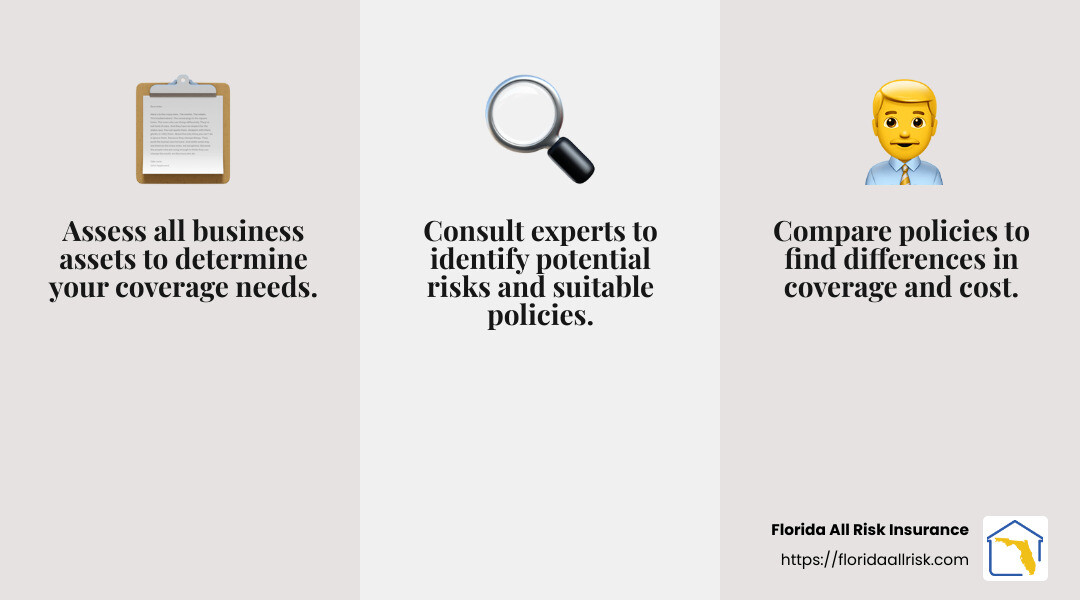
Consult Experts
Insurance can be complex, and having an expert on your side can be invaluable. Consult with an insurance agent or broker who understands your industry and location. They can provide insights into potential risks you might not have considered and help you find a policy that fits your budget and coverage needs.
At Florida All Risk Insurance, our experts are ready to guide you through the process, ensuring you get the best commercial property insurance for your business. Their personalized service can help you steer the sometimes confusing world of insurance, making sure you have the right protection in place.
By evaluating your needs, comparing policies, and consulting with experts, you can ensure your business is well-protected. Up next, we’ll answer some frequently asked questions to further clarify common concerns about commercial property insurance.
Frequently Asked Questions about Commercial Property Insurance
What is commercial property insurance?
Commercial property insurance is a type of coverage that protects your business’s physical assets. This includes your building, equipment, inventory, furniture, and even outdoor signs. Its primary purpose is to safeguard these assets against risks like fire, theft, storms, and vandalism. However, it typically doesn’t cover damages from earthquakes or floods unless you add specific coverage for those events. This insurance is crucial for business owners as it helps cover repair or replacement costs, ensuring that a disaster doesn’t lead to financial ruin.
What are the types of commercial insurance?
Commercial insurance comes in various forms, each designed to protect different aspects of your business. The two main types are:
-
Property Insurance: This covers physical assets like your building and contents. It’s essential for protecting against losses from events like fire, theft, or vandalism.
-
Casualty Insurance: This type covers your business against legal liabilities. It includes protection against claims arising from injuries or damages caused by your business operations or products.
These two categories form the backbone of commercial insurance, but there are also specialized policies like professional liability insurance, workers’ compensation, and business interruption insurance, each addressing specific business needs.
How much does commercial property insurance cost?
The cost of commercial property insurance varies widely based on several factors. On average, small businesses might pay around $67 per month, or about $800 annually. However, your premium could be higher or lower depending on:
- Location: Areas prone to natural disasters or high crime might have higher rates.
- Construction: Buildings made with fire-resistant materials might enjoy lower premiums.
- Occupancy: The type of business you run influences risk levels. For example, a restaurant might pay more than an office.
- Fire and Theft Protection: Proximity to fire stations and the presence of security systems can reduce costs.
Understanding these factors can help you better estimate your insurance costs and find a policy that fits your budget while providing the necessary protection.
Conclusion
In summary, commercial property insurance is a vital tool for safeguarding your business’s physical assets. It provides protection against unforeseen events like fire, theft, storms, and vandalism, ensuring that your business can recover swiftly without financial burden. By understanding the various coverage options and factors influencing costs, you can make informed decisions that best suit your business needs.
At Florida All Risk Insurance, we pride ourselves on offering personalized service custom to each client’s unique requirements. Based in St. Petersburg, Florida, we have experience in helping businesses across Florida find the right coverage at competitive rates. Our independent agency status allows us to connect you with a wide range of carriers, ensuring you get the best possible insurance solutions.
Whether you’re a small business owner or managing a larger enterprise, our team is here to guide you through the process. We believe in clear communication, expert advice, and a commitment to protecting your business assets effectively. Reach out to us today to explore your commercial property insurance options and secure peace of mind for your business.