Understanding Flood Insurance: Protecting Your Home from Water Damage
Looking for a flood insurance quote? Here’s what you need to know:
- What it is: Specialized coverage for water damage not included in standard homeowners insurance
- How to get a quote: Call your insurance agent, use FEMA’s NFIP tool (10 minutes), or try private insurers (2-5 minutes)
- What you’ll need: Property address, year built, foundation type, and estimated property value
- Average cost: $700/year nationally, but varies widely based on flood risk zone
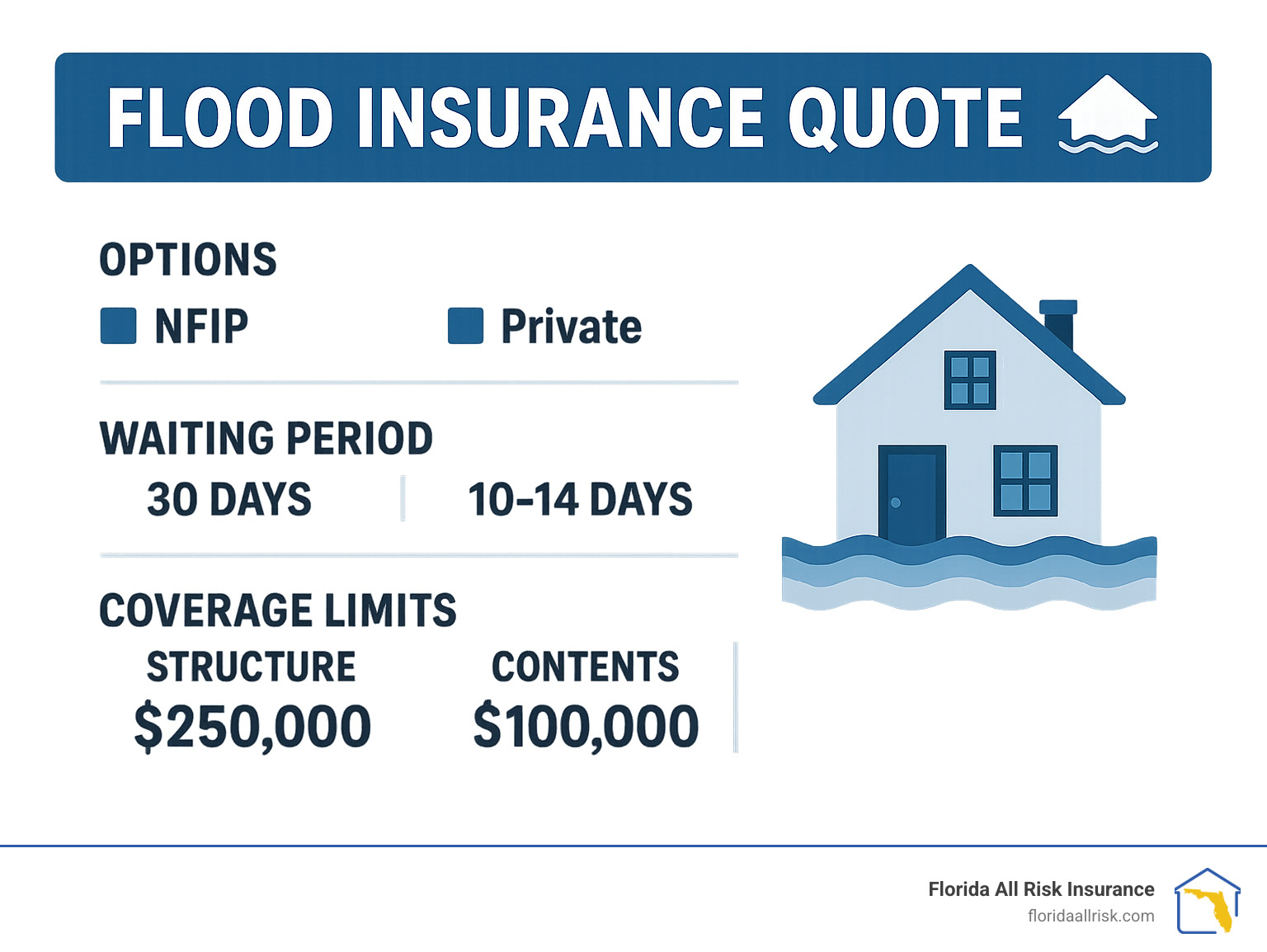
- Coverage limits: NFIP offers up to $250,000 for structure and $100,000 for contents
Water is wonderful in pools and at the beach, but devastating when it enters your home uninvited. Flood insurance quotes are your first step toward protecting your property from one of nature’s most common and destructive forces. Just one inch of floodwater can cause over $25,000 in damage to an average home, yet standard homeowners policies specifically exclude flood damage.
Most people don’t realize that more than 40% of flood insurance claims come from properties outside designated high-risk zones. That means even if you think you’re safe, you might not be. Flooding can result from heavy rains, melting snow, storm surge, or even blocked drainage systems.
I’m Jason Miller, a second-generation insurance professional with over 20 years of experience helping Florida homeowners obtain accurate flood insurance quotes and comprehensive coverage custom to their specific needs. Having personally guided thousands of clients through the process, I understand the confusion and concerns many face when navigating flood insurance options.
Quick flood insurance quote definitions:
– fema flood zone map
– do all homes in florida require flood insurance
– average price of flood insurance in florida
Flood Insurance 101: What It Is & Why You Probably Need It
When it comes to protecting your home, flood insurance is that critical piece of the puzzle most people don’t realize they’re missing until water is seeping under their front door. So what exactly is flood insurance? It’s a specialized policy designed specifically to cover damage caused by flooding – something your regular homeowners policy specifically excludes.
According to FEMA, a flood is officially defined as “a general and temporary condition of partial or complete inundation of two or more acres of normally dry land area or of two or more properties from overflow of inland or tidal waters, from unusual and rapid accumulation or runoff of surface waters from any source, or from mudflow.” That’s a mouthful, but it basically means water where it shouldn’t be, affecting multiple properties.
The National Flood Insurance Program (NFIP), managed by FEMA, has been providing flood coverage since 1968. Working with nearly 23,000 participating communities across the country, they offer policies through a network of more than 50 insurance companies. Think of them as the safety net for the ‘water from outside your home’ problems that keep insurance adjusters up at night.
Here’s a reality check many homeowners don’t realize: federal disaster assistance isn’t the safety net you might think it is. For one, it’s only available when the President declares a disaster – which happens for less than 10% of all flooding events in the US. And even when assistance is available, it typically comes as a loan you’ll need to repay with interest, not a free check to rebuild your life.
The numbers tell a sobering story:
– Flooding stands as America’s most common and costly natural disaster
– The NFIP provides nearly $1.3 trillion in coverage against flood damage
– Just one inch of floodwater can soak you with up to $25,000 in damage
For Florida homeowners, the risk is even more pronounced. Our beautiful coastal state faces threats from hurricanes, heavy rainfall, and rising sea levels – a triple threat that makes getting a flood insurance quote one of the smartest moves you can make to protect your financial future. You can learn more about why you should buy flood insurance from FloodSmart.gov.
What Counts as a “Flood” Under Insurance Rules?
Not all water problems qualify as “flooding” in the insurance world. Your shower overflow that ruins your bathroom floor? Not a flood. That broken pipe that soaked your kitchen? Also not a flood.
For water damage to qualify as a flood under insurance definitions, it needs to meet specific criteria:
First, the water must affect at least two properties or cover at least two acres of normally dry land. This is sometimes called the “two-acre rule.” Second, the water must come from outside sources like overflowing rivers or lakes, unusual rapid accumulation of surface water, or mudflow (which is essentially a river of liquid mud flowing across normally dry land).
Water damage from erosion along a body of water can also qualify when it’s caused by waves or water exceeding normal cyclical levels. But if your home is the only one affected by water – maybe from that washing machine hose that burst while you were on vacation – that’s not considered a flood for insurance purposes.
Understanding these distinctions is crucial when getting a flood insurance quote because these definitions determine whether your claim gets paid or denied.
Homeowners vs. Flood Policies—Key Differences
One of the biggest misconceptions I encounter with new clients is the belief that their standard homeowners policy will cover flood damage. Let me be crystal clear: they are completely separate policies with different coverages, deductibles, and claims processes.
Your homeowners insurance typically covers water damage from burst pipes, rain that comes through a wind-damaged roof, or the water used to extinguish a fire. Essentially, it covers water coming from inside your home or directly from above.
What it absolutely does NOT cover is rising water from outside your home, storm surge, overflow from bodies of water, or surface water flowing on the ground. This is where flood insurance becomes essential.
Flood insurance specifically covers building damage from floodwaters, contents damage from floodwaters, mud damage from flooding, and erosion damage when directly caused by flooding.
Another key difference is how deductibles work. Flood policies have separate deductibles for building and contents coverage. This means if both your home structure and your personal belongings are damaged in a flood, you’ll pay two deductibles when filing a claim. It’s a detail many homeowners miss until they’re filing their first claim.
At Florida All Risk Insurance, I’ve seen the heartbreak on clients’ faces when they find their homeowners policy won’t cover flood damage – often after it’s too late. That’s why I always recommend getting a comprehensive flood insurance quote to understand your coverage options before the waters rise. An ounce of prevention truly is worth a pound of cure – or in this case, potentially hundreds of thousands of dollars in uninsured losses.
Who Needs Flood Insurance & When It’s Required
Let me be straight with you – almost everyone in Florida should have flood insurance. While some neighborhoods face higher risks than others, the reality is that no Florida property is completely safe from flooding. After helping thousands of homeowners protect their investments, I’ve seen how flooding can affect properties in all kinds of locations, often when least expected.
FEMA organizes flood risk into different zones that help determine your vulnerability:
- Special Flood Hazard Areas (SFHA): These zones (starting with A or V) have at least a 1% chance of flooding annually – what’s commonly called the 100-year floodplain
- Moderate Risk Areas: Zones B or X (shaded) face between 0.2% and 1% annual flooding chance
- Minimal Risk Areas: Zones C or X (unshaded) have less than 0.2% annual flooding chance
If your home sits in an SFHA and you have a federally backed mortgage (like an FHA, VA, or conventional loan through Fannie Mae or Freddie Mac), your lender will absolutely require flood insurance. This isn’t optional – it’s a non-negotiable condition of your loan.
Here’s the eye-opening truth, though: more than 40% of all flood insurance claims come from properties outside those high-risk zones. This statistic surprises many of my clients, but it perfectly illustrates why flood protection matters for virtually all Florida homeowners.
Want to check your property’s flood zone? You can use the FEMA Flood Map Service Center or simply contact us at Florida All Risk Insurance. We’ll help you interpret these sometimes confusing maps and explain what they mean for your specific home.
One important note: flood insurance is only available in communities that participate in the National Flood Insurance Program. Thankfully, most Florida communities do participate, making coverage widely available throughout our state.
Do I Need Flood Insurance Outside Zone AE?
Zone AE is one of those Special Flood Hazard Areas where mortgage lenders typically require flood insurance. But what if you’re in Zone X or another lower-risk area? Should you still get a flood insurance quote?
Based on my two decades of experience helping Florida homeowners, my answer is absolutely yes. Here’s why this matters:
First, “lower risk” doesn’t mean “no risk.” More than 25% of all flood insurance claims come from properties in those supposedly safer zones. I’ve seen countless homeowners devastated by flooding in areas that were considered relatively safe.
Second, flood insurance in lower-risk zones is dramatically more affordable – often just a few hundred dollars annually. That’s a small price for significant protection.
Third, Florida’s landscape is constantly changing. Between new development altering water flow patterns, natural erosion, and climate factors, what’s considered low-risk today might not stay that way.
Finally, our Florida weather patterns have become increasingly unpredictable, with heavy rainfall events becoming both more common and more intense.
I remember helping a client in St. Petersburg who lived in a Zone X area that had never flooded in her 30 years of ownership. After getting a flood insurance quote from us (just $350 annually), her home experienced significant flooding from an unprecedented rainfall just eight months later. Her policy covered over $42,000 in damages – a decision that saved her from financial disaster.
You can check your property’s flood zone using our FEMA Flood Zone Map tool, but remember these maps don’t tell the complete story. Local drainage issues, proximity to water bodies, and your property’s elevation all play crucial roles in your actual flood risk.
Is Flood Insurance Ever Required by Law?
While Florida doesn’t have a state law requiring all homeowners to carry flood insurance, several situations effectively make it mandatory:
If you have a government-backed mortgage (FHA, VA, USDA) or a conventional loan through Fannie Mae or Freddie Mac, and your property sits in a Special Flood Hazard Area, federal regulations require you to maintain flood insurance. This isn’t optional – it’s required by federal law.
Have you received federal disaster assistance for flood damage in the past? If so, you must maintain flood insurance to remain eligible for any future disaster aid. This requirement stays with the property, even if you sell it.
Even without federal mandates, many private lenders impose their own flood insurance requirements, sometimes even for properties outside high-risk zones. They’re protecting their investment, and you should too.
Some condominium associations in Florida require individual unit owners to maintain their own flood insurance policies in addition to the master policy. This provides important protection for your personal belongings and interior finishes.
The consequences of skipping required flood insurance can be severe. Your lender might purchase a force-placed policy on your behalf (typically at a much higher premium) and add the cost to your mortgage payment. Worse, you could become ineligible for federal disaster assistance when you need it most.
At Florida All Risk Insurance, we help our clients understand their flood insurance obligations and find the most cost-effective ways to meet those requirements. Getting a flood insurance quote is your first step toward both compliance and peace of mind.
Getting Your Flood Insurance Quote: Step-by-Step

I remember when my neighbor Tom finally decided to get flood insurance after years of procrastination. “I thought it would be this huge ordeal,” he told me later. “But I was in and out with a flood insurance quote in less than 10 minutes!” His experience isn’t unusual – getting a quote is actually one of the easiest parts of protecting your home.
The good news is you have several paths to choose from, depending on your comfort level with technology and how much guidance you’d like:
You can go directly through the National Flood Insurance Program’s quoting tool, which typically takes about 10 minutes to complete. Or if you prefer speed, many private insurers now offer streamlined processes that can deliver quotes in as little as 2-5 minutes. And of course, working with an independent agency like us at Florida All Risk Insurance gives you the best of both worlds – access to NFIP and private market options with experienced guidance along the way.
Before you begin, take a few minutes to gather some basic information about your property – your address, when it was built, rough square footage, and what type of foundation you have. You’ll also want to have a general idea of your home’s structural value and what your belongings might be worth.
Once you have these details handy, simply choose your preferred quoting method and answer the questions prompted. The systems will guide you through estimating your coverage needs, and before you know it, you’ll be reviewing options that include different coverage limits, deductibles, and waiting periods.
At Florida All Risk Insurance, we often find that homeowners appreciate having someone explain these options in plain English. After all, flood insurance has some unique features that can be confusing at first glance.
What Information Will I Need for a Flood Insurance Quote?
Getting an accurate flood insurance quote is a bit like baking – having all your ingredients measured and ready makes the whole process go smoothly. Here’s what you’ll need to have on hand:
Your complete property address is obviously essential – not just for identification but because your physical location determines much of your flood risk. You’ll also need to provide the year your home was built, as construction standards have changed over time.
The type of foundation your home has matters tremendously in flood insurance – whether it’s a concrete slab, crawlspace, full basement, or liftd structure. Similarly, insurers will want to know how many floors your building has, as multi-story homes often have lower relative risk.
You’ll need to estimate the replacement cost of your structure – not the market value, but what it would take to rebuild. Similarly, if you want contents coverage (and most people should), you’ll need to estimate the value of your belongings.
If you happen to know your flood zone, that’s helpful, though the quoting systems can usually determine this automatically. And if you have a mortgage, have that information ready too, as your lender may have specific requirements.
Some additional information can be particularly valuable: an Elevation Certificate (if you have one), details about previous flood losses, and information about flood mitigation features like flood vents. If you’re replacing an existing policy, having those details handy will help ensure you maintain appropriate coverage.
Don’t worry if you’re unsure about some of these details – at Florida All Risk Insurance, we can help you identify your flood zone and estimate replacement costs if needed. We’re here to make the process as painless as possible.
How Long Does a Flood Insurance Quote Take?
“I don’t have time for this right now” is one of the most common reasons people put off getting flood insurance. But the truth is, getting a flood insurance quote takes less time than ordering a pizza.
If you go through the NFIP’s official quoting tool, you’re looking at about 10 minutes from start to finish. One thing to note – you’ll need to complete the quote in a single session, as the tool doesn’t save your progress. So make sure you have those 10 minutes available without interruption.
Private market insurers have really streamlined their processes in recent years. Many use sophisticated mapping technology and automated property evaluations that can generate quotes in as little as 2-5 minutes. It’s quite impressive how quickly they can assess your property’s risk profile.
When you work with us at Florida All Risk Insurance, we can often provide preliminary quotes during a single phone call. I recently helped a client named Sarah who had been putting off flood insurance for years because she thought it would be complicated. She was genuinely shocked when we provided her with multiple flood insurance quote options during our 15-minute conversation.
Remember though, getting a quote is just the first step. Once you decide to purchase a policy, there’s typically a 30-day waiting period before coverage takes effect (though there are some exceptions, which we’ll cover later). So while getting the quote might be quick, it’s important not to delay starting the process.
Comparing Flood Insurance Quotes Like a Pro
Once you have several flood insurance quotes in hand, you might feel a bit overwhelmed by the options. Here’s how to cut through the confusion and make a smart choice.
First, look closely at the coverage limits. What’s the maximum amount the policy will pay for your building’s structure? What about for your personal belongings? Are there any additional coverages included, such as debris removal or loss avoidance measures? The NFIP standard limits are $250,000 for buildings and $100,000 for contents, but private policies may offer higher limits if you need them.
Next, examine the deductibles carefully. Flood policies typically have separate deductibles for building and contents coverage. A higher deductible will lower your premium, but make sure you could actually afford to pay that amount out-of-pocket after a flood.
Waiting periods are another critical factor. The NFIP standard is 30 days, meaning you won’t be covered for any flood that happens within a month of purchasing your policy. Many private policies have shorter waiting periods of 15 days or less. There are exceptions for certain situations like loan closings or map revisions.
Don’t skip over the exclusions section! Pay special attention to basement limitations (flood policies typically offer limited coverage for basements), whether detached structures are covered, and if the policy includes additional living expenses if you can’t stay in your home after a flood.
The company’s reputation matters too – especially their financial stability and claims handling reputation. After all, a policy is only as good as the company backing it when disaster strikes.
Finally, consider the total cost – not just the annual premium, but any fees and surcharges, along with available payment options. At Florida All Risk Insurance, we always remind clients that the lowest price isn’t necessarily the best value. What matters most is having comprehensive coverage that actually responds when you need it.
For more detailed information about costs in different areas of Florida, check out our Flood Insurance Cost page, which breaks down all the factors that influence premiums and provides helpful average cost estimates.
Coverage Deep-Dive: What’s In, What’s Out, & How Much You Can Buy
When you’re looking at a flood insurance quote, understanding exactly what you’re buying is just as important as the price. I’ve helped thousands of Florida homeowners steer these waters (pun intended!), and the coverage details often surprise them.
Think of flood insurance as having two main buckets: building coverage and contents coverage. Your home’s structure falls under building coverage—that’s the walls, foundation, electrical systems, plumbing, HVAC equipment, water heaters, and built-in appliances like your dishwasher. Even permanently installed items like carpeting, bookcases, and window blinds are protected. Your detached garage gets some love too (up to 10% of your building coverage).
Contents coverage, meanwhile, protects your personal belongings—the furniture you’ve carefully selected, the clothes in your closet, your portable kitchen appliances, and even food stored in your freezer.
However, there’s always a “but” with insurance, right? Flood policies won’t cover preventable mold or mildew damage. Your beautiful landscaping, deck, patio, fences, and swimming pool? Not covered. Need a hotel while repairs happen? Standard flood policies don’t cover these temporary living expenses. And you can kiss goodbye to coverage for cash, precious metals, and important documents unless you’ve made special arrangements.
The basement situation catches many homeowners off guard. If you have a below-grade area (any floor below ground level on all sides), coverage becomes quite limited. While foundation elements, utilities, HVAC systems, washers, dryers, and freezers are covered, that entertainment center and furniture you’ve set up in your finished basement aren’t protected under standard policies. I’ve seen this painful reality play out with several clients who learned this too late.
NFIP Coverage Limits Explained
The National Flood Insurance Program (NFIP) has set some firm boundaries on coverage that haven’t changed since 1994, despite skyrocketing construction costs:
| Property Type | Building Coverage | Contents Coverage |
|---|---|---|
| Residential | $250,000 | $100,000 |
| Commercial | $500,000 | $500,000 |
These limits apply per building, so if you have a detached guest house or other structures, you’ll need separate policies. And here’s something that trips up many homeowners: flood policies have separate deductibles for building and contents coverage. These typically range from $1,000 to $10,000 each. Selecting higher deductibles can lower your premium, but remember—that’s more money out of your pocket when water starts rising.
For many Florida homeowners I work with, especially those with homes valued above $250,000 (which is increasingly common), these NFIP limits just don’t provide adequate protection. When reviewing your flood insurance quote, always consider whether the coverage limits truly reflect your home’s value and your personal belongings.
Private Market Perks & Pitfalls
The good news is you have options beyond the NFIP. Private flood insurance has expanded significantly in recent years, offering some compelling advantages—but also a few potential drawbacks you should understand.
The biggest advantage of private flood insurance? Higher coverage limits. While NFIP caps out at $250,000 for your home, private insurers might offer up to $5,000,000 in building coverage and $500,000 or more for contents. That’s a game-changer for higher-value properties.
Private policies often include additional living expenses too—so if your home becomes uninhabitable after a flood, your hotel and temporary housing costs are covered. Many private insurers also offer more comprehensive basement contents coverage, shorter waiting periods (typically 15 days instead of the NFIP’s 30), replacement cost coverage for personal property without depreciation, and better protection for detached structures.
But private flood insurance isn’t perfect. Some insurers are picky about which properties they’ll cover, particularly in high-risk flood zones. Unlike the NFIP, private insurers can choose not to renew your policy, potentially leaving you vulnerable. Some lenders still hesitate to accept private flood insurance, though federal regulations now require them to accept private policies that meet certain criteria. And private market rates can jump more dramatically after major flood events.
Here’s how they stack up:
| Feature | NFIP | Private Market |
|---|---|---|
| Maximum Building Coverage | $250,000 (residential) | Up to $5,000,000 |
| Maximum Contents Coverage | $100,000 (residential) | Up to $500,000 |
| Waiting Period | 30 days | Typically 15 days |
| Additional Living Expenses | Not covered | Often included |
| Basement Contents | Limited coverage | More comprehensive options |
| Guaranteed Renewability | Yes | No |
| Replacement Cost for Contents | For primary residences only | Often available |
At Florida All Risk Insurance, we’re independent, which means we can offer both NFIP and private flood insurance options. I personally help clients compare flood insurance quotes from multiple sources to find the right balance of coverage and cost. After all, the best flood policy isn’t necessarily the cheapest—it’s the one that truly protects your home when water starts rising.
Dollars & Sense: Pricing Factors and Money-Saving Tips
Ever opened a flood insurance quote and felt your heart sink at the number? You’re not alone. Flood insurance costs can vary dramatically, but understanding what drives those numbers can help you make sense of your premium—and maybe even lower it.
Back in 2021, FEMA shook things up with their Risk Rating 2.0 system. Gone are the days of simple zone-based pricing. Now, your premium is as unique as your property, taking into account a whole range of factors that paint a more accurate picture of your actual flood risk.
Your flood zone still matters, of course. Properties in high-risk A or V zones typically face higher premiums than those in the more moderate B, C, or X zones. But that’s just the beginning of the story.
Elevation might be the single most powerful factor affecting your rate. The relationship between your home’s height and the Base Flood Elevation (BFE) can make a dramatic difference—sometimes hundreds or even thousands of dollars annually for just a one-foot difference.
Your home itself plays a starring role too. The way it’s built (construction type), what it sits on (foundation style), how tall it stands (number of floors), and whether you have a basement all factor into the equation. And naturally, the more coverage you buy and the lower deductible you choose, the higher your premium will climb.
Past claims can come back to haunt you as well. If your property has a history of flood damage, insurers take notice—and often adjust premiums accordingly.
The good news? There are plenty of ways to tip the scales in your favor. Flood mitigation measures like proper vents, liftd utilities, and good drainage systems can significantly reduce your risk—and your premium along with it.
Don’t overlook community efforts either. If your city or county participates in FEMA’s Community Rating System (CRS), you might automatically qualify for discounts based on community-wide floodplain management activities.
While the national average for flood insurance hovers around $700 annually, Florida’s unique flood risk landscape creates a much wider range. Our clients see premiums from as low as $300 in some inland areas to over $6,000 in high-risk coastal zones. But remember—even the highest premium pales in comparison to the cost of uninsured flood damage.
How to Lower Your Flood Premium
If your flood insurance quote has you seeing stars, don’t panic. There are several proven strategies that could help bring that number down to earth.
An Elevation Certificate might be your most powerful tool. Yes, getting one requires an upfront investment (typically $500-$2,000 for the survey), but if your home sits higher than the mapped flood level, the premium savings could pay for that certificate many times over in just a few years.
For homes with enclosed areas below the lowest floor, proper flood vents can work wonders. These specially designed openings allow floodwater to flow through rather than pushing against your foundation—potentially reducing your premium by up to 80% in some cases. I’ve seen clients cut their annual premiums by thousands simply by installing the right vents.
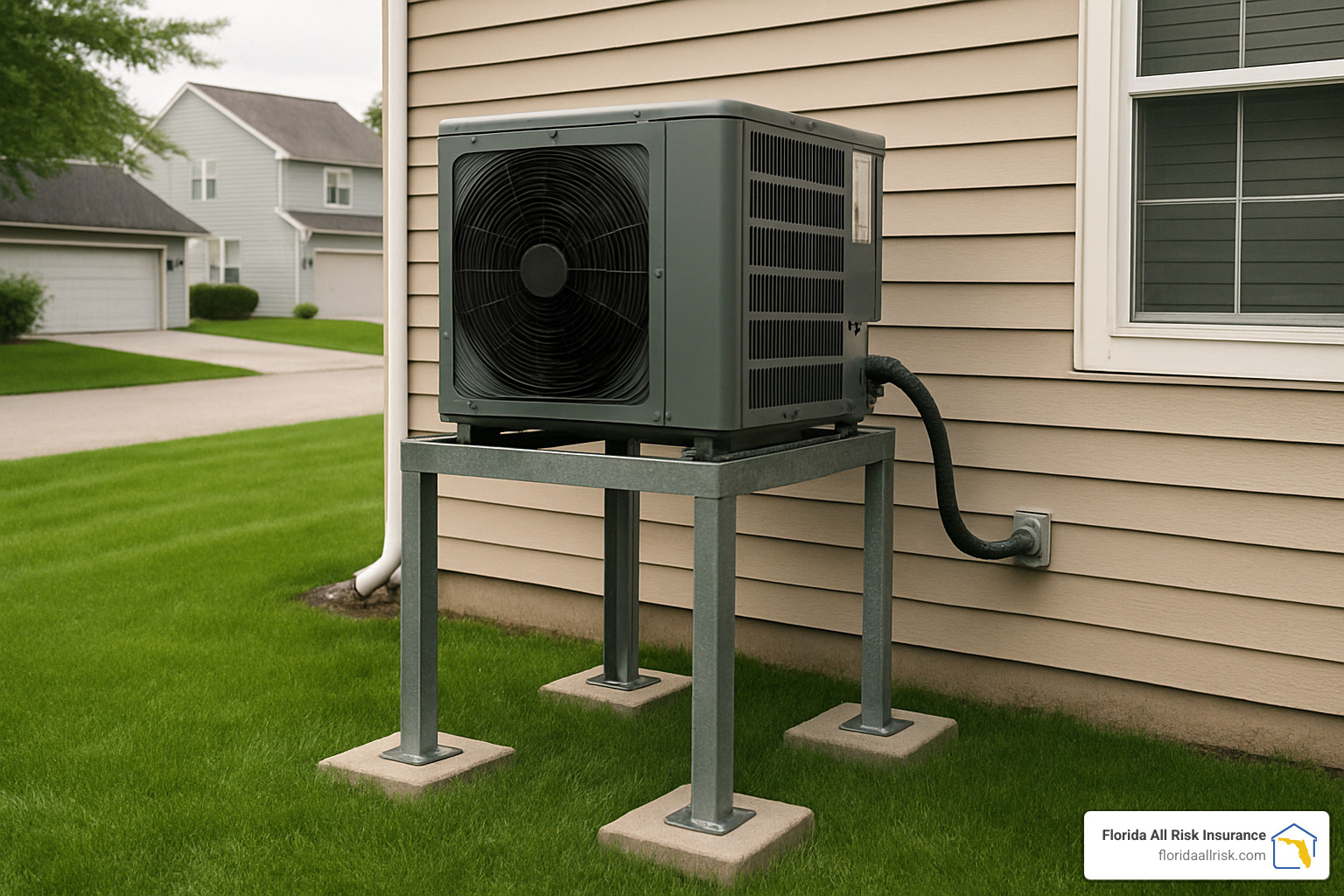
Your utilities deserve some attention too. Elevating HVAC systems, water heaters, and electrical panels above the base flood elevation not only protects these expensive components during a flood but can also translate to lower premiums. The photo above shows a perfect example of a properly liftd outdoor HVAC unit that helped one of our clients qualify for a substantial rate reduction.
The deductible lever is always available too. Bumping up from a $1,000 to a $5,000 or even $10,000 deductible could shave 15-30% off your annual premium. Just make sure you have that deductible amount set aside in case you need to file a claim.
Don’t underestimate the power of proper drainage. Making sure water flows away from your foundation through thoughtful landscaping and drainage systems can reduce your risk profile and sometimes qualify for premium reductions.
Finally, there’s strength in numbers. Communities that participate in FEMA’s Community Rating System can secure discounts of up to 45% for all policyholders in the area. If your community isn’t participating, consider reaching out to local officials—your advocacy could benefit everyone. Learn more about these community-based strategies at Community mitigation.
Can I Get a Cheap Flood Insurance Quote in Florida?
“Cheap” is relative when it comes to flood insurance in the Sunshine State. Our geography and climate create unique challenges, but there are definitely ways to find more affordable coverage.
First, never assume the NFIP is your only option. While the federal program provides excellent coverage, private market policies are increasingly competitive—sometimes dramatically so, especially for properties in preferred or moderate-risk zones. At Florida All Risk Insurance, we routinely check both markets to find the best value.
If your property has been newly mapped into a Special Flood Hazard Area, you might qualify for lower “newly mapped” rates that gradually increase over time rather than jumping immediately to full risk rates. This can provide substantial savings in the first few years while you implement mitigation strategies.
Owners of older homes should inquire about Pre-FIRM subsidized rates. If your home was built before your community’s first Flood Insurance Rate Map, you might qualify for these lower rates, though they’re being phased out gradually under Risk Rating 2.0.
Living in a moderate-to-low risk area (Zones B, C, or X)? Ask us about a Preferred Risk Policy. These specialized NFIP policies offer the same quality coverage at significantly reduced rates for eligible properties.
The Average Cost of Flood Insurance in Florida varies tremendously by location. Some of our inland clients pay just $400-$600 annually for solid coverage, while those in coastal high-risk zones might see premiums of $3,000 or more for the same protection.
Even if the premium seems steep, I always remind clients to consider the alternative. With average flood claims around $43,000 and just one inch of water potentially causing $25,000 in damage, going without coverage is a gamble few can afford to take—especially since standard homeowners insurance explicitly excludes flood damage.
At Florida All Risk Insurance, we’re committed to finding you the most affordable flood insurance quote without sacrificing the protection your home deserves. Our access to multiple carriers allows us to thoroughly shop the market for the best combination of coverage and price, and our expertise helps identify discount opportunities you might otherwise miss.
Filing a Claim & Recovering Fast
No one wants to think about their home being damaged by floodwaters, but knowing how to file a claim efficiently can make a world of difference when disaster strikes. I’ve guided hundreds of homeowners through this process, and I can tell you that preparation is your best ally.
When floodwaters recede, the clock starts ticking. You’ll need to report your loss immediately by contacting your insurance agent or company. Don’t wait – the sooner you start the process, the sooner you’ll receive help. Within 24-48 hours, an adjuster should reach out to schedule an inspection of your property.
Before that adjuster arrives, grab your smartphone and document everything. Take detailed photos and videos of all damaged items before you start cleaning up. This visual evidence will be invaluable for your claim. You’ll need to submit a formal Proof of Loss document within 60 days of the flood – this isn’t optional, it’s required to substantiate your claim.
After the adjuster visits your property and assesses the damage, the insurance company will review your documentation alongside the adjuster’s report. If everything is in order, they’ll issue payment for your covered losses.
Throughout this entire process, keep meticulous records of every conversation with your insurance company. Save emails, take notes during phone calls, and hold onto receipts for emergency repairs or temporary housing expenses. These details might seem trivial when you’re dealing with a flooded home, but they can make the difference between a smooth claim and a frustrating ordeal.
Step-by-Step Flood Claim Checklist
The best time to prepare for a flood claim is before the water rises. Start by creating an inventory of your possessions with photos, videos, and receipts. Store important documents in waterproof containers and keep your flood insurance quote and policy information readily accessible – I recommend taking photos of these documents with your phone so you’ll have them even if you need to evacuate.
When floodwaters enter your home, safety becomes your top priority. Watch for electrical hazards and contaminated water before entering. Once it’s safe, contact your insurance agent or company immediately to report the loss. Then document everything before you start removing damaged items – those photos and videos will be your best evidence.
As you begin recovery, separate damaged items from undamaged ones, and remove water as quickly as possible to prevent mold growth. I always recommend keeping samples of damaged materials like carpet and drywall sections – these can help the adjuster assess the damage accurately.
When your adjuster arrives, provide all your documentation and work together to complete your Proof of Loss form. Review any settlement offer carefully before accepting it, and don’t hesitate to ask questions if something doesn’t seem right.

At Florida All Risk Insurance, we don’t just provide you with a flood insurance quote and disappear. We stand beside our clients throughout the entire claims process, advocating for you when you need it most. Our team has helped countless Florida homeowners steer the aftermath of floods, and we’re ready to help you too.
Common Claim Misconceptions
I’ve heard many misconceptions about flood insurance claims over the years, and clearing these up now can save you significant heartache later.
Many people believe federal disaster assistance will cover their flood losses, but the truth is much less reassuring. This assistance only becomes available when the President declares a major disaster – which happens for less than 10% of flooding events. Even then, what you’ll receive is typically a loan that must be repaid with interest, not a grant to rebuild your home.
When it comes to mold damage, flood insurance may cover it, but only if it’s a direct result of the flood and you’ve taken reasonable steps to prevent its growth after the waters recede. This is why acting quickly to dry out your property is so important.
Another common misconception I hear is about timing. Some homeowners think they can wait until a storm is approaching to purchase flood insurance. Unfortunately, there’s typically a 30-day waiting period before your coverage takes effect. By the time you see a hurricane on the weather map, it’s usually too late to get protected.
Many people also assume their flood insurance quote covers everything that their homeowners policy doesn’t. The reality is that flood insurance has specific limitations, particularly for basements, outdoor property, and additional living expenses like temporary housing.
Finally, while your adjuster plays a crucial role in the claims process, you – the policyholder – are responsible for documenting and substantiating your loss through the Proof of Loss form. The more thorough your documentation, the smoother your claim will be.
Understanding these realities before disaster strikes can help you better prepare and set realistic expectations about the recovery process. At Florida All Risk Insurance, we believe in honest conversations about coverage before you need it, so you’re never caught by surprise when it matters most.
Frequently Asked Questions about Flood Insurance Quotes
How much coverage can I buy?
When it comes to protecting your home from flooding, one size definitely doesn’t fit all. Through the National Flood Insurance Program (NFIP), residential property owners can purchase up to $250,000 in building coverage and $100,000 in contents coverage. If you own a commercial property, those limits increase to $500,000 for both building and contents.
But what if your beautiful Tampa Bay waterfront home is worth well over $250,000? Or what if your art collection alone exceeds the $100,000 contents limit? Don’t worry—you have options:
Excess flood insurance works like a second layer of protection, kicking in after your NFIP policy reaches its limits. This can provide millions in additional coverage for higher-value homes.
Private flood insurance often offers much higher coverage limits—I’ve helped clients secure up to $5,000,000 in building coverage and $500,000 for contents through our private market partners.
For those special items like artwork, jewelry, or antiques, scheduled personal property endorsements can ensure these treasures are fully protected beyond standard policy limits.
When you reach out to us for a flood insurance quote, we’ll take the time to understand your specific situation and recommend coverage that truly protects what matters to you—not just the minimum required by your mortgage company.
Can renters get a flood insurance quote?
Absolutely! As a renter, your landlord’s insurance protects the building, but it doesn’t cover a single item you own. If floodwaters damage your furniture, electronics, clothing, or other belongings, you’ll be facing those costs alone—unless you have flood insurance.
The NFIP offers contents-only policies specifically designed for renters, with coverage available up to $100,000. Many of our private market carriers offer even higher limits if needed.
Getting a flood insurance quote as a renter follows the same basic process as for homeowners, but it’s often simpler. You’ll just need details about your unit and the value of your belongings.
The best part? Renters’ flood insurance is surprisingly affordable. Many of my clients in moderate to low-risk areas pay between $100-$300 annually—a small price for significant peace of mind. Just last month, a renter in Clearwater told me she’d been putting off getting flood coverage because she assumed it would be expensive. She was shocked when her quote came in at just $187 for the year.
Your standard renters insurance policy specifically excludes flood damage, making this additional protection essential, especially in our flood-prone Florida communities.
Is there really a 30-day waiting period?
Yes, in most cases, there is a 30-day waiting period before your flood insurance kicks in. This rule exists to prevent folks from waiting until they see storm clouds gathering before buying coverage. I’ve had the difficult conversation too many times with homeowners calling for a flood insurance quote as a hurricane approaches, only to learn they can’t get immediate protection.
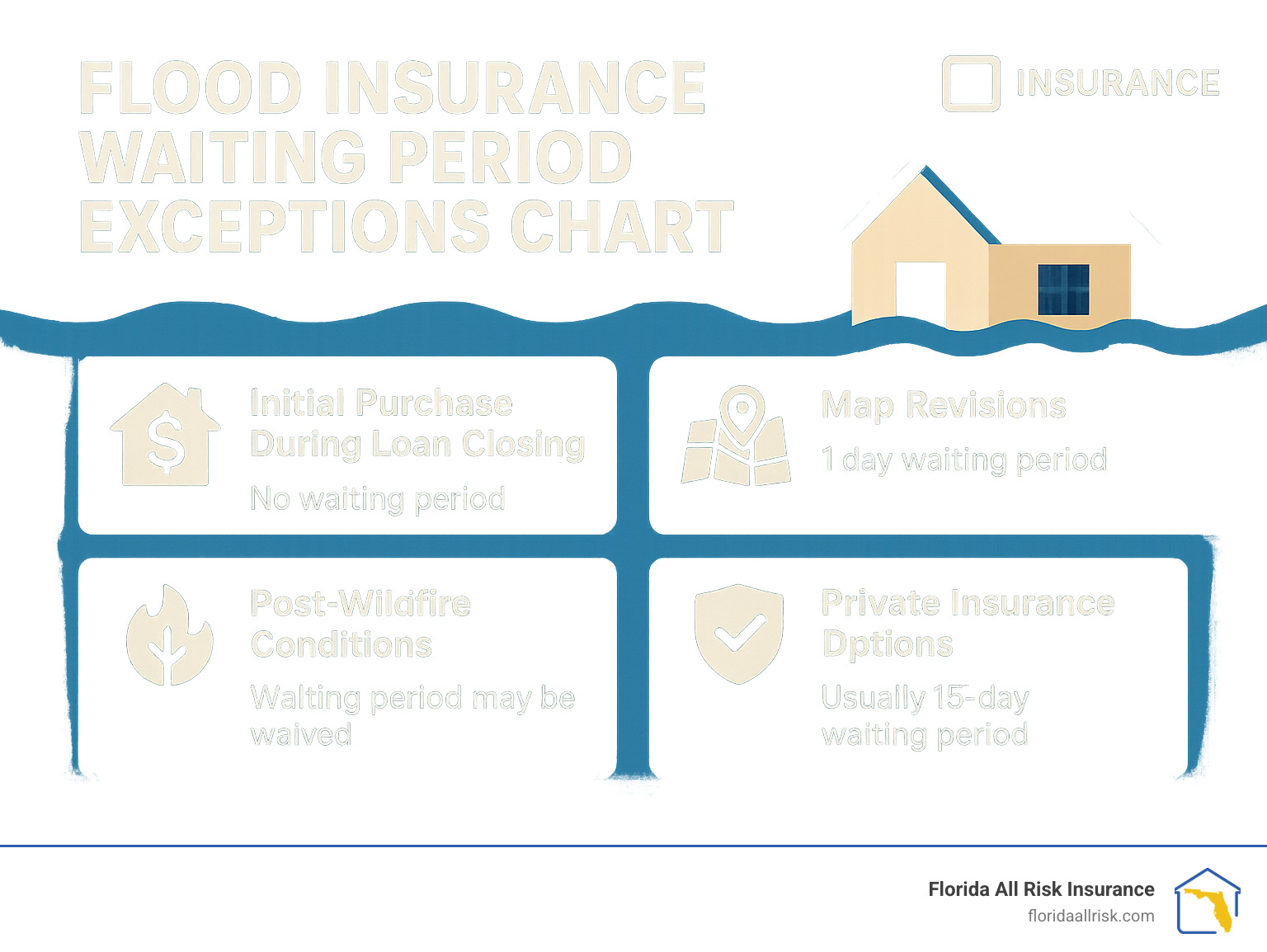
Fortunately, there are several important exceptions to this waiting period:
New home purchase: If you’re buying flood insurance in connection with making, increasing, extending, or renewing your mortgage loan, your coverage can begin immediately. This is why many of our clients secure their policies at closing.
Map changes: If FEMA recently redrew the flood maps and your property is newly designated as high-risk, you can get coverage with just a one-day waiting period if you purchase within 13 months of the map change.
Post-wildfire flooding: For properties affected by flooding on federal lands caused by post-wildfire conditions, the waiting period may be waived entirely.
Private insurance options: Many of our private market carriers offer shorter waiting periods—typically 15 days instead of 30, which can be crucial during Florida’s extended hurricane season.
The bottom line? Don’t wait for storm warnings to think about flood insurance. The best time to get a flood insurance quote is now, when skies are clear and you have time to make an informed decision about protecting your home and belongings.
Conclusion
Let’s face it – flooding can turn your dream home into a nightmare faster than you can say “sandbag.” Throughout Florida, water damage remains one of nature’s most destructive and common forces, yet so many homeowners still don’t have proper protection.
I’ve spent years helping Florida families recover after floods, and there’s nothing more heartbreaking than telling someone their standard homeowners policy won’t cover a dime of their flood damage. That’s why getting a flood insurance quote isn’t just paperwork – it’s peace of mind.
Whether you choose the stability of an NFIP policy or the improved coverage of a private market option, what matters most is having something in place before those storm clouds gather. Hope isn’t a strategy when it comes to Florida’s unpredictable weather.
Here’s what I want you to remember:
Water doesn’t care about flood zone maps. Those “low-risk” designations offer little comfort when you’re wading through your living room – which explains why over 40% of flood claims come from outside high-risk zones. Just one inch of floodwater can cause $25,000 in damage to an average home, turning your biggest investment into your biggest headache.
The differences between NFIP and private flood insurance options really matter when it comes to what’s covered and how quickly you can get back on your feet. And please don’t wait until you see a named storm on the weather map – that 30-day waiting period means your protection starts next month, not tomorrow.
Taking simple mitigation measures around your home can dramatically reduce your premium while better protecting your property. And understanding exactly what your policy covers (and doesn’t) helps prevent those painful “wait, that’s not included?” moments during claims.
As Floridians, we face flood risks unlike anywhere else in the country. Our unique geography, frequent storms, and rising sea levels create perfect conditions for water damage. At Florida All Risk Insurance, we’ve built our reputation on helping homeowners throughout the state find flood coverage that truly fits their specific situation. Being independent means we can offer both NFIP and private market options, ensuring you get comprehensive protection without overpaying.
Your home represents years of hard work and countless memories. Don’t leave it unprotected from one of Florida’s most common threats. Contact Florida All Risk Insurance today for a personalized flood insurance quote that gives you real peace of mind. When it comes to flooding in Florida, it’s never a question of if, but when – and having the right coverage before the water rises makes all the difference between a temporary inconvenience and a financial disaster.
For more detailed information about flood coverage options available through Florida All Risk Insurance, visit our More info about flood coverage page.