Geico Condo Insurance Florida: Smart 2025 Guide
Why Understanding Condo Insurance is Essential for Florida Residents
Navigating condo insurance in Florida requires understanding how an individual policy differs from your condo association’s master policy and what specific protections you need in the Sunshine State.
Key Facts About Florida Condo Insurance:
- Coverage Type: An HO-6 policy is designed to protect your unit’s interior and personal belongings.
- Average Cost: While national averages are lower, Florida is the most expensive state for property insurance due to hurricane risk.
- Master Policy Gap: Your association’s coverage doesn’t protect your personal property or interior improvements.
- Required Protection: Loss assessment coverage is crucial for covering shared repair costs after a major event.
- Common Exclusions: Flood damage requires a separate policy, typically through the NFIP.
Living in a Florida condo means enjoying coastal beauty, but it also involves a complex insurance landscape. Your condo association has a master policy for common areas and the building exterior, leaving significant gaps in protection for your personal investment. Florida’s unique climate, with its hurricanes and flood risks, makes having the right condo insurance essential.
Many condo owners mistakenly believe their association’s master policy provides complete protection. In reality, you are responsible for insuring everything from your interior walls and flooring to your furniture and personal belongings. Without proper HO-6 coverage, you could face thousands in out-of-pocket costs after a covered loss.
Decoding Your HO-6 Policy: Standard Coverages Explained
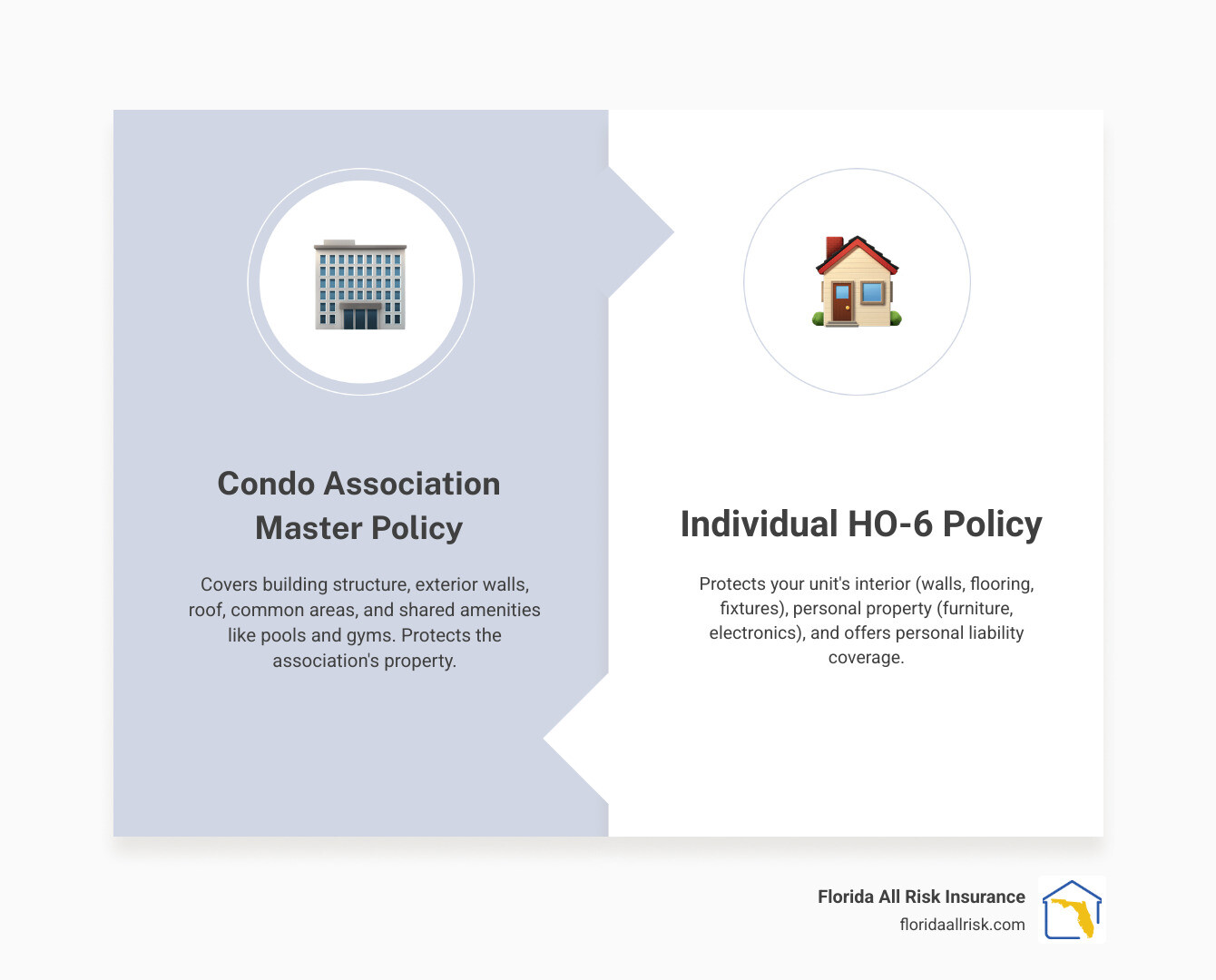
Many condo owners mistakenly believe their association’s master policy has them completely covered. The reality is that there are significant gaps that could leave you financially exposed. Your HO-6 policy is a personal safety net designed to fill those holes. While the master policy protects the building’s exterior, roof, and common areas, your HO-6 policy protects everything inside your unit.
That expensive kitchen renovation, your electronics, and your furniture are typically not covered by the master policy. For comprehensive details about how condo insurance works in Florida’s unique environment, explore our dedicated Condo Insurance page.
Personal Property Protection
This coverage protects your personal belongings—from furniture, electronics, and clothing to appliances and artwork. When you add up the replacement cost of everything in your condo, the total is often much higher than you might estimate.
A key decision is choosing between Replacement Cost versus Actual Cash Value (ACV).
- Replacement Cost: Pays to replace your damaged items with new ones of similar quality, without deducting for depreciation.
- Actual Cash Value: Pays what your items were worth at the time of the loss, factoring in depreciation.
For example, if a fire destroys your three-year-old laptop, Replacement Cost coverage gives you enough to buy a comparable new one. ACV would only provide what the used laptop was worth. Creating a home inventory is the best way to document your belongings. The National Emergency Management Association’s home inventory guide provides excellent instructions. Many policies also include off-premises protection, covering your belongings even when they’re not in your unit, like if items are stolen from your car.
Dwelling (Building Property) Coverage
While the master policy covers the building’s exterior, your dwelling coverage focuses on everything from your interior walls inward. This is often called “walls-in” coverage. It protects the investments that make your condo yours, such as interior walls, flooring, custom cabinetry, and upgraded fixtures. Without it, you would pay out-of-pocket to restore your unit after a fire or water damage. Any renovations or upgrades you make increase your unit’s value and should be reflected in your dwelling coverage amount.
Personal Liability and Medical Payments
Personal liability coverage is your financial shield if you’re found legally responsible for injuries to others or damage to their property within your unit. If a guest slips and falls in your condo, or your dishwasher leaks and damages the unit below, this coverage handles legal expenses and potential settlement costs up to your policy limit.
Medical payments coverage works alongside liability, paying for minor medical bills for guests injured on your property, regardless of who is at fault. This can prevent small accidents from turning into large liability claims.
Loss of Use (Additional Living Expenses)
If a disaster makes your condo unlivable, Loss of Use coverage becomes a financial lifeline. It covers the increased costs of living elsewhere while your unit is being repaired, including temporary housing, hotel bills, and meal expenses. In Florida, this is particularly valuable during hurricane season when a covered event could force you to relocate. This coverage pays the difference between your normal living expenses and these temporary increased costs, providing peace of mind during a stressful time.
Master Policy vs. Your Individual Policy: A Critical Distinction
Many condo owners don’t fully understand the crucial distinction between their association’s master policy and their individual HO-6 coverage. Knowing where one policy ends and the other begins is key to avoiding unexpected costs. The master policy is the foundation, insuring the building’s structure, while your HO-6 policy protects your personal space and belongings.
What the Condo Association’s Master Policy Covers
The master policy is the protective umbrella for the entire complex, safeguarding the shared investment of all residents. Its primary responsibilities include:
- Building Structure: The roof, foundation, exterior walls, and other structural components.
- Common Areas: Lobbies, hallways, elevators, and other shared interior spaces.
- Shared Amenities: Pools, fitness centers, clubhouses, and landscaping.
- Association Liability: Protects the condo association from lawsuits arising from accidents in common areas.
Crucially, the master policy’s protection typically stops at your unit’s front door.
“All-In” vs. “Bare Walls”: Why Your Master Policy Type Matters
Not all master policies are the same. The type your association carries determines how much individual dwelling coverage you need.
- “Bare Walls-In” Policies: This is the most basic type, common in Florida. The master policy covers only the building’s structure, stopping at the drywall. You are responsible for everything inward, including flooring, cabinets, fixtures, and interior walls. This policy type requires you to have robust dwelling coverage on your HO-6.
- “Single Entity” Policies: This policy offers a middle ground, covering the building plus the original fixtures and finishes in your unit. If you’ve made upgrades (e.g., replacing laminate counters with granite), your HO-6 policy would need to cover the value of the upgrade.
- “All-In” Policies: This is the most comprehensive master coverage, protecting the building, common areas, and all fixtures and improvements within individual units. With this policy, your HO-6 can focus more on personal property and liability, though some dwelling coverage is still wise.
You must review your HOA documents or ask your property manager to clarify which policy type your association has.
Why Loss Assessment Coverage is Non-Negotiable in Florida
Loss assessment coverage is essential for Florida condo owners. It protects you when a major disaster causes damage that exceeds the master policy’s coverage limits or falls within its deductible.
For example, if a hurricane causes $2 million in damage and the master policy has a $1.5 million limit and a $100,000 deductible, the association is short $600,000. To cover this shortfall, the association will levy a special assessment against all unit owners. Your share could be thousands of dollars. Without loss assessment coverage, you would pay this out of pocket. With master policy deductibles rising in Florida, this coverage has become more critical than ever. For more on hurricane preparedness, the Florida Division of Emergency Management offers excellent resources.
Key Factors That Influence Florida Condo Insurance Costs
Florida consistently ranks as one of the most expensive states for property insurance, and condo insurance is no exception. The state’s coastal location, hurricane exposure, and flat terrain create a high-risk environment for insurers. While national averages may be a few hundred dollars annually, Florida residents often pay significantly more. Understanding what drives these costs can help you make informed decisions.
Your Condo’s Specifics
The unique features of your property play a massive role in determining your insurance rates.
- Location and ZIP Code: A condo on the beach will have a higher risk profile—and premium—than one a few miles inland due to storm surge and wind risk.
- Building’s Age and Construction: Newer buildings constructed to modern hurricane codes often receive better rates. Concrete block construction is typically viewed more favorably than wood-frame construction due to its wind resistance.
- Flood Zone: While flood insurance is a separate policy, being in a high-risk flood zone signals a higher overall risk to insurers, which can indirectly affect your HO-6 premium.
Your Coverage and Policy Choices
The coverage you select has a direct impact on your premium.
- Deductible Selection: A higher deductible lowers your premium but increases your out-of-pocket cost when you file a claim. Florida policies often have a separate, higher hurricane deductible.
- Coverage Limits: The amount of personal property, dwelling, and liability coverage you choose will affect your cost. It’s important to accurately assess your needs to avoid being underinsured or overpaying.
- Optional Endorsements: Adding riders for things like high-value jewelry or increased mold remediation coverage will increase your premium.
- Replacement Cost vs. Actual Cash Value: Choosing replacement cost coverage for your belongings costs more but provides better protection by not factoring in depreciation.
How to Find Discounts on your Florida condo insurance
Several discounts can help reduce your premiums without sacrificing essential protection.
- Wind Mitigation: This is one of the most significant discounts available in Florida. Features like hurricane shutters, impact-resistant windows, and a reinforced roof can lead to substantial savings. A certified wind mitigation inspection is required to qualify.
- Security and Safety Systems: Monitored burglar alarms, fire alarms, and sprinkler systems can lower your premium.
- Multi-Policy Bundling: Insuring your condo and car with the same carrier usually results in a discount on both policies.
- Claims-Free History: Insurers reward responsible owners who have not filed recent claims with lower rates.
- Group Affiliations: Some employers, professional organizations, or alumni groups offer access to group insurance rates.
Navigating Claims, Management, and Exclusions

Understanding how to get the right coverage, steer the claims process, and recognize policy limitations are essential skills for every Florida condo owner. With the right knowledge, you can confidently protect your investment.
How can Florida residents get a condo insurance quote?
Getting an accurate quote requires providing specific details about your unit and your coverage needs. Be prepared to share:
- Your condo’s address, square footage, year of construction, and construction type (e.g., concrete block or wood frame).
- Information about any safety and wind mitigation features, such as hurricane shutters, impact-resistant windows, or security alarms.
- Your desired coverage limits for personal property, dwelling, and liability.
- Your HOA’s master policy type (“bare walls-in,” “single entity,” or “all-in”), as this directly impacts how much dwelling coverage you need.
Working with an independent agency like Florida All Risk Insurance can streamline this process. We compare options from multiple carriers to find you comprehensive coverage at a competitive rate. For more information, explore our homeowners insurance solutions.
The Claims Process: What to Expect
Filing a claim can be straightforward if you know the steps.
- Report the Claim Promptly: Contact your insurer via their app, website, or phone hotline as soon as possible. Provide details about what happened.
- Document Everything: Before making repairs, take extensive photos and videos of the damage. Create a list of damaged or stolen items. Keep receipts for any immediate expenses you incur to prevent further damage, such as hiring a water extraction service.
- Meet the Adjuster: An insurance adjuster will inspect the damage to assess the loss. Be present for the inspection to point out all damage and ask questions.
- Settle the Claim: Based on the adjuster’s report and your policy terms, the insurer will issue a settlement. Thorough documentation and clear communication are key to a smooth process.
What is typically NOT covered by Florida condo insurance?
Understanding exclusions is as important as knowing what’s covered. Standard HO-6 policies typically do not cover:
- Flood Damage: Damage from rising water (storm surge, overflowing rivers, heavy rain accumulation) is excluded. This requires a separate policy, usually from the National Flood Insurance Program (NFIP). Learn more about flood insurance for condos.
- Earth Movement: Earthquakes and sinkholes are generally excluded, though sinkhole coverage may be available as an add-on in some parts of Florida.
- Wear and Tear: Gradual deterioration, maintenance issues, and neglect are not covered. Insurance is for sudden and accidental losses.
- Pest Damage: Damage from termites, rodents, or other infestations is considered a maintenance issue.
- Mold: Coverage for mold is often limited or excluded, especially if it results from a long-term leak or high humidity rather than a sudden, covered event like a burst pipe.
Frequently Asked Questions about Florida Condo Insurance
Here are answers to some of the most common questions we hear about condo insurance in Florida.
Is condo insurance required by law in Florida?
No, condo insurance is not required by state law in Florida. However, it is almost always a practical necessity.
- Mortgage Lenders: If you have a mortgage, your lender will require you to maintain an HO-6 policy to protect their financial interest in your property.
- Condo Associations: Your condo association’s bylaws will almost certainly mandate that all unit owners carry their own insurance to cover their personal property, liability, and interior structure.
So, while not legally mandated by the state, you will need coverage to satisfy your lender and your HOA.
How is condo insurance different from renters insurance?
While both condo insurance (HO-6) and renters insurance (HO-4) cover personal belongings and liability, they are designed for different situations. The key difference is dwelling coverage.
- Condo Insurance (HO-6): Is for owners. It includes dwelling coverage to protect the interior structure of your unit, such as walls, flooring, and fixtures, which you are responsible for.
- Renters Insurance (HO-4): Is for tenants. It does not include dwelling coverage because the landlord’s insurance covers the building structure.
An HO-6 policy is designed to work in tandem with your association’s master policy, while a renters policy is completely independent of the landlord’s insurance.
How much condo insurance do I really need?
Determining the right amount of coverage is a personal process, but it can be broken down into four key areas:
- Personal Property: Create a home inventory to estimate the total replacement cost of all your belongings. People often underestimate this value, which can range from $50,000 to $100,000 or more.
- Dwelling Coverage: The amount you need depends heavily on your association’s master policy. A “bare walls-in” policy requires significant dwelling coverage, while an “all-in” policy requires much less. You need enough to cover rebuilding the interior of your unit and any upgrades you’ve made.
- Liability Protection: Consider your personal risk. Do you entertain often? Do you have pets? Standard limits often start at $100,000, but increasing this to $300,000 or $500,000 is often surprisingly affordable and provides much greater protection against lawsuits.
- Loss Assessment: In Florida, this is critical. Review your master policy’s deductible. Your loss assessment coverage should be high enough to cover your potential share of that deductible plus any additional costs from a major event like a hurricane. A limit of $50,000 or more is often recommended.
Conclusion: Secure Your Peace of Mind with the Right Partner
Navigating the intricacies of condo ownership in the Sunshine State can feel like a complex puzzle. An HO-6 policy is a vital necessity, filling the significant gaps left by your condo association’s master policy. We’ve covered the crucial protections for your personal property, your unit’s interior, and your personal liability, while also highlighting Florida’s unique risks and the importance of loss assessment coverage.
Understanding factors like your master policy type and available discounts is paramount to securing the right protection at a fair price. At Florida All Risk Insurance, we specialize in these complexities. As an independent agency in St. Petersburg, Florida, we provide personalized service and access to a wide range of carriers. We don’t just sell policies; we find custom solutions to ensure you are comprehensively protected without overpaying. You don’t have to steer the complexities of Florida condo insurance alone.
Ready to protect your investment and secure your peace of mind? Contact Florida All Risk Insurance today for a personalized policy review and a competitive quote.
Ready to get started? Explore our comprehensive Florida homeowners insurance solutions and let our St. Petersburg-based experts guide you.
Contact Us
Getting the right condo insurance protection in Florida doesn’t have to be a solo journey. Our team at Florida All Risk Insurance is here to help you understand your coverage options, review your master policy, and find the right policy for your needs and budget.
As a local agency based in St. Petersburg, we understand Florida’s unique insurance market. We leverage our expertise and access to multiple carriers to provide you with personalized service and competitive options. Reach out today for a no-obligation consultation.
Florida All Risk Insurance
Address: [Company Address, Saint Petersburg, FL]
Phone: [Company Phone]
Email: [Company Email]