A lot of Lutz boat owners are in the same spot right now. The boat is in the driveway or storage lot, the trailer lights finally work, the kids want a lake day, and you're trying to answer one practical question before the next launch: what insurance do I need for this thing in Florida?
That question gets harder around Lutz because local boating life isn't just one kind of boating. You might spend one weekend on an inland lake, the next towing to the coast for a Gulf run, and then spend hurricane season worrying about where the boat is stored when the weather turns. Lutz watercraft insurance works best when it's built around that mix of inland use, road towing, coastal exposure, and storm planning.
Table of Contents
- Starting with a Saturday Morning on the Water
- What Watercraft Insurance Actually Covers
- Florida and Lutz Risks That Shape Your Policy
- Required Versus Recommended Coverage for Lutz Boaters
- How to Buy a Watercraft Policy in Lutz
- What Drives the Cost and How to Save
- Filing a Claim Without Losing Your Weekend
- Why a Local Independent Agent Matters
- Contact Us
Starting with a Saturday Morning on the Water
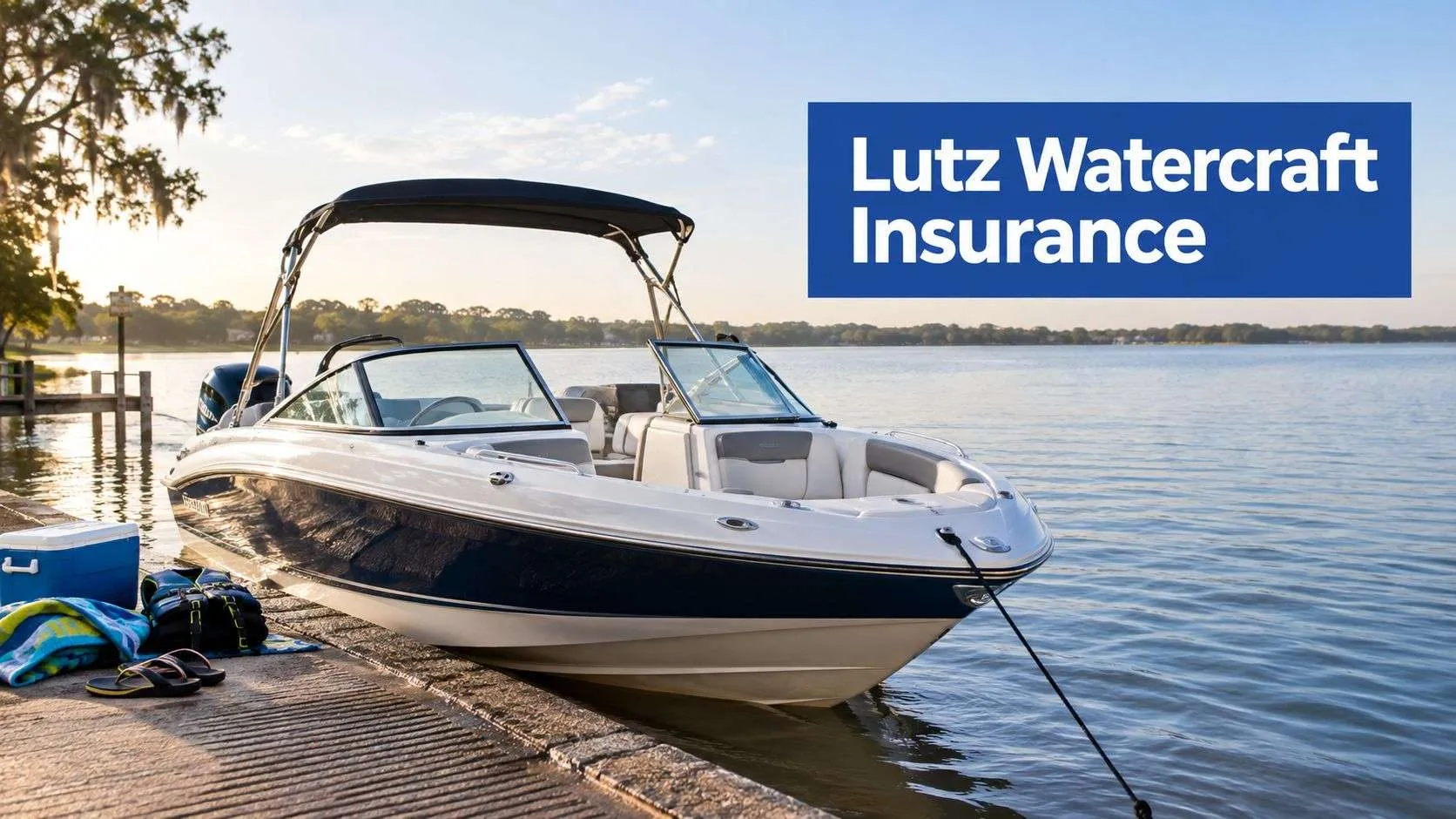
It's a Saturday in Lutz. The cooler is packed, life jackets are stuffed into the bow, and a family is backing a 21-foot bowrider down the ramp for a quick day on the water. Maybe the plan is a local freshwater run first. Maybe it's a trailer trip toward the Gulf for a longer ride before the afternoon weather builds.
Everything feels routine until it doesn't.
The prop catches something shallow near a sandbar. The steering feels wrong. A passenger stumbles when the boat jerks, and a dark line of thunderstorms starts building faster than expected. Back at the dock, you also notice gear left in the boat while the trailer sits unattended. In a single outing, the risks change from simple fun to hull damage, passenger injury, towing trouble, storm exposure, and possible theft.
That's why watercraft insurance matters more in Florida than many first-time owners expect. Boats don't just face collision risk. They face storage risk, weather risk, trailer risk, and liability risk around crowded ramps and busy holiday weekends.
Practical rule: If your boating plans include both inland lakes and occasional coastal trips, your insurance needs are broader than a one-use policy assumption.
There's another reason this deserves careful attention. The U.S. recreational boating base is large and steady. The Insurance Information Institute reported 11.9 million registered recreational watercraft in the United States in both 2015 and 2016, and its 2018 accident data showed that 77% of fatal watercraft accident victims drowned, while 84% of those victims were not wearing life jackets in the Insurance Information Institute fact book. That same source also notes that open motorboats accounted for 46% of reported accidents, personal watercraft for 19%, and cabin motorboats for 15%.
Those numbers help explain why insurers ask detailed questions about the kind of boat you own, where you use it, and how you store it.
A good policy decision for a Lutz owner usually comes down to six things:
- Your boat itself: What's being protected if the hull, motor, or electronics are damaged.
- Your liability exposure: What happens if someone else gets hurt or their property is damaged.
- Your waterways: Whether you stay inland or also trailer to saltwater.
- Your weather plan: How you handle named storms and off-season storage.
- Your paperwork: Registration, title timing, and lender or marina requirements.
- Your support after a loss: Who answers the phone when the claim happens on a weekend.
What Watercraft Insurance Actually Covers
Watercraft insurance is a package policy built for boats, personal watercraft, and similar recreational vessels. It's different from auto coverage and usually much more specific than people expect. The easiest way to understand it is to break it into the major parts.
Hull coverage and how value is settled
Hull coverage pays for damage to the boat itself, subject to the policy terms and deductible. That can include the hull, motor, and often attached equipment. If you scrape gelcoat at a crowded ramp, strike an underwater obstruction, or have a small onboard fire, this is the part of the policy you'd look to first.
The key question is how the policy values the boat after a loss. Some forms use agreed value, while others use actual cash value. Agreed value aims at a pre-set insured amount if the boat is a total loss. Actual cash value factors in depreciation. For many owners, that distinction becomes very important after a serious storm or major impact.
A good place to compare the basic forms available for Florida owners is the Florida boat insurance coverage page.
Liability, medical payments, and passenger injuries
Liability coverage helps when you're legally responsible for bodily injury or property damage. Think about a wake-related passenger injury, a collision at low speed near a marina, or damage to another vessel while docking. Liability coverage can also include legal defense costs, depending on the policy form.
Some policies also include medical payments. That can help with immediate medical expenses for you or passengers after a boating accident, regardless of fault, subject to the policy wording.
A lot of first-time owners focus on damage to their own boat first. In practice, liability can become the larger concern if another person is injured.
Uninsured boater, personal effects, and trailer protection
Some policies offer uninsured or underinsured boater protection. That can matter if another operator causes an accident and doesn't carry enough coverage. On crowded Florida waterways, that's not a minor consideration.
You may also see options for personal effects and fishing or watersports gear. If items are stolen from the boat or damaged in a covered event, this part may help. Trailer coverage is another common add-on, and it matters more than many owners think because trailering is part of the boating lifestyle in Lutz.
If you ever move from personal recreational use into rentals or organized excursions, policy needs change quickly. Operators exploring reservation systems for charter-style activity planning often use tools such as boat tour booking software, but that kind of business use usually requires a different insurance conversation than a personal weekend boat.
Basic forms and common exclusions
Not every policy covers every problem.
Typical exclusions can include wear and tear, corrosion, manufacturer defects, gradual deterioration, and certain forms of neglect. Using the boat as a full-time residence can also fall outside a standard recreational policy. If an outboard fails because of long-term maintenance issues rather than a covered accident, a claim may not respond the way an owner expects.
That's why plain-language policy review matters. A broad policy can still have narrow triggers.
Florida and Lutz Risks That Shape Your Policy
A boat used around Lutz faces a mixed risk profile. You're not dealing with only one environment. You're balancing inland launches, road travel, outdoor storage, and possible coastal day trips. That mix changes what “enough coverage” looks like.
One part of the risk is market reality. Boat insurance is a specialized line with measurable demand. One market study estimated the global boat insurance market at USD 915 million in 2024 and projected USD 1.21 billion by 2032 at a 4.2% CAGR, while another projected the broader boats-and-yachts insurance market at USD 3.02 billion in 2025 rising to USD 4.06 billion by 2030 at a 6% CAGR, with North America as the largest region in 2025. A related market summary also said North America accounted for 43% of the global boat insurance market in boat insurance market research. That tells you this isn't a fringe coverage issue. It's a defined market because the exposure is real.
Why local use patterns matter
For Lutz owners, risk often starts before the boat even touches water. A boat stored outside can be exposed to wind, tree debris, theft, and flooding. A trailer trip adds road risk. Launching onto an inland lake creates one set of exposures, while towing west for saltwater use creates another.
Saltwater use matters because coastal conditions are harder on engines, wiring, and hull systems. Marine underwriting guidance also notes that boats used in coastal waters are often priced higher than inland-only boats because hurricane-prone locations can produce total-loss events, and saltwater accelerates deterioration, as discussed in marine underwriting coverage notes from Insurance Journal.
Matching the hazard to the policy
A Lutz owner usually benefits from thinking in hazards instead of generic labels.
| Hazard | Typical Impact on Boat | Coverage Response |
|---|---|---|
| Summer thunderstorms | Lightning, sudden wind damage, rough-water impact | Hull coverage, plus careful review of weather-related deductibles |
| Coastal day trips | Corrosion, grounding, larger weather exposure | Policy built for saltwater navigation and physical damage |
| Outdoor storage | Theft, vandalism, falling limbs, water intrusion | Comprehensive-style physical damage terms and secure storage planning |
| Busy ramps and holiday traffic | Contact damage, passenger falls, dock impacts | Liability, medical payments, and hull coverage |
| Named storms | Severe wind damage, displacement, total loss risk | Strong hull valuation terms and storm preparation planning |
The best policy for a Lutz boater usually isn't the broadest sounding one. It's the one that matches where the boat actually goes and where it actually sits when you're not using it.
Required Versus Recommended Coverage for Lutz Boaters
Florida boat owners often assume there's a blanket insurance requirement for recreational vessels. There usually isn't.
Florida does not require recreational boat owners to carry liability or hull insurance under state law, although financing agreements, marina contracts, and similar private arrangements often make coverage a practical requirement, according to Florida boat insurance guidance on Florida law and lender requirements. Florida registration rules also don't require proof of insurance to title and register a vessel, and newly purchased boats must generally be titled and registered within 30 days, with proof of purchase carried during that period, as explained in Florida vessel registration guidance.
That legal minimum surprises many first-time owners. It also creates confusion, because “not required by the state” is not the same thing as “safe to go without.”
What's actually required
Some Florida-specific obligations do exist.
For example, Florida's Boating Safety Act requires rental operations called liveries to maintain liability insurance of at least $500,000 per person and $1,000,000 per event, as noted in Florida livery insurance requirements. And for personal watercraft in Florida, operators born after January 1, 1988 must have a NASBLA-approved boating safety course certificate to operate vessels with more than 10 horsepower, while riders must wear a properly fitted personal flotation device underway, according to Florida personal watercraft operation requirements.
For a typical Lutz family with a privately owned recreational boat, those facts translate into this: the law may let you operate without a policy, but your lender, marina, or common sense may not.
What most Lutz boaters should strongly consider
| Coverage | Florida Minimum / Requirement | Recommended for Lutz |
|---|---|---|
| Liability | Generally not required for private recreational boats | Strongly recommended for lake traffic, docking, and passenger injury exposure |
| Hull physical damage | Generally not required by state law | Recommended if you'd struggle to repair or replace the boat yourself |
| Medical payments | Not generally required | Helpful for passenger injuries after slips, cuts, or wake incidents |
| Uninsured boater | Not generally required | Worth considering where other operators may carry little or no coverage |
| Trailer coverage | Not generally required as part of vessel registration | Recommended for owners who regularly tow to ramps |
| Named storm planning | Not generally required | Important for Florida storage and hurricane season decisions |
A few common local examples make this more real. A personal watercraft collision on a neighborhood lake raises liability and injury questions fast. A Gulf day trip can expose an outboard to harsher conditions than an inland owner expects. A boat left at a dock before a storm may create a very different financial outcome depending on the hull terms you chose.
How to Buy a Watercraft Policy in Lutz
Buying a boat policy goes smoother when you gather the details before you ask for quotes. Marine underwriting relies on specifics, and those details directly affect what an insurer is willing to cover.
Start with the boat and usage facts
Have the basics ready before you talk with an agent or complete an application:
- Hull identification number: The HIN is one of the first items an insurer will want.
- Make, model, length, and age: These shape how the vessel is classified.
- Horsepower and motor type: Outboard, inboard, and other setups affect risk differently.
- Storage location: Driveway, dry storage, covered marina, or another arrangement matters.
- Trailer details: If you tow regularly, include the trailer and how it's stored.
- Planned waterways: Inland-only use is not the same as occasional Gulf access.
The reason insurers ask for all of this is straightforward. Marine underwriting often turns on vessel value, length, age, propulsion type, engine count, mooring or storage location, navigational area, operator experience, and prior claims history, with some insurers also looking at safe-boating training and even auto driving history as proxy indicators of operator risk, based on Chubb's boat insurance underwriting overview.
Review the declarations page slowly
Don't skim the declarations page. That's where first-time owners miss the details that matter later.
Check these items carefully:
- Settlement basis: Is the boat insured on an agreed-value basis or actual-cash-value basis?
- Navigation limits: Are your intended waterways included?
- Deductible structure: Is there a separate storm or wind deductible?
- Exclusions: Does the policy limit coverage for racing, neglect, or certain equipment?
- Seasonal terms: If there's a lay-up period, does it match how you really use the boat?
If a policy assumes inland use only and you trailer to saltwater a few times a year, that isn't a small mismatch. It's a claim problem waiting to happen.
Finish the purchase like an owner, not just a shopper
Once the policy is bound, save the documents in more than one place. Keep a digital copy on your phone and a printed copy in a dry pouch on the boat. If the vessel is financed, confirm the lienholder is listed correctly.
Before hurricane season, review the policy again. Boats move, usage expands, and storage arrangements change. A policy that fit when you bought the boat might not fit by the time summer storms arrive.
What Drives the Cost and How to Save
Boat insurance pricing in Florida comes down to a relatively small group of rating factors. The big ones are the boat's value, length, age, propulsion type, engine setup, storage and mooring location, navigational area, operator experience, and prior claims history. Those are the same high-signal variables underwriters focus on because they affect expected frequency and severity of loss, as described in the boat insurance cost and coverage discussion from Florida All Risk Insurance.
The biggest cost levers for a Lutz owner
A small freshwater fishing boat stored under cover will usually be viewed differently than a larger, faster vessel that sees coastal use and sits outdoors year-round. The more expensive the boat is to repair or replace, the more attention the insurer pays to where it goes and how it's protected.
Operator history matters too. Someone with clean prior experience and formal boating education often presents differently than a new owner with no track record. Storage can help or hurt. So can your willingness to accept a higher deductible.
Ways owners often lower premium without gutting coverage
Many Lutz owners save money by changing the risk profile instead of just trimming coverage. Common approaches include:
- Bundling other policies: Some carriers offer discounts when home or auto coverage is placed together.
- Completing safety training: Boating education can help show lower operator risk.
- Improving theft protection: Secure storage, alarms, and tracking devices can help.
- Paying in a way the carrier prefers: Some insurers price annual pay differently than installment billing.
- Using seasonal limits carefully: A lay-up arrangement can help if it matches actual use.
Here's a simple way to think about premium direction rather than exact pricing.
| Vessel Type | Base Premium Range | With Discounts Applied |
|---|---|---|
| Jon boat | Lower end of the market | Often lower with secure storage and clean operator history |
| Pontoon | Moderate, depending on value and horsepower | May improve with bundling and seasonal use terms |
| Bay boat | Moderate to higher, especially with coastal use | Can improve with training, storage, and deductible choices |
| Center console | Often higher because of value, speed, and coastal exposure | Discounts may help, but storm and navigation factors still matter |
The cheapest quote usually isn't the best value in a Florida boating market shaped by weather and mixed water use. A lower premium can come from narrower navigation territory, weaker valuation terms, or exclusions you won't notice until a claim.
Filing a Claim Without Losing Your Weekend
A boat claim feels chaotic in the moment, especially when it happens at a ramp, near a sandbar, or during bad weather. The best approach is calm, documented, and chronological.

What to do first at the scene
Start with people, not property. Make sure everyone is safe, account for passengers, and move the boat to a safer position if that can be done without creating more danger.
Then document the scene before repairs or cleanup change it. Photograph the hull damage, motor area, trailer if relevant, surrounding water conditions, any other vessel involved, and visible registration or identifying marks.
What to gather before the adjuster calls
Have these items ready as soon as practical:
- Policy information: Policy number and carrier contact details.
- Boat information: Registration, HIN, and recent photos if you have them.
- Loss details: Date, time, location, weather, and a plain-language description.
- Repair support: Receipts, maintenance records, and any prior marine survey for an older boat.
- Third-party details: Names, contact information, and witness notes if another vessel was involved.
If the accident is serious, separate reporting duties may apply under boating law and law-enforcement procedures. Don't guess. Report promptly and ask what documentation is required.
How the claim usually moves
Hull claims and liability claims don't always move at the same pace. A straightforward prop or hull damage inspection may be relatively direct. A liability claim involving another person's injuries, legal questions, or disputed fault can take longer because the insurer has to collect statements and evaluate responsibility.
Your deductible generally applies to covered physical damage to your own boat. It doesn't work the same way for every part of a policy, so read that section carefully.
Take photos before the boat is moved, if safety allows. A clear on-scene record often prevents weeks of back-and-forth later.
Repair authorization matters too. If you rush into major repairs before the insurer inspects the damage, you can complicate the process. Temporary steps to protect the boat are usually sensible. Full repair decisions should follow the carrier's instructions.
Why a Local Independent Agent Matters
A local independent agent earns their value in marine insurance by translating your actual boating life into the policy language carriers use. That's different from getting a generic online quote built around assumptions that may not fit your boat, your waterways, or your storage setup.
An independent agent can compare multiple carrier forms side by side. That matters when one policy handles navigation limits one way, another treats hull valuation differently, and a third has stricter storm deductible terms. For a Lutz owner, those differences aren't academic. They affect what happens when you tow inland one weekend and west for saltwater use the next.
Why local context changes the advice
A captive quote process often starts with a narrow template. A local independent discussion starts with questions that matter in real life.
- Where is the boat stored: Outdoor driveway storage is a different exposure than covered dry storage.
- Where do you use it: Inland-only use is not the same as mixed inland and coastal use.
- Who operates it: Family use, teen operators, and guest use can all matter.
- What happens before storms: Your hurricane preparation routine can affect how coverage decisions feel later.
If you want a plain-English explanation of how this kind of agency model works, this overview of what an independent insurance agent does is a useful starting point.
Why support matters after you buy
The value of a local relationship usually shows up after the paperwork is signed. You may need annual reviews before hurricane season, updates when the boat changes, help adding a lienholder, or guidance when a claim happens on a weekend.
This is also the one place where a local agency option fits naturally into the discussion. Florida All Risk Insurance is an independent Florida agency that offers watercraft coverage through multiple carriers, which can help when a boat owner wants to compare terms for coastal use, storm deductibles, trailer exposure, and liability protection without relying on a single carrier form.
A local advisor also helps first-time owners avoid simple but expensive mistakes. Common examples include underinsuring electronics, assuming the trailer is automatically covered, forgetting to update navigation territory, or keeping a policy written around an older storage arrangement that no longer applies.
The right agent isn't just quoting a boat. They're matching a policy to where that boat lives, how it moves, and what could go wrong on your most common trip.
The best result is usually steady, boring confidence. You know what the policy covers, what it excludes, what documents to keep onboard, and who to call if weather or an accident interrupts the day.
Contact Us
Florida All Risk Insurance
Saint Petersburg, FL
Phone: (727) 555-0184
Email: [email protected]
If you want help sorting through Lutz watercraft insurance without guessing at coverage terms, Florida All Risk Insurance can help you compare policy options, review storm and navigation details, and match coverage to how you really boat. Visit Florida All Risk Insurance to request guidance, or reach out if you want a policy review before your next lake day, coastal trip, or hurricane season update.