

Why Your Condo Needs More Than Just the Building’s Master Policy
Flood insurance for condos is often misunderstood. Many Florida owners believe the association’s master policy handles everything, but that policy usually stops at the drywall.
Quick take-aways:
• Association Master Policy (RCBAP) – Building & common areas up to $250,000 per unit
• Individual Unit Policy – Needed for personal belongings and interior upgrades
• Mandatory in Special Flood Hazard Areas (SFHAs) when you have a federally-backed mortgage
• Worth considering everywhere in Florida – storm surge, king tides and heavy rain ignore map lines
• Two coverages – Building (association) and Contents (owner)
Florida’s mix of storm surge, cloud-burst rains and high groundwater means floods can hit even “low-risk” buildings. After Hurricane Ian, some owners learned—too late—that cabinets, flooring and furniture were never covered by the master policy. One 12-unit building with no master flood coverage faced $325,000 in damage and equal special assessments for every owner.
I’m Jason Miller, a second-generation agent who has spent 20 years untangling flood rules for condo associations and individual owners. The lesson is simple: master coverage protects the shell; unit policies protect your life inside it.
Useful terms:
– fema flood zone map
– average cost of flood insurance in florida
– flood insurance for businesses
Mapping Your Condo’s Flood Risk
Think of FEMA flood maps as a financial weather report. Any zone that starts with “A” or “V” is an SFHA—a lender will demand flood coverage if your mortgage is federally backed.
Key points to read the map:
• Base Flood Elevation (BFE) – water height during the “100-year” flood (1 % chance every year).
• Coastal Barrier Resources System – insurance required even if you’re mapped low-risk.
• Buildings straddling two zones use the higher-risk zone.
Check your address with FEMA’s online lookup before you shop policies; five minutes now can prevent closing-table chaos later.
What Is a Special Flood Hazard Area (SFHA)?
An SFHA means a 26 % chance of flooding over a 30-year mortgage. When three things align—SFHA, federally-backed loan, and NFIP availability—insurance is mandatory for every unit, even a penthouse.
Community Participation & NFIP Eligibility
Cities that join the NFIP’s Regular Program open up full coverage for residents. Extra credit through the Community Rating System can cut premiums up to 45 %. If a city drops out, property values and financing options drop with it. Mixed-use properties and Flood Insurance for Businesses follow the same participation rules.
Flood Insurance for Condos: Rules & Requirements
The world of flood insurance for condos can feel like trying to solve a puzzle with pieces that keep changing shape. Federal regulations create a layered system that depends on where your building sits, how it’s used, and who holds the mortgage.
The National Flood Insurance Act of 1968 started it all, but today’s rules come from multiple sources. Fannie Mae’s B7-3-06 guidelines spell out exactly what lenders need to see, while NFIP regulations determine what coverage is actually available.
Here’s where it gets tricky for condo buildings in Special Flood Hazard Areas: your association must carry a master flood policy covering at least 80% of the building’s replacement cost – or the maximum NFIP coverage per unit, whichever is less. If that master policy falls short of minimum requirements, individual unit owners need to fill the gap with their own policies.
Mixed-use buildings add another wrinkle. When more than 25% of your building serves commercial purposes – think condos with retail shops on the ground floor – different rules kick in. These buildings often need commercial flood policies instead of residential coverage.
The NFIP condo brochure provides official guidance, but we’ve found that many associations still struggle with the technical details. That’s where professional help makes the difference between proper coverage and costly gaps.
| Requirement Type | Federal Mandate | Lender Guidelines |
|---|---|---|
| SFHA Properties | Master policy required if federally-backed mortgages exist | Must verify adequate building coverage |
| Coverage Minimum | 80% replacement cost or max NFIP per unit | Individual policies if master insufficient |
| Mixed-Use Buildings | Commercial rules if >25% non-residential | Different underwriting requirements |
| Documentation | Proof of coverage for loan closing | Specific policy forms required |
Association Responsibilities vs. Unit-Owner Duties
Your condo association holds the primary responsibility for building flood insurance when you’re in a flood zone. This master policy obligation covers the building structure, common areas like lobbies and pools, and any permanently installed fixtures in your unit.
But here’s something that surprises many owners: associations aren’t legally required to buy flood insurance just because the building sits in a flood zone. Since the association itself doesn’t have a mortgage, no federal law forces them to purchase coverage.
This creates a dangerous gap. We’ve seen association boards vote against master policies to keep monthly fees low, not realizing they’re setting up owners for massive special assessments after flood damage.
Individual unit owners remain responsible for everything the master policy doesn’t cover – your furniture, clothing, electronics, and any improvements you’ve made to your unit. Think custom kitchen cabinets, upgraded flooring, or that expensive home theater system.
The co-insurance penalty becomes crucial here. If your association skimps on coverage and only insures 60% of the building’s value instead of the required 80%, every claim gets reduced proportionally. A $100,000 claim becomes a $75,000 payment, leaving the association – and potentially you through special assessments – to cover the difference.
What Happens During an NFIP Lapse?
Congressional budget battles occasionally shut down the National Flood Insurance Program, creating headaches for anyone trying to buy or refinance a condo. During these program lapses, new policies can’t be issued and existing policies can’t be renewed.
Lenders have developed a loan-closing workaround that keeps transactions moving. You can still close if you provide proof that you’ve applied for NFIP coverage and paid the premium. The key documents include your application receipt, premium payment confirmation, and a commitment to transfer any existing policy to the new property.
We help clients gather this documentation quickly because timing matters. Policy gaps during lapses leave both associations and unit owners without protection, making it essential to maintain continuous coverage even when federal programs face uncertainty.
The good news? These lapses typically get resolved within days or weeks, and coverage becomes effective retroactively to the application date. But those gaps still create real risk that nobody wants to face during Florida’s storm season.
Picking the Right Policy Type for Your Building
Choosing coverage boils down to two questions: How much of the building is residential, and how high is your total replacement cost?
• 75 % or more residential floor area? You qualify for the Residential Condominium Building Association Policy (RCBAP).
• Less than 75 % residential or town-home ownership structure? You’ll need the General Property Form (commercial) or individual policies.
Private insurers now write flood policies that often beat NFIP pricing and raise limits, but confirm lender acceptance before switching. See our guide to the Best Flood Insurance Florida for details.
RCBAP Highlights
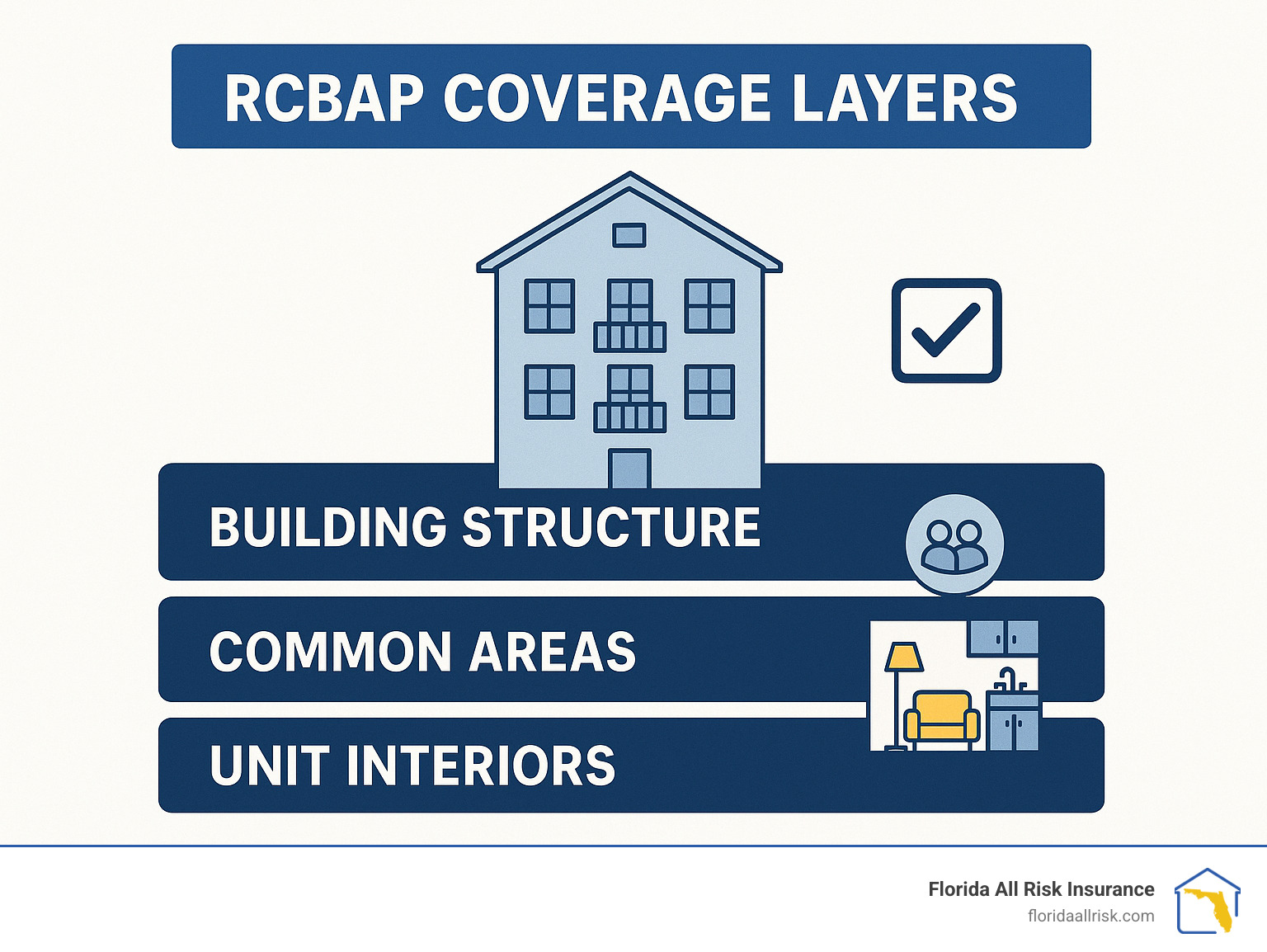
• Up to $250,000 × number of units in building coverage.
• Must equal at least 80 % of replacement cost or claims are reduced.
• Single deductible applies to the whole loss.
Individual Policies
Use a Dwelling Form when the association has no flood policy or when you want extra protection for:
• Personal belongings (contents)
• Interior upgrades and betterments
• Assessment gaps if the association is under-insured
Private & Excess Options
If your building’s replacement cost tops NFIP limits, excess or private flood policies fill the gap—often at lower premiums, especially for liftd, newer construction.
Calculating Coverage, Deductibles & Cost

Start with a current replacement-cost appraisal. Flood insurance isn’t based on market value; it’s what it costs to rebuild today. Under NFIP rules, insure to at least 80 % of that number or face a co-insurance penalty.
Maximum NFIP limits:
• Building: $250,000 × number of units
• Contents (under RCBAP): $100,000 total
If the appraisal exceeds NFIP limits, add excess coverage. Use updated Average Cost of Flood Insurance in Florida data to compare NFIP vs. private quotes.
Deductible Strategy
Higher deductibles reduce premium but increase cash needed after a loss. Lenders often cap deductibles; pick a number your reserves can truly cover. Many associations set a separate deductible reserve so owners aren’t hit with emergency assessments.
Staying Compliant & Recovering After a Flood

Have these ready before storm season:
1. Policy declarations page (digital & waterproof hard copy).
2. Current elevation certificate.
3. Unit-by-unit photo inventory.
File your proof-of-loss within 60 days. NFIP allows advance payments so repairs can start quickly. Up to $30,000 in Increased Cost of Compliance (ICC) money is available when local codes force elevation or flood-proofing.
If insurance and ICC still fall short, low-interest SBA disaster loans can bridge the gap. Get a fresh Flood Insurance Quote after repairs so coverage reflects any code-driven upgrades.
Mixed-Use & Commercial Space
When more than 25 % of the building is commercial, residential and commercial areas may claim under separate policies. Good documentation prevents overlap or gaps during settlement.
Post-Flood Checklist for Owners
• Request any association claim documents for your records
• File your contents or improvements claim separately
• Track special assessments tied to the loss; some unit policies reimburse them
Frequently Asked Questions about Flood Insurance for Condos
Do upper-floor condo owners really need flood coverage?
This question comes up constantly, and I understand why. It seems logical that a 10th-floor unit wouldn’t need flood insurance for condos protection. Unfortunately, federal law doesn’t care which floor you’re on.
If you have a federally-backed mortgage and your building sits in a Special Flood Hazard Area, you need flood insurance – period. The mandatory purchase rule applies to every unit with qualifying mortgages, whether you’re on the ground floor or the penthouse.
But here’s what many upper-floor owners don’t realize: you’re still vulnerable in ways that might surprise you. When Hurricane Ian hit Southwest Florida, we saw upper-floor units damaged by wind-driven rain through windows and balcony doors. Broken pipes during storms create flooding that your regular condo policy won’t cover.
The bigger financial risk comes from special assessments. When your association lacks adequate master coverage and the building suffers flood damage, every owner gets hit with repair costs. We’ve seen owners on the 15th floor pay thousands in special assessments for lobby and parking garage flood damage they never experienced directly.
What if my association is under-insured?
Under-insurance creates a double whammy that can devastate condo owners financially. The co-insurance penalty hits first – if your association maintains less than 80% of replacement cost coverage, the insurance company reduces claim payments proportionally.
Here’s how the math works against you: If your building needs $2 million to rebuild but only carries $1 million in coverage (50% of replacement cost), claims get paid at only 62.5% of actual damages. A $100,000 flood loss would result in just $62,500 in insurance proceeds.
The second hit comes through special assessments for the uncovered portion. Every owner shares these costs equally, regardless of whether their individual unit suffered damage. We’ve seen associations levy $15,000 special assessments per unit after major flood events with inadequate coverage.
Your best protection involves advocating for adequate association coverage at annual meetings. If your board resists due to premium costs, consider purchasing individual dwelling coverage that protects against assessment risks. We help owners understand their options when associations won’t maintain proper coverage levels.
Can I switch from NFIP to a private flood policy mid-term?
Yes, switching is definitely possible and often beneficial. Private flood insurance has become increasingly competitive, sometimes offering 30-40% premium savings with broader coverage than NFIP policies provide.
The timing advantage works in your favor – private policies typically don’t impose waiting periods when you’re replacing existing NFIP coverage. This means you can switch immediately without coverage gaps, unlike initial flood insurance purchases that require 30-day waiting periods.
For individual unit owners, the process is straightforward. Just ensure your lender accepts private flood insurance before canceling your NFIP policy. Most major lenders now accept private coverage that meets federal guidelines.
Association policy switches require more coordination. The board must approve master policy changes, and we recommend comparing coverage terms carefully. Private policies might offer higher limits and additional coverages like loss of use, but they may also have different exclusions than NFIP policies.
We help both associations and individual owners evaluate whether private options provide better value for their specific situations. Sometimes NFIP remains the better choice, particularly for older buildings or those with previous claims history.
Conclusion
Protecting your condo investment shouldn’t feel like solving a puzzle with missing pieces. Flood insurance for condos brings together federal regulations, association responsibilities, and individual coverage needs in ways that can overwhelm even experienced property owners.
That’s where we come in. At Florida All Risk Insurance in St. Petersburg, we’ve been helping Florida condo owners make sense of flood insurance for over two decades. As an independent agency, we’re not tied to just one insurance company – which means we can shop around to find you the best coverage at the most competitive rates.
Whether your association needs an RCBAP master policy or you’re looking for individual unit coverage to fill the gaps, we understand the unique challenges Florida condos face. From storm surge in coastal areas to flash flooding from afternoon thunderstorms, we’ve seen how quickly water damage can turn a dream home into a financial nightmare.
The good news? You don’t have to figure this out alone. We’ll review your building’s flood zone, check your association’s master policy, and make sure you have the right protection in place. No confusing insurance jargon, no pressure – just straight talk about what you need and why.
Don’t wait until the next hurricane warning to find coverage gaps. Florida’s weather doesn’t follow anyone’s schedule, and flood insurance for condos typically requires a 30-day waiting period before coverage kicks in.
Ready to get started? More info about our flood coverage services is just a click away. Because when it comes to protecting your condo, experience really does make all the difference – and we’ve got plenty of both.

