Best Insurance Companies for Condo Owners 2025: Secure
Why Finding the Best Insurance Companies for Condo Owners Matters

Finding the best insurance companies for condo owners means securing reliable protection for your unit, personal belongings, and liability. This coverage fills the critical gaps left by your HOA’s master policy.
Condo insurance is your financial safety net. Your HOA’s policy covers the building’s exterior and common areas, but it won’t protect your personal belongings, interior upgrades, or liability if someone is injured in your unit. Without your own HO-6 policy, you are personally responsible for replacing everything inside your walls if a disaster occurs.
The challenge lies in finding an insurer that balances comprehensive coverage, competitive cost, and proven reliability. This is especially true in Florida, where risks like hurricanes and flooding demand careful consideration.
I’m Jason Miller, owner of Florida All Risk Insurance. With over 20 years of experience, I’ve helped thousands of Florida residents find the right protection. I know what separates great insurers from mediocre ones, and I’m here to share that knowledge with you.
Continue reading to learn how to evaluate insurers, understand your coverage needs, and find the right policy for your Florida condo at the best possible price.
Understanding Condo Insurance (HO-6): What It Is and What It Covers
Condo insurance, or an HO-6 policy, is designed specifically for condominium owners. It provides a critical layer of protection that picks up where your Homeowners Association (HOA) master policy leaves off. While the HOA’s insurance covers the building’s exterior and shared spaces, your HO-6 policy protects your personal space and financial well-being.
Unlike a traditional homeowners policy (HO-3) that covers an entire house, an HO-6 policy focuses on the “walls-in.” This includes your personal property, interior structures like cabinets and flooring, and liability for accidents within your unit. Without it, any damage to your belongings or the interior of your unit would come directly out of your pocket.
Key Condo Insurance Coverages
These are the core components every Florida condo owner should understand:
-
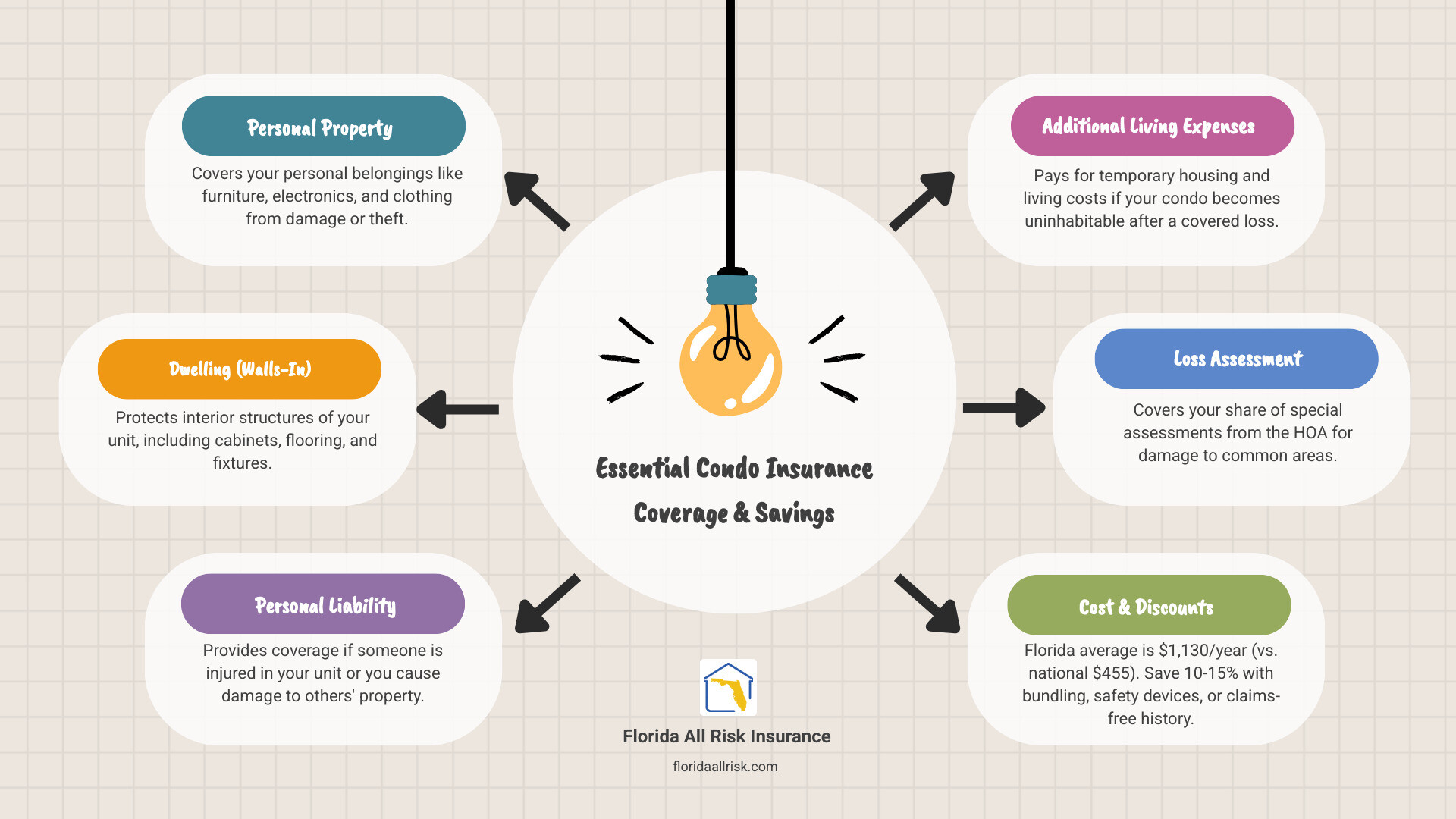
Dwelling Coverage (Walls-In Coverage): This covers repairs to the interior of your unit, including walls, floors, fixtures, and cabinets. The amount you need depends on your HOA’s master policy. A “bare-walls” policy means you’re responsible for everything inside, while an “all-in” policy may cover fixtures, leaving you to cover only the deductible. Always check your HOA bylaws to know your responsibility.
-
Personal Property Coverage: This protects your belongings—furniture, electronics, clothing, etc.—from perils like fire, theft, or vandalism. We recommend creating a home inventory to ensure you have enough coverage to replace everything.
-
Personal Liability: This protects you financially if someone is injured in your condo or if you accidentally damage another’s property. If a guest falls or a pipe in your unit damages a neighbor’s condo, this coverage helps with medical bills and legal fees. Most policies start at $100,000, but we often recommend $300,000 to $500,000 for robust protection.
-
Loss of Use (Additional Living Expenses – ALE): If a covered event makes your condo uninhabitable, this coverage pays for additional living expenses like hotel stays, temporary rent, and meals while your unit is repaired.
-
Loss Assessment Coverage: If your HOA levies a special assessment on unit owners to cover a large deductible or costs exceeding the master policy’s limits (common after a hurricane), this coverage helps pay your share. Standard limits are often low ($1,000), so we advise increasing it, as assessments can be substantial.
-
Medical Payments: This covers minor medical expenses for guests injured on your property, regardless of fault, helping to prevent small incidents from becoming large liability claims.
To learn more, explore our Condominium Insurance Guide 2025.
Essential Add-Ons and Endorsements
Customize your policy with these important add-ons for comprehensive security:
-
Water Backup and Sump Overflow: Standard policies often exclude damage from water backing up through sewers or drains. This endorsement is crucial in Florida due to heavy rainfall.
-
Identity Theft Protection: Helps cover costs associated with restoring your identity, such as legal fees and lost wages.
-
High-Value Items Scheduled Coverage: Standard policies have limits on items like jewelry, art, or collectibles. “Scheduling” these items individually provides broader coverage and higher payout limits.
-
Flood Insurance: Standard HO-6 policies do not cover flood damage. This is a separate policy that protects your property from external flooding events like storm surges. Even if your HOA has building flood insurance, it won’t cover your belongings. We strongly recommend a separate Flood Insurance for Condos policy, available through the National Flood Insurance Program (NFIP) or private insurers.
-
Building Code Coverage: Covers the extra costs to bring your condo up to current building codes during repairs after a covered loss.
-
Equipment Breakdown Coverage: Covers repair or replacement of major appliances and home systems (like A/C or water heaters) due to mechanical or electrical failure.
-
Fair Rental Value: If you rent out your condo and a covered loss makes it uninhabitable, this reimburses you for lost rental income.
How to Find the Best Insurance Companies for Condo Owners
Finding the right insurer is about balancing coverage, service, and financial stability. As an independent agency, we partner with a wide range of reputable carriers to find the perfect fit for your needs without being tied to a single provider.
Finding the Best Insurance Companies for Condo Owners: Overall Value and Reliability
When we help our clients in Saint Petersburg, we prioritize these core principles for identifying a reliable insurer:
- Financial Strength: An insurer’s ability to pay claims, especially after a widespread disaster, is paramount. Look for high ratings from agencies like AM Best (an “A+” is superior).
- Customer Satisfaction: How an insurer treats its customers is invaluable. We review metrics like J.D. Power scores, which reflect the overall policyholder experience.
- Complaint Ratio: The National Association of Insurance Commissioners (NAIC) tracks customer complaints. A ratio below 1.00 indicates fewer complaints and suggests better service.
- Comprehensive Coverage Options: The best companies offer flexible policies with a wide array of endorsements to tailor coverage to your specific risks.
- Competitive Pricing: We leverage our access to multiple carriers to compare rates and discounts, ensuring you receive excellent value without sacrificing service.
- Policy Clarity: Top insurers communicate clearly, so you understand what is and isn’t covered. We ensure there are no surprises down the road.
Finding the Best Insurance Companies for Condo Owners: Digital Experience and Quick Claims
Convenience and efficiency are key. The best insurance companies for condo owners often excel with their digital tools and streamlined claims.
- Tech-Savvy Insurers: Look for companies with user-friendly websites, mobile apps, and online portals for managing policies and submitting claims.
- Mobile App and Online Policy Management: A robust mobile app allows you to access documents, make payments, and initiate claims from anywhere, which is highly convenient for busy condo owners.
- Digital Claims Process: Companies that allow you to submit photos and documentation online can significantly speed up resolution times. Some insurers use AI to process simple claims in minutes.
- Fast Payouts: While major claims require investigation, companies known for quick approval and payment for straightforward cases stand out. For more insights, refer to our Condominium Insurance Claims guide.
- Online Quotes: The ability to get a quick, accurate quote online indicates a commitment to efficiency. However, we always recommend speaking with an agent to ensure all your needs are addressed.
Best for Bundling and Discounts
Saving money doesn’t mean sacrificing coverage. We are experts at finding discounts that can significantly reduce your premiums.
- Multi-Policy Discount (Bundling): This is one of the most effective ways to save. Bundling your condo and auto insurance with the same provider can earn discounts of 7% to 15% or more.
- Protective Devices Discount: Installing safety features like smoke detectors, fire alarms, security systems, deadbolt locks, and sprinkler systems can lead to discounts.
- Claims-Free Discount: Many insurers reward you with a discount for maintaining a good claims history over a certain period.
- Other Common Discounts: Ask about savings for being a new homeowner, living in a gated community, setting up automatic payments, or being a retired or mature homeowner.
We’re always looking for these savings opportunities. Many principles for saving on home insurance also apply to condo policies. Learn more about how you can Save on Homeowners Insurance.
Best for Specific Needs (e.g., Military, New Owners)
Sometimes, the “best” insurer isn’t just about general rankings but about how well they cater to specific demographics or situations.
- Military Affiliation Benefits: Certain providers offer specialized benefits, low rates, and unique coverages for service members, veterans, and their families.
- New Owner Resources: Some insurers provide excellent resources for new condo owners, such as first-time homebuyer guides and personal property calculators to help you determine adequate coverage.
- Short-Term Rental Coverage: If you plan to rent your unit on platforms like Airbnb, you’ll need specialized coverage. Standard HO-6 policies often exclude this, so look for insurers that offer an endorsement for it.
- High-Value Condo Specialists: Owners of luxury condos may need insurers who specialize in high-value policies, which offer broader coverage, higher limits, and more personalized service.
As an independent agency, we can connect you with carriers that truly understand and cater to your situation. For general guidance on home insurance in the state, see our Homeowners Insurance Florida page.
Decoding the Cost of Your Condo Insurance Policy
The cost of condo insurance can vary significantly based on a wide range of factors. In Florida, the average annual rate for condo insurance is notably higher than the national average, ranging from approximately $962 to $1,130 per year, compared to the national average of around $455 per year. This difference highlights the unique risk profile of our state, primarily due to hurricane exposure and other natural disaster risks.

Key Factors That Influence Your Premium
Many elements come into play when calculating your condo insurance premium. We consider all these factors to find you the most accurate and competitive quotes:
- Location (ZIP Code): Your specific address within Saint Petersburg and Florida is a primary driver of cost. Areas prone to higher crime rates, severe weather (like hurricanes and tropical storms), or located in flood zones will generally have higher premiums.
- Condo Age and Building Materials: Older condominium buildings may have higher premiums. Conversely, condos built with hurricane-resistant or fire-resistant materials might qualify for lower premiums. The age of the roof is also a significant factor in Florida.
- Coverage Limits and Deductible Amount: The more coverage you purchase, the higher your premium will be. Choosing a lower deductible (the amount you pay out-of-pocket) will result in a higher premium, and vice-versa. We can help you find the right balance.
- Claims History: A history of previous insurance claims can signal a higher risk to insurers, often leading to increased premiums.
- Credit Score: In Florida, your credit-based insurance score is a factor in determining your premium. A higher score generally indicates a lower risk, leading to better rates.
- HOA Master Policy Type: The type of master policy your HOA carries (bare-walls, all-in) directly impacts how much dwelling coverage you need, which in turn affects your premium.
- Security and Safety Features: As mentioned in the discounts section, features like smoke detectors, sprinkler systems, and security alarms can reduce your premium.
- Replacement Cost vs. Actual Cash Value: Choosing replacement cost coverage (which pays to replace items at their current market value without depreciation) will result in a higher premium than actual cash value. We generally recommend replacement cost for better protection.
For more detailed insights into property claims, check out our Florida Condo Property Claims Guide.
How to Save Money on Your Condo Insurance
Comprehensive coverage should not break the bank. Here are our top tips for condo owners in Saint Petersburg to save money:
- Shop Around and Compare Quotes: As an independent agency, we do the shopping for you, comparing options from multiple reputable carriers.
- Raise Your Deductible: Opting for a higher deductible can lower your annual premium. Just be sure you can comfortably afford to pay that deductible if you need to file a claim.
- Bundle Policies: Combining your condo insurance with other policies, such as auto insurance, can lead to substantial multi-policy discounts.
- Install Safety and Security Devices: Equip your condo with smoke detectors, fire alarms, and security systems to earn you discounts.
- Maintain a Good Credit Score: A strong credit history can positively impact your insurance rates.
- Review Your Policy Annually: Review your policy every year with your agent to ensure your coverage is still adequate and that you’re taking advantage of all available discounts.
- Ask About All Available Discounts: Inquire about savings for being claims-free, a new homeowner, or for setting up automatic payments.
- Understand Your HOA’s Master Policy: By knowing exactly what your HOA’s insurance covers, you can avoid duplicating coverage and only pay for what you truly need.
Navigating the Claims Process and Choosing a Financially Strong Provider
When a disaster strikes, the last thing you want is a difficult claims process or an insurer that can’t meet its financial obligations. A company’s reputation for handling claims and its financial stability are just as important as its coverage options and price.
The Condo Insurance Claims Process
A smooth claims process is a hallmark of the best insurance companies for condo owners. While every situation is unique, here’s a general overview of how a condo insurance claim typically works:
- Documenting Damage: Immediately after a loss, safely document all damage with photos and videos. Make a list of damaged or stolen items.
- Contacting Your Insurer: Report the claim as soon as possible. Many modern insurers allow you to initiate claims through a mobile app, online portal, or by phone.
- Adjuster Assessment: An insurance adjuster will be assigned to your case. They will inspect the damage, review your documentation, and assess the extent of the loss. Clear communication and a fair assessment are key.
- Payout Timeline: The time it takes to receive a payout can vary. Simple claims might be processed in days, while larger, more complex claims will take longer. Companies with a reputation for efficiency and clear communication are highly valued.
- Smooth Experience: The best insurers guide you through the process with empathy and clarity, providing regular updates and explaining each step.
For a deeper dive into the claims process, our Florida Condo Property Claims Guide offers invaluable information.
Why Financial Strength and Customer Satisfaction Matter
Choosing an insurer is like choosing a long-term partner for your financial security. Their financial stability and commitment to customer satisfaction are non-negotiable.
-
AM Best Ratings: We always advise looking for insurers with high financial strength ratings from independent organizations like AM Best. An “A+” (Superior) rating indicates a company has an excellent ability to meet its policy obligations. This is particularly crucial in Florida, where catastrophic events can strain an insurer’s resources.
-
J.D. Power Customer Satisfaction: J.D. Power conducts extensive surveys measuring customer satisfaction. High scores indicate that policyholders are generally happy with their insurer’s pricing, service, and claims handling.
-
NAIC Complaint Ratio: As mentioned earlier, the National Association of Insurance Commissioners (NAIC) complaint ratio provides an objective measure of how many complaints an insurer receives relative to its size. A ratio below 1.00 is a strong positive indicator.
-
Financial Stability and Reliable Payouts: These ratings boil down to one thing: confidence that your insurer will be there to pay your claim, promptly and fairly. In a state like Florida, this is essential. For broader insights, you can refer to resources like Consumer Reports’ analysis of homeowners insurance companies.
-
Customer Service Reputation: Beyond numbers, a company’s reputation for empathetic and responsive customer service is invaluable, especially during the stressful period following a loss. We prioritize carriers known for their excellent service.
Understanding these metrics helps us guide you toward the best insurance companies for condo owners. For a more general guide, you can also check out our Best Homeowners Insurance Guide 2025.
Frequently Asked Questions about Condo Insurance
What’s the difference between an HOA master policy and my own condo policy?
Your HOA’s master policy covers the building’s structure and common areas (like the roof, elevators, and hallways). Your personal HO-6 condo policy covers everything from the “walls-in,” including your personal belongings, interior structures like cabinets and flooring, liability for accidents in your unit, and temporary living expenses. You need to understand your HOA’s policy to know how much personal coverage to buy. For more details, check out our guide on Condo Association Insurance Florida.
Is flood insurance included in a standard condo policy?
No, standard HO-6 policies do not cover damage from flooding. This is a crucial exclusion, especially in Florida. You must purchase a separate flood insurance policy. Your condo association may have flood insurance for the building, but it likely won’t cover your personal belongings or interior upgrades.
How much condo insurance do I actually need?
The right amount of coverage depends on the value of your personal belongings, the cost to rebuild the interior of your unit (check your HOA’s master policy), and your personal liability risk. Create a home inventory to accurately estimate your personal property needs, and consider a liability limit of at least $300,000 to $500,000. We recommend replacement cost value for your personal property. Don’t forget to factor in potential HOA assessments; we often advise higher limits than the standard $1,000 for Florida condo owners.
Conclusion: Securing Your Peace of Mind
Choosing the best insurance for your condo is a vital step in protecting your investment and financial future. By understanding what an HO-6 policy covers, knowing what factors influence cost, and evaluating providers based on their reliability and service, you can make a confident and informed decision. Remember to review your HOA’s master policy, assess your personal coverage needs, and look for a provider that offers a strong combination of value, stability, and customer care.
Navigating the complexities of condo insurance can be challenging, but you don’t have to do it alone. The experts at Florida All Risk Insurance can help you compare options from multiple carriers to find the perfect policy for your needs and budget. We’re based right here in Saint Petersburg, Florida, and we understand the unique insurance landscape of our beautiful state. Our independent agency status means we work for you, providing personalized service and access to a wide range of carriers to ensure custom coverage and competitive rates.
Ready to find the right coverage for your condo? Get a personalized condo insurance quote today!
Have more questions? Contact our team of independent agents to discuss your specific needs.
Florida All Risk Insurance
Address: 3400 34th St N, Saint Petersburg, FL 33713
Phone: (727) 800-4757
Email: [email protected]