Workers’ Compensation Insurance in Florida: A Complete Guide for Employers and Employees
Why Workers’ Compensation Insurance is Essential for Every Florida Business
Workers compensation insurance is a crucial type of coverage that provides medical care and cash benefits to employees who get injured or become ill on the job. This no-fault system protects both workers and employers: employees receive guaranteed benefits regardless of who caused the accident, while employers gain legal protection from most injury-related lawsuits.
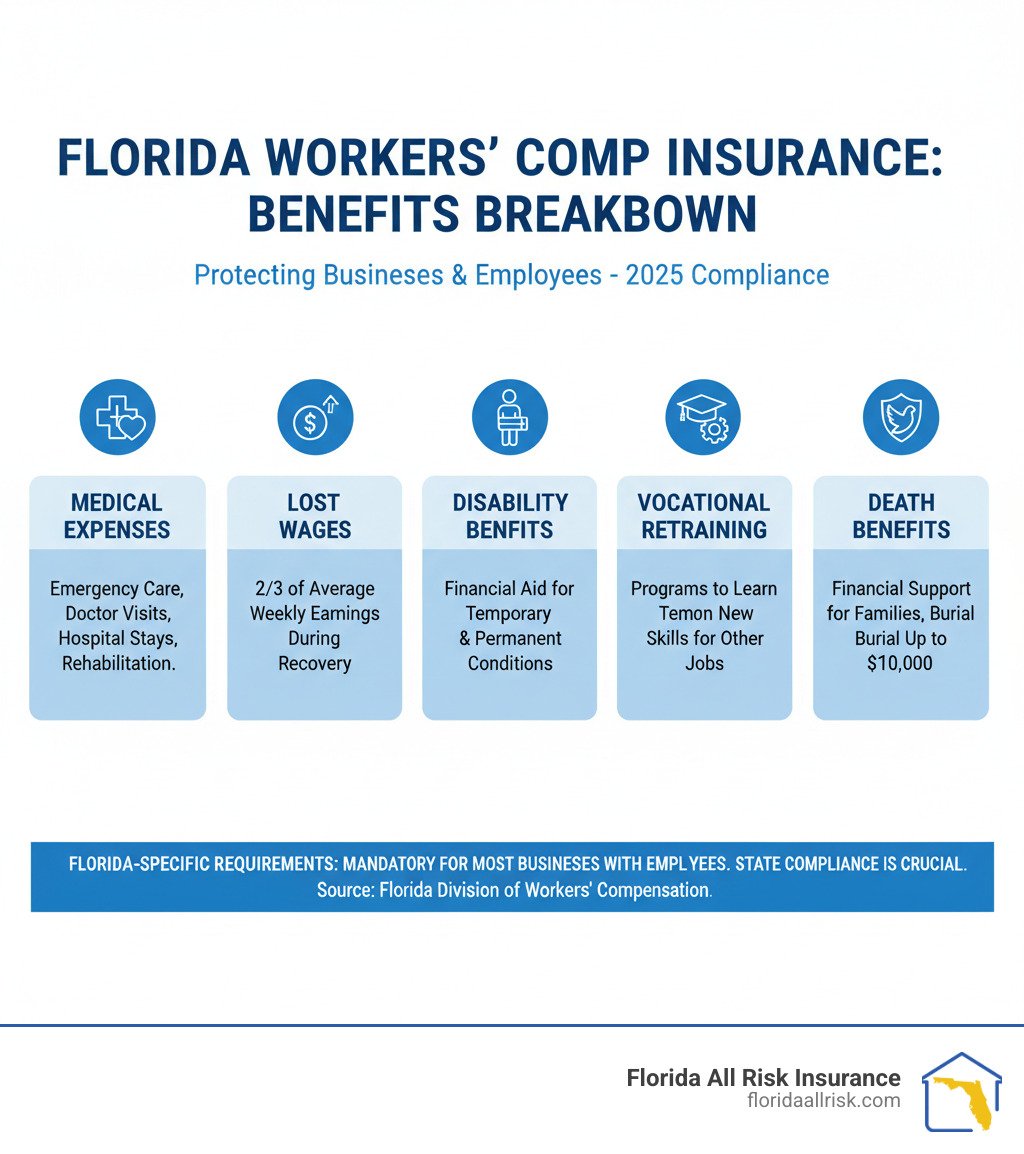
Workers compensation insurance generally covers:
- Medical expenses: Doctor visits, hospital stays, surgery, and rehabilitation.
- Lost wages: Typically two-thirds of average weekly wages during recovery.
- Disability benefits: Payments for temporary or permanent disabilities.
- Vocational rehabilitation: Retraining if workers can’t return to their original job.
- Death benefits: Financial support for families and burial expenses.
Nearly every state requires businesses with employees to carry this coverage, though specific rules vary. In Florida, most businesses with employees must have workers compensation insurance. The system works as a “grand bargain” where employees exchange their right to sue for guaranteed benefits, and employers receive protection from costly lawsuits. This insurance is distinct from health or disability coverage, as it specifically addresses job-related incidents and includes wage replacement benefits.
For over 20 years, we’ve helped Florida businesses steer workers compensation requirements, seeing how crucial proper coverage is for protecting both employees and business owners from the financial impact of workplace injuries.
What is Workers’ Compensation and Why is it Essential?
At Florida All Risk Insurance, we know that protecting your team is paramount. Workers compensation insurance is more than a legal requirement; it’s a fundamental pillar of workplace safety and financial security for both employers and employees. It ensures that if an employee gets hurt or becomes ill because of their job, they receive the care and financial support they need without delay, allowing everyone to focus on their work with confidence.
The Core Purpose: A No-Fault System
The foundation of workers’ compensation is its “no-fault” system. This means an employee is eligible for benefits for a work-related injury or illness regardless of who was at fault. This “grand bargain” means employees give up their right to sue their employer for damages in exchange for guaranteed, prompt benefits. This predictable framework provides swift access to medical treatment and wage replacement, removing the need for lengthy and costly legal battles over blame. This “exclusive remedy” provision is a cornerstone of the system, safeguarding businesses from most injury-related litigation.
Benefits for Employers
For employers, workers compensation insurance offers benefits beyond legal compliance. The most significant is lawsuit protection, which shields your business from potentially crippling legal fees and large settlements. It also helps control costs by replacing unpredictable accident expenses with regular, manageable premiums, allowing for better financial planning. Furthermore, having this coverage is a sign of a responsible employer. It demonstrates your commitment to employee well-being, which can boost morale and help attract and retain top talent. As an independent agency, we help businesses find comprehensive coverage, including workers compensation insurance and robust Business Liability Insurance, to protect your bottom line and your people.
Benefits for Employees
For employees, workers compensation insurance is a vital safety net that provides comprehensive support without the worry of costly medical bills or lost income. Key benefits include:
- Medical Expense Coverage: Covers all necessary medical care, including doctor visits, hospital stays, surgery, prescriptions, and rehabilitation.
- Wage Replacement: Provides a portion of lost wages (often two-thirds of the average weekly wage in Florida) if an injury prevents them from working during recovery.
- Vocational Rehabilitation: Offers retraining and job placement assistance to help employees acquire new skills if they cannot return to their previous job due to a permanent injury.
- Disability Payments: Provides financial support for both temporary and permanent disabilities resulting from a work injury, calculated based on state guidelines.
- Death Benefits: In the unfortunate event of a work-related fatality, dependents receive financial support and coverage for burial expenses up to the state limit.
Who is Required to Have Coverage and Are There Exemptions?
Understanding if your business needs workers compensation insurance can feel complex, as rules vary by state. However, the basic framework is straightforward: if you have employees, you likely need coverage. The main determining factors are your number of employees, your industry, and the type of workers you employ.
Who Needs Workers Compensation Insurance?
In Florida, the requirements are specific to your industry and employee count. For non-construction businesses, coverage is mandatory once you have four or more employees. This count includes all full-time, part-time, temporary, and seasonal workers, as well as corporate officers who are not exempt. For the construction industry, the rules are much stricter due to the higher risk of injury: coverage is required if you have just one employee, including yourself if your business is incorporated. Agricultural businesses have their own set of rules, typically requiring coverage if they employ 6 or more regular employees and/or 12 or more seasonal workers for at least 30 days during a season.
Business owners, such as sole proprietors and partners in a partnership, are generally not considered employees and are automatically exempt from needing to cover themselves. However, they can file to elect to be covered by a policy. This is often a wise choice, as personal health insurance policies almost universally exclude work-related injuries, leaving you personally liable for all medical bills and lost income. Furthermore, many general contractors and clients, especially in construction, will not award a contract without proof of workers compensation insurance, making it a practical business necessity even when not legally mandated. Our expertise in Small Business Insurance in Florida can help you steer these specific requirements.
Are Contractors, Subcontractors, and Volunteers Covered?
The distinction between employees and independent contractors is a critical and often litigated area. Generally, true independent contractors are not considered employees and are not covered by your policy. However, states are extremely strict about this classification. Florida uses a ‘right to control’ test to determine a worker’s status—it’s not about what a contract says, but about the reality of the working relationship. If you, the employer, have the right to direct and control how the work is done, not just the final result, that person is likely an employee. This includes controlling work hours, providing tools and equipment, and dictating the methods of work. Misclassifying an employee as a contractor to avoid paying for insurance, an act known as payroll fraud, can lead to severe penalties, including back-premiums, fines up to double the avoided premium, stop-work orders, and even felony charges.
To protect your business, it’s a non-negotiable best practice to require all contractors and subcontractors to provide a valid Certificate of Insurance (COI) as proof that they carry their own workers compensation insurance. Volunteers are also typically not covered because they are not paid employees, though some organizations purchase voluntary coverage as an extra layer of protection. For broader protection when dealing with third parties, consider Commercial General Liability Insurance.
Common Exemptions from Coverage Requirements
While most employers need coverage, some specific exemptions exist. In Florida, these can include:
- Business Owners: In a non-construction corporation, up to three corporate officers can file for an exemption with the state, provided they own at least 10% of the company. In a construction corporation, only one officer can apply for an exemption under the same ownership criteria.
- Small Businesses: As mentioned, non-construction businesses with fewer than four employees are generally exempt.
- Specific Industries: Certain commission-based real estate agents, some transportation workers who own and operate their own vehicles, and domestic employees in private homes may be exempt under specific conditions.
It’s crucial to remember that being eligible for an exemption doesn’t always make it the best choice. The exemption application must be filed and approved by the state; simply being eligible is not enough. Forgoing coverage, even when legal, can expose your business and personal assets to significant financial risk if an uninsured injury occurs on your watch.
Understanding Your Workers Compensation Insurance Policy

Your workers compensation insurance policy is your roadmap for protecting your business and employees. Understanding its key components—coverage details, exclusions, and the claims process—is essential for managing workplace injuries effectively. Key concepts you’ll encounter include return-to-work programs and Maximum Medical Improvement (MMI). MMI is a critical milestone in a workers’ comp claim. It signifies the point at which a doctor determines an employee’s medical condition has stabilized and is unlikely to improve further with additional treatment. Once MMI is reached, the focus shifts from temporary to permanent benefits. The physician will assign an Impairment Rating (IR), a percentage that quantifies the degree of permanent functional loss. This rating is then used to calculate any permanent partial disability (PPD) benefits the employee is entitled to receive under Florida’s statutory formula.
What Does Workers’ Comp Cover?
Workers compensation insurance provides comprehensive, no-fault protection for injured workers. The benefits are designed to cover both the medical and financial impact of a workplace injury.
- Medical Expenses: This is the cornerstone of coverage. It pays for 100% of all necessary and authorized medical care, including emergency room visits, doctor appointments, hospital stays, surgery, prescriptions, and physical therapy, with no out-of-pocket costs for the employee.
- Lost Wages (Temporary Disability): This replaces a portion of the employee’s income while they are unable to work during their recovery. In Florida, this is typically two-thirds of their average weekly wage, subject to a state maximum. These benefits, known as indemnity benefits, begin after a seven-day waiting period.
- Rehabilitation Costs: This covers both physical therapy to restore function and vocational rehabilitation. Vocational rehab provides counseling, retraining, and job placement assistance if the employee’s permanent restrictions prevent them from returning to their previous job.
- Permanent Disability Benefits: If a work injury results in a permanent impairment after reaching MMI, these benefits provide ongoing payments. The amount is based on the impairment rating and state-specific schedules.
- Death Benefits: In the tragic event of a work-related death, this provides financial support to the deceased worker’s dependents and covers burial expenses up to the state limit (currently $7,500 in Florida).
What is Typically Not Covered?
While coverage is broad, it is specifically for incidents arising “out of and in the course of employment.” Common exclusions include:
- Injuries that occur outside of work during personal time.
- Accidents during a normal commute to and from work (the “coming and going” rule).
- Intentional self-inflicted injuries or injuries sustained while trying to harm someone else.
- Injuries resulting solely from intoxication from alcohol or illegal drugs. In Florida, if an employee tests positive after an accident, it is presumed the intoxication was the primary cause.
- Injuries that occur while committing a crime or through willful and blatant disregard of a known, major safety rule.
- “Mental-mental” claims, which are psychological conditions like stress or anxiety caused by job pressures without an accompanying physical injury. Florida law generally requires a physical injury to be the primary cause of any related mental health condition for it to be covered.
The Step-by-Step Claims Process
A smooth claims process ensures employees get help quickly. The typical steps are:
- Employee Reports Injury: The employee must report the injury to their supervisor or employer promptly. In Florida, this should be done within 30 days of the accident to protect their right to benefits.
- Employer Files Report: The employer must report the injury to their insurance carrier by filing a “First Report of Injury or Illness” form. This must be done within 7 days of learning about the injury.
- Insurer Investigates: The insurance company’s adjuster reviews the case, gathers medical records, may take recorded statements from the employee and witnesses, and determines if the injury is work-related and covered under the policy. They may also request an Independent Medical Examination (IME) with a doctor of their choosing to get a second opinion.
- Claim Approval or Denial: The insurer notifies all parties in writing whether the claim is approved or denied. In Florida, the carrier has 120 days to investigate the claim’s compensability. Denied claims can be appealed through the state’s workers’ compensation system by filing a Petition for Benefits.
- Benefits and Treatment Begin: Once approved, the insurer pays for authorized medical treatment and provides wage replacement benefits if the employee is out of work beyond the 7-day waiting period.
- Return-to-Work Coordination: The employer, insurer, and medical team work together to help the employee return to work safely. This often involves a formal return-to-work program with modified or light-duty assignments that accommodate any temporary medical restrictions.
- Claim Closure: The claim is closed once the employee has fully recovered and returned to work, or after they have reached MMI and all permanent disability and medical benefits have been settled and paid.
How Premiums Are Calculated and How It Differs From Other Insurance
Workers compensation insurance premiums are customized to your business, ensuring you pay a fair price for your specific level of risk. Unlike a flat-rate policy, your cost reflects the real-world risks your employees face, meaning an office-based business will pay significantly less than a construction company with the same payroll.
Calculating the Cost of Workers Compensation Insurance
Several key factors are multiplied together to determine your final premium:
- Classification Codes: The National Council on Compensation Insurance (NCCI) assigns a four-digit code to each job type based on its inherent risk. A riskier job, like roofing (code 5551), has a much higher rate than a lower-risk job, like clerical office work (code 8810).
- Payroll: Your premium is calculated based on a rate per $100 of your total payroll for each classification code. The base formula is: (Payroll / $100) x Classification Code Rate.
- Experience Modification Rate (EMR): Often called an ‘e-mod’ or ‘x-mod,’ this is arguably the most impactful factor you can control. It acts as a multiplier on your premium, rewarding safe workplaces and penalizing those with poor claims histories. The EMR compares your company’s actual claims losses to the expected losses for a business of your size and industry. It’s calculated using data from the past three years, excluding the most recent policy year. An EMR of 1.0 is the industry average. A rate below 1.0 (e.g., 0.85) means your claims history is better than average, and you’ll receive a credit or discount on your premium. A rate above 1.0 (e.g., 1.20) means your history is worse than average, resulting in a debit or surcharge. A single large claim can negatively impact your EMR for three years.
- Discounts and Credits: Insurers offer credits for implementing state-certified safety programs, maintaining a drug-free workplace, or having a formal safety committee. These proactive measures reduce risk and directly lower your costs.
Insurers conduct annual premium audits to reconcile your estimated payroll with your actual payroll, adjusting your premium up or down accordingly. To help with cash flow and avoid large audit bills, many businesses opt for pay-as-you-go plans, which base premiums on each actual payroll period. We can provide detailed Business Insurance Quotes Tampa to help you budget accurately.
Actionable Strategies to Control and Lower Your Premiums
While some factors like industry risk are fixed, you have significant control over your workers’ comp costs. Implementing the following strategies can directly impact your EMR and eligibility for credits:
- Prioritize a Written Safety Program: A documented, enforced safety program is the foundation of risk management. It should include regular training, hazard identification, and clear safety protocols for all job functions. This not only prevents injuries but also makes you eligible for safety-related premium credits.
- Implement a Return-to-Work Program: Getting an injured employee back to work quickly, even in a limited or modified capacity, is one of the most effective ways to control claim costs. It keeps the employee engaged and dramatically reduces lost-wage payments, which heavily influence your EMR.
- Establish a Drug-Free Workplace: Florida offers a mandatory 5% premium credit for employers who implement a state-certified drug-free workplace program. This involves written policies, employee notification, and specific types of testing.
- Review Class Codes Annually: Work with your agent to ensure your employees are classified correctly. Misclassification can lead to significant overpayment or a large, unexpected bill at your annual audit.
- Report Claims Immediately and Stay Involved: Promptly report all injuries, no matter how minor. Work closely with your insurance adjuster to manage the claim, ensure the employee is getting proper care, and watch for any red flags of potential fraud.
Workers’ Comp vs. Health and Disability Insurance
It’s easy to confuse workers’ comp with other types of insurance, but they serve distinct and separate purposes.
- Trigger: Workers’ comp covers only work-related injuries and illnesses. Health insurance covers personal, non-occupational medical needs, and disability insurance provides income replacement for injuries or illnesses that can happen on or off the job.
- Who Pays: Employers are legally required to pay the full premium for workers’ compensation. Health and disability insurance costs are often shared with employees or are entirely optional.
- Benefits: Workers’ comp covers 100% of medical costs for a covered injury and provides wage replacement. Health insurance has deductibles, co-pays, and coinsurance, and does not replace wages.
- Legal Protection: This is a key differentiator. Workers’ comp provides employers with “exclusive remedy” protection from most lawsuits related to workplace injuries, a benefit not offered by health or disability insurance.
State Laws and Penalties for Non-Compliance
Workers compensation insurance laws vary significantly by state, affecting who needs coverage, how benefits are administered, and where you can buy a policy. Some states, known as monopolistic states (Ohio, North Dakota, Washington, and Wyoming), require employers to purchase coverage exclusively from a state-operated fund. This means there is no private insurance market. Fortunately, Florida operates in a competitive private market. This gives you the flexibility to choose your provider from hundreds of approved carriers, allowing you to shop for the best combination of price, service, and financial stability.
State laws differ on factors like employee thresholds for required coverage, rules for medical provider choice, and benefit calculation formulas. You can find detailed information on Florida’s requirements for workers’ compensation on the state’s official website. It’s also worth noting that federal employees, longshoremen, and harbor workers are covered under separate federal programs administered by the U.S. Department of Labor, not state law.
What Happens if You Don’t Have Coverage?
Operating without mandatory workers compensation insurance is a high-stakes gamble that can have devastating consequences for your business. The penalties are designed to ensure compliance and are severe enough to threaten a company’s survival.
Potential consequences in Florida and other states include:
- Severe Financial Penalties: States impose hefty fines. In Florida, the penalty for non-compliance is a minimum of $1,000 or double what the employer would have paid in premiums for the period they were without coverage (up to two years), whichever is greater, plus investigation costs. For example, if your premium would have been $15,000 for a two-year period of non-compliance, your penalty would be $30,000.
- Stop-Work Orders: This is one of the most powerful enforcement tools. The Florida Division of Workers’ Compensation can issue an immediate stop-work order on-site, forcing you to cease all business operations at that location and any other site in Florida. The order remains in effect until you obtain proper coverage and pay all penalties in full. This leads to immediate lost revenue, a severely damaged reputation, and potential breach of contract with your clients. Continuing to operate in violation of a stop-work order is a third-degree felony.
- Personal Liability for Injuries: Without insurance, you and your business are personally responsible for 100% of an injured employee’s medical bills, lost wages, and rehabilitation costs. A single serious injury involving surgery and extended time off work could easily lead to expenses totaling hundreds of thousands of dollars, potentially bankrupting your business and putting your personal assets at risk.
- Loss of Lawsuit Protection: You lose the “exclusive remedy” protection that is the cornerstone of the workers’ comp system. This means an injured employee can sue your business directly in civil court for damages. In addition to their medical costs and lost wages, they can sue for non-economic damages like pain and suffering, which are uncapped and can far exceed standard workers’ comp benefits.
- Criminal Charges: Knowingly operating without required coverage is a serious crime. In Florida, repeated non-compliance or operating in violation of a stop-work order can lead to felony charges, punishable by fines and imprisonment.
Conclusion: Navigating Your Workers’ Comp Needs in Florida
Florida’s competitive private market for workers compensation insurance gives businesses choices, but comparing options, benefits, exclusions, and costs can feel overwhelming. Partnering with an experienced, independent advisor can make a meaningful difference in selecting coverage that fits your operations, budget, and workforce. The goal is simple: keep your people safe, respond quickly when injuries happen, comply with state law, and protect your business from avoidable financial risk.
As local experts in St. Petersburg and across the state, we help clarify requirements, translate policy language, and coordinate with multiple top-rated carriers to find effective solutions. We also highlight practical steps that can reduce claims and premiums over time, such as safety training, a documented return-to-work program, and regular review of job classifications to ensure correct payroll coding.
When you’re ready to take the next step:
- Get a personalized Workers’ Compensation Insurance quote tailored to your team and operations: https://floridaallrisk.com/insurance_products/business/workers-comp/
- Schedule a free coverage review to confirm your policy aligns with current risks and Florida’s requirements: https://floridaallrisk.com/commercial-insurance-st-petersburg-fl/
A well-structured workers’ comp strategy supports your employees when they need it most and helps your company operate with confidence. If you have questions about classifications, audits, experience mods, or how to integrate return-to-work plans, our team is here to help you navigate every step.
Contact Us
Florida All Risk Insurance
Address: 7901 4th St. N STE 4302, Saint Petersburg, FL 33702
Phone: 727-577-4300
Email: [email protected]