

Workers’ Comp Rate Florida 2025: A Practical Guide to the -1.0% Decrease and What It Means for Your Business
Florida employers have reason to be optimistic. For the eighth consecutive year, the workers’ compensation landscape is becoming more affordable: the workers comp rate florida is set to decrease again in 2025. The Florida Office of Insurance Regulation (OIR) has approved a statewide overall rate decrease of 1.0% for the voluntary market, effective January 1, 2025, for new and renewal policies. While the drop is less dramatic than 2024’s 15.1% decrease, it signals continued stability and the lasting impact of legislative reforms, safety improvements, and responsible claims management across the state.
This guide explains what changed (and why), how your own premium is built, and the practical steps you can take to control costs without sacrificing coverage or care for injured employees. For businesses seeking comprehensive information about workers’ compensation requirements and regulations, the U.S. Department of Labor’s Office of Workers’ Compensation Programs provides valuable federal-level resources and guidance.
2025 Quick Facts
- Overall rate change: -1.0% (voluntary market)
- Effective date: January 1, 2025 (new and renewal policies)
- Maximum weekly compensation: $1,295 (up from $1,260 in 2024)
- Minimum weekly compensation: $20
- Consecutive years of decreases: 8
- Cumulative drop since 2003: nearly 78%
- Key regulatory bodies: National Council on Compensation Insurance (NCCI) and Florida Office of Insurance Regulation (OIR)
A statewide average, however, is just a starting point. Your actual premium reflects your specific exposure and claims history. Three elements drive what you pay:
- Your industry classification (NCCI class code)
- Your total payroll for each class code
- Your Experience Modification Rate (EMR), which adjusts premium up or down based on loss experience relative to your industry
Risk varies widely by job. A clerical employee rated at roughly $0.13 per $100 of payroll presents a very different exposure than a roofer rated at roughly $8.24 per $100 of payroll. That spread is by design: workers’ compensation pricing aims to match expected loss costs to the hazards inherent in the work performed.
I’m Jason Miller, an insurance professional with more than 20 years of experience helping Florida businesses steer workers’ comp. If you understand how premiums are calculated and how to improve the factors you control, you can often reduce spend year over year—even in a steady market.
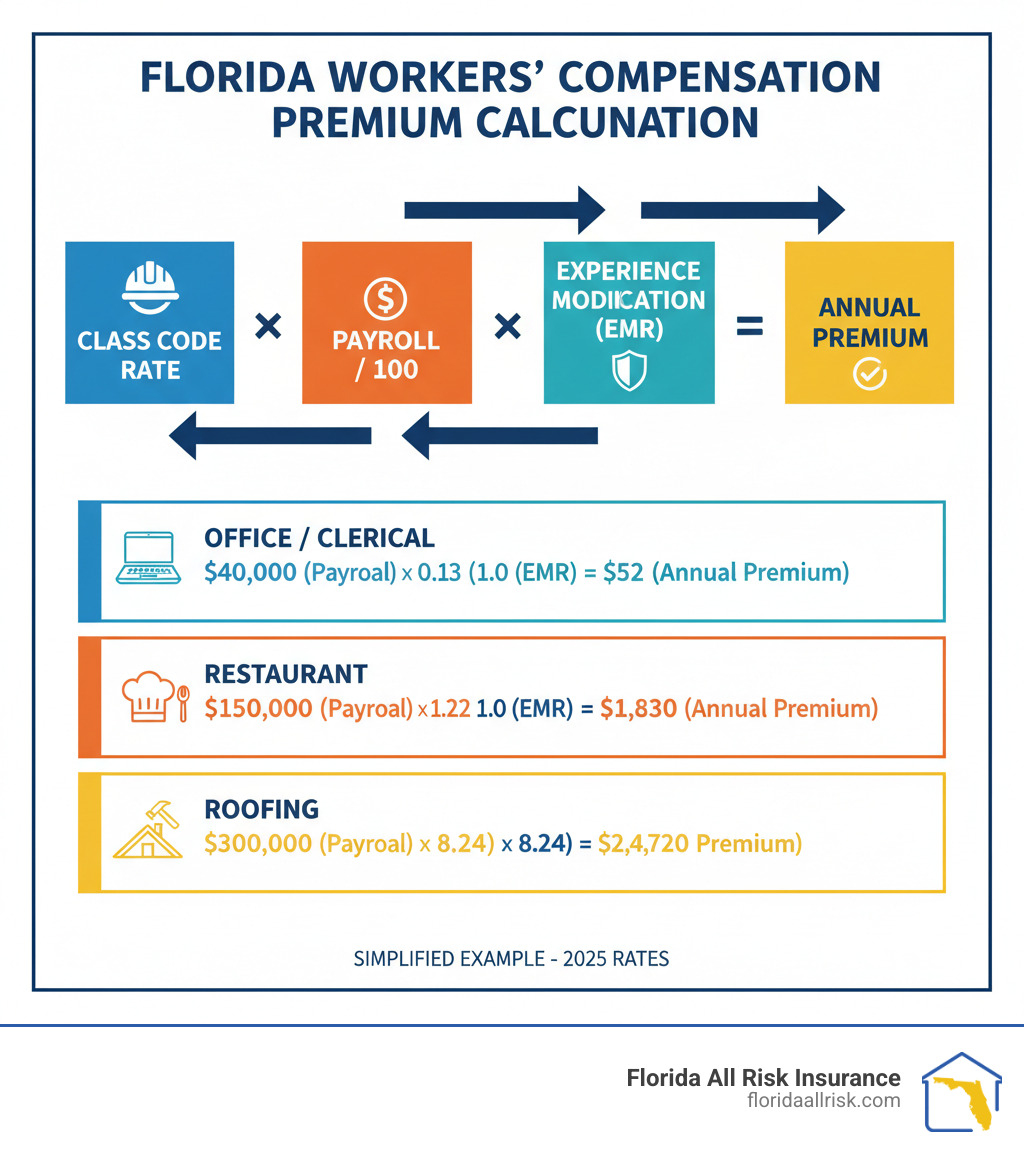
In the sections that follow, we unpack the 2025 change, walk through the premium formula with real-world examples, discuss the broader forces that shape Florida’s rates, and share proven, actionable strategies to lower costs while protecting your team.
Understanding the 2025 Workers Comp Rate Florida Decrease
Floridas 2025 workers comp rate filing was prepared by the National Council on Compensation Insurance (NCCI) and approved by the Florida Office of Insurance Regulation (OIR). The final order authorizes a statewide overall decrease of 1.0% for the voluntary market, effective January 1, 2025. This change applies to new and renewal policies with inception dates on or after that date.
The OIR reached its decision after reviewing NCCIs actuarial analysis of loss experience, claim frequency and severity trends, medical and wage inflation, and the projected impact of recent legislative changes. You can read the official language in the Final Order from the Florida Office of Insurance Regulation, which details the approved filing and effective dates: https://content.govdelivery.com/attachments/FLOIR/2024/11/18/file_attachments/3073435/Final%20Order-NCCI%20Rate%20Filing%20Signed.pdf.
What changedand what didnt
- The average rate level drops by 1.0% for the voluntary market. This is a statewide average; some individual class codes may see increases or larger decreases.
- 2025s maximum weekly compensation increases to $1,295 (from $1,260 in 2024), reflecting growth in the statewide average weekly wage. The minimum remains $20.
- Floridas market remains highly competitive, with multiple carriers actively writing coverage and offering credits for strong safety practices.
- Despite the average decrease, your own premium may move differently depending on your class mix, payroll changes, and EMR.
Why the decrease is modest this year
The headline decrease is smaller than last years 15.1%. One key reason: 2024s Senate Bill 362 (SB 362) increased physician reimbursement from 110% to 175% of Medicare for certain services, improving access to care but adding cost pressure to the system. NCCIs analysis estimated the legislation adds approximately +5.6% to overall system costs. Without SB 362, Floridas experience supported a much larger decrease. After offsetting the legislative impact, the final statewide change settled at 1.0% for 2025.
The long arc: eight straight years of decreases
Florida has now recorded eight consecutive rate reductions, with a cumulative drop of nearly 78% since 2003. This outcome is the product of multiple forces working together over time: statutory reforms, improved safety and risk management, more efficient claims handling, and carrier competition in a healthy market.
Benefits and wage benchmarks you should know
The state ties the maximum weekly benefit to the statewide average weekly wage. Each year, the Bureau of Workforce Statistics produces the figure that drives this adjustment. For 2025, the maximum weekly benefit is $1,295. You can find statutory guidance in Florida Statute 440.12 regarding the calculation and timing of these changes: http://www.leg.state.fl.us/Statutes/index.cfm?Appmode=DisplayStatute&Search_String=&URL=0400-0499/0440/Sections/0440.12.html. General wage and labor data used in these calculations are tracked by the Florida Department of Commerces Bureau of Workforce Statistics: https://www.floridajobs.org/.
Who is affected and when
- New policies effective on or after January 1, 2025, receive the new rates.
- Renewals on or after January 1, 2025, also transition to the new rates.
- Experience-rated accounts will see the combined effect of 2025 rates and their new EMR, which reflects three policy years of claims history (excluding the most recent expiring year).
Bottom line: The 1.0% statewide decrease is another step in a long, positive trend. But the statewide average is just a baselinethe levers that truly change your premium are your class codes, payroll, and EMR. The next section explains how those components come together.
How Your Workers Compensation Premium Is Calculated
Workers compensation pricing follows a straightforward formula. Understanding each component lets you pinpoint exactly where to focus for savings without compromising coverage.
The basic premium formula
(Annual Employee Payroll / $100) x Class Code Rate x Experience Modification Rate (EMR) = Estimated Annual Premium
- Payroll establishes how much exposure you have to workplace injuries.
- The class code rate reflects the risk associated with the work performed.
- The EMR adjusts cost up or down according to your claims record relative to peers.
Sample Florida scenarios for 2025
| Business Type | Annual Payroll | Class Code | 2025 Rate (per $100) | EMR (Example) | Estimated Annual Premium |
|---|---|---|---|---|---|
| Clerical Office | $100,000 | 8810 | $0.13 | 1.0 | $130 |
| Restaurant | $300,000 | 9082 | $1.22 | 1.0 | $3,660 |
| Roofing Contractor | $500,000 | 5551 | $8.24 | 1.2 | $49,440 |
These examples show why classification, payroll, and EMR all matter. Even modest improvements to safety (and thus EMR) can reduce total cost significantly, especially in higher-hazard classes.
Class codes: the backbone of rating
The National Council on Compensation Insurance (NCCI) assigns each job type a class code. Every code carries a rate per $100 of payroll that reflects expected claim costs for that type of work. For 2025 in Florida, examples include:
- Clerical Office (8810): $0.13
- Restaurant (9082): $1.22
- Property Management (9015): $2.74
- Electrical Wiring (5190): $3.23
- Roofing (5551): $8.24
Accurate classification is essential. If an employee regularly performs duties outside a lower-risk class, or if your operations have changed, you could be overpaying or face a bill at audit. A quick periodic review of your chart of accounts, job descriptions, and actual duties can prevent misclassification and unnecessary costs.
Payroll: what counts and what to watch
Carriers rate your policy on estimated annual payroll and reconcile at audit with your actual payroll. Key payroll points for Florida:
- Overtime premium may be excluded. While you still report overtime, the premium portion of overtime pay is typically excluded from rating, which can lower cost for businesses with frequent OT.
- Bonuses, commissions, and certain allowances can be includable for rating. Keep documentation clear so auditors can verify.
- Subcontractors matter. In Florida, if a subcontractor lacks valid workers comp coverage, you may be charged for their payroll (or the carrier may impute payroll) because the exposure ultimately sits with you. Before work begins, collect certificates of insurance and verify coverage is in force.
- Owners and officers. Florida allows certain owners/officers to exclude themselves by filing the required exemption with the state. If you elect to include or exclude, confirm that your policy and payroll estimates reflect your election.
Your Experience Modification Rate (EMR)
The EMR compares your claim experience to peers with similar operations. It typically uses three years of audited premium and loss data (excluding the most recent expiring year). A 1.0 EMR is average:
- Below 1.0: credit EMR (premium decreases)
- Above 1.0: debit EMR (premium increases)
NCCIs formula emphasizes frequency over severity, because frequent small claims are better predictors of future losses than one rare large claim. Preventing small injuries, reporting quickly, and using return-to-work can have outsized influence on your EMR.
Beyond the basics: adjustments and plan features
- Schedule rating. Many carriers apply discretionary credits or debits based on your risk characteristics (e.g., safety culture, premises conditions, management experience). Strong documentation of safety initiatives can support a favorable schedule credit.
- Drug-free workplace and safety program credits. Florida may allow premium credits when you implement a qualifying drug-free workplace program or formal safety program. Ask your agent which credits apply and what documentation carriers require.
- Managed care networks. Using preferred medical providers familiar with occupational injuries can reduce time away from work and claim costs.
- Deductible options and pay-as-you-go. Deductible plans can lower premium if you retain more claim costs. Pay-as-you-go billing ties premium to real-time payroll, improving cash flow and reducing audit surprises.
Premium audit: how to prepare
Every policy is subject to an audit after the term ends. To minimize disruptions and avoid unexpected bills:
- Keep clean, organized payroll records (including overtime breakdowns).
- Maintain job descriptions and time allocations when employees perform different duties under separate class codes.
- Track subcontractor certificates of insurance, work dates, and scope of work.
- Communicate operational changes to your agent mid-term so estimates can be adjusted before audit.
Simple worked examples
- Office expansion. You add two clerical employees mid-year, increasing clerical payroll by $80,000. Using a $0.13 rate and a 1.0 EMR, the additional premium is roughly ($80,000 / 100) x $0.13 x 1.0 = $104 for the rest of the policy term, pro-rated by months in force. Small payroll changes in low-risk classes have minimal impact.
- Restaurant adding delivery drivers. If a restaurant adds in-house delivery drivers, those wages might fall under a different class code with higher risk. Accurate classing from day one prevents a large audit bill.
- Roofing with improved safety. A roofer invests in fall protection and training, cutting claim frequency. Over time, a lower EMR can reduce total premium by thousands per year because the EMR multiplies across all eligible payroll.
Understanding each piece of the formula shows where to focus effort: accurate class codes, careful payroll tracking, and a safety-first culture that protects people and drives the EMR lower over time.
What Shapes Floridas Workers Comp Rates
While your premium is tailored to your operations, the base rates you start from are influenced by a broader ecosystem of data, policy, and economics. Knowing these forces helps you anticipate where costs may move next.
The rate-setting process: NCCI and OIR
Each year, NCCI analyzes carrier-reported losses and expenses, develops an actuarial indication, and files a proposed rate level change with the Florida OIR. The OIR functions as an independent regulator: it reviews the filing for adequacy (to ensure claims can be paid) and for fairness (to avoid excessive or discriminatory rates). Public hearings give stakeholders a chance to comment on the proposed change; information about the annual hearing process is published by OIR: https://floir.com/events/national-council-on-compensation-insurance-public-rate-hearing-2024.
After review, the Insurance Commissioner issues a final order that sets the rate level for the coming year. The 2025 order approves a 1.0% statewide average decrease for the voluntary market.
Legislative changes: balancing access and affordability
Floridas 2024 Senate Bill 362 (SB 362) increased the maximum reimbursement for physicians treating injured workers (from 110% to 175% of Medicare rates for applicable services). The goal: strengthen provider participation and improve timely access to care. NCCIs actuarial review estimated this change adds about +5.6% to system costs. Without SB 362, the underlying loss experience supported a larger average decrease; after factoring it in, the final approved change is a modest 1.0%.
This is a classic balancing act: richer medical reimbursements can improve injured worker outcomes but also push against rate reductions. Policymakers, regulators, and actuaries continually weigh these trade-offs to keep the system sustainable for both employers and employees.
Claims frequency and severity
Florida continues to see improvements in claim frequency, the primary driver behind eight straight years of rate reductions. Safer workplaces, better training, improved equipment, and proactive risk management all play a role. At the same time, the average cost per claim (severity) can rise due to medical inflation, evolving treatment patterns, and wage growth that affects indemnity benefits.
Nationally, the U.S. Bureau of Labor Statistics tracks workplace injury and illness trends that provide helpful context for frequency improvements and industry-specific risk patterns: https://www.bls.gov/iif/.
Wages and benefitshe link to the maximum weekly compensation
Florida indexes the maximum weekly benefit to the statewide average weekly wage, ensuring benefits reflect wage trends. For 2025, that maximum is $1,295. Statutory authority for calculating and applying this figure appears in Florida Statute 440.12: http://www.leg.state.fl.us/Statutes/index.cfm?Appmode=DisplayStatute&Search_String=&URL=0400-0499/0440/Sections/0440.12.html. The Florida Department of Commerces Bureau of Workforce Statistics publishes the wage data underlying these adjustments: https://www.floridajobs.org/.
Medical cost dynamics and care delivery
Beyond the fee schedule changes in SB 362, other factors shape medical costs over time: adoption of evidence-based treatment guidelines, availability of specialists, telemedicine utilization, pricing for pharmaceuticals and durable medical equipment, and return-to-work coordination. Employers who engage early with medical providers, provide clear light-duty options, and communicate consistently often achieve faster recoveries and lower overall costs.
Compliance and enforcement
Floridas regulatory environment encourages broad participation and timely benefit delivery. Compliance efforts help create a level playing field for businesses for example, discouraging improper classing or operating without required coverage. You can find state-level information about workers compensation compliance and resources through the Florida Division of Workers Compensation: https://www.myfloridacfo.com/division/wc.
The takeaway: macro factors set a baseline, but your results are driven by the decisions you make every dayfrom the training you deliver to the speed and quality of your claim reporting and return-to-work practices.
Actionable Strategies to Lower Your Workers’ Comp Costs
A statewide average decrease is welcome, but cost control happens on the ground. The following strategies help you prevent injuries, manage claims effectively, and ensure you’re paying the right amount for the exposure you actually have. The Occupational Safety and Health Administration (OSHA) offers extensive resources for workplace safety programs that can significantly reduce your workers’ compensation costs.

Build a safety program that fits how you really work
One-size-fits-all safety manuals gather dust. Tailor your program to your specific tasks, equipment, and workforce.
- Identify your top five loss drivers and address them first with clear procedures and checklists.
- Train new hires early and often; reinforce safety expectations during toolbox talks or shift huddles.
- Track leading indicators (near-misses, safety observations) not just OSHA-recordable injuries. The sooner hazards are flagged, the easier they are to fix.
- Reward accurate reporting and a speak-up culture. Psychological safety around reporting prevents small issues from becoming claims.
Report incidents immediately and coordinate care
Fast reporting enables early intervention, better medical outcomes, and lower costs.
- Establish a simple, step-by-step reporting process and post it where every employee can see it.
- Use nurse triage or designated clinic partners to guide injured workers to appropriate care quickly.
- Encourage supervisors to complete incident reports the same day and capture photos or diagrams when relevant. Accurate details speed claim handling.
Use return-to-work to reduce disability duration
A structured return-to-work (RTW) program helps employees recover at work rather than at home.
- Maintain a list of light-duty tasks and update it with input from supervisors.
- Communicate with the treating physician about available accommodations so restrictions are clear and realistic.
- Check in regularly with recovering employees and supervisors to monitor progress and resolve obstacles.
Your RTW program lowers indemnity costs (wage replacement) and often reduces medical duration too—a double win for your people and your premium. For complex benefit interactions, including how Medicare can intersect with workers' comp, see our explainer: https://floridaallrisk.com/medicare-workers-compensation/.
Keep payroll and class codes accurate year-round
Avoid audit surprises by maintaining clean records and updating your carrier as operations evolve.
- Review job duties when roles change or when you add services that might trigger a different class code.
- Segregate payroll for employees who regularly perform distinctly separate tasks under different class codes, and maintain time records to support the split.
- Before subcontracted work begins, collect and verify certificates of insurance; build expiration reminders into your calendar. If a subcontractor’s coverage lapses mid-project, you may be charged for their exposure at audit.
For nuances related to subcontractors and independent contractors, see our guide to 1099 workers' comp requirements and best practices: https://floridaallrisk.com/1099-workers-comp-complete-guide/.
Manage your EMR like a multi-year project
Because the EMR looks back over multiple years, consistent practices deliver compounding benefits.
- Focus on preventing small, frequent claims; frequency weighs more heavily than one-off severity.
- Ensure your loss runs are accurate. Work with your adjuster to close claims promptly when appropriate and correct errors.
- Evaluate whether nurse case management, telemedicine, or specialist referrals could improve outcomes on complex claims.
Leverage credits, plan options, and service resources
- Drug-free workplace and safety program credits may be available when your programs meet state and carrier criteria. Ask what documentation is required.
- Explore pay-as-you-go premium billing if your payroll fluctuates. It can reduce cash flow strain and audit adjustments.
- Consider managed care networks to streamline care and strengthen return-to-work.
When to partner with an independent agent
Navigating classification, audits, loss control resources, and market options is easier with a knowledgeable advocate. As an independent agency, we compare multiple carriers, help you interpret class codes, and surface credits and services you might otherwise miss. If you’re new to coverage or have grown beyond a payroll service’s basic plan, you may benefit from a deeper review of your program structure.
For broader context on improving your risk profile, including when a business is viewed as "high risk" and how to address it, explore our resource: https://floridaallrisk.com/high-risk-small-business-insurance-guide/. To understand how an independent agency relationship can benefit you, see: https://floridaallrisk.com/why-you-should-work-with-an-independent-insurance-agency/. If you're starting or scaling a company, our overview of core protections for smaller firms is here: https://floridaallrisk.com/insurance-for-small-businesses/.
The bottom line: pair targeted injury prevention with fast, compassionate claim handling and accurate reporting. That’s the formula for protecting people and lowering costs over time.
Conclusion: Turn a Modest Statewide Decrease into Meaningful Savings
Florida’s -1.0% rate decrease for 2025 is another sign of a strong, stable workers’ comp market. But the statewide average is just the starting line. The biggest levers on your premium are under your control: accurate class codes, diligent payroll practices, a safety-first culture, and a disciplined return-to-work program that shortens disability duration and supports employees through recovery. Over time, that approach shows up in your EMR—and in your bottom line.
If you’d like help pressure-testing your numbers, identifying credits, or prioritizing safety investments, our team in Saint Petersburg is here to share proven, practical guidance drawn from decades of working with Florida employers across industries.
Take action today to optimize your workers’ compensation coverage:
- Get a personalized workers’ comp quote and compare carrier options: https://floridaallrisk.com/get-a-quote/
- Schedule a complimentary workers’ comp policy review to find savings and close gaps: https://floridaallrisk.com/insurance_products/business/
Don’t wait for your next renewal to start saving. Contact Florida All Risk Insurance now to find how much you could save on your 2025 workers’ compensation premium while ensuring comprehensive protection for your employees.
Contact Us
Florida All Risk Insurance
Address: 7710 66th St N, Pinellas Park, FL 33781
Phone: (727) 522-7777
Email: [email protected]

