Why Workers Comp Quotes Florida Are Essential for Your Business
Finding the right Workers comp quotes Florida is a critical step in protecting your business from financial risk and ensuring compliance with state law. For most Florida businesses, workers’ compensation isn’t optional. Whether you run a retail shop with four employees or a construction company with one, the law likely requires you to carry this coverage.
Here’s a quick overview of what you need to know:
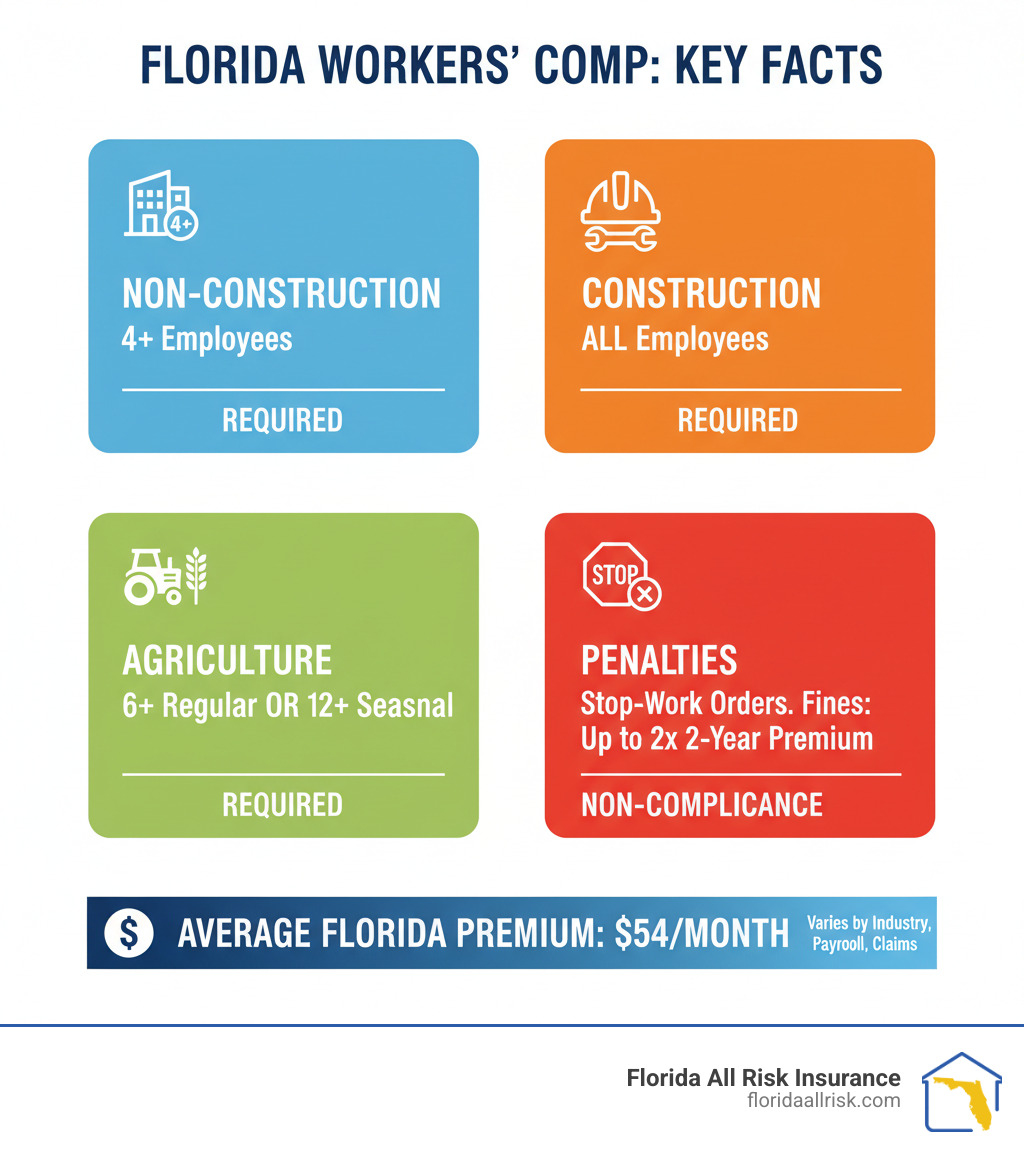
- Who Needs It? Coverage is mandatory for non-construction businesses with 4+ employees, construction businesses with 1+ employee, and agricultural businesses with 6+ regular employees.
- How to Get Quotes: Gather your business info (FEIN, payroll, job duties) and contact an independent insurance agent, who can shop multiple carriers for you.
- What’s the Cost? The average is around $54/month, but your rate will depend on your industry, payroll, and claims history.
Operating without required coverage can lead to severe penalties, including stop-work orders and fines of up to twice the estimated cost of two years of premiums. Beyond legal compliance, workers’ comp protects your business from potentially devastating lawsuits when an employee is injured on the job.
I’m Jason Miller, and for over 20 years, I’ve helped Florida businesses steer complex insurance decisions. At Florida All Risk Insurance, we specialize in finding competitive Workers comp quotes Florida businesses can count on. We work with multiple carriers to ensure you get the right coverage at a price that fits your budget.
Understanding Florida’s Workers’ Comp Requirements
Before you start shopping for workers comp quotes Florida, it’s crucial to understand what the law requires. Knowing these rules can save you from serious headaches and financial consequences. Florida law is specific about who needs coverage, and the requirements vary by industry.
Who is Required to Have Coverage?
Florida’s workers’ compensation laws are designed to protect employees and ensure businesses operate responsibly. The state’s requirements differ by industry:
-
Non-Construction Businesses: If you run a retail store, restaurant, or office, you must carry workers’ comp if you have four or more employees. This includes full-time, part-time, and corporate officers. For more general information, explore our guide to Small Business Insurance in Florida.
-
Construction Industry: Due to higher risks, construction businesses must carry coverage for every single employee. This includes business owners who are corporate officers or LLC members. Primary contractors are also responsible for ensuring their subcontractors have coverage. You can review the common requirements for Florida workers’ compensation to ensure you’re compliant.
-
Agricultural Businesses: You need workers’ compensation if you have six or more regular employees or 12 or more seasonal workers who work for more than 30 days.
-
Out-of-State Employers: If you hire workers in Florida, you must ensure your policy includes Florida coverage.
Are There Any Exemptions?
While many businesses need coverage, some exemptions are available. However, exemptions are not automatic and must be applied for. In non-construction industries, sole proprietors and partners are automatically excluded but can elect to be covered. LLC members or corporate officers may also be eligible to exempt themselves by filing an official application.
In construction, corporate officers or LLC members might be able to apply for an exemption, but the rules are much stricter. To be considered exempt, you must file an application with the Florida Division of Workers’ Compensation. If you are exempt, any work-related medical expenses or lost wages for yourself would come out of your own pocket. For more details, check out our 1099 Workers Comp Complete Guide.
What Are the Penalties for Non-Compliance?
Skipping required workers’ compensation coverage can have devastating consequences. The penalties are severe:
-
Stop-Work Order: The state can force your business to cease all operations immediately until you comply with the law.
-
Financial Penalties: You will face a fine equal to twice the amount you would have paid in premiums for the preceding two-year period.
-
Loss of “Exclusive Remedy” Protection: Workers’ comp normally protects you from being sued by an injured employee. Without it, you lose this protection, opening your business to potentially bankrupting lawsuits. The cost of a single lawsuit can far exceed any premium you might have saved. You can learn more about the details on enforcement and penalties from the state.
The bottom line: non-compliance is a risk not worth taking.
What Florida Workers’ Compensation Actually Covers
When you’re shopping for Workers comp quotes Florida, you’re investing in a comprehensive safety net for your employees and your business. Workers’ compensation is a “no-fault system,” meaning an employee who gets hurt or sick because of their job receives benefits regardless of who was at fault.
Covered Benefits for Employees
When a team member suffers a work-related injury or illness, workers’ comp provides a lifeline. The coverage is designed to address both immediate needs and long-term recovery.
-
Medical Care: Workers’ comp covers all necessary medical treatment related to the workplace incident. This includes emergency room visits, doctor’s appointments, hospital stays, surgery, prescriptions, and physical therapy. The employee receives no bills for this care.
-
Lost Wages: If an employee cannot work due to their injury, the policy replaces a portion of their lost wages. In Florida, injured workers typically receive two-thirds (about 67%) of their average weekly wage, providing a crucial financial bridge during recovery.
-
Disability Benefits: For injuries with lasting effects, disability benefits provide additional support. This can include Temporary Total Disability (TTD) if they can’t work at all, Permanent Impairment Disability (PPD) for a permanent limitation, or Permanent Total Disability (PTD) in the most severe cases.
-
Rehabilitation Services: Vocational rehabilitation, such as retraining or job placement assistance, helps employees adapt if they cannot return to their previous job.
-
Death Benefits: In the most tragic circumstances, workers’ comp provides financial support to the employee’s family. This includes up to $7,500 in funeral expenses and income payments up to a total of $150,000. Our Workers Compensation Insurance Complete Guide goes into more detail about these protections.
Common Exclusions from Coverage
As comprehensive as it is, workers’ comp doesn’t cover every situation. Understanding these boundaries is important when evaluating Workers comp quotes Florida.
- Off-the-Clock Injuries: Injuries that happen outside of work hours or during a regular commute are not covered.
- Intoxication or Drug Use: If an employee is injured while under the influence of alcohol or illegal drugs, benefits may be denied.
- Intentional Actions: Self-inflicted injuries or injuries resulting from starting a fight or willful misconduct are excluded.
- Purely Emotional Injuries: Claims for emotional distress alone, without an accompanying physical workplace injury, are generally not covered.
- Common Illnesses: Catching the flu or a common cold is not a workers’ comp issue unless it can be proven to be a direct result of occupational exposure.
Decoding the Cost: How Premiums Are Calculated
One of the biggest questions for business owners is, “How much will this cost?” While the average cost of workers’ compensation in Florida is around $54 per month, your actual premium depends on a specific formula and several unique factors related to your business.

The Premium Calculation Formula
At its core, the premium calculation follows a standardized formula used by insurance carriers across Florida:
(Annual Payroll / $100) x Classification Rate x Experience Modification Rate (EMR) = Premium
Let’s break this down. Your annual payroll is the base for the calculation. The classification rate is a number assigned to different job types based on their risk level. Finally, the Experience Modification Rate (EMR) is a multiplier that reflects your business’s specific claims history. An EMR below 1.0 gives you a credit, while an EMR above 1.0 results in a surcharge.
Key Factors That Influence Your Workers Comp Quotes in Florida
When you shop for Workers comp quotes Florida, several concrete factors directly influence your premium.
-
Total Payroll: The more you pay your employees, the higher your premium will be, as it reflects greater potential exposure for lost wage claims.
-
Employee Job Duties (Class Codes): This is one of the most impactful factors. The National Council on Compensation Insurance (NCCI) assigns specific codes to every job. A clerical worker has a very low rate, while a roofer has a very high rate. Ensuring employees are classified correctly is crucial for an accurate premium.
-
Claims History (EMR): Your EMR acts as your business’s safety report card. A history of few or no claims will lower your premium, while multiple or severe claims will increase it. This factor typically applies once your annual premium reaches a certain threshold (around $5,000).
-
Industry: High-risk industries like construction, manufacturing, and agriculture will naturally face higher base rates than lower-risk office environments.
-
Insurance Carrier: Different carriers have different appetites for risk and pricing models. An independent agent can shop your policy with multiple carriers to find the one that views your business most favorably.
How to Get Workers Comp Quotes in Florida: A Step-by-Step Guide
Securing the right coverage at the best price requires a methodical approach. Following these steps will streamline the process and help you make an informed decision for your business.
Step 1: Gather Your Business Information
Before you start looking for quotes, have your information ready to make the process faster and more accurate. You will need:
- Business legal name, structure (LLC, Corp, etc.), and all physical locations.
- Federal Employer Identification Number (FEIN).
- Detailed payroll records, broken down by each employee’s job type.
- Clear employee job descriptions (e.g., what they do day-to-day).
- Prior workers’ comp insurance history, including policy numbers and any claims from the past 3-5 years.
- Information on all owners and officers, including their duties and whether they will be covered or exempt.
Step 2: Explore Your Options for Getting a Quote
Once your information is ready, it’s time to explore where to get your Workers comp quotes Florida. You have a few avenues:
-
Independent Insurance Agent (Recommended): This is the approach we take at Florida All Risk Insurance. An independent agent works for you, not a single insurance company. We have relationships with multiple carriers, allowing us to shop your policy to find the best combination of price and coverage. This saves you time and provides expert guidance. Learn more about Why You Should Work With an Independent Insurance Agency.
-
Directly to an Insurance Carrier: You can approach a single insurance company for a quote. However, this limits your options, and you’ll have to repeat the process with multiple carriers to compare rates.
-
Florida Workers’ Compensation Joint Underwriting Association (JUA): This is the “insurer of last resort” for businesses denied coverage in the private market. Premiums are typically higher than those from private carriers.
-
Self-Insurance: This option is only for very large corporations with the financial stability to cover their own claims and requires state approval. It is not a viable option for most small to medium-sized businesses.
Step 3: Understanding Your Workers Comp Quotes in Florida
Receiving multiple Workers comp quotes Florida can be confusing. Don’t just look at the bottom-line price. It’s crucial to compare the details to ensure you’re getting the best value.
-
Premium and Payment Options: Compare the total annual cost. Also, ask about payment plans. Many carriers offer monthly, quarterly, or pay-as-you-go options, which tie your payments to your actual payroll and can greatly help with cash flow.
-
Coverage Limits: While employee benefits are set by law, the Employer’s Liability limits (Part B) can vary. This protects you from lawsuits. Standard limits are often $100,000/$500,000/$100,000, but higher limits offer more protection for a modest cost.
-
Deductibles: Some policies offer a deductible, which can lower your premium. However, this means you pay the first portion of a claim out-of-pocket. Consider your risk tolerance before choosing this option.
-
Exclusions: Review the policy for any unusual exclusions that could leave your business vulnerable. Ask your agent to clarify anything you don’t understand.
Smart Strategies to Lower Your Florida Workers’ Comp Premiums
While some cost factors are fixed, proactive business owners have several opportunities to control and reduce their workers’ compensation expenses. These strategies can directly impact your Workers comp quotes Florida and create a safer, more efficient workplace.
Implement a Formal Safety Program
A robust safety program is the most effective way to reduce claims, which in turn lowers your EMR and premiums. Many insurers offer discounts for businesses with documented safety protocols.
- Conduct and document regular safety training for all employees on topics like proper lifting and equipment operation.
- Perform routine workplace inspections to identify and correct hazards before they cause an accident.
- Create a written safety manual that outlines company policies and procedures. This demonstrates your commitment to a safe workplace and is a key component of overall Business Insurance for Small Businesses.
Manage Claims Effectively
Even with a great safety program, accidents can happen. How you manage a claim can significantly impact its cost and your future premiums.
- Ensure prompt injury reporting. Establish a clear process for employees to report injuries immediately. As an employer, you must then submit documentation to your insurer quickly.
- Establish a return-to-work program. Work with the doctor and insurer to get injured employees back to work in a modified-duty capacity. This reduces lost wage payments and helps the employee’s recovery.
- Maintain open communication with your insurer. Cooperating fully and providing information promptly helps expedite the claim. Our Insurance Products: Business: Workers Comp page offers more insights.
Ensure Accurate Employee Classification
Misclassifying employees is a common and costly mistake. It’s crucial to get this right for fair Workers comp quotes Florida.
- Use the correct NCCI classification codes. Work with your agent to ensure every employee is assigned the right code based on their actual job duties. An office worker should not be classified as a field worker.
- Properly distinguish between W-2 employees and 1099 independent contractors. Misclassifying an employee as a contractor to avoid premiums can lead to significant fines. Our 1099 Workers Comp Complete Guide provides more detail on this complex topic.
Frequently Asked Questions about Florida Workers’ Comp
Workers’ compensation can be complex. Here are clear, simple answers to some of the most common questions we hear from Florida business owners beyond just getting Workers comp quotes Florida.
What is the statute of limitations for filing a claim in Florida?
There are two important deadlines. An employee must report a work-related injury to their employer within 30 days of the incident. After that, the employee generally has two years from the date of injury to formally file a claim petition, according to the Florida statute of limitations. Missing the 30-day reporting window can jeopardize the claim.
Do I need workers’ comp for part-time or 1099 employees?
Part-time employees absolutely count toward your employee total. For a non-construction business, if you have three full-time workers and one part-time worker, you have hit the four-employee threshold and need coverage.
For 1099 independent contractors, you generally do not need to provide coverage, as they are considered self-employed. However, the state has strict rules defining a contractor versus an employee. Misclassifying an employee as a contractor can lead to severe penalties. In the construction industry, you are responsible for ensuring any subcontractor you hire has their own workers’ comp coverage. Our 1099 Workers Comp Complete Guide explains this in detail.
What is an Experience Modification Rate (EMR)?
An Experience Modification Rate (EMR), or Mod Rate, is a multiplier that adjusts your workers’ comp premium based on your company’s specific claims history compared to the average for your industry. It’s essentially your business’s safety report card.
- An EMR of 1.0 is the industry average.
- An EMR below 1.0 (e.g., 0.85) means your safety record is better than average, and you receive a premium credit (a discount).
- An EMR above 1.0 (e.g., 1.20) means your claims history is worse than average, and you pay a premium debit (a surcharge).
A good EMR not only saves you money but can also help you qualify for more contracts, as many general contractors require subcontractors to have an EMR of 1.0 or lower.
Conclusion: Partnering with an Expert for Peace of Mind
Securing the right workers’ compensation coverage is more than a legal requirement—it’s a fundamental part of protecting your business and your team. By understanding Florida’s rules, how premiums are calculated, and how to implement safety strategies, you can create a safer workplace and protect your financial future.
We know that navigating the market to find the best Workers comp quotes Florida can feel overwhelming. The rules are complex, and the stakes are high. This is why so many Florida business owners choose to work with an experienced, independent insurance agency.
At Florida All Risk Insurance, we act as your advocate. As an independent agency based in St. Petersburg, we aren’t tied to a single insurance company. We have relationships with a wide range of quality carriers, allowing us to shop your policy to find the coverage that truly fits your business needs and budget. We do the heavy lifting of gathering quotes and explaining the differences, so you can make an informed decision with confidence.
Your business is your livelihood. Protecting it with the right workers’ compensation coverage is one of the smartest investments you can make. Don’t leave this crucial decision to chance.
Ready to protect your team and your business? Don’t delay – secure your peace of mind today!
Contact Florida All Risk Insurance today for a free, no-obligation workers’ comp quote! We’ll take the time to understand your business and find coverage that gives you confidence at a competitive price.
Learn more about how we help St. Petersburg businesses thrive with comprehensive business insurance solutions.
Contact Us:
Florida All Risk Insurance
Address: 700 94th Ave N Ste. 300, Saint Petersburg, FL 33702
Phone: (727) 577-4700
Email: [email protected]