Understanding Florida’s SR-22 Certificate: What Every Driver Should Know
If your license was suspended or revoked in Florida and you received a notice to file an SR-22, you’re not alone. Many drivers search for “What is SR22 Florida” and discover that it isn’t a special insurance policy at all—it’s a certificate your insurer files with the state to prove you carry the required liability coverage. Understanding what the SR-22 does, who needs it, and how to maintain it will help you reinstate and protect your driving privileges without surprises.
Quick Answer: SR-22 in Florida
- What it is: A Certificate of Financial Responsibility your insurer files with the Florida Highway Safety and Motor Vehicles (FLHSMV); it is not a separate insurance policy
- Who needs it: Drivers designated as high risk due to violations such as DUI, driving without insurance, at-fault crashes without insurance, reckless driving, or excessive points leading to suspension
- Minimum coverage required: 10/20/10 liability limits ($10,000 bodily injury per person / $20,000 per accident / $10,000 property damage), in addition to required PIP
- How long: Commonly 3 years of continuous, uninterrupted coverage; a lapse can re-trigger suspension and may reset the clock
- Filing fee: Generally $15–$25 (one time), plus higher premiums driven by the underlying violation, not by the SR-22 form itself
- How it’s filed: Your insurer submits the SR-22 electronically to FLHSMV
Many people assume they must “buy SR-22 insurance.” In reality, the SR-22 is an electronic filing added to a standard auto insurance policy that meets the mandated limits. Your insurer attaches the SR-22 to your policy and notifies the state you are compliant. If coverage cancels or lapses, the insurer must notify the FLHSMV—usually via an SR-26 cancellation notice—promptly, which can cause immediate suspension until you’re reinstated with a new filing.
Why Florida Uses the SR-22
Florida requires proof of financial responsibility after certain violations to ensure that higher-risk drivers consistently maintain insurance. The SR-22 allows regulators to monitor coverage in real time: if your policy lapses, the state is alerted and can suspend your license and registration quickly. This system protects the public, encourages compliance, and helps you document your return to good standing.
What the SR-22 Covers (and What It Doesn’t)
- The filing itself doesn’t pay claims; your underlying auto policy does.
- The SR-22 confirms that your policy includes the minimum required liability coverage. For SR-22 cases, that means Bodily Injury Liability (BIL) of at least 10/20 plus $10,000 in Property Damage Liability (PDL) and Personal Injury Protection (PIP) as required under Florida’s no-fault system.
- You can raise your limits above the minimums for better protection—often wise, given current medical and repair costs.
Where to Start
- Review your notice from FLHSMV or the court to determine whether you need an SR-22 or the stricter FR-44 (used for DUI/DWI cases).
- Contact an agency experienced with Florida financial responsibility filings. They can help you select a compliant policy, manage the electronic filing, and explain reinstatement steps.
Misconceptions to Avoid
- “SR-22 insurance” is not a separate product. It’s a certificate attached to a regular policy.
- The certificate is not what raises your premium. Your rate increases primarily stem from the violation(s) that triggered the requirement.
- You must keep coverage continuous for the full required term. Any lapse can cause automatic suspension and additional fees.
At Florida All Risk Insurance, we’ve helped drivers across Florida complete SR-22 filings quickly and maintain coverage through the full term. If you’re unsure whether you need SR-22 or FR-44, or whether a non-owner policy could be a fit, the sections below explain each option and the steps to stay compliant.
How This Guide Is Organized
- What the SR-22 is and why Florida requires it
- Which violations typically trigger SR-22 and how FR-44 differs
- Step-by-step filing, reinstatement, and removal
- Costs, coverages, and ways to keep premiums in check
- Special cases like non-owner policies and moving in or out of state
What Is an SR-22 in Florida and Why Is It Required?
Defining the SR-22: Proof of Financial Responsibility
An SR-22 is a Certificate of Financial Responsibility. It is filed by your insurer with the Florida Highway Safety and Motor Vehicles (FLHSMV) to verify you carry state-mandated liability coverage. You can’t purchase a standalone “SR-22 policy.” Instead, the SR-22 filing is added to a compliant auto policy, and your insurer submits it electronically. This digital filing allows the state to monitor your insurance status in near real-time. If your coverage ends for any reason, your insurer is required to alert the state immediately, which can trigger prompt penalties and license suspension.
For a closer look at the form and what information is included, see our SR-22 overview at https://floridaallrisk.com/sr22-form/.
Legal Background and the State’s Interest
Florida’s financial responsibility laws require proof that certain drivers carry adequate insurance to protect others on the road. The SR-22 is one mechanism the state uses to enforce these laws for drivers with higher-risk histories. The state’s interest is rooted in public safety and financial protection for all motorists. By mandating that high-risk drivers prove their insurance status, Florida aims to reduce the number of uninsured drivers and ensure that victims of accidents have a source of financial recovery for their injuries and property damage. For statutory context, review Florida Statutes Chapter 324 (Financial Responsibility) at https://www.leg.state.fl.us/statutes/index.cfm?Appmode=DisplayStatute&URL=0300-0399/0324/0324.html and the FLHSMV’s overview of financial responsibility at https://www.flhsmv.gov/insurance/financial-responsibility/.
Common Violations That Trigger an SR-22 Requirement
Although your individual notice from FLHSMV controls, these are frequent reasons the state requires an SR-22:
- DUI or DWI convictions: Florida generally requires an FR-44—not an SR-22—for DUI/DWI. The FR-44 has much higher liability limits; see the FR-44 section below.
- Driving without insurance: This is often discovered during a traffic stop for another violation, leading to compounded penalties.
- At-fault crashes while uninsured: The state takes this combination very seriously, as it directly results in uncovered damages for other parties.
- Reckless driving or major moving violations: A conviction for reckless driving demonstrates a significant disregard for safety that warrants state monitoring.
- Excessive points leading to suspension: A pattern of violations can trigger the requirement. For example, accumulating 12 points in 12 months, 18 points in 18 months, or 24 points in 36 months will result in a license suspension and likely an SR-22 requirement upon reinstatement.
- Hardship or restricted license: Reinstatement under restrictions often includes filing requirements to ensure compliance while privileges are limited.
- Court-ordered or administrative suspensions: Including unsatisfied judgments from a crash or certain non-driving suspensions that still affect your license.
For more on driving without insurance, see our practical guide at https://floridaallrisk.com/driving-without-insurance-florida-guide/.
SR-22 vs. Your Insurance Policy
The SR-22 doesn’t change how your policy pays claims; it certifies that your policy meets minimum liability requirements. You can carry higher limits than the minimums to better protect your savings and future earnings. If you currently have only PIP and PDL, you’ll need to add Bodily Injury Liability (BIL) to meet SR-22 standards.
How the State Monitors Compliance
- Your insurer files the SR-22 with FLHSMV, confirming your coverage.
- If you cancel or your policy lapses for nonpayment, the insurer files an SR-26 cancellation notice.
- Upon receiving an SR-26, the state can automatically suspend your license and registration.
- Reinstatement typically requires new proof of insurance with a fresh SR-22 filing and payment of reinstatement fees.
When in doubt, you can check the status of your Florida driver license and any outstanding requirements using the official FLHSMV Driver License Check at https://services.flhsmv.gov/DLCheck/.
Quick Note on FR-44 for DUI/DWI
Florida uses a separate filing—the FR-44—for DUI and DWI. It requires much higher liability limits than an SR-22, which substantially affects premiums. If your notice specifies FR-44, an SR-22 won’t satisfy the requirement. We cover the FR-44 in detail in the Special Cases section.
The SR-22 Process: From Filing to Removal
Navigating the SR-22 from start to finish is manageable if you understand the steps, timelines, and potential pitfalls. This section walks you through obtaining the filing, reinstating your license, maintaining continuous coverage, and finally removing the requirement.
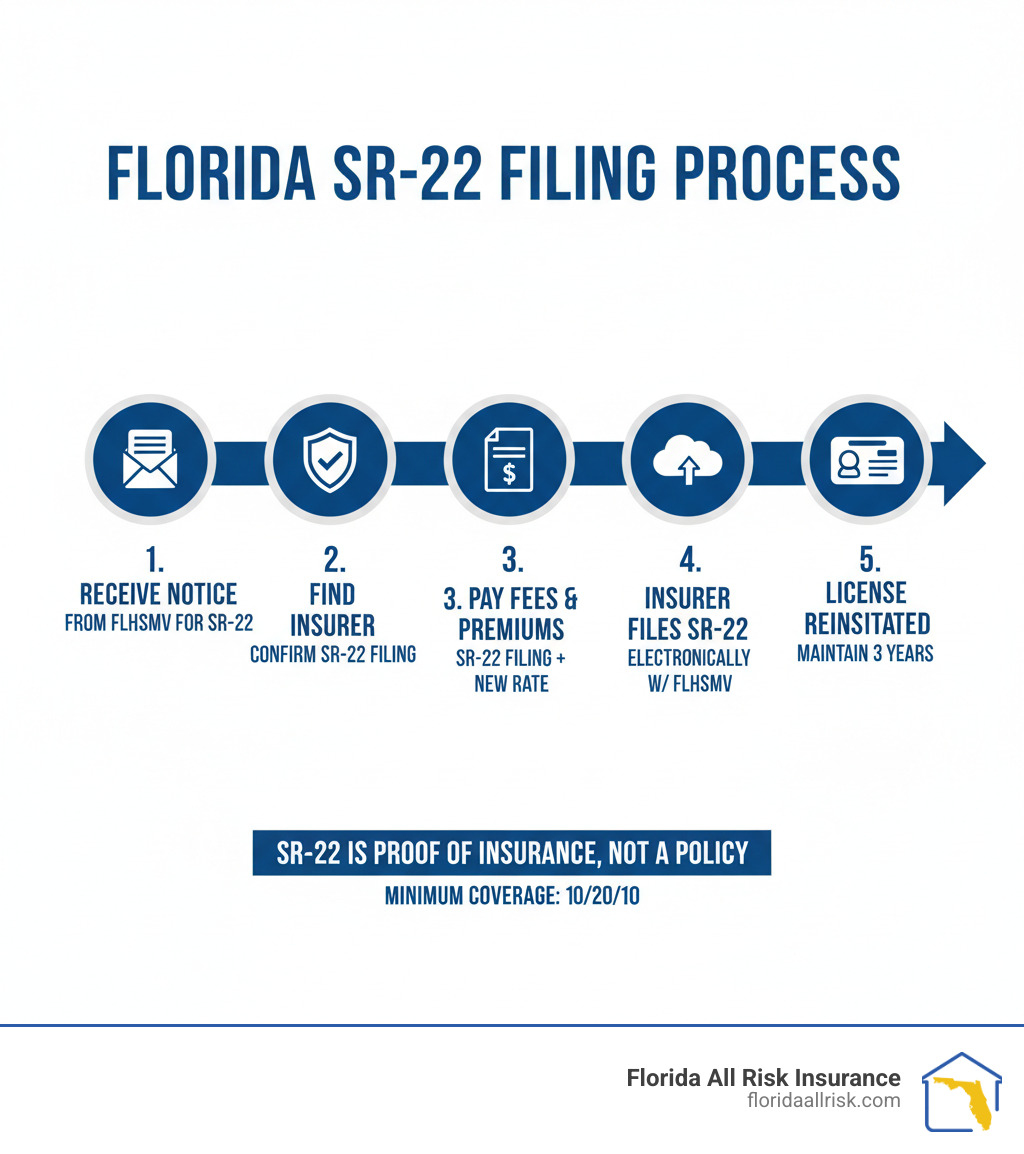
How to Obtain an SR-22 Certificate in Florida
- Confirm your requirement: Review your FLHSMV or court notice and determine whether you need SR-22 or FR-44. If unsure, check your status and requirements online via the official FLHSMV Driver License Check at https://services.flhsmv.gov/DLCheck/.
- Choose a willing insurer: Not all carriers file SR-22s. An independent agency can compare multiple companies that do. If you're shopping, our Florida auto insurance guide can help at https://floridaallrisk.com/florida-auto-insurance-quotes-guide/.
- Purchase a qualifying policy: Your policy must include the required minimum liability limits for SR-22 filings (10/20/10) plus PIP.
- Insurer files the SR-22: Your insurer submits the filing electronically to FLHSMV. You’ll generally receive confirmation for your records.
- Pay the filing fee: Expect a one-time $15–$25 administrative fee from your insurer.
Once the filing is accepted, you can proceed with reinstatement steps. This often involves more than just the SR-22. You may also need to pay outstanding court fines, complete a required driver improvement course (such as a 12-hour Advanced Driver Improvement or ADI course), and pay a license reinstatement fee to the FLHSMV. You can handle many reinstatement tasks through the FLHSMV MyDMV Portal at https://mydmvportal.flhsmv.gov/.
For additional information on SR-22 requirements across different states, the National Association of Insurance Commissioners provides a helpful overview of financial responsibility laws and filing requirements.

Reinstatement and How Long You Must Maintain the SR-22
In Florida, most SR-22 requirements last three consecutive years. In many cases, the clock begins on your reinstatement date (check your notice for your exact start date). The essential rule is continuous coverage:
- No gaps: Even a short lapse for nonpayment can trigger immediate suspension.
- Policy changes: Switching insurers is allowed, but the new company must file an SR-22 before the old one cancels to avoid a coverage gap.
- Moving: If you move out of Florida while the requirement is active, Florida can still require proof of financial responsibility. You may need to maintain a policy and filing that satisfies Florida’s rules, even if insured in another state. This often means finding an insurer in your new state that can make an “out-of-state filing” on your behalf to the FLHSMV. Confirm requirements before you move.
You can verify your SR-22 status and view outstanding requirements from time to time using the FLHSMV Driver License Check at https://services.flhsmv.gov/DLCheck/.
Penalties for Lapsing or Canceling SR-22 Coverage
Allowing your SR-22-backed policy to lapse is the fastest way to extend your restrictions and increase your costs:
- SR-26 cancellation notice: Your insurer must notify FLHSMV immediately if your policy cancels or lapses. There is no grace period.
- Automatic suspension: Your license and vehicle registration can be suspended promptly upon receipt of the SR-26.
- Reinstatement fees: Expect to pay reinstatement fees that commonly range from $150 to $500. For a first-time lapse, the fee might be $150, but it increases to $250 for a second lapse and $500 for subsequent lapses within a three-year period.
- Resetting the timeline: A lapse often resets your SR-22 term, effectively starting a new three-year period from the date you reinstate coverage. This is a critical and costly consequence to avoid.
Pro tip: Set up automatic payments with a backup payment method. Also consider signing up for billing alerts via text or email so you get immediate notice if a payment fails.
How SR-22 Requirements End (Removal)
When you complete the full term without any lapses and have no outstanding requirements, the SR-22 can be removed. Generally, the process looks like this:
- Verify your end date using the FLHSMV Driver License Check tools.
- Ask your insurer to remove the SR-22 filing at your renewal after the end date.
- Consider re-shopping your insurance. Completing the SR-22 period and keeping a clean record going forward can improve your rates over time.
Keep documentation for your records in case you need to prove your compliance later.
Understanding the Costs and Coverage Requirements
While the filing fee for an SR-22 is small, most drivers focus on the bigger question: how much will my insurance cost? The answer depends on your violation, driving history, location, vehicle, coverage limits, and more. Here’s what to know and how to manage the impact.
Minimum Insurance Requirements for SR-22 in Florida
Florida is a no-fault state, which means drivers carry Personal Injury Protection (PIP) to cover their own initial medical expenses regardless of fault. A standard policy also includes Property Damage Liability (PDL). When an SR-22 is required, you must add Bodily Injury Liability (BIL) to at least the minimum levels below:
- $10,000 BIL per person
- $20,000 BIL per accident
- $10,000 PDL per accident
These 10/20/10 limits satisfy the SR-22 filing requirement, but many drivers choose higher limits—such as 25/50/25, 50/100/50, or more—because medical bills and vehicle repair costs can easily exceed the minimums. Higher limits cost more in premium but offer significantly more protection for your assets. Learn more about selecting appropriate liability limits at https://floridaallrisk.com/liability-car-insurance-florida/.
Optional coverages worth considering:
- Uninsured/Underinsured Motorist (UM/UIM): Helps if you’re hit by someone with no or too little BIL coverage.
- Collision and Comprehensive: Covers damage to your vehicle from crashes, theft, vandalism, weather, or animal strikes.
- Rental reimbursement and roadside assistance: Convenience features that can make an interruption easier to handle.
The True Cost of an SR-22: Filing Fee vs. Premium Changes
- Filing fee: A one-time administrative cost of roughly $15–$25 charged by your insurer to file the SR-22.
- Premium impact: Your rate increase largely stems from the underlying violation (e.g., DUI, reckless driving, at-fault crash without insurance), not from the SR-22 itself. The violation places you into a higher-risk category in the eyes of insurers, and this reclassification is the primary driver of higher premiums. Expect higher premiums for the duration of the SR-22 requirement and often for a few years after.
DUI-related cases (usually requiring FR-44) tend to produce the biggest increases because they also mandate much higher liability limits. Other violations may still result in a substantial bump but vary by insurer and personal factors like age, claims history, credit-based insurance score (where applicable), garaging location, and vehicle type. The violation will remain on your driving record for several years, impacting your insurance score and rates even after the SR-22 filing is no longer required. For more on how rates are determined, see https://floridaallrisk.com/auto-insurance-rates-florida/.
Practical Ways to Keep Costs Manageable
- Shop smart: Different insurers price risk differently, especially in high-risk categories. Independent agencies can compare multiple carriers for you.
- Consider a non-owner policy if you don’t own a vehicle: It often costs less and still satisfies the SR-22 requirement. See https://floridaallrisk.com/non-owner-car-insurance-florida-guide/.
- Optimize deductibles and coverages: Raising a collision/comprehensive deductible can lower premiums, but keep it affordable for your budget.
- Maintain a clean record: Tickets and at-fault crashes during the SR-22 period can drive rates higher and extend the time you are considered high-risk.
- Keep continuous coverage: A lapse can cause suspension and may reset your SR-22 timeline, costing far more in the long run.
- Ask about telematics or usage-based programs: Safe driving discounts may help offset some of the cost.
- Re-shop annually: As more time passes since your violation, your risk profile improves. Shopping for new quotes every year can help you find a lower rate sooner.
Paying Over Time and Avoiding Lapses
If your budget is tight, ask your insurer about installment options. Many carriers offer monthly billing with automatic payments. Set reminders a few days before the due date and consider keeping a small cushion in the funding account. Because a lapse can restart the clock and trigger fees, prevention is almost always cheaper than reinstatement.
Special Cases: FR-44 and Non-Owner SR-22 Insurance
Florida uses more than one type of financial responsibility filing. Two scenarios come up often: FR-44 for DUI/DWI and non-owner SR-22 policies for drivers without a car.
SR-22 vs. FR-44: What’s the Difference in Florida?
The FR-44 is a certificate of financial responsibility used specifically for DUI and DWI convictions. It requires substantially higher liability limits than the SR-22:
- FR-44: 100/300/50 (BIL $100,000 per person / $300,000 per accident; PDL $50,000 per accident)
- SR-22: 10/20/10 (BIL $10,000 per person / $20,000 per accident; PDL $10,000 per accident)
Because FR-44 mandates much higher limits and is associated with serious violations, it can be much more expensive. The requirement typically lasts three years, and—just like the SR-22—any lapse can trigger an SR-26 notice and immediate suspension. For a deeper dive into DUI insurance considerations, visit https://floridaallrisk.com/dui-auto-insurance-florida/ and review the FLHSMV’s official DUI FAQs at https://www.flhsmv.gov/driver-licenses-id-cards/education-courses/dui-and-iid/dui-faqs/.
For the state’s broader financial responsibility rules, see the FLHSMV’s guidance at https://www.flhsmv.gov/insurance/financial-responsibility/.
What If I Need an SR-22 but Don’t Own a Vehicle?
A non-owner SR-22 policy—sometimes called an operator’s policy—allows drivers who don’t own a car to satisfy the state’s filing requirement. It generally provides liability coverage when you drive vehicles you do not own, like borrowed or rental cars.
Key points:
- It is typically less expensive than a standard policy because it doesn’t insure a specific car and doesn’t include physical damage coverage for a vehicle.
- It won’t cover vehicles you own or regularly use, and it typically won’t extend to vehicles in your household. For example, if you live with a spouse or parent and have regular access to their car, a non-owner policy may not be appropriate; you might need to be added to their policy instead.
- It provides the coverage necessary for your insurer to file the SR-22 with the FLHSMV on your behalf.
A non-owner policy is an excellent fit for individuals who rely on public transportation or ridesharing but want to maintain a valid license and occasionally drive a borrowed car. It’s also a solution for those who drive a company-provided vehicle for work but need to fulfill a personal license requirement.
To learn more about eligibility and when a non-owner policy makes sense, see our guide at https://floridaallrisk.com/non-owner-car-insurance-florida-guide/.
Moving, Switching Insurers, and Other Special Situations
- Moving out of Florida: If you have an active Florida SR-22/FR-44 requirement, Florida can still require proof of financial responsibility even after you relocate. Coordinate with your new-state insurer and verify that your filing remains valid for Florida’s rules.
- Switching insurers: You can switch carriers to save money, but avoid a gap. Have the new insurer file the SR-22 before the old policy cancels.
- Adding or removing vehicles: Your filing stays with your policy, not a specific car. If you change vehicles, make sure your policy updates and remains in force.
- Court orders vs. administrative requirements: Follow the most stringent requirement on your notice. If a court imposes additional conditions, you must satisfy both.
Common Mistakes to Avoid
- Treating SR-22 as optional: Driving without the filing in place when required can lead to suspension and additional penalties.
- Missing payments: Even a brief lapse can reset your timeline, add fees, and complicate reinstatement.
- Filing the wrong certificate: If your notice requires FR-44, an SR-22 won’t satisfy it. Confirm your requirement before purchasing a policy.
- Assuming the requirement ends automatically: Verify your end date, then request removal of the filing at renewal so you don’t pay for it longer than necessary.
Conclusion
An SR-22 in Florida is simply proof—filed by your insurer—that you carry the liability coverage the state requires after certain violations. It’s not a standalone policy, and it doesn’t pay claims by itself. The core challenge is staying continuously insured for the full term, typically three years, and avoiding any lapse that could restart the clock. Understanding the process—how to file, reinstate, maintain, and eventually remove the requirement—helps you move forward with confidence.
Key takeaways:
- The SR-22 is a certificate tied to your policy, not a type of insurance.
- Most requirements last three years of uninterrupted coverage.
- Florida uses FR-44, with higher limits, for DUI/DWI cases.
- Non-owner policies can satisfy SR-22 requirements if you don’t own a car.
- The biggest cost driver is the underlying violation, not the filing fee.
- Monitoring your status and setting up payment safeguards can prevent costly lapses.
If you need help choosing between a standard SR-22 policy and a non-owner option, understanding whether you need SR-22 or FR-44, or finding a budget-friendly solution that meets Florida’s rules, Florida All Risk Insurance is here to help.
Strong CTAs:
- Call now for same-day SR-22 filing and guidance: (727) 353-1100
- Get a fast, no-obligation Florida SR-22 quote online: https://floridaallrisk.com/florida-auto-insurance-quotes-guide/
Contact Us
Florida All Risk Insurance
- Address: 7901 4th St N, Suite 300, Saint Petersburg, FL 33702
- Phone: (727) 353-1100
- Email: [email protected]
Have questions about SR-22, FR-44, or non-owner policies? We’re happy to walk you through your options and file your certificate quickly so you can get back on the road with confidence.