

What is a group health insurance plan: 2025 Smart Guide
Understanding Group Health Insurance Plans in Florida
Many Florida business owners and employees ask, what is a group health insurance plan? In simple terms, it’s a single insurance policy purchased by an employer or organization that provides medical coverage to its eligible employees and their dependents. By covering multiple people under one master policy, the insurance risk is spread across the entire group, which typically results in lower premiums and more accessible coverage.
Key Features of Group Health Insurance Plans:
- Master Policy: A single contract covers all eligible members of the group.
- Shared Costs: Employers typically contribute a significant portion of the premiums, often 50% or more.
- Risk Pooling: The financial risk is spread across all group members, leading to more stable and affordable rates.
- Guaranteed Issue: Eligible employees and dependents are generally guaranteed coverage regardless of pre-existing health conditions.
- Tax Benefits: Employee premium contributions are often made with pre-tax dollars, lowering their taxable income.
Employer-sponsored health insurance is the most common form of health coverage in the United States. According to recent data, 48.7% of the U.S. population was covered by employer-provided group health insurance in 2022. The average annual premium for an individual plan was $8,435 (with employees paying 17%), while family coverage averaged $23,968 (with employees paying 29%).
In Florida’s competitive job market, offering major medical insurance is no longer just a perk—it’s a necessity for attracting and retaining top talent. Group health plans provide significant advantages over individual coverage, making them a cornerstone of a strong employee benefits package.
What is a Group Health Insurance Plan and How Does It Work?
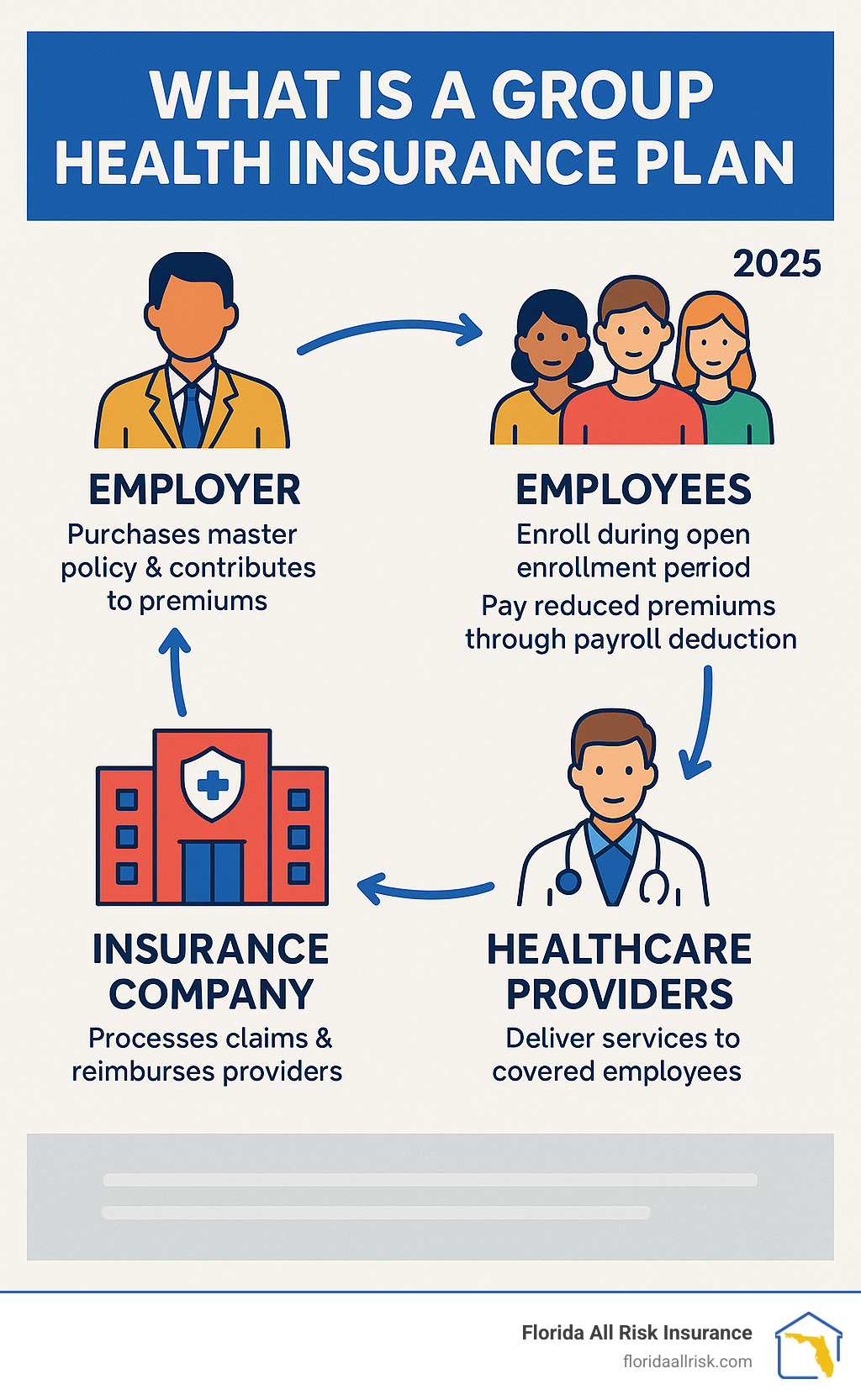
Group health insurance is a system designed to spread the financial risk of healthcare across a large pool of people, making coverage more affordable and accessible. This is accomplished through a single “master policy” that an employer purchases to cover its entire eligible workforce, rather than each person needing an individual contract.

Defining Group Health Insurance
So, what is a group health insurance plan? It is formally defined as an employee welfare benefit plan established or maintained by an employer or employee organization (or both) to provide medical care for participants and their dependents. This can be done directly or through insurance, reimbursement, or other means. The core concept is the master policy, which pools a group of individuals together. This risk-spreading principle is what allows insurers to offer lower per-person premiums and often more comprehensive benefits compared to what an individual might find on their own. For a precise technical definition, you can refer to the Group Health Plan – Glossary on Healthcare.gov.
The Mechanics of a Group Plan
The process of a group health insurance plan begins with the employer, who selects a plan or a range of plan options from an insurance carrier. This decision is based on the company’s budget, the needs of its employees, and the desired level of coverage.
Once the plans are selected, there is an annual “open enrollment” period when employees can sign up for coverage or make changes to their current selections. New hires are typically given a special enrollment period shortly after they start. During enrollment, employees choose a plan and decide whether to add eligible family members, such as a spouse or children.
A key advantage is how premiums are handled. The employer pays a portion of the premium, and the employee’s share is deducted from their paycheck, usually on a pre-tax basis. This lowers the employee’s taxable income, providing an additional financial benefit. When a covered individual receives medical care, the provider submits a claim to the insurance company. The insurer processes the claim according to the plan’s terms, and the member pays any remaining costs like deductibles or co-payments.
Eligibility and Participation Requirements
To offer a group health insurance plan, a business must meet certain eligibility and participation requirements, which can vary by state and insurance carrier. Generally, a business must have at least one full-time equivalent employee who is not the owner or the owner’s spouse. This ensures a legitimate “group” exists for coverage.
Individual employees must also meet eligibility criteria, which usually means working a minimum number of hours per week (often 30 or more) to be considered full-time. A waiting period, typically up to 90 days, may apply before a new employee’s coverage becomes effective. This helps manage costs by preventing individuals from signing up only when they have an immediate health need.
Most plans allow employees to add dependents, including spouses and children up to age 26, for an additional premium. To ensure a balanced risk pool, insurers often require a minimum participation rate, meaning a certain percentage of eligible employees (typically 70-75%) must enroll in the plan for it to be offered.
The Advantages of Group Health Insurance
Offering a group health insurance plan is a strategic business decision that provides significant advantages for both employers and employees. It helps cultivate a healthier, more stable workforce and serves as a powerful tool for attracting and retaining top talent in a competitive market.

Benefits for Employers
For employers, the benefits of a group health insurance plan are extensive. In today’s job market, a comprehensive health plan is an expected part of a competitive compensation package. It is essential for attracting and retaining skilled workers, which in turn reduces employee turnover and the associated costs of recruitment and training.
A healthy workforce is a productive workforce. When employees have access to quality healthcare, they are less likely to miss work due to illness and are better equipped to manage chronic conditions. This leads to higher productivity, improved morale, and a more positive work environment.
There are also direct financial incentives. Employer-paid premiums for group health insurance are generally 100% tax-deductible as a business expense. Furthermore, eligible small businesses may qualify for the Small Business Health Care Tax Credit, which can cover up to 50% of the premiums they pay, providing substantial cost savings.
Benefits for Employees
From an employee’s standpoint, a group health insurance plan provides significant financial security and peace of mind. The most direct benefit is lower healthcare costs. Because risk is spread across the group, premiums are typically more affordable than those for individual plans. Employers also cover a large portion of the cost. In 2023, the average annual premium for an individual group plan was $8,435, with the employee contributing only 17% of that amount. For family coverage, the average cost was $23,968, with the employee paying 29%.
Beyond the cost savings, employees gain access to comprehensive plans that might be expensive or difficult to obtain on the individual market. Group plans are also “guaranteed issue,” which means coverage cannot be denied or priced higher due to pre-existing health conditions, a critical protection established by the Affordable Care Act (ACA).
The convenience of employer-sponsored plans is another major benefit. Premiums are automatically deducted from paychecks, simplifying payments. Employees also have a clear point of contact, such as an HR department or benefits administrator, to help with questions and enrollment.
Exploring the Types and Coverage of Group Health Plans
When selecting a group health insurance plan, businesses can choose from various plan structures, network types, and funding models. Understanding these options is key to designing a benefits package that meets the needs of your employees while fitting within your company’s budget.

Common Types of Group Health Insurance Plans
When considering what is a group health insurance plan in practice, several common structures emerge, each offering a different balance of cost, flexibility, and access to care.
- Health Maintenance Organization (HMO): These plans often have lower premiums and out-of-pocket costs. They require members to use doctors, hospitals, and specialists within their network and to select a Primary Care Physician (PCP) who manages their care and provides referrals.
- Preferred Provider Organization (PPO): PPO plans offer more flexibility. Members can see both in-network and out-of-network providers without a referral, but their costs will be lower if they stay in-network. This flexibility typically comes with higher premiums.
- Point of Service (POS): A POS plan is a hybrid of an HMO and a PPO. Like an HMO, it requires a PCP referral to see specialists. Like a PPO, it allows members to seek care out-of-network, but at a higher cost.
- Exclusive Provider Organization (EPO): An EPO is similar to a PPO in that referrals are not usually needed to see specialists. However, like an HMO, it generally does not cover care received from out-of-network providers except in emergencies.
- High-Deductible Health Plan (HDHP): HDHPs have lower monthly premiums but higher annual deductibles. They are designed to be paired with a Health Savings Account (HSA), a powerful, tax-advantaged savings vehicle. HSAs offer a unique triple tax benefit: contributions are tax-deductible, the funds grow tax-free, and withdrawals for qualified medical expenses are also tax-free. Both employees and employers can contribute to an HSA (up to annual limits set by the IRS), and the funds belong to the employee, rolling over year after year and remaining with them even if they change jobs.
Plans can also be categorized by their funding model. In a fully-insured plan, the employer pays a fixed premium to an insurance company, which then assumes the financial risk for all employee claims. In a self-funded plan, a larger employer assumes the financial risk itself and pays for employee claims directly, often hiring a third-party administrator (TPA) to manage the plan.
What Does Group Health Insurance Typically Cover?
Any group health insurance plan offered today must comply with the Affordable Care Act (ACA), which mandates coverage for a set of ten “Essential Health Benefits.” This ensures that all plans provide a comprehensive baseline of care.
These essential benefits include:
- Ambulatory patient services (outpatient care)
- Emergency services
- Hospitalization (for inpatient care, like surgery)
- Maternity and newborn care
- Mental health and substance use disorder services, including behavioral health treatment
- Prescription drugs
- Rehabilitative and habilitative services and devices (to help with recovery or skill development)
- Laboratory services
- Preventive and wellness services and chronic disease management
- Pediatric services, including oral and vision care for children
Supplemental and Ancillary Benefits
While the ACA’s Essential Health Benefits provide a strong foundation, many employers choose to build a more robust and competitive benefits package by offering ancillary insurance products. These are separate policies that cover services not typically included in a standard medical plan.
- Dental Insurance: Covers a portion of the costs for preventive care (cleanings, exams), basic procedures (fillings, extractions), and major procedures (crowns, bridges, root canals). Offering dental coverage encourages employees to maintain their oral health, which is linked to overall health.
- Vision Insurance: Helps cover the costs of routine eye exams, prescription glasses, and contact lenses. This is a highly valued benefit, especially in a workforce that spends significant time in front of screens.
- Life Insurance: A group life insurance policy provides a financial payout to an employee’s beneficiaries in the event of their death. Employers often provide a base amount of coverage (e.g., one year’s salary) at no cost to the employee, with the option to purchase additional coverage.
- Disability Insurance: This provides income replacement if an employee is unable to work due to a non-work-related illness or injury. Short-term disability (STD) covers a period typically up to six months, while long-term disability (LTD) can provide benefits for many years, or even until retirement.
Group vs. Individual Plans: Key Differences and Regulations
To fully understand what is a group health insurance plan, it’s helpful to compare it to individual health insurance. The two types of coverage differ in key areas, including cost, plan options, enrollment rules, and the regulations that govern them.
Comparing Group Health Insurance to Individual Plans
Here’s a breakdown of how group and individual health plans typically compare:
- Cost: Group plans are usually less expensive for the individual. Employers share the cost of the premium, and the employee’s portion is often paid with pre-tax dollars, providing a tax advantage. With an individual plan, the person is responsible for the entire premium, although income-based subsidies may be available through the Health Insurance Marketplace.
- Plan Choice: In a group plan, the employer selects the plan options available to employees. This simplifies the choice but limits the selection. The individual market offers a much wider array of plans from various carriers, allowing for more personalized selection.
- Enrollment: Group plan enrollment occurs during an annual open enrollment period set by the employer or during a special enrollment period following a qualifying life event (like getting hired). Individual plan enrollment is restricted to the annual Open Enrollment Period unless a person qualifies for a Special Enrollment Period.
- Underwriting: Group health plans feature guaranteed issue, meaning eligible employees cannot be denied coverage or charged more based on pre-existing conditions. The risk is spread across the group. Individual plans purchased on the Marketplace also have this protection, but some off-Marketplace plans may have different underwriting rules.
- Portability: Group health insurance is tied to employment; if you leave your job, you typically lose your coverage. An individual plan is fully portable and stays with you regardless of your employment status.
What happens to your group health insurance plan if you leave your job?
Losing your job doesn’t mean you have to lose your health coverage immediately. Several options are available:
- COBRA: The Consolidated Omnibus Budget Reconciliation Act is a federal law that allows eligible employees and their dependents to continue their group health coverage for a limited time (typically 18 months) after leaving a job. However, the individual must pay the full premium plus a small administrative fee, which can be costly. You can find more details on COBRA coverage at Healthcare.gov.
- Special Enrollment Period (SEP): Losing job-based health coverage is a qualifying life event that triggers a Special Enrollment Period. This allows you to enroll in a new individual plan through the Health Insurance Marketplace outside of the standard open enrollment window. You may also qualify for subsidies to lower your costs.
- Spouse’s Plan: If your spouse has group coverage through their job, losing your own coverage may make you eligible to enroll in their plan under a Special Enrollment Period.
What regulations govern a group health insurance plan?
A group health insurance plan operates under a framework of federal and state laws designed to protect consumers.
- ERISA (Employee Retirement Income Security Act): This foundational federal law sets minimum standards for most voluntarily established health and welfare benefit plans in private industry. ERISA does not require employers to offer a plan, but it regulates the operation of plans that are established. Its key protections for participants include requiring plans to provide participants with important information about the plan features and funding (via a Summary Plan Description, or SPD), setting minimum standards for participation, vesting, and funding, establishing fiduciary responsibilities for those who manage and control plan assets, and creating a grievance and appeals process for participants to get benefits from their plans. It is primarily enforced by the U.S. Department of Labor.
- ACA (Affordable Care Act): The ACA introduced sweeping reforms to the U.S. healthcare system. Key provisions affecting group plans include the requirement to cover essential health benefits, the prohibition of denials or higher charges for pre-existing conditions, and the elimination of lifetime and annual dollar limits on essential coverage. It also established the employer shared responsibility provision (the ’employer mandate’), which requires applicable large employers (ALEs) — generally those with 50 or more full-time equivalent employees — to offer affordable, minimum-value health coverage to their full-time employees or face a potential penalty.
- HIPAA (Health Insurance Portability and Accountability Act): HIPAA provides data privacy and security provisions to keep your health information safe. It also includes provisions that limit exclusions for pre-existing conditions and prevent discrimination based on health status.
- IRS (Internal Revenue Service): The tax code, as enforced by the Internal Revenue Service (IRS), governs the tax advantages of group health plans, such as the tax-deductibility of employer premiums and the pre-tax treatment of employee contributions.
Frequently Asked Questions
As you explore what is a group health insurance plan, some common questions often arise. Here are clear, straightforward answers to some of the most frequent inquiries we receive.
How many employees are needed for a group health insurance plan?
The minimum number of employees required for a group health insurance plan can vary by state and insurance carrier. In Florida and most other states, a business can typically qualify for a small group plan with as few as two employees. Generally, at least one of these must be a common-law W-2 employee who is not the business owner or the owner’s spouse. This ensures a true “group” exists.
For insurance purposes, a “small employer” is usually defined as having between 1 and 50 full-time equivalent employees. Businesses with more than 50 employees are considered “large employers,” and may be subject to different rules, such as the ACA’s employer mandate. It’s always best to confirm the specific requirements in your state.
Can a self-employed person get group health insurance?
Generally, a self-employed individual with no employees is considered a “group of one” and is not eligible to purchase a group health insurance plan. Group plans are designed to spread risk across multiple people. A sole proprietor without any W-2 employees would typically need to purchase an individual health insurance plan, either through the Health Insurance Marketplace or directly from a carrier.
However, there is an important exception. If a self-employed individual hires at least one W-2 employee who is not their spouse, the business may then become eligible to offer a group health plan. In that case, the business owner could enroll in the plan alongside their employee.
Are employer contributions to health insurance taxable?
One of the most significant financial advantages of a group health insurance plan is its favorable tax treatment for both employers and employees.
For employees, the contributions an employer makes toward their health insurance premiums are not considered taxable income. This means employees receive a valuable benefit without it increasing their tax burden, making it a form of tax-free compensation.
For employers, the premiums they pay for their employees’ group health insurance are generally considered a tax-deductible business expense. This can significantly lower the company’s overall tax liability. This mutually beneficial tax structure makes offering a group health plan a financially sound decision for all parties involved.
What is a ‘qualifying life event’ (QLE)?
A qualifying life event is a change in your situation that allows you to make changes to your health insurance coverage outside of the regular open enrollment period. This creates a Special Enrollment Period (SEP), usually lasting 30 or 60 days, during which you can enroll in a plan or change your existing one. Common QLEs for group health plans include:
- Loss of other health coverage: For example, losing coverage from a spouse’s plan or aging off a parent’s plan at age 26.
- Changes in household: Getting married, divorced, having a baby, or adopting a child.
- Changes in employment: A change in employment status for you or your spouse that affects benefits eligibility.
- Change in residence: Moving to a new location where your current plan is not available.
It’s crucial to notify your employer or benefits administrator as soon as a QLE occurs, as the window to make changes is limited.
What is the difference between a deductible, copay, and coinsurance?
These are the three main types of out-of-pocket costs you’ll encounter with a health plan. Understanding them is key to predicting your healthcare expenses.
- Deductible: This is the fixed amount you must pay for covered health care services before your insurance plan starts to pay. For example, if your deductible is $1,000, you pay the first $1,000 of covered services yourself. After you meet your deductible, you usually only pay a copayment or coinsurance for covered services, and the insurance company pays the rest.
- Copayment (Copay): This is a fixed amount (for example, $30) you pay for a specific covered health care service, such as a doctor’s visit or a prescription drug. Copays are typically paid at the time of service and often do not count toward your deductible.
- Coinsurance: This is your share of the costs of a covered health care service, calculated as a percentage (for example, 20%) of the allowed amount for the service. You start paying coinsurance after you’ve met your deductible. For example, if your plan’s allowed amount for an office visit is $100 and your coinsurance is 20%, you pay $20 once your deductible is met. The insurance company pays the remaining 80%.
Navigating Your Group Health Insurance Options
Understanding what is a group health insurance plan is more than just learning about an employee benefit; it’s about recognizing a strategic tool for business success. It is an investment that yields returns in the health of your team and the strength of your company. Offering a quality group health plan is a proven way to attract and retain top talent, improve productivity, and leverage valuable tax advantages. When employees feel secure in their health coverage, they are more engaged, loyal, and focused.
We know that navigating health insurance can be complex, with its many regulations, plan types, and carrier options. That’s where Florida All Risk Insurance can help. As an independent agency based in St. Petersburg, Florida, we specialize in helping businesses across the state simplify the process of finding and managing group health plans.
We believe that every business is unique. We avoid a one-size-fits-all approach, instead taking the time to understand your company’s specific needs, budget, and workforce. Because we are an independent agency, we partner with a wide range of top-rated insurance carriers, giving you access to a diverse selection of plans and competitive rates.
Our goal is to help you build a plan that is not only compliant but also genuinely supports your employees’ well-being and aligns with your business objectives. Don’t let the complexity of health insurance be a barrier. We are here to provide clarity and help you find the right coverage with confidence. Ready to see what’s possible? Explore our Group Health Insurance Plans or dive deeper into your group health coverage options to find the perfect fit for your business.
Contact Us
We hope this guide has helped clarify what is a group health insurance plan and how it can benefit your business and employees. Navigating health benefits can be challenging, but you don’t have to do it alone.
Here at Florida All Risk Insurance, we are committed to helping Florida businesses thrive. Based in Saint Petersburg, FL, our experienced team is ready to provide the personalized guidance you need. Whether you have more questions or are ready to get a quote, we’re here to help.
Florida All Risk Insurance
Address: 123 Main Street, Suite 400, Saint Petersburg, FL 33701
Phone: (727) 828-1234
Email: [email protected]

