What is a fully insured group health plan 101: Easy Guide
Understanding Fully Insured Group Health Plans: The Foundation of Employee Benefits
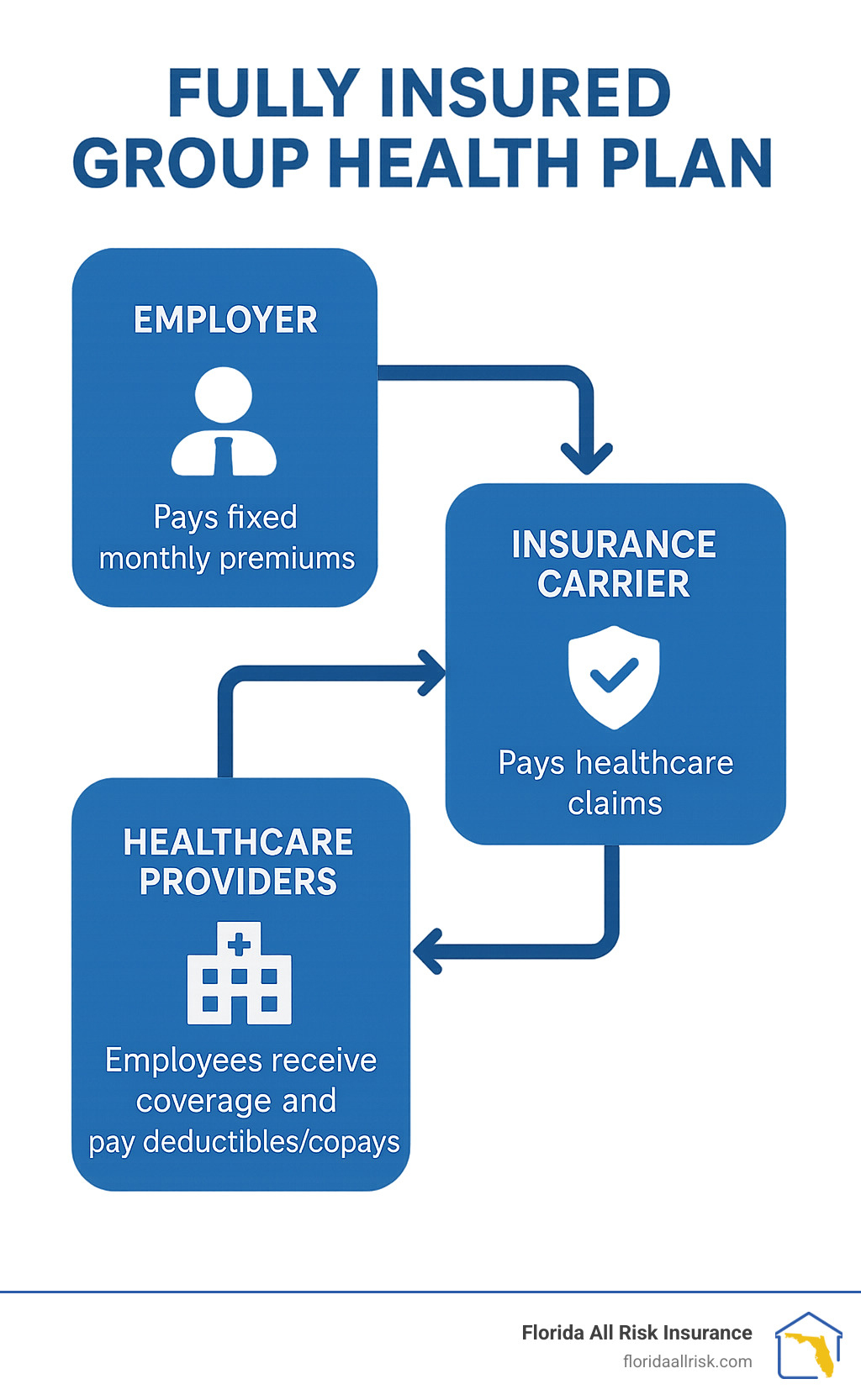
What is a fully insured group health plan? This question sits at the heart of employee benefits decisions for thousands of Florida businesses. A fully insured group health plan is a traditional health insurance arrangement where an employer pays fixed monthly premiums to an insurance carrier, and the carrier assumes all financial risk for employee healthcare claims.
Quick Answer:
- Definition: Employer-sponsored health coverage where an insurance company assumes all financial risk
- How it works: Employer pays fixed premiums, insurer pays all claims
- Best for: Small to medium businesses seeking predictable costs and minimal administrative burden
- Key benefit: Protection from catastrophic healthcare expenses
- Primary responsibility: Insurance carrier handles claims, compliance, and provider networks
The world of employee health benefits can feel overwhelming for business owners. With healthcare costs continuing to rise and complex regulations to steer, choosing the right coverage model requires careful consideration. According to recent industry data, 86% of employers with under 50 employees have a traditional-style (fully-insured) plan, making it the most common approach to group health coverage.
For Florida businesses, understanding this foundational insurance model is crucial. Whether you’re a startup looking to attract top talent or an established company reviewing your benefits strategy, fully insured plans offer a time-tested approach. While they may not be the perfect fit for every business, they provide an excellent foundation for companies prioritizing predictability and administrative simplicity.
What is a Fully Insured Group Health Plan?
When Florida business owners ask “what is a fully insured group health plan?”, they’re looking at the most straightforward path to employee health benefits. In this traditional model, your business pays a set monthly premium to an insurance carrier, and in return, the carrier takes on all the financial risk for your employees’ medical claims.
This arrangement functions like a classic insurance contract. The insurance carrier handles everything from processing claims to managing provider networks, which frees your HR team to focus on other priorities. The primary appeal of fully insured plans is their predictability. Your monthly premium remains the same regardless of claim volume, from routine check-ups to emergency surgeries. This stability simplifies budgeting for business owners who need to know their exact health benefit costs each month.
For small to mid-sized Florida businesses, this model offers particular appeal. The 86% of employers with under 50 employees who choose traditional fully insured plans do so because this approach provides comprehensive business health insurance without the complexity of self-funding. The third-party insurance carrier becomes a partner in providing healthcare coverage, taking on the administrative burden that could otherwise overwhelm smaller companies.
How a Fully Insured Plan Works: The Mechanics
Understanding the step-by-step process of fully insured health plans helps business owners see why this model works so well for many Florida companies.

Plan selection is the first step. Working with a broker or carrier, you’ll explore options like HMOs, PPOs, and EPOs, each with different network structures and cost-sharing arrangements.
Premium calculation is based on your enrolled member count, employee ages, geographic location, and chosen benefits. New groups often receive standard “book rates,” while established groups see their claims history factored into renewal pricing.
Employee enrollment is when team members select their coverage level (e.g., individual, family) based on their needs and your company’s offerings.
Monthly premium payments are your primary financial commitment. This fixed amount is consistent throughout the policy year, regardless of claim volume, eliminating cost surprises. Changes in enrollment will adjust the total premium.
Claims processing is handled entirely by the insurance company. When employees receive medical care, providers submit claims directly to the insurer, which manages all adjudication according to policy terms.
Employee cost-sharing involves three key components. Deductibles are the amount employees pay before insurance begins. Copayments are fixed amounts for specific services. Coinsurance is a percentage of costs employees pay after meeting their deductible.
Annual renewal is when you renegotiate with your insurer based on your group’s claims experience, healthcare cost trends, and market conditions. This process can significantly impact future premiums.
What are the responsibilities under a fully insured group health plan?
The division of responsibilities in fully insured group health plans creates a clear framework for all parties.
Employer responsibilities include timely premium payments to maintain coverage, accurate enrollment tracking for additions and departures, clear plan communication to keep employees informed, and maintaining current employee census data for proper billing. Proactively seeking the best available plans at renewal is also a key duty.
Employee responsibilities involve financial participation and personal accountability. Most employees contribute to premiums through payroll deductions, typically paying about 17% for individual coverage and 27% for family coverage. They are also responsible for understanding plan details to make informed decisions and paying out-of-pocket costs like deductibles, copayments, and coinsurance.
Insurance carrier responsibilities encompass the core functions of the plan. They assume all financial risk for covered claims. They handle claims adjudication, processing all claims from providers and members. They are responsible for provider network management, maintaining relationships with doctors and hospitals. Finally, they ensure regulatory compliance with all state and federal insurance requirements.
The Pros and Cons of a Fully Insured Approach
To understand what is a fully insured group health plan, it’s crucial to weigh its benefits and drawbacks. The decision between a fully insured plan and other models depends on your company’s comfort with risk, financial situation, and administrative capacity. Making an informed choice means finding the right balance between financial stability and cost control.
Advantages for Employers and Employees
Many Florida businesses gravitate toward fully insured plans for several compelling reasons.

Predictable costs are a primary advantage. Employers pay a fixed monthly premium, eliminating the risk of unexpected bills from high claims. This financial stability simplifies budgeting significantly compared to models with variable monthly costs.
Reduced financial risk is a core feature. If an employee incurs hundreds of thousands of dollars in treatment costs, the insurance company is liable, not your business. This protection from catastrophic claims provides significant peace of mind.
Administrative simplicity is a major benefit, particularly for small businesses. The insurance carrier handles claims processing, provider network management, and member inquiries, reducing the burden on your HR team.
Compliance assurance is another valuable aspect. The insurer is responsible for ensuring the plan meets state insurance mandates and helps with federal regulations like HIPAA, navigating a complex and ever-changing legal landscape on your behalf.
Employee security is improved through access to established provider networks and clear benefit structures. A recognizable insurance card and predictable copayments provide a sense of stability for your team.
Disadvantages and Potential Drawbacks
Despite the benefits, fully insured plans have limitations that businesses must consider.
Higher costs are the trade-off for convenience and risk transfer. Premiums include the insurer’s administrative costs, profit margins, and state premium taxes. Data shows that fully insured plan premiums have risen significantly in recent years, often outpacing general inflation.
Lack of flexibility is a key drawback. You choose from a carrier’s pre-set menu of plan designs with limited customization. It’s difficult to tailor benefits to your specific workforce, such as adjusting coverage for services they may not need or value.
No data or surplus return means you have limited insight into your group’s health trends. If your employees have a healthy year with low claims, the insurance company retains the surplus premium. You also don’t receive detailed claims data that could inform wellness initiatives.
State-mandated benefits can increase costs. While the insurer handles compliance, these mandates may force you to pay for coverage that your employees do not need or want, adding to the overall premium cost.
The bottom line is that fully insured plans trade cost and flexibility for predictability and simplicity. For many Florida businesses, especially smaller ones, that’s a trade worth making. But understanding these limitations helps you make a more informed decision.
Fully Insured vs. Self-Insured: A Head-to-Head Comparison
When you’re exploring what is a fully insured group health plan, the conversation naturally leads to comparing it with its primary alternative: self-insured plans. As your business grows, understanding these funding alternatives becomes increasingly important. The choice hinges on your risk tolerance, company size, and desired level of control. For a deeper look at the alternative, it is helpful to understand the mechanics of a self-funded group health insurance plan.
Understanding the Core Differences
The two models differ significantly in practice. A fully insured plan is like renting a furnished apartment, while a self-insured plan is like buying and furnishing a house.
| Feature | Fully Insured | Self-Insured |
|---|---|---|
| Financial Risk | Assumed by insurance carrier | Assumed by employer (often with stop-loss) |
| Cost Structure | Fixed monthly premiums | Variable monthly costs (claims + admin fees) |
| Plan Flexibility | Limited customization | High customization (design and benefits) |
| Administrative Burden | Low (handled by insurer) | High (managed by employer or TPA) |
| Primary Regulation | State and Federal (ACA) | Federal (ERISA) only |
- Risk Assumption: In a fully insured plan, the insurance carrier assumes all financial risk. With a self-insured plan, the employer assumes the risk, though most purchase stop-loss insurance to protect against catastrophic claims.
- Cash Flow Predictability: Fully insured plans offer stable, predictable monthly premiums, simplifying budgeting. Self-insured plans have variable costs based on actual claims, which can fluctuate significantly.
- Cost Control Potential: While stable, fully insured plans may have higher long-term costs. Self-insured plans offer potential savings if claims are managed effectively and the workforce is healthy.
- Plan Design Customization: Self-insured plans allow for complete customization of benefits to match workforce needs. Fully insured plans offer limited flexibility, with employers choosing from pre-designed packages.
- Data Transparency: Self-insured employers receive detailed claims data, enabling them to identify health trends and implement targeted wellness programs. This data is typically not available in fully insured plans.
- Surplus Retention: In a self-insured plan, any funds remaining in the claims account at year-end belong to the employer. In a fully insured plan, the insurer keeps all unused premiums as profit.
Regulatory Landscape: State Rules vs. Federal ERISA
The regulatory environment is a critical, often overlooked, differentiator.
Fully insured plans are subject to dual regulation. They are primarily regulated by state departments of insurance and must comply with state-specific benefit mandates (e.g., coverage for certain services). They are also subject to federal laws like the Affordable Care Act (ACA).
Self-insured plans fall under the exclusive jurisdiction of the federal Employee Retirement Income Security Act (ERISA) of 1974. This federal oversight exempts them from state insurance mandates, which is a major advantage for multi-state employers seeking to offer uniform benefits across all locations.
Who is Each Plan Best Suited For?
Different models work best for different types of organizations.
Fully insured plans are typically ideal for:
- Small businesses with under 50 employees, which benefit from cost predictability and low administrative burden.
- Startups that need to focus on growth rather than managing complex healthcare benefits.
- Risk-averse organizations that prefer to transfer the financial risk of catastrophic claims to an insurer.
- Companies seeking budget stability with fixed monthly healthcare costs.
Self-insured plans generally make sense for:
- Large corporations (500+ employees) with the financial reserves to handle fluctuating claims.
- Companies with healthy workforces that can benefit from lower-than-average claims costs.
- Businesses desiring plan customization to create benefits packages custom to their employees.
- Organizations focused on long-term cost control that can use data to implement effective wellness and cost-containment strategies.
Many successful companies start with a fully insured plan and transition to a self-insured model as they grow and their needs evolve.
Cost Considerations and Alternatives
Financial planning for health benefits requires understanding the total cost of coverage and exploring modern insurance solutions. Healthcare expenses are a significant budget item, and the cost of what is a fully insured group health plan involves more than just the monthly premium.
What are the cost considerations for a fully insured group health plan?
When budgeting for a fully insured plan, several components make up your total healthcare investment.
Premium determination varies by business size. For small groups, insurers use “modified community rating,” basing rates on factors like employee ages and location, but not on the group’s specific health conditions. Large groups face “experience rating,” where their past claims history heavily influences future premiums.
The average annual premium for employer-sponsored health insurance is a significant investment. According to KFF Employer Health Benefits Survey data, these costs continue to rise, making cost management a priority for all businesses.
Employee contributions are essential for managing these costs. Most businesses share the premium cost with employees. On average, employees contribute about 17% of the premium for individual coverage and 27% for family coverage through payroll deductions.
Tax implications offer some financial relief. Employer-paid premiums are generally tax-deductible as a business expense. Employees can also make their contributions on a pre-tax basis through a Section 125 Cafeteria Plan, which lowers their taxable income.
Exploring Alternatives to Traditional Fully Insured Plans
The evolving healthcare landscape offers innovative benefit strategies that provide more flexibility and cost control than traditional plans. These alternatives can provide affordable employee health insurance options for Florida businesses.
Level-funded plans offer a middle ground between fully insured and self-insured models. Employers pay a fixed monthly amount that covers administrative fees, stop-loss insurance, and a claims fund. These plans provide the budget predictability of a fully insured model but operate like a self-funded plan. If claims are lower than projected, the employer may receive a refund from the unused claims fund at the end of the year.
Health Reimbursement Arrangements (HRAs) use a defined contribution approach. Instead of buying a group plan, the employer provides tax-free funds for employees to use on qualifying medical expenses, including individual health insurance premiums.
-
The Individual Coverage HRA (ICHRA) provides employees a tax-free allowance to buy their own health insurance on the individual marketplace. This offers maximum flexibility for employees to choose plans that fit their needs. ICHRAs provide the cost predictability of a fixed allowance without the direct claims risk of traditional self-insured plans.
-
The Qualified Small Employer HRA (QSEHRA) is designed for companies with fewer than 50 full-time employees that do not offer a group health plan. It allows employers to reimburse employees for medical expenses and individual plan premiums up to an annual limit set by the IRS.
These alternatives provide varying degrees of risk and flexibility, allowing businesses to tailor their benefits approach more precisely than a one-size-fits-all fully insured plan.
Conclusion: Choosing the Right Path for Your Business
Navigating the complexities of employee health benefits is no small feat, but understanding what is a fully insured group health plan is a crucial first step. We’ve seen that these plans offer a compelling blend of predictability, security, and administrative ease, making them a cornerstone for many businesses, especially smaller ones. They provide peace of mind by transferring financial risk to the insurer and simplifying the day-to-day management of benefits.
However, we also recognize their limitations, such as higher costs and less flexibility compared to other funding models. The choice between fully insured, self-insured, or a hybrid alternative ultimately hinges on our business’s unique risk tolerance, financial capacity, and the specific needs of our workforce.
As independent agents at Florida All Risk Insurance, based right here in St. Petersburg, Florida, we pride ourselves on helping businesses like yours steer these intricate decisions. We offer comprehensive insurance solutions, extending beyond health plans to homeowners, flood, auto, and commercial insurance. Our expertise allows us to provide personalized service and access to a wide range of carriers, ensuring custom coverage and competitive rates. We believe that choosing the right path for your health benefits is about aligning your plan with your business goals, your risk tolerance, and your employees’ needs. It’s about finding that sweet spot where cost-effectiveness meets comprehensive care.
For more insights on how to choose a group health insurance plan or to discuss your specific needs, our team is ready to assist. To explore the best group health insurance products for your Florida-based business and get a personalized assessment, contact our expert team today.
Contact Us
Ready to find the perfect health insurance solution for your Florida business? We’d love to help you steer fully insured group health plans and explore all your options.
At Florida All Risk Insurance, we understand that choosing the right health benefits can feel overwhelming. That’s why we’re here to make the process as smooth as possible. Our team of experienced professionals has been helping businesses across Florida find comprehensive insurance solutions that fit their unique needs and budgets.
Whether you’re still wondering what is a fully insured group health plan means for your specific situation, or you’re ready to get quotes and compare options, we’re just a phone call or email away. We believe in building relationships, not just selling policies – and that means taking the time to understand your business, your employees, and your goals.
Florida All Risk Insurance
Address: Saint Petersburg, FL
Phone: (727) 345-6600
Email: [email protected]
Don’t let the complexity of health insurance hold you back from providing great benefits to your team. Reach out today, and let’s start a conversation about how we can help protect what matters most to your business.