

What are group health insurance plans: 2025 Ultimate Guide
Understanding What Are Group Health Insurance Plans
What are group health insurance plans? They are health policies purchased by an employer or organization to offer medical benefits to employees and their families. This system forms the bedrock of healthcare access for a significant portion of the American population. Unlike individual insurance, which assesses risk on a person-by-person basis, group plans leverage the power of collective bargaining and risk pooling. By spreading the potential for high medical costs across a diverse group of people—some healthy, some needing care—insurers can offer more stable and affordable premiums. This model is not just a benefit; it’s a cornerstone of the U.S. economy, with the Kaiser Family Foundation reporting that 48.7% of the U.S. population relies on employer-sponsored coverage.
For businesses, offering a group plan is a strategic move to attract and retain top talent in a competitive labor market. For employees, it often represents the only feasible path to high-quality, comprehensive medical coverage for themselves and their loved ones.
Key features that define group health insurance include:
- Employer-sponsored coverage: Offered as a core component of a company’s compensation and benefits package.
- Shared costs: A financial partnership where the employer typically pays a significant portion of the premium, with the employee covering the rest.
- Risk pooling: The fundamental principle where the risk of high healthcare costs is spread across all members of the group, preventing individuals from being penalized for their health status.
- Pre-tax savings: Employee premium contributions are deducted from their paycheck before taxes are calculated, lowering their overall taxable income.
- Family coverage: The ability to extend coverage to legal spouses and dependent children, usually up to age 26.
- Guaranteed issue: No medical exams or health questionnaires are required for an employee to enroll, eliminating the risk of being denied coverage due to pre-existing conditions.
The core advantage is the cost-sharing model. By negotiating a single master contract for the entire group, employers can secure much lower rates from insurance companies than an individual could find on their own. This guide will provide a comprehensive walkthrough of everything you need to know about these essential plans.

What are group health insurance plans terms simplified:
- how to choose a group health insurance plan
- what is a self funded group health insurance plan
- Small business employee benefits
What Are Group Health Insurance Plans and How Do They Work?
Group health insurance plans are a partnership between employers and employees that makes quality healthcare accessible and affordable. For businesses, they are a powerful tool for attracting and retaining talent, while employees gain access to medical coverage that would be significantly more expensive if purchased individually.
Defining What Are Group Health Insurance Plans
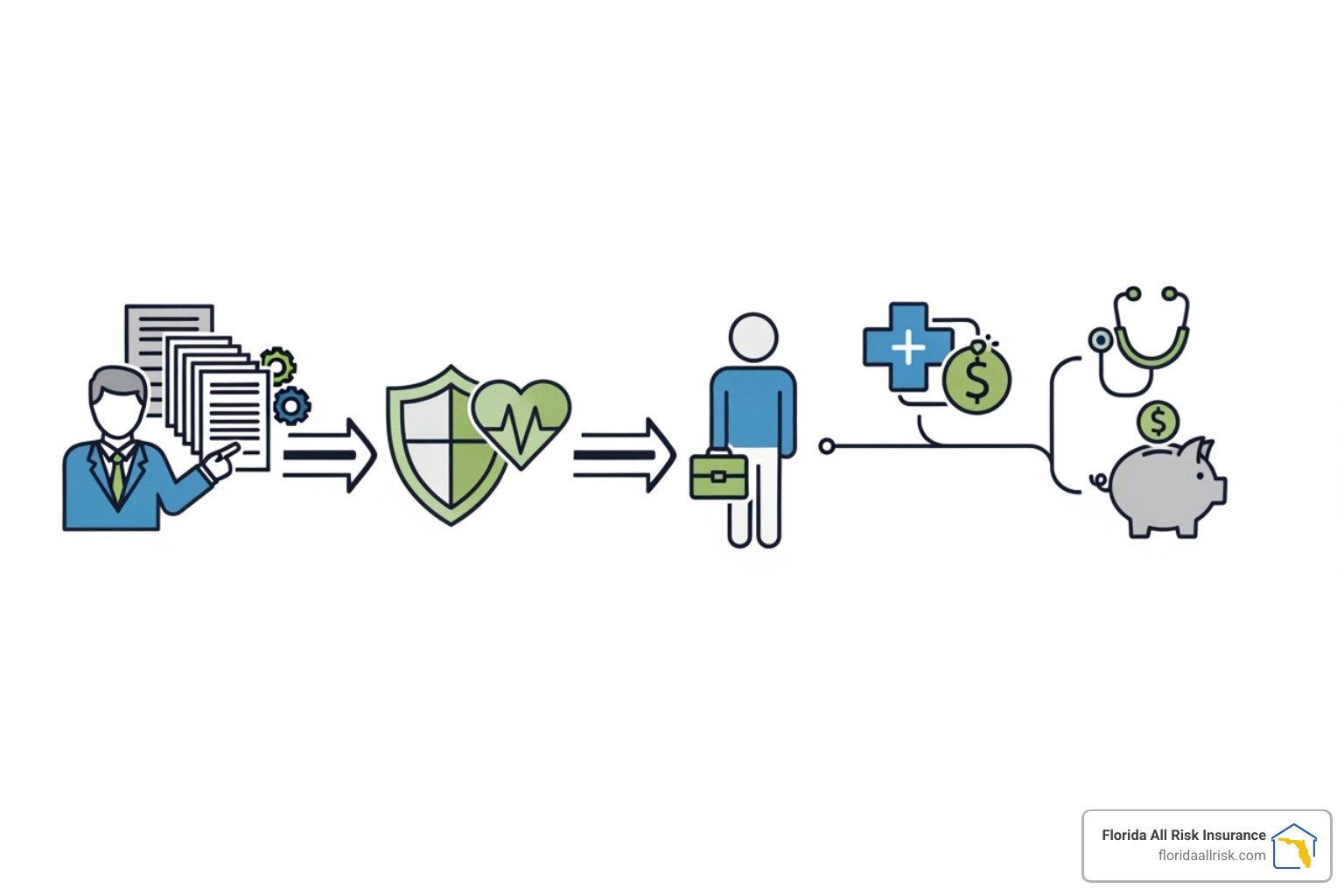
A Group Health Plan (GHP) is a single insurance contract purchased by an employer or organization to provide health coverage to all its eligible employees and, often, their dependents. The Social Security Administration defines a GHP as health coverage provided by an employer or employee organization that is based on current employment.
The foundational principle that makes this system work is risk dispersion. Imagine an insurance pool with 100 people. In any given year, a few may have very high medical costs, some will have moderate costs, and many will have very low costs. By insuring the entire group under one policy, the high costs of the few are offset by the low costs of the many. This allows the insurer to calculate a stable, predictable premium for the group as a whole, resulting in lower premiums than would be possible if each person were insured individually. This “bulk purchasing” power also leads to guaranteed acceptance; no eligible employee can be denied coverage or charged a higher rate based on their personal health history or pre-existing conditions. Even small businesses can leverage this model, as detailed in our guide to Group Health Insurance Plans for Small Businesses.
The Mechanics: From Premiums to Coverage
The lifecycle of a group health plan follows a clear, structured process:
- Employer Plan Selection: The process begins with the employer. They work with an insurance broker to analyze the needs of their workforce and the company’s budget. They select one or more plans to offer their employees.
- Employee Enrollment: Employees can enroll in the plan during specific times. The most common is the annual open enrollment period, a window of a few weeks each year when employees can sign up, change their plan, or add/remove dependents. The other opportunity is during a Special Enrollment Period (SEP), which is triggered by a Qualifying Life Event (QLE). QLEs include events like getting married, having a baby, losing other health coverage, or moving.
- Participation Requirements: To ensure the risk pool is balanced and not skewed toward only those who are sick, insurance carriers typically require a minimum participation rate. This means a certain percentage of eligible employees—often around 70%—must enroll in the plan for the insurer to issue the policy.
Premium cost-sharing is a cornerstone of the GHP model. Employers typically cover a substantial portion of the monthly premium, often between 70% and 80%, making the employee’s share much more manageable. For example, if a plan’s total monthly premium is $500, the employer might pay $400, leaving the employee with a $100 responsibility. This contribution is made via pre-tax payroll deductions, which provides an additional financial benefit by lowering the employee’s taxable income.
Eligibility is generally extended to full-time employees, defined by the ACA as those working 30 or more hours per week. Coverage can also be extended to their dependents, which typically includes a legal spouse and children up to age 26, regardless of whether they are married, a student, or financially dependent on the parent. For a more detailed overview, see Business Health Insurance.
Group vs. Individual Health Insurance: A Clear Comparison
The differences between group and individual plans are stark, particularly in cost, accessibility, and regulation. Group plans leverage employer contributions and risk pooling for affordability, while individual plans offer greater personal choice.
| Aspect | Group Plans | Individual Plans |
|---|---|---|
| Monthly Cost | Lower employee portion due to significant employer contribution. | Full premium paid by the individual. |
| Family Coverage | Employer often subsidizes a large portion of dependent premiums. | Individual pays the full, often very high, premium for family members. |
| Underwriting | Guaranteed issue. No health questions asked; rates are based on the group’s overall demographics. | Medical underwriting may be required (outside of ACA open enrollment). Health status can affect plan options and rates. |
| Health Questions | None required for eligibility or rates. | May affect plan options and require detailed health information. |
| Plan Choices | Limited to the options pre-selected and offered by the employer. | Full selection from the state’s health insurance marketplace or private market. |
| Network Access | Networks are specific to the plans offered by the employer. | Individual can choose a plan based on their preferred network of doctors and hospitals. |
| Job Changes | Coverage is tied to employment and typically ends. COBRA continuation coverage is an option but requires the individual to pay the full premium. | Coverage is portable and continues as long as premiums are paid, regardless of employment status. |
| Cost Stability | Premiums are set for a year at a time, providing predictable costs. | Premiums can change annually based on market factors and personal details. |
Exploring the Types of Group Health Insurance Plans
Group health plans are not one-size-fits-all. They come in various structures to suit different business needs, budgets, and employee preferences. Understanding the main categories—from how care is managed to how the plan is funded—is crucial for choosing the right option for your team.
Common Managed Care Plans: HMO, PPO, and More
Most group plans today are “managed care” plans. These plans contract with networks of doctors, hospitals, and other healthcare providers to deliver care to their members at a reduced cost. The main differences lie in network flexibility, cost, and how employees access specialist care.
- Health Maintenance Organization (HMO): HMOs are designed to be cost-effective. They require members to use providers within their network for care to be covered (except in emergencies). Members must select a Primary Care Physician (PCP) who acts as a gatekeeper, managing their overall care and providing referrals to see in-network specialists.
- Best for: Employees who want lower premiums and are comfortable with choosing a PCP to coordinate their care and staying within a specific network of providers.
- Preferred Provider Organization (PPO): PPOs are the most popular plan type due to their flexibility. Members can see any provider they choose, whether they are in or out of the plan’s network, without needing a referral. However, staying within the “preferred” network results in significantly lower out-of-pocket costs (e.g., lower copays and deductibles).
- Best for: Employees who want the freedom to see any doctor or specialist without a referral and are willing to pay higher premiums for that flexibility.
- Point-of-Service (POS): A POS plan is a hybrid of an HMO and a PPO. Like an HMO, members typically choose a PCP and need referrals for in-network specialist care. Like a PPO, they have the option to go out-of-network for care, but it will come at a much higher cost.
- Best for: Employees who want the lower costs associated with an HMO but still want the option to go out-of-network if necessary.
- Exclusive Provider Organization (EPO): An EPO is like a PPO in that members don’t need a PCP or referrals to see specialists. However, it’s similar to an HMO in that there is generally no coverage for out-of-network care except in true medical emergencies.
- Best for: Employees who want the freedom to see specialists without a referral but don’t mind being restricted to a specific network to keep costs lower than a PPO.
Each plan’s network restrictions are a key factor. To compare these options in more depth, see Florida Medical Insurance Plans.
Consumer-Driven Health Plans (CDHPs) and Savings Accounts
A growing trend in group health is the rise of Consumer-Driven Health Plans (CDHPs), which pair a high-deductible health plan with a tax-advantaged savings account.
- High-Deductible Health Plans (HDHPs): These plans feature lower monthly premiums but require the member to pay a higher deductible before the insurance begins to cover costs. The goal is to make consumers more mindful of healthcare costs.
- Health Savings Accounts (HSAs): Often paired with an HDHP, an HSA is a powerful, tax-advantaged savings account used for qualified medical expenses. It offers a triple tax advantage: contributions are tax-deductible, the funds grow tax-free, and withdrawals for medical costs are tax-free. The account is owned by the employee and is portable, meaning they keep the funds even if they change jobs. Unused funds roll over each year.
- Health Reimbursement Arrangements (HRAs): An HRA is an employer-funded account that employees can use to pay for out-of-pocket medical expenses. The employer sets the contribution amount and determines what expenses are eligible. Unlike an HSA, the employer owns the account, and funds typically do not roll over if the employee leaves the company.
- Flexible Spending Accounts (FSAs): An FSA allows employees to set aside pre-tax money from their paychecks to pay for qualified medical or dependent care expenses. The primary drawback is the “use-it-or-lose-it” rule, where most unused funds are forfeited at the end of the plan year.

Funding Structures: Who Takes the Risk?
- Fully-Insured Plans: This is the traditional and most common model, especially for small businesses. The employer pays a fixed monthly premium to an insurance carrier. In return, the insurer assumes all the financial risk for the employees’ medical claims. This model offers predictable, fixed costs, making budgeting easier, but it can be more expensive over the long term and offers less flexibility in plan design.
- Self-Funded Plans (Self-Insurance): In this model, typically used by larger companies, the employer pays for employee medical claims directly from company funds, essentially acting as its own insurer. They usually hire a Third-Party Administrator (TPA) to handle claims processing. To mitigate the risk of unexpectedly large claims, most self-funded employers purchase “stop-loss” insurance, which kicks in once claims exceed a certain threshold. This model offers maximum control, plan design flexibility, and potential savings if claims are lower than expected. You can learn more about What is a Self-Funded Group Health Insurance Plan?.
- Level-Funded Plans: A hybrid approach gaining popularity with small to mid-sized businesses. Employers pay a fixed monthly amount to an insurer or TPA. This payment covers administrative costs, stop-loss insurance premiums, and an anticipated amount for claims. If actual claims at the end of the year are lower than anticipated, the employer may receive a refund or credit for a portion of the surplus. This offers some of the cost predictability of a fully-insured plan with the potential savings of a self-funded one.
The Regulatory Landscape: ACA, ERISA, and Tax Implications
Understanding what are group health insurance plans requires navigating a complex regulatory framework designed to protect both employers and employees. Foundational laws like the Employee Retirement Income Security Act (ERISA) and the Affordable Care Act (ACA) establish critical rules for fairness, transparency, and access, while the U.S. tax code provides significant financial incentives that make these plans attractive.
The Role of ERISA in Protecting Plan Participants
The Employee Retirement Income Security Act (ERISA) of 1974 is the primary federal law governing most private-sector employee benefit plans, including group health insurance. It doesn’t mandate that employers offer benefits, but for those who do, it sets minimum standards to ensure fairness and transparency.
- Fiduciary Responsibilities: ERISA requires that plan managers (fiduciaries) act solely in the best interest of plan participants and their beneficiaries. This means their decisions must be for the exclusive purpose of providing benefits and defraying reasonable plan expenses.
- Plan Information Disclosure: A key requirement is transparency. Employers must provide participants with a Summary Plan Description (SPD) at no charge. This crucial document must be written in plain language and explain what the plan provides, how it operates, when an employee can begin to participate, how to file a claim, and how to appeal a denied claim.
- Claims and Appeals Process: ERISA guarantees participants the right to a formal review process if a claim for benefits is denied. The plan must provide a written explanation for the denial and give the participant a reasonable opportunity to appeal the decision. This structured process ensures that claims are not arbitrarily denied.
- Participant Rights and Protections: It is illegal for an employer to fire or retaliate against an employee for exercising their rights under an ERISA-covered plan, such as filing a legitimate medical claim or inquiring about benefits.
These vital protections are enforced by the U.S. Department of Labor’s Employee Benefits Security Administration (EBSA), with additional resources available from the U.S. Department of Health and Human Services.
How the Affordable Care Act (ACA) Shaped Group Insurance
The Patient Protection and Affordable Care Act (ACA) of 2010 introduced some of the most significant reforms to the U.S. healthcare system, with major impacts on group health insurance.
- Employer Mandate: This provision, also known as the “employer shared responsibility provision,” applies to Applicable Large Employers (ALEs)—generally businesses with 50 or more full-time equivalent employees. ALEs must offer affordable, minimum-value health coverage to their full-time employees and their dependents or face potential penalties.
- Affordable Coverage: Coverage is considered “affordable” if the employee’s contribution for the lowest-cost, self-only plan does not exceed a certain percentage of their household income (this percentage is adjusted annually).
- Minimum Value: A plan provides “minimum value” if it covers at least 60% of the total allowed cost of benefits (its actuarial value).
- Essential Health Benefits (EHBs): All non-grandfathered small group and individual plans must cover ten categories of essential health benefits, including ambulatory patient services, emergency services, hospitalization, maternity and newborn care, mental health and substance use disorder services, prescription drugs, rehabilitative services, laboratory services, preventive and wellness services, and pediatric services.
- No Pre-existing Condition Exclusions: Insurers can no longer deny coverage or charge higher premiums to anyone due to a pre-existing health condition.
- Dependent Coverage to Age 26: The ACA allows adult children to remain on a parent’s health plan until they turn 26.
The ACA also established the Small Business Health Options Program (SHOP) marketplace, an online portal where small businesses can compare plans and, in some states, access the Small Business Health Care Tax Credit. You can learn more about how the ACA affects businesses and explore our Small Company Health Insurance options.
Tax Implications for Employers and Employees
The tax code provides powerful incentives for offering and participating in group health insurance.
- For Employers:
- Tax Deductibility: Premiums paid by the employer are generally 100% tax-deductible as an ordinary business expense.
- Small Business Health Care Tax Credit: This credit is designed to help smaller businesses afford coverage. To be eligible, an employer must have fewer than 25 full-time equivalent employees, pay average annual wages below a certain threshold (adjusted for inflation), and contribute at least 50% of the premium cost for employee-only coverage. The credit can be worth up to 50% of the employer’s premium contributions.
- For Employees:
- Pre-Tax Contributions: Employee contributions to premiums are typically made with pre-tax dollars through a Section 125 cafeteria plan. This reduces their total taxable income, resulting in lower federal, state, Social Security, and Medicare taxes. For example, an employee earning $50,000 who contributes $2,000 a year to health premiums is only taxed on $48,000 of income.
- Tax-Free Benefits: The medical benefits and insurance payments employees receive are generally not considered taxable income.
These significant tax advantages make group health plans one of the most cost-effective and tax-efficient forms of compensation available. For specific guidance, consult the Internal Revenue Service (IRS) and our guide to Small Business Employee Benefits.
Weighing the Pros, Cons, and Key Considerations

Deciding to offer group health insurance is a major strategic decision. While the advantages are substantial, weigh them against the costs and administrative responsibilities.
The Benefits for Employers and Employees
Offering a quality group health plan provides a significant return on investment through both tangible and intangible benefits that foster a healthier, more stable workforce.
For Employers:
- Attracting and Retaining Talent: In a competitive job market, a robust benefits package is often the deciding factor for top candidates. It signals that a company invests in its people, which is crucial for retention and reducing costly turnover.
- Increased Productivity and Reduced Absenteeism: A healthy workforce is a productive workforce. When employees have access to preventive care and can treat illnesses promptly, it leads to fewer sick days. It also reduces “presenteeism”—the phenomenon of employees coming to work while sick and performing at a lower capacity.
- Tax Advantages: As a business expense, employer contributions to health insurance premiums are fully tax-deductible, directly lowering the company’s taxable income and the net cost of providing the benefit.
- Improved Company Culture and Morale: Offering health benefits demonstrates a genuine concern for employee well-being, fostering a positive work environment, and boosting morale and loyalty.
For Employees:
- Accessibility and Affordability: For many Americans, group plans are the only viable path to comprehensive and affordable health coverage. The employer’s premium contribution drastically reduces the financial burden on the employee.
- Financial Security and Peace of Mind: Health insurance provides a crucial safety net against catastrophic medical costs. Knowing that major medical events are covered provides invaluable peace of mind for employees and their families.
- Pre-Tax Savings: Paying for premiums with pre-tax dollars effectively increases an employee’s take-home pay compared to purchasing post-tax individual insurance.
- Guaranteed Coverage: Employees are guaranteed coverage regardless of their health history or pre-existing conditions, which is not always the case on the individual market.
These advantages are discussed further in the article Benefits of Health Benefits.
Drawbacks and Important Considerations
While highly beneficial, implementing a group plan comes with challenges that require careful planning and management.
- Significant Employer Costs: The financial commitment is a major budget item. Employers must carefully plan for the cost of premiums, which tend to rise annually.
- Administrative Burden: Managing a health plan requires significant administrative effort. This includes handling open enrollment, processing new hires and terminations, answering employee questions, and ensuring compliance with laws like ERISA, COBRA, and the ACA.
- Limited Employee Choice: Unlike the individual market, employees are limited to the one or two plans selected by the employer. This can be a drawback if the chosen plan’s network or structure doesn’t align with an employee’s specific needs.
- Loss of Coverage with Job Change: Because coverage is tied to employment, it creates a potential coverage gap for employees who leave the company. While COBRA offers a temporary solution, it is often prohibitively expensive.
How to Choose the Right Group Health Insurance Plan
Selecting the right plan is a multi-step process that involves balancing costs, benefits, and the unique needs of your workforce.
- Assess Your Budget and Employee Needs: First, determine what your company can realistically afford to contribute. Then, survey your team to understand their priorities. Are they young and healthy, perhaps valuing a low-premium HDHP with an HSA? Or do you have more employees with families who might prefer a lower-deductible PPO? Anonymous surveys can gather valuable data on preferred doctors, family coverage needs, and cost-sharing preferences.
- Evaluate Total Costs vs. Benefits: Look beyond the monthly premium. Create a spreadsheet to compare the total potential cost of different plans. Analyze the deductibles, copays, coinsurance, and out-of-pocket maximums. A plan with a low premium but a high deductible might be more expensive in the long run for an employee who needs regular care.
- Compare Provider Networks: A plan is only as good as its network. Ensure the plan’s network includes a sufficient number of high-quality doctors, specialists, and hospitals in the areas where your employees live. Check for key local hospitals and pediatricians if you have many employees with families. A broad PPO network offers flexibility, while a more limited HMO network can offer significant savings if it includes the providers your team uses.
- Work with an Independent Insurance Broker: Navigating the group health insurance market is complex. An experienced, independent broker is an invaluable partner. They don’t work for one insurance company; they work for you. A good broker will help you with every step: assessing your needs, gathering quotes from multiple carriers, comparing complex plan details, managing enrollment, and providing year-round support for compliance and renewals.
For a detailed walkthrough, see the guide on How to Choose a Group Health Insurance Plan.
Frequently Asked Questions About What Are Group Health Insurance Plans
When exploring group health insurance for the first time, employers and employees often have similar questions. Here are concise answers to some of the most common inquiries.
What is the most popular type of group health plan?
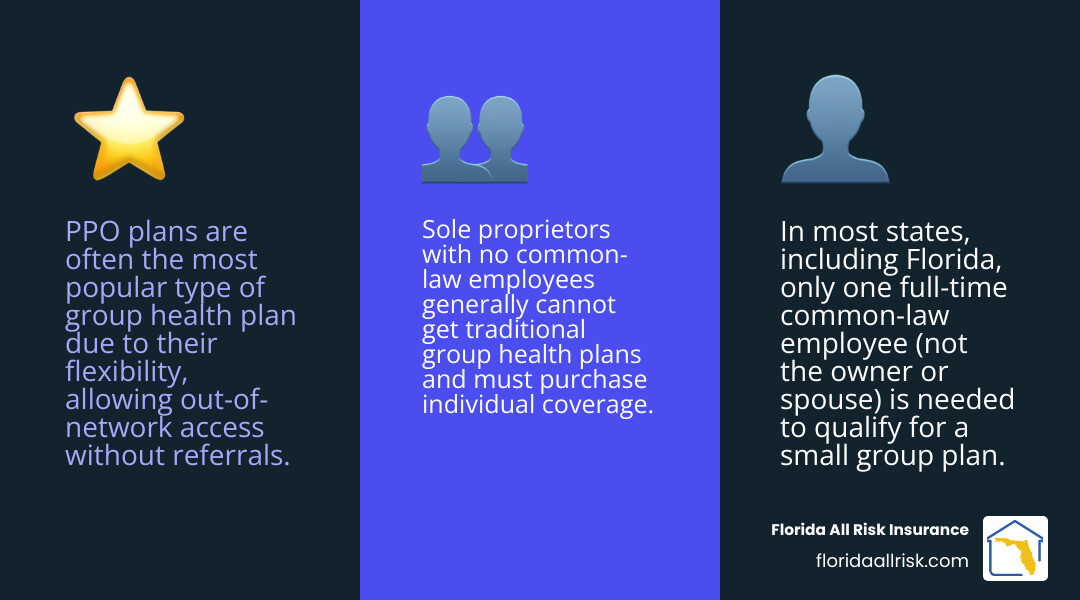
Preferred Provider Organization (PPO) plans are consistently the most popular choice for both employers and employees. Their key advantage is flexibility. PPOs allow members to see providers both in and out of the network without needing a referral from a primary care physician. While using an in-network provider is always more cost-effective, the freedom to choose any doctor or specialist provides valuable peace of mind. This balance of choice and managed cost appeals to a diverse workforce with varying healthcare needs.
How many employees are needed for group health insurance?
You don’t need a large workforce to qualify for group coverage. In Florida and most other states, a business generally needs only one full-time equivalent W-2 employee besides the owner or their spouse to be eligible for a small group plan. This employee must be a “common-law employee” on the company’s payroll, not an independent contractor. This low threshold makes the significant benefits of group coverage highly accessible, even for very small businesses.
Can a self-employed person get a group health insurance plan?
The answer depends entirely on your business structure. A true sole proprietor with no employees is considered an individual and is not eligible for a group plan; they must purchase individual health insurance. However, if you are self-employed but have legally established your business (e.g., as an S-Corp or LLC) and have hired at least one common-law W-2 employee (who is not your spouse), you can establish a small group health plan. This allows the business owner to participate in the plan and gain access to the benefits of group coverage. For those who don’t qualify, other options like Health Savings Accounts (HSAs) paired with an individual plan can help manage healthcare costs. We offer guidance on plans for the self-employed.
What is COBRA continuation coverage?
The Consolidated Omnibus Budget Reconciliation Act (COBRA) is a federal law that gives employees who lose their health benefits the right to choose to continue their group health benefits for a limited period under certain circumstances, such as voluntary or involuntary job loss, reduction in hours worked, or other qualifying events. While it prevents a gap in coverage, the individual must pay the full premium for the coverage, including the portion the employer used to pay, plus a small administrative fee. This often makes COBRA a very expensive option.
What is the difference between a copay, deductible, and coinsurance?
These are the three main types of out-of-pocket costs:
- Deductible: The amount you must pay for covered health care services before your insurance plan starts to pay. For example, if you have a $2,000 deductible, you pay the first $2,000 of covered services yourself.
- Copay (or Copayment): A fixed amount you pay for a covered health care service after you’ve paid your deductible. For example, you might have a $25 copay for a doctor’s visit.
- Coinsurance: The percentage of costs of a covered health care service you pay after you’ve paid your deductible. For example, if your coinsurance is 20%, you pay 20% of the bill, and the insurance company pays 80%.
Conclusion: Securing the Right Coverage for Your Team
Understanding the nuances of group health insurance—from plan types like PPOs and HMOs to the regulations under the ACA and ERISA—is the first step toward making a strategic decision for your business. These plans are more than just a benefit; they are an investment in your team’s health, well-being, and your company’s success. Choosing the right plan requires balancing costs, coverage, and employee needs. For businesses in Florida, navigating these options can be simplified with expert guidance. At Florida All Risk Insurance, we help you find a plan that fits your unique business needs.
To find the perfect health coverage for your team, explore our Group Health Insurance plans.
Contact Us
Florida All Risk Insurance
Saint Petersburg, FL
Phone: (727) 538-4720
Email: [email protected]

