

How much is commercial auto insurance in florida: Top 5!
Why Understanding Commercial Auto Insurance Costs Matters for Florida Businesses
Florida is home to an estimated 3.6 million small businesses, many of which rely on vehicles every day. From contractors and delivery services to real estate agents and landscapers, commercial vehicles keep Florida’s economy moving. But they also expose businesses to significant financial risk in the event of an accident.
How much is commercial auto insurance in Florida? For most Florida businesses that use vehicles, this is a critical budgeting question. Commercial auto insurance in Florida averages $266 per month (about $3,192 per year), but costs can vary significantly based on your industry, vehicles, and drivers.
Florida consistently ranks among the most expensive states in the country for commercial auto coverage. High traffic density, severe weather, insurance fraud, and rising repair costs all contribute to liftd rates in the Sunshine State. Understanding why these prices are so high, and what you can do about them, is essential to protecting your bottom line.
Quick Answer: Florida Commercial Auto Insurance Costs
- Average Monthly Premium: $266
- Average Annual Range: $1,200 to $3,370 per vehicle
- Minimum Liability: Around $158 per month ($1,897/year)
- Full Coverage: Around $473 per month ($5,678/year)
Costs vary based on industry, vehicle type, driver records, location, and coverage limits. Without proper insurance, businesses can face lawsuits, out-of-pocket repair and medical expenses, and even closure after a serious accident.
This guide breaks down what you can expect to pay, why Florida’s rates are so high, and how to get the protection you need without overpaying. It explains the key factors that determine your premium and shares practical strategies to reduce your costs.
As Jason Miller, I have spent over 20 years helping Florida businesses steer the complexities of commercial insurance. My team at Florida All Risk Insurance has guided thousands of business owners, helping them secure comprehensive coverage at competitive rates in this challenging market.
Understanding the Essentials of Commercial Auto Insurance in Florida
For many Florida businesses, vehicles are essential tools. This section defines commercial auto insurance, clarifies who needs it, and outlines Florida’s legal requirements to help you understand the costs.
What Is Commercial Auto Insurance and Who Needs It?
Commercial auto insurance is a specialized liability and property damage policy designed to cover vehicles used for business purposes. If a vehicle is involved in an accident while being used for work, a commercial policy helps pay for medical expenses, property damage, and legal costs, protecting your business’s assets from potentially devastating lawsuits and claims. Unlike a personal policy, it is tailored to the higher risks inherent in business operations.
Any Florida company that uses vehicles to conduct business needs this coverage. This applies not only to vehicles owned by the business but also to personal vehicles used regularly for work-related tasks (non-owned auto exposure).
You almost certainly need commercial auto insurance if your business involves:
- Transporting Goods or People: This includes delivery services (packages, food), taxi or limousine services, and non-emergency medical transport.
- Providing a Service: Businesses like contractors, plumbers, electricians, and landscapers who travel to job sites with tools and equipment.
- Sales and Client Visits: Professionals like real estate agents, outside sales reps, and consultants who drive to meet clients.
- Gig Economy Work: Drivers for rideshare or delivery apps often need a commercial or specialized hybrid policy, as personal insurance typically excludes this work.
- Non-Profits and Religious Organizations: Any organization that uses vans or buses to transport members, volunteers, or clients.
Even if a vehicle is only occasionally used for a work errand, like a trip to the bank or post office, it can create a coverage gap on a personal policy. If a vehicle is used to generate income, transport goods or people for a fee, or is driven by employees for work, you need a commercial auto policy. Florida All Risk Insurance can help you determine whether your current use requires a dedicated commercial auto policy.
The Critical Difference: Commercial vs. Personal Auto Policies
A common mistake is assuming a personal auto policy covers business use. This can create serious coverage gaps. Personal policies are not designed for the higher liability of commercial use, which often involves more mileage, different cargo, and employee drivers.
If an accident happens during business activities, a personal policy could deny the claim, leaving you and your business responsible for all costs.
Commercial policies are built for these higher risks, covering a wider range of vehicles and protecting your business when an employee is driving.
| Feature | Personal Auto Insurance | Commercial Auto Insurance |
|---|---|---|
| Primary Purpose | Personal, family, and commuting use | Business operations, generating income |
| Coverage for Employees | Typically none | Covers authorized employees driving for business |
| Liability Limits | Lower, for individual risk | Higher, for business liability |
| Vehicle Types | Standard cars, SUVs, minivans | Cars, vans, trucks, specialized vehicles |
| Usage | Commuting, personal errands | Deliveries, client visits, hauling goods/people |
| Cost | Generally lower | Generally higher due to increased risk |
Florida’s Minimum Legal Requirements
Florida is a “no-fault” state, meaning your own insurance pays for your initial medical expenses after an accident, regardless of fault. Florida law requires all vehicles to have:
- Personal Injury Protection (PIP): $10,000. This helps cover medical expenses and lost wages for you, resident relatives, and certain passengers.
- Property Damage Liability (PDL): $10,000. This covers damage you cause to someone else’s property.
While Bodily Injury Liability (BIL) is not always required, it is highly recommended to protect your business assets if you’re at fault in an accident that injures someone. These are only state minimums; most businesses need higher limits for adequate protection.
For current details on required coverage, you can review the official Florida auto insurance requirements from the Florida Department of Highway Safety and Motor Vehicles.
Certain commercial vehicles, especially those with a U.S. Department of Transportation (USDOT) number or that engage in interstate commerce, may have additional federal liability requirements. You can confirm applicable federal rules by checking your USDOT number or docket number.
How Much is Commercial Auto Insurance in Florida? A Detailed Cost Breakdown
So, how much is commercial auto insurance in Florida? While the exact cost depends on your unique business, we can provide some concrete numbers and averages to guide you.
Understanding the Average Price: How Much is Commercial Auto Insurance in Florida?
The average cost of commercial auto insurance in Florida is $266 a month, or about $3,192 annually. The typical annual cost ranges from $1,200 to $3,370 per vehicle. Florida’s rates are the highest among the 25 most populous states, nearly double the national average of $147 a month. This is due to factors like high accident frequency, a litigious environment, insurance fraud, and catastrophic weather events.
Looking at specific coverage types:
- State minimum liability averages around $158 a month ($1,897 a year). This is the bare minimum and is often insufficient for most businesses.
- Full Coverage policies, which include collision and comprehensive, average around $473 a month ($5,678 a year).
Despite high averages, 37% of small businesses in Florida pay less than $100 per month, showing the wide variation in costs. This often applies to sole proprietors in low-risk industries using a single vehicle. Industry also plays a major role; for example, a new tow truck insurance policy can average $619 a month due to specialized risks, while contractors might see averages around $257 a month for a standard pickup truck.
Key Factors That Influence Your Premium
Your premium is based on a comprehensive risk assessment. Here are the key factors:
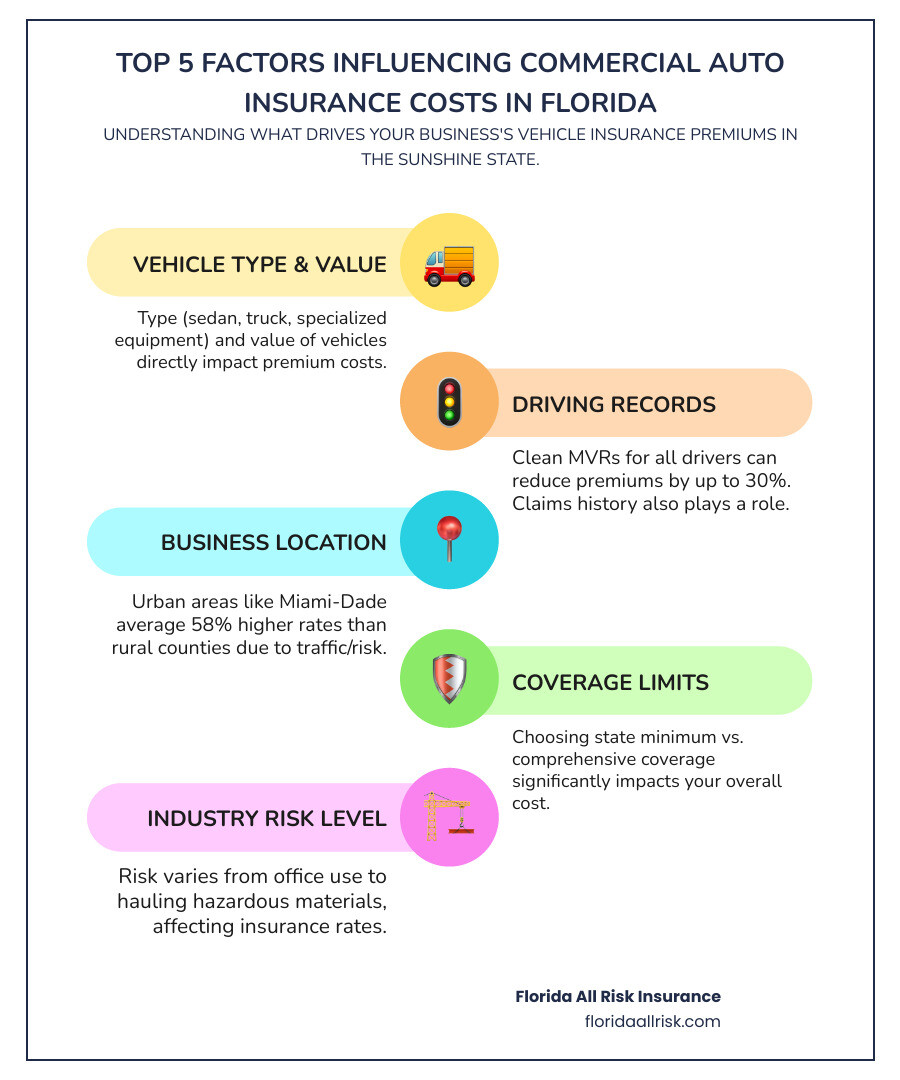
- Your Business Industry: An accountant visiting clients faces far less risk than a construction company hauling heavy equipment or a business transporting hazardous materials. Insurers classify industries by risk level, which directly impacts the base rate.
-
Number and Type of Vehicles: A fleet costs more to insure than a single car. The vehicle’s type, weight, value, and typical repair cost also matter significantly. A sedan is cheaper to insure than a heavy-duty dump truck, which can cause more damage in an accident.
Estimated Annual Premiums by Vehicle Type in Florida
Vehicle Type Average Annual Premium (Liability Only) Average Annual Premium (Full Coverage) Sedan (e.g., for sales) $1,500 – $2,500 $3,000 – $4,500 Cargo Van (e.g., for deliveries) $1,800 – $3,000 $4,000 – $6,000 Pickup Truck (e.g., for contracting) $2,000 – $3,500 $4,500 – $7,000 Box Truck (e.g., for moving/local freight) $3,500 – $6,000 $7,000 – $12,000+ Note: These are estimates and can vary widely based on other factors.
-
Driving Records: The driving history of every employee operating a company vehicle is critical. Clean Motor Vehicle Records (MVRs) lower rates, while accidents, speeding tickets, or DUIs will significantly increase them.
- Your Business’s Claims History: A history of frequent or costly claims signals higher risk to insurers, leading to higher premiums at renewal. A clean claims history can earn you discounts.
- Business Location (Garaging Address): Operating in high-traffic, high-crime urban areas like Miami-Dade, Broward, and Palm Beach counties costs significantly more than in rural areas like Alachua or Leon County due to higher rates of accidents, theft, and litigation.
- Travel Radius: Local routes (e.g., under a 50-mile radius) are lower risk than regional or long-haul travel that crosses state lines, as more time on the road and unfamiliar routes increase accident exposure.
- Coverage Limits and Deductibles: Higher liability limits (e.g., $1 million) increase your premium but offer crucial protection for your business assets. A higher deductible on your physical damage coverage lowers your premium but means you pay more out-of-pocket for a claim.
Common Coverage Options (And What’s Not Included)
Understanding your coverage options is key to building the right policy.
Standard Coverages:
- Bodily Injury Liability (BIL): Covers injuries to others if you’re at fault.
- Property Damage Liability (PDL): Covers damage to others’ property if you’re at fault.
- Personal Injury Protection (PIP): Required in Florida; covers medical costs for you and your passengers regardless of fault.
- Collision Coverage: Pays for damage to your vehicle from a collision.
- Comprehensive Coverage: Protects your vehicle from non-collision events like theft, fire, or storms.
- Uninsured/Underinsured Motorist (UM/UIM): Covers you if you’re hit by a driver with little or no insurance.
Specialty Coverages:
- Hired and Non-Owned Auto (HNOA): Crucial if employees use their own cars for work or if you rent vehicles.
- Loading and Unloading Coverage: Insures goods during transport, loading, or unloading.
- Garagekeepers Legal Liability: For businesses that service or store customer vehicles.
- On-Hook Towing Coverage: For tow trucks, covers damage to the vehicle being towed.
What’s Typically NOT Covered:
- Intentional damage.
- Personal property inside the vehicle (e.g., laptops, tools).
- Employee injuries on the job (covered by Workers’ Compensation).
- Routine maintenance or mechanical wear and tear.
- Cargo, unless specific cargo coverage is added.
Smart Strategies to Reduce Your Commercial Auto Insurance Costs
Even with Florida’s high rates, you can take steps to lower your premiums without sacrificing protection. Proactive solutions can help you save money.
Proactive Risk Management and Safety Protocols
Insurers reward businesses that demonstrate a commitment to safety. Implementing and documenting strong risk management protocols is one of the most effective ways to lower your long-term costs.
- Strict Hiring Standards: Don’t just hire licensed drivers; hire safe drivers. Establish clear criteria, such as no major violations in the last five years and no more than one minor violation in the last three. Always run Motor Vehicle Record (MVR) checks before hiring and annually for all drivers.
- Ongoing Employee Training: A one-time orientation isn’t enough. Invest in regular driver safety training. This can include online courses, in-person workshops on defensive driving (like the National Safety Council’s program), or specific training for vehicle types (e.g., trailer safety). Document all completed training.
- Formal, Written Safety Policies: Create a driver safety manual that all employees must read and sign. Key policies should include:
- A zero-tolerance policy for distracted driving (no texting, handheld calls).
- Procedures for pre- and post-trip vehicle inspections.
- A clear, step-by-step accident reporting protocol.
- Rules regarding personal use of company vehicles.
- Rigorous Vehicle Maintenance: Keep a detailed, documented maintenance log for each vehicle. Regular oil changes, tire rotations, and brake inspections not only prevent accidents caused by mechanical failure but also demonstrate to insurers that you are a responsible fleet owner.
- Telematics and Dashcams: Using GPS tracking and dashcams is one of the fastest-growing ways to manage risk and earn discounts (often 5-15%). Telematics monitor speed, hard braking, and rapid acceleration, providing data to coach drivers. Dashcams can provide indisputable evidence in an accident, protecting you from fraudulent claims and incorrect at-fault determinations.
- Anti-Theft Devices: Professionally installed alarms and GPS tracking systems can lower your comprehensive coverage premium by reducing the risk of theft, which is a significant concern in many parts of Florida.
- Manage Your Claims History: For minor incidents like a cracked windshield or a small fender bender, consider paying for repairs out-of-pocket. Avoiding small, frequent claims keeps your loss history clean and prevents premium hikes at renewal.
Optimizing Your Policy for Maximum Savings
Smart policy management can also lead to direct savings.
- Higher Deductibles: Choosing a higher deductible on collision and comprehensive coverage will lower your annual premium.
- Bundling Policies: Combine your commercial auto policy with a Business Owner’s Policy (BOP) or general liability to get a discount, often around 12%.
- Paying Annually: Paying your premium in one lump sum instead of monthly can save you 9% or more.
- Annual Policy Review: Review your coverage with us annually to ensure it still fits your business needs and you aren’t paying for unnecessary coverage.
- Ensure Policy Accuracy: Make sure all information, from vehicle details to driver lists, is up-to-date to avoid incorrect premiums or denied claims.
Getting a Quote: Finding Out How Much Commercial Auto Insurance is in Florida for Your Business
Navigating Florida’s complex commercial auto insurance market can be challenging. The best way to determine how much commercial auto insurance is in Florida for your business is to get a personalized quote. Being prepared makes the process much smoother.
Preparing Your Information for an Accurate Quote
To get the most accurate quotes, gather some key information beforehand. This will streamline the process and ensure insurers provide you with custom rates.
Here’s a checklist of what you’ll generally need:
- Business Name, Address, and a description of your operations
- Federal Employer Identification Number (EIN)
- Vehicle Information: Year, make, model, and Vehicle Identification Number (VIN) for each vehicle
- Vehicle Usage: Estimated annual mileage, typical cargo, and travel radius (local, regional)
- Driver Information: Full names, dates of birth, and driver’s license numbers for all drivers
- Prior Insurance History: Details about previous policies and claims
- Desired Coverage: An idea of the liability limits and deductibles you want
Providing accurate information is crucial for getting the right coverage and ensuring a smooth claims process in the future.
The Advantage of Using an Independent Insurance Agent
Working with an independent insurance agent like us at Florida All Risk Insurance offers significant advantages in the Florida market.
- Expert Guidance: We specialize in Florida’s unique market and can help you steer its regulations and risks.
- Personalized Service: We take the time to understand your business to tailor recommendations that fit your risk profile and budget.
- Access to Multiple Carriers: As an independent agency, we shop around with a wide network of top-rated insurers on your behalf, comparing quotes to find you the best value.
- Market Knowledge: We stay current on trends and discounts to ensure you get competitive rates.
- Claims Assistance: If you need to file a claim, we act as your advocate to guide you through the process.
- Long-Term Partnership: We aim to build lasting relationships, providing ongoing support as your business evolves.
Frequently Asked Questions about Florida Commercial Auto Insurance
We hear many questions about commercial auto insurance in Florida. Here are clear answers to some of the most common inquiries.
Is commercial auto insurance tax-deductible in Florida?
Yes, the IRS generally considers commercial auto insurance premiums an “ordinary and necessary” business expense, which means you can typically deduct the cost on your federal tax returns. Since Florida has no state income tax, this deduction applies at the federal level. Always consult a tax professional for advice specific to your business.
Does commercial auto insurance cover personal use of a company vehicle?
This depends on your policy. Generally, if an employee is authorized to drive a company vehicle, your commercial policy may provide coverage even for some personal use. However, policies can have limitations. It’s crucial to have a clear company policy regarding personal use and to ensure your insurance provider is aware of how your vehicles are used. We can help you review your policy to understand these specific terms.
What are the penalties for driving without required commercial auto insurance in Florida?
Operating a commercial vehicle in Florida without the required insurance can lead to severe penalties for your business, including:
- License and Registration Suspension: Your driver’s license and vehicle registration can be suspended for up to three years.
- Reinstatement Fees: You will have to pay significant fees (often over $150) to restore your license and registration.
- Fines: Your business could face substantial fines.
- Personal Liability: If you’re in an accident while uninsured, your business could be held personally liable for all damages and legal costs, which can be financially devastating.
It is not worth the risk to operate without proper coverage. You can learn more from the Florida Department of Highway Safety and Motor Vehicles about the penalties for not owning commercial auto insurance.
Conclusion
Understanding how much commercial auto insurance is in Florida is a vital part of running a business responsibly. While the state has high insurance costs, knowing the factors that influence your premiumfrom your industry and vehicles to driver records and locationhelps you make informed decisions instead of guessing at your risks.
Commercial auto coverage is more than a legal requirement; it is a financial safety net that can keep an accident from becoming a crisis. The right policy can help pay for injuries, property damage, legal defense, and vehicle repairs after a covered loss, allowing you to focus on keeping your business running.
Even in a high-cost state like Florida, you are not powerless. By investing in driver training, maintaining your vehicles, enforcing written safety policies, and choosing coverage limits and deductibles that match your risk tolerance, you can often manage your premiums without sacrificing essential protection.
As an independent agency based in St. Petersburg, Florida All Risk Insurance focuses on the unique challenges Florida businesses face on the road. Our agents understand local traffic patterns, weather exposures, regulatory requirements, and industry-specific risks. We work with a broad network of insurance carriers, which allows us to compare options and help you find coverage that fits both your operations and your budget.
If you rely on vehicles for your livelihood, it is worth taking a closer look at your current coverage. Many businesses find they are either underinsured or paying for protections they do not truly need. A focused review can reveal opportunities to improve protection, reduce gaps, and potentially lower costs.
Ready to see what you could save on Florida commercial auto insurance?
Get a personalized quote for your affordable commercial vehicle insurance today!
Our team will review your vehicles, drivers, and operations to recommend coverage custom to your business, not a one-size-fits-all template.
Take the next step to protect your business vehicles and cash flow.
Contact our experienced agents for a comprehensive, no-obligation review of your current policy and a side-by-side comparison of options. We are here to help you understand your choices so you can insure your business with confidence.
Contact Us
Florida All Risk Insurance
Address: 7901 4th St N, Suite 300, Saint Petersburg, FL 33702
Phone: (727) 440-4204
Email: [email protected]
Website: https://floridaallrisk.com/
Whether you are just starting a business or managing a growing fleet, our team is ready to help you explore commercial auto, homeowners, flood, and personal auto insurance solutions across Florida.

