

Trucking Company Insurance Florida 2025: Secure Haul
The Engine of Florida’s Economy: Why Trucking Insurance is Non-Negotiable
Trucking company insurance Florida is essential for protecting your business on the road. Whether you’re hauling citrus from the central ridge, fresh seafood from the Gulf Coast, aerospace components from the Space Coast, or critical retail goods to support the state’s booming population and tourism industry, comprehensive insurance coverage shields your trucks, cargo, and livelihood from financial disaster. Florida’s busy highways see over 70 million miles of commercial truck traffic daily, making proper insurance not just smart business—it’s legally required.
Quick Answer: What You Need for Florida Trucking Insurance
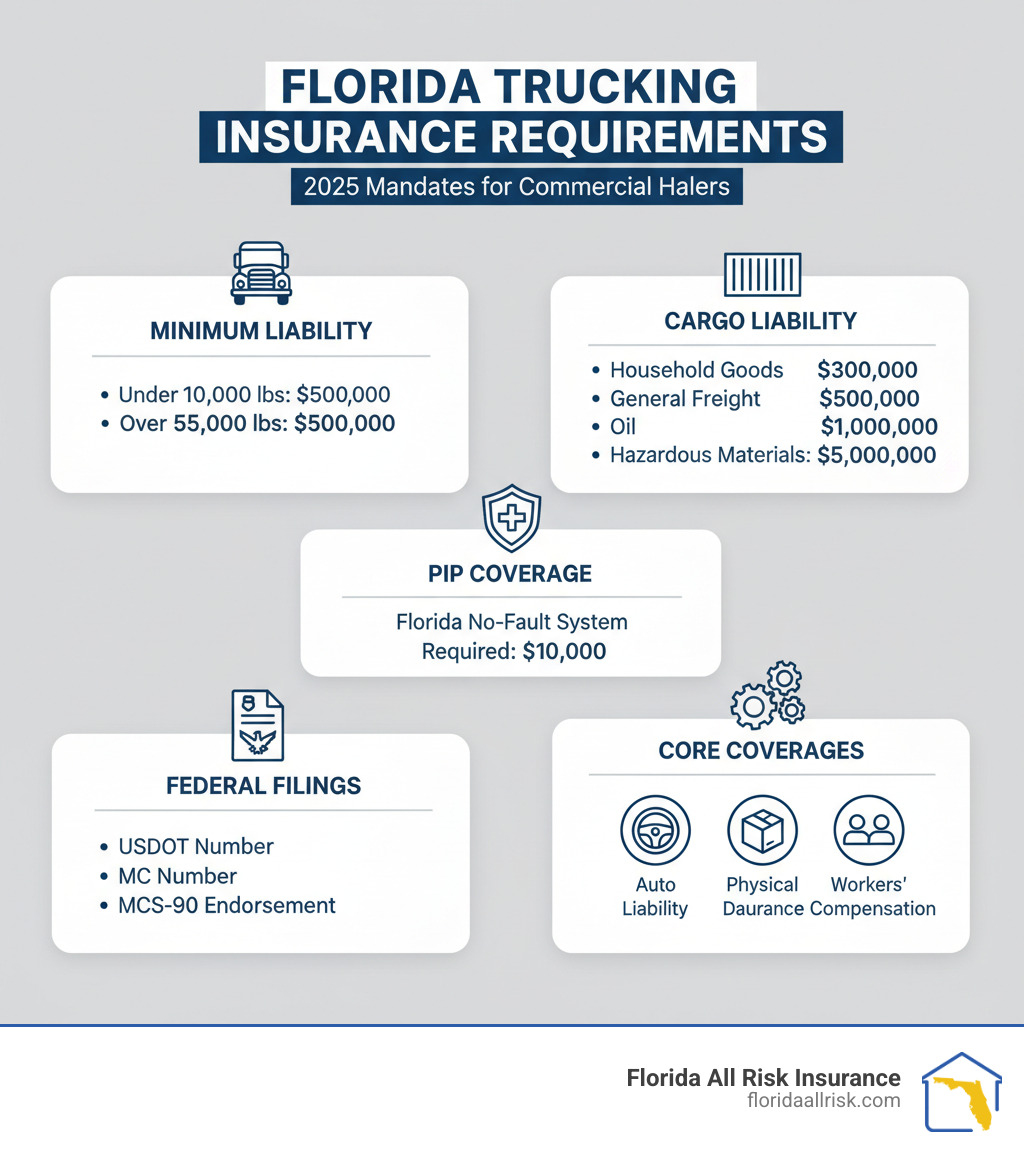
- Minimum Liability: $50,000 for trucks under 10,000 lbs; $500,000 for rigs over 55,000 lbs
- Required PIP Coverage: $10,000 Personal Injury Protection (Florida is a no-fault state)
- Cargo-Specific Mandates: $300,000 (household goods), $500,000 (general freight), $1,000,000 (oil), $5,000,000 (hazmat)
- Core Coverages: Auto liability, physical damage, cargo insurance, workers’ compensation, general liability
- Federal Filings: USDOT number, MC number, MCS-90 endorsement for interstate commerce
Florida ranks as a top state for total tonnage hauled, acting as a critical logistics hub for the southeastern U.S. and Latin America. Its major ports, including PortMiami, Port Everglades, and JAXPORT, are gateways for international trade, meaning trucks are constantly moving containers and goods from ships to distribution centers and final destinations. This intricate supply chain relies on the seamless operation of trucking companies. The I-4 corridor, I-95, I-75, and Florida’s Turnpike are critical economic arteries connecting these ports, distribution centers, and markets.
This high-volume environment means Florida trucking operations face unique challenges: congested metro areas increase accident risk, tropical weather threatens cargo, and strict state regulations require specific coverage levels. Without proper trucking company insurance Florida coverage, a single accident could bankrupt your business.
I’m Jason Miller, and with my family’s combined 60+ years of Florida insurance experience, I have deep insight into the specific challenges you face. I’ve helped Florida trucking companies secure comprehensive protection for over 20 years, navigating state-specific regulations to find competitive rates.
What is Commercial Truck Insurance?
Commercial truck insurance is a specialized policy designed to protect businesses that operate heavy-duty vehicles. It goes beyond standard auto insurance by addressing the unique risks of large trucks, valuable cargo, and the significant liabilities of trucking operations. This comprehensive protection typically covers damages to your truck, injuries to others, property damage, and loss or damage to the cargo you’re transporting. Given the potential for severe damage in an accident, the right trucking company insurance Florida is a crucial investment in your business’s future.
To learn more about how we can protect your business, explore our Commercial Truck Insurance options.
Commercial Truck vs. Commercial Auto Insurance: Key Differences
While often confused, commercial truck insurance and standard commercial auto insurance are distinct. Commercial auto generally covers lighter vehicles like delivery vans. The key differences lie in:
- Vehicle Size and Weight: Commercial trucks are significantly larger, leading to greater potential for damage and severe injuries, which dramatically increases liability risk.
- Specialized Coverages: Trucking requires unique coverages like motor truck cargo insurance, bobtail insurance, and reefer breakdown coverage, which aren’t part of standard commercial auto policies.
- Cargo Value: Trucks often transport highly valuable goods, necessitating specific cargo insurance to protect against loss or damage.
- Federal Regulations: Interstate trucking companies must comply with complex federal regulations (FMCSA) that don’t apply to most commercial auto users.
We tailor policies specifically for the commercial trucking industry, recognizing that a “one-size-fits-all” approach won’t work. For a deeper dive into custom solutions, visit our page on Commercial Truck Insurance Florida.
Navigating Florida’s Legal Maze: State and Federal Insurance Requirements
Operating a trucking business in Florida means juggling state regulations and federal mandates. Whether your trucks stay within Florida’s borders (intrastate) or cross state lines (interstate), you must prove you have the financial responsibility to cover potential accidents. Without the correct coverage, you face hefty fines, impounded vehicles, and even the suspension of your operating license.
For official details, the Florida Auto Insurance Requirements page from the FLHSMV is a valuable resource. It’s required reading for anyone running trucks in the Sunshine State.
Florida’s Minimum Insurance Requirements
As a “no-fault” state, Florida mandates Personal Injury Protection (PIP). This unique requirement means that regardless of who is at fault in an accident, the first $10,000 of medical expenses and lost wages for your driver are covered by your own policy. This is designed to expedite initial medical care and reduce lawsuits for minor injuries. Every commercial truck in Florida needs a minimum of $10,000 in PIP coverage.
Florida also requires liability coverage, but the minimums increase with vehicle weight. While a standard auto policy might have low limits, even a light truck under 10,000 lbs needs $50,000 in liability coverage. For rigs over 55,000 lbs, which includes most semi-trucks, the minimum jumps to $500,000. The logic is simple: bigger trucks can cause bigger damage, and the state wants to ensure there’s enough money to cover the potential costs.
Cargo-Specific Liability Mandates in Florida
What you haul is as important as the truck you haul it in. Florida sets different liability requirements based on cargo type:
- Household Goods: If you’re moving furniture and personal belongings, you’ll need $300,000 in liability coverage.
- General Freight: This covers the vast majority of commercial cargo and requires $500,000.
- Oil or Petroleum Products: Due to environmental risks, you’ll need $1,000,000 in coverage.
- Hazardous Materials (Hazmat): The highest risk requires $5,000,000 in liability coverage.
Additionally, intrastate household goods movers need $5,000 per vehicle and $10,000 per catastrophic event in cargo insurance. Operating without the proper cargo-specific coverage is illegal. We help trucking companies match their coverage to their cargo. Learn more on our Cargo Insurance for Trucks page.
Federal Filings for Interstate Truckers
The moment your wheels cross state lines, you enter the regulatory world of the Federal Motor Carrier Safety Administration (FMCSA). These federal requirements are in addition to Florida’s state mandates.
Key federal requirements include:
- USDOT Number: A unique identifier for your company that tracks your safety record and compliance history.
- Motor Carrier (MC) Number: Grants you the authority to operate as a for-hire transportation business across state lines.
- MCS-90 Endorsement: This is not an insurance policy itself, but rather a guarantee to the public that you have the required liability coverage to pay for damages in a major accident. It ensures that even if your policy has exclusions that would normally deny a claim, the insurer will still pay the public up to the federally mandated limits. The insurer can then seek reimbursement from you, making it a powerful tool for public protection but a significant financial risk for you if your primary policy doesn’t cover the incident. This endorsement is non-negotiable for interstate carriers.
- Unified Carrier Registration (UCR): An annual registration program for interstate carriers.
These federal requirements can feel overwhelming, and the consequences of non-compliance extend beyond immediate fines. Violations are recorded against your USDOT number and negatively impact your Compliance, Safety, Accountability (CSA) score. A poor CSA score can lead to more frequent and intrusive roadside inspections, higher insurance premiums, and a loss of business, as many brokers and shippers refuse to work with carriers who have unsatisfactory safety ratings. We handle these complex filing obligations, making sure your trucking company insurance Florida coverage meets both state and federal standards. You can find more information on the official FMCSA website (Opens in a new window).
Building Your Policy: Essential Coverages for Your Trucking Company in Florida
Building the right trucking company insurance Florida policy is about creating a safety net that protects your business when things go wrong. Your policy needs to reflect the real risks you face, whether you’re hauling construction materials through Tampa or running long-haul routes across the Southeast. A policy that works for a local dump truck operator won’t make sense for a refrigerated carrier.
The foundation of any solid trucking insurance policy includes several key coverages. We help you match these to your actual operations, not just sell a standard package. Visit our Insurance Products: Trucking Insurance page to explore the full range of protection options.
Core Protections: Liability and Physical Damage
Every policy starts with two fundamental coverages: liability and physical damage.
Primary Auto Liability is your first line of defense. This coverage pays for bodily injury and property damage you cause to others, including medical bills, vehicle repairs, and legal costs. It is often written with a Combined Single Limit (CSL), meaning a single pool of money is available for all damages and injuries in an accident, which is preferable to split limits for commercial trucks. Florida’s minimum liability requirements are just a starting point. We consistently recommend carrying higher limits, as a single serious accident can quickly generate claims exceeding state minimums. For detailed information, check out our Commercial Truck Liability Insurance page.
Physical Damage coverage protects your most valuable assets—your trucks and trailers. It comes in two parts:
- Collision Coverage: Handles repairs or replacement when your truck is damaged in an accident with another vehicle or object.
- Comprehensive Coverage: Protects against non-collision events like theft, vandalism, fire, and natural disasters. This is particularly important in Florida, where hurricanes and tropical storms can cause significant damage. Comprehensive coverage ensures you can repair or replace equipment without draining your capital. When setting up this coverage, you’ll need to decide between Actual Cash Value (ACV) and a Stated Amount, which is a predetermined value for your vehicle.
Learn more about coverage options for larger vehicles on our 18 Wheeler Truck Insurance page.
Protecting Your Payload: Cargo and Specialty Coverages
Your cargo is your business. Motor Truck Cargo Insurance covers the goods you’re transporting from loss, damage, or theft. Policy limits should always match or exceed the maximum value of goods you typically haul. A single uninsured cargo claim can wipe out months of profits.
For temperature-sensitive goods, Reefer Breakdown/Spoilage coverage is indispensable. Florida’s heat can quickly destroy a perishable load if your refrigeration unit fails. This coverage pays for cargo losses when your cooling system breaks down. For carriers hauling fresh produce or seafood, this coverage is a business necessity. Visit our Cargo Insurance for Trucks page for more information.
Beyond the Highway: General Liability and Workers’ Compensation
While auto liability covers accidents on the road, General Liability Insurance protects your business from other common risks. This includes incidents that happen off the road, such as a customer slipping and falling at your depot, your driver causing property damage while making a delivery on foot, or errors in delivery that lead to a client’s financial loss. It also covers advertising injury, such as libel or slander. For any trucking business with a physical location or that interacts with customers on their property, general liability is a crucial layer of protection against lawsuits that could arise from everyday business operations.
If you have employees, including drivers, dispatchers, or mechanics, Florida law requires you to carry Workers’ Compensation Insurance. This coverage is vital as it pays for medical expenses and lost wages for employees who are injured on the job, regardless of fault. For trucking, this could be anything from a driving accident to an injury sustained while loading or unloading cargo. Without it, you are personally liable for these costs and face severe state penalties. Even if you exclusively use owner-operators, the classification can be complex, and having a policy can protect you from legal challenges that attempt to reclassify them as employees.
Coverage for Specific Operations
Certain trucking operations require specialized protection to address unique exposures.
Non-Trucking Liability (NTL) is essential for owner-operators leased to a motor carrier. It provides liability coverage when you’re using your truck for personal, non-business reasons, like running errands on your day off. Your carrier’s policy only covers you when you’re under dispatch.
Bobtail Insurance is similar but covers your tractor when it’s being driven without a trailer attached, regardless of whether you’re under dispatch. This could be when you’re driving to a repair shop or returning to the terminal after dropping a trailer.
Trailer Interchange coverage is for operations that involve hauling trailers you don’t own under a formal interchange agreement. It covers physical damage to the non-owned trailer while it’s in your possession. These specialized coverages protect you from gaps that standard policies miss.
Decoding Your Premium: What Determines the Cost of Florida Trucking Insurance?
Calculating your trucking company insurance Florida premium involves a detailed risk assessment. Insurance underwriters examine numerous factors to determine your potential for claims. Understanding these variables can help you make smarter decisions and potentially save money.
How Truck Type and Cargo Impact Your Rates
The nature of your equipment and cargo are among the biggest drivers of your insurance costs. A box truck making local deliveries in Tampa doesn’t have the same risk profile as an 18-wheeler hauling hazardous materials.
- Vehicle Type, Age, and Condition: An 18-wheeler carries higher liability risk than a box truck due to its size. Specialized vehicles like tankers or dump trucks have unique risks that drive up premiums. Newer trucks with advanced safety features and a good maintenance history often qualify for lower rates.
- Gross Vehicle Weight (GVW): Heavier trucks can cause more damage, so they generally have higher premiums.
- Type of Cargo: Hazardous materials command the highest premiums. Perishables require reefer breakdown coverage, adding to the cost. High-value goods increase cargo insurance premiums. General freight typically has the most reasonable rates.
- Hauling Radius: Local operations (within 100 miles) generally have lower rates than regional or long-haul operations (over 300 miles) due to less time on the road and familiarity with routes.
If you operate a box truck, you can find more detailed cost insights on our Box Truck Insurance Cost Guide.
Key Factors Influencing Your Trucking Company Insurance Florida Premiums
Beyond the truck and its cargo, several other elements play a major role in determining your premium.
- Driver Experience and CDL History: Experienced drivers with clean Commercial Driver’s License (CDL) records are seen as lower risk. New drivers (less than two years of experience) often face higher premiums.
- Motor Vehicle Records (MVR): A history of accidents, traffic violations, or serious infractions like DUIs will significantly increase your rates.
- Claims History: Frequent or costly claims in the past signal higher risk to insurers. A clean claims history can help you secure better rates.
- USDOT Safety Record: For interstate carriers, a poor safety rating from the FMCSA can lead to dramatically higher premiums or difficulty obtaining coverage. Insurers closely monitor your Compliance, Safety, Accountability (CSA) scores, which are based on data from roadside inspections and crash reports. High scores in critical BASICs (Behavior Analysis and Safety Improvement Categories) like Unsafe Driving, Hours-of-Service Compliance, or Vehicle Maintenance are major red flags for underwriters. A proactive safety program aimed at keeping these scores low is one of the most effective long-term strategies for controlling insurance costs.
- Garage Location: Parking your trucks in a high-traffic or high-theft area can slightly increase rates compared to a quieter, rural location.
- Coverage Limits and Deductibles: Higher liability limits increase your premium but offer greater protection. Higher deductibles can lower your premium, but you’ll pay more out-of-pocket in a claim.
- The Role of Technology and Telematics: Insurers are increasingly rewarding trucking companies that embrace technology. Installing telematics devices and dashcams can lead to significant premium discounts. Telematics provides data on driving behaviors like speeding, hard braking, and idling, allowing you to coach drivers and improve safety. Dashcams provide indisputable evidence in the event of an accident, helping to quickly determine fault and protect your company from fraudulent claims. Adopting this technology demonstrates a commitment to safety that underwriters view favorably.
Finding the sweet spot between comprehensive coverage and affordable rates is what we do best. We work hard to find you the Best Truck Insurance Rates without compromising on protection.
Finding the Right Partner: How to Get the Best Trucking Insurance in Florida
Securing the right trucking company insurance Florida is about finding a partner who understands your business. The process involves careful risk assessment, policy customization, and connecting with an agent who can advocate for your needs.
Insurance Needs for Different Trucking Operations
Your trucking operation is unique, and your insurance should reflect that. A one-truck owner-operator faces different risks than a 50-truck fleet.
- Owner-Operators: If you’re leased to a motor carrier, you’ll need Non-Trucking Liability (NTL) or Bobtail coverage for personal use, as the carrier’s policy only covers you under dispatch. If you’re running with your own authority, you’ll need a full policy with primary liability, physical damage, and cargo insurance.
- Private Carriers: Businesses that haul their own goods (e.g., a construction company) need primary liability and physical damage coverage, and often benefit from general liability protection.
- Motor Carriers with Fleets: Managing multiple trucks and drivers requires comprehensive fleet policies, workers’ compensation, and higher liability limits to protect business assets. We offer specialized Fleet Insurance Risk Management solutions.
- New Ventures: Start-up trucking companies often face higher premiums due to a lack of operating history and safety data. Many standard insurance carriers are hesitant to write policies for new ventures, viewing them as an unknown risk. This makes it critical for new owner-operators and motor carriers to partner with an independent agent who has access to specialty insurance markets that cater to new authorities. An experienced agent can also provide invaluable guidance on navigating the complex process of obtaining a USDOT and MC number and ensuring all federal and state filings are completed correctly from day one, preventing costly delays.
We work with truckers at every stage, from their first truck to managing growing fleets. Our Commercial Truck Insurance Agency has the experience to guide you.
The Advantage of an Independent Insurance Agent for Your Trucking Company Insurance Florida
Working with a “captive” agent who represents a single insurance company limits your options. As an independent agency, we aren’t tied to any single provider. We work with a wide network of top-rated carriers specializing in commercial trucking.
This approach provides several key benefits:
- Market Access: We compare policies and rates from multiple insurers to find the best combination of coverage and cost for your specific operation.
- Unbiased Advice: Our job is to find the right fit for you, not to sell a specific company’s product. We explain your options in plain language so you know exactly what you’re buying.
- Local Expertise: Based in St. Petersburg, we have intimate knowledge of Florida’s unique trucking landscape, from I-4 congestion to hurricane preparedness. We know the challenges of operating in Florida’s competitive market.
- Policy Customization: We don’t offer generic policies. We take the time to understand your operation and craft a customized insurance package that provides optimal protection without unnecessary costs.
- Claims Assistance: When you have a claim, we act as your advocate with the insurance carrier to ensure a fair and efficient resolution. We speak their language so you don’t have to.
- Ongoing Policy Management: Your business isn’t static, and your insurance shouldn’t be either. We provide annual policy reviews to ensure your coverage evolves with your business. Whether you’ve added trucks, changed your hauling radius, or improved your safety record, we’ll proactively adjust your policy and shop the market to ensure you always have the best protection at the most competitive price.
The relationship matters as much as the policy. You can learn more about these advantages on our page explaining Why You Should Work With An Independent Insurance Agency.
Frequently Asked Questions about Florida Trucking Insurance
We’ve helped hundreds of trucking companies across Florida find the right coverage. Here are answers to some of the most common questions we hear.
How quickly can I get trucking insurance coverage and the necessary filings in Florida?
We know you can’t afford to wait. We can often bind your coverage immediately, providing a Certificate of Insurance (COI) on the spot so you can start hauling. Necessary federal and state filings are typically completed in 24 to 48 hours. We work efficiently to get your paperwork filed so you can get on the road.
Does a commercial truck policy cover personal use of the vehicle?
It depends on your specific policy. A standard commercial policy is for business use only. If you’re an owner-operator leased to a carrier, their policy covers you under dispatch. For personal errands, you need Non-Trucking Liability (NTL) insurance. Without it, you’re uninsured during personal trips. Never assume your business policy covers personal use; let’s review your situation to ensure there are no gaps.
How can I lower my trucking insurance costs in Florida?
Lowering your premium is an active process. The most effective strategies include: 1) Maintaining a clean driving record for all drivers. 2) Implementing a strong safety program that includes regular training and vehicle maintenance. 3) Installing telematics and dashcams to monitor performance and prove fault in accidents. 4) Increasing your deductible, which lowers the premium but increases your out-of-pocket cost per claim. 5) Paying your premium in full annually to avoid installment fees. We can review your specific operation to identify the most impactful cost-saving opportunities for your business.
What happens if I don’t have the correct insurance in Florida?
Operating without proper trucking company insurance Florida coverage can destroy your business. The consequences are severe:
- Fines and Penalties: You face substantial fines from state and federal authorities.
- Suspended Authority: Your USDOT or MC number could be deactivated, grounding your operation legally.
- Impounded Vehicles: Your truck can be impounded during an inspection, leading to towing and storage fees.
- Personal Liability: If you’re in an accident, you are personally liable for all damages, medical bills, and legal fees, which could lead to bankruptcy.
- No Loads: Brokers and shippers require proof of insurance. Without it, you can’t get work.
The small amount you might save on premiums isn’t worth the risk. We’re here to ensure you have the necessary coverage to operate legally and securely.
Secure Your Haul and Your Future
Florida’s highways are the lifeblood of our state’s economy, but they also expose your trucking business to significant risks. From navigating I-4 congestion to preparing for hurricane season, the challenges are real. Trucking company insurance Florida isn’t just an expense; it’s your financial safety net and legal shield.
Florida’s insurance landscape is complex, with state and federal rules that vary based on your truck’s weight and cargo. A generic, off-the-shelf policy won’t provide adequate protection. That’s where we come in. At Florida All Risk Insurance, we’ve spent decades helping truckers steer through this complexity. We don’t just sell policies; we build partnerships by understanding your specific operation and crafting coverage that fits.
Based in St. Petersburg and serving truckers statewide, we bring local expertise and access to multiple top-rated carriers. This means competitive rates, comprehensive protection, and an advocate in your corner when you need it most.
Don’t leave your business vulnerable. For a comprehensive review of your trucking insurance needs and to explore customized policy options designed specifically for Florida operations, visit our Trucking Insurance solutions page.
Ready to protect your trucks, cargo, and livelihood with coverage you can trust? Get A Quote today, and let’s build a policy that keeps you moving forward with confidence!
Contact Us
Florida All Risk Insurance
St. Petersburg, FL
Email: [email protected]

