

Non-Owner Car Insurance: Essential Guide 2026
Why Non-Owner Car Insurance Matters for Florida Drivers
In a state like Florida, with its bustling cities, sprawling suburbs, and constant influx of tourists, being able to drive is often a necessity, even if you don’t own a car. Non-owner car insurance is a specialized liability policy for drivers who don’t own a vehicle but occasionally get behind the wheel. Whether you borrow a friend’s car for a beach trip, rent vehicles for business, or use car-sharing services to run errands, this coverage protects you financially if you cause an accident.
Quick Answer: What You Need to Know
- What it is: Liability coverage for drivers without a personal vehicle. It follows you, not a specific car.
- What it covers: Bodily injury and property damage you cause to others in an at-fault accident.
- What it costs: Averages around $77/month in Florida, often 5–15% cheaper than standard auto insurance, though this can vary significantly.
- Who needs it: Frequent renters, car-sharing users, regular borrowers, drivers maintaining continuous coverage, or those needing an SR-22/FR-44 filing to reinstate a license.
- Who doesn’t need it: Car owners with their own insurance, drivers listed on a household policy, or those who only drive company cars for business purposes.
- What it doesn’t cover: Damage to the car you’re driving, your own injuries (unless you add optional coverage like PIP), or commercial activities like rideshare driving.
I’m Jason Miller, and for over 20 years, I’ve helped Florida drivers navigate complex insurance decisions. My team at Florida All Risk Insurance specializes in finding the right non-owner car insurance for clients who need reliable protection without owning a car, whether you’re between vehicles, saving up for a down payment, or prefer a car-free lifestyle.
For foundational definitions, you can also review our detailed explanations of bodily injury liability and personal injury protection insurance.
What is Non-Owner Car Insurance?
If you enjoy the freedom of driving but don’t own a car, non-owner car insurance is a practical solution. It’s a liability policy designed for individuals who drive vehicles they don’t own, whether it’s a borrowed car, a rental, or a car-sharing vehicle. Unlike traditional auto insurance tied to a specific car, a non-owner policy follows you, the driver. This means your coverage applies to any eligible vehicle you have permission to drive.
This coverage provides liability protection, meaning if you’re at fault in an accident, it helps cover costs for injuries to other people and damage to their property. It helps protect your financial future, supports compliance with Florida’s financial responsibility laws, and provides peace of mind when you step behind the wheel.
For a deeper dive into how this coverage works in Florida, explore our comprehensive guide to non-owner car insurance in Florida and our broader overview of insurance for non-owners.
How It Works: Primary vs. Secondary Coverage
Understanding how non-owner car insurance works means knowing the difference between primary and secondary coverage. This distinction is crucial for managing your financial risk.
When you drive a car you don’t own, the vehicle’s insurance policy is the primary coverage. If you cause an accident, that policy pays for damages and injuries first, up to its limits.
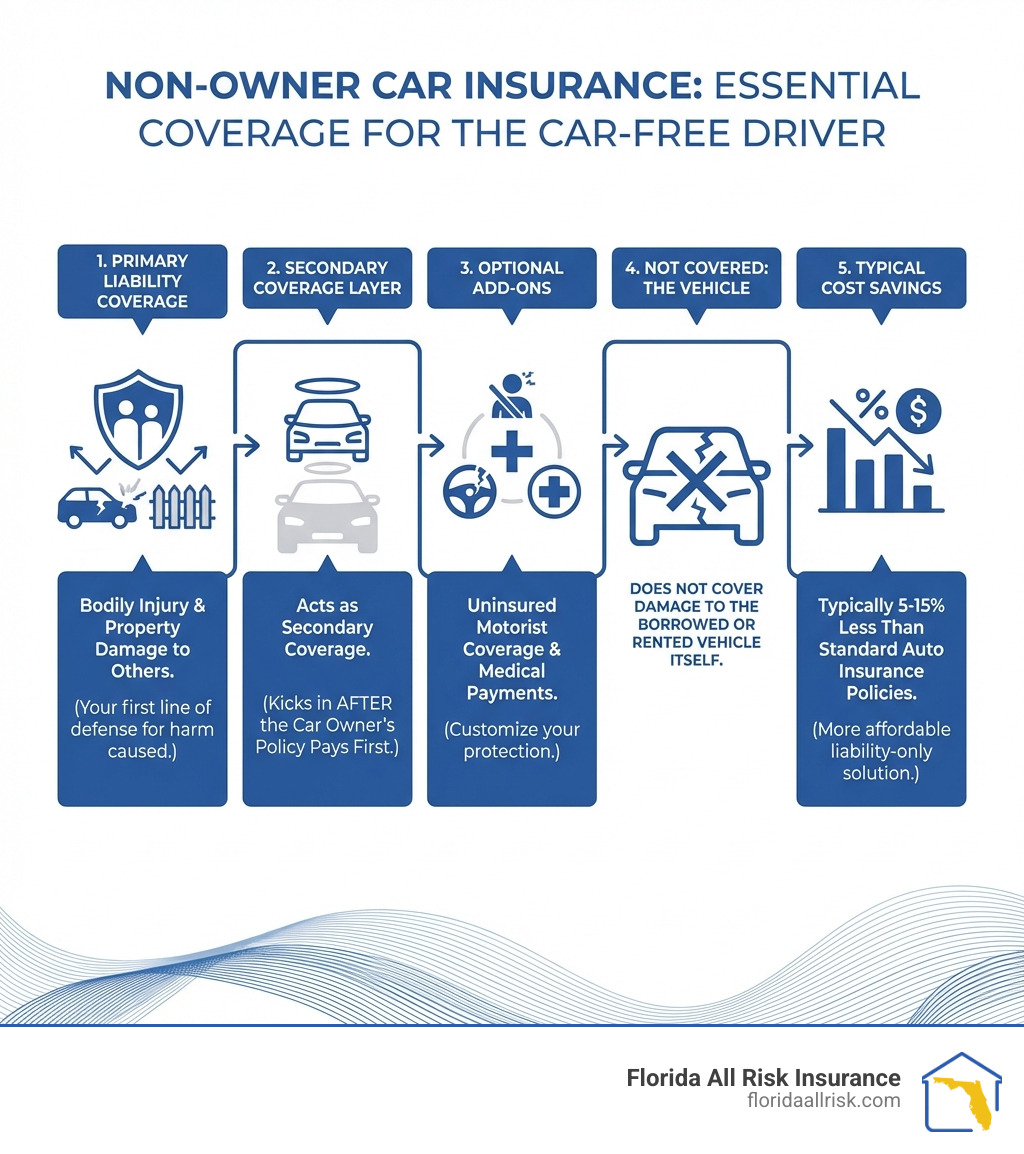
Your non-owner car insurance typically acts as secondary coverage. It can kick in to cover costs that exceed the primary policy’s limits. For example, imagine you borrow a friend’s car and cause an accident resulting in $60,000 in medical bills for the other driver and $15,000 in damage to their vehicle, for a total of $75,000. Your friend’s policy has a $25,000 bodily injury liability limit per person and a $10,000 property damage limit. Their insurance would pay out its maximum of $35,000. This leaves a $40,000 shortfall. If your non-owner policy has limits of $50,000/$100,000/$50,000, it could cover the remaining $40,000. Without it, you might be personally sued and held responsible for that amount.
This secondary layer of protection can be invaluable, helping shield you from significant out-of-pocket expenses and potential lawsuits. It acts as your personal safety net on the road, no matter whose car you’re driving, and prevents a bad accident from turning into a personal financial catastrophe.
For context on how liability insurance generally works and why it matters, the Insurance Information Institute’s auto insurance overview is a helpful resource.
Who Needs a Non-Owner Policy (And Who Doesn’t)?
Deciding if non-owner car insurance is right for you depends on your driving habits and how often you rely on vehicles you do not own. For certain Florida drivers, it’s an essential and cost-effective solution.

You Should Consider a Non-Owner Policy If…
This specialized coverage is a strong fit for Florida drivers in these situations:
- You frequently rent cars: An annual non-owner policy is often cheaper than purchasing the rental company’s liability insurance for each trip, especially if you rent for more than a few weeks per year. The liability coverage offered at the rental counter can be expensive and may only provide state-minimum limits. Your non-owner policy provides consistent, reliable liability protection that you control. It can complement other protection, such as the rental company’s damage waiver or coverage from your credit card.
- You use car-sharing services: Services that let you access vehicles by the hour or day may provide only basic or complex insurance arrangements. While these services include some insurance, the limits might be low, or the terms might be confusing. A non-owner policy adds a personal layer of liability protection beyond what the service offers, giving you a safety net you can count on.
- You often borrow cars from friends or family: The car owner’s policy is primary, but their limits might not be enough in a serious accident. Filing a claim on their policy could also cause their rates to increase. Your non-owner policy can act as a backup, covering costs that exceed their policy and helping protect both your finances and your relationships by minimizing the financial impact on your friend or family member.
- You want to maintain continuous insurance coverage: Gaps in your insurance history can lead to higher premiums later when you purchase a standard auto policy. Insurers view continuous coverage as a sign of a responsible driver. A non-owner policy helps you avoid these rate hikes when you’re between cars or taking a break from vehicle ownership, potentially saving you hundreds of dollars in the future.
- You need to file an SR-22 or FR-44: If a court or the DMV requires you to file an SR-22 (for certain violations) or an FR-44 (for a DUI conviction in Florida) to reinstate your license but you don’t own a car, a non-owner policy is often the most affordable way to fulfill this legal requirement. You can learn more in our detailed guide on what an SR-22 is in Florida and how it works.
- You are considered a high-risk driver: For drivers with a challenging record, such as past accidents, violations, or a DUI, a non-owner policy can be an affordable way to secure required liability coverage while you work to improve your history. It demonstrates responsibility to insurers and can be a crucial step toward getting back on the road legally and affordably. Our resource on DUI auto insurance in Florida explains how insurers typically evaluate these situations.
You Probably Don’t Need a Non-Owner Policy If…
This policy is not ideal for everyone. You likely don’t need it if:
- You own a car: Your standard auto insurance policy already provides liability coverage for that vehicle and may offer limited protection when you occasionally drive other cars with permission. This is often referred to as “permissive use.”
- You are listed on a household member’s policy: If you live with someone and are listed as a driver on their policy, you are typically covered when driving their insured vehicles. Check the policy details to see if this coverage extends to cars you rent or borrow outside the household. Our guide on auto insurance for families has more details on how household policies work.
- You are covered by a company car for business use: Your employer’s commercial policy should cover you for work-related driving, though the extent of coverage can vary. It is important to clarify with your employer and review the policy, especially regarding any personal use of the company vehicle.
- You drive infrequently: If you only drive once or twice a year, the cost of an annual non-owner policy may not be justified. Relying on the car owner’s primary insurance (with their permission) might be sufficient, provided you understand the limits and exclusions of that coverage and are comfortable with the potential risk.
Florida’s own resources on financial responsibility and insurance, such as information from the Florida Department of Highway Safety and Motor Vehicles, can also help you determine whether ongoing coverage is required in your situation.
What Does Non-Owner Car Insurance Cover (And What Does It Exclude)?
Knowing the specific protections of non-owner car insurance is key. It’s a helpful tool for car-free drivers in Florida, but it has clear strengths and limitations. A non-owner policy helps you meet liability requirements without owning a vehicle and can provide essential backup protection when you borrow or rent a car.
For an in-depth breakdown of how this works in the Sunshine State, see our driver’s guide to non-owner car insurance in Florida and our overview of auto insurance coverage options.
Standard Inclusions: Your Core Liability Protection
The main purpose of non-owner car insurance is liability protection, covering your financial responsibility if you cause an accident while driving a vehicle you do not own.
- Bodily Injury Liability: Helps pay for the medical expenses, lost wages, and pain and suffering of others injured in an accident you cause. It can also help cover legal defense costs if you are sued as a result of the crash.
- Property Damage Liability: Helps cover the cost of repairing or replacing other people’s property you damage in an accident, such as their vehicle, a fence, or other structures.
The specific limits and terms depend on your policy. Choosing limits that reflect your assets and risk tolerance is important, and an independent agent can help you evaluate appropriate levels of protection.
Optional Coverages for Broader Protection
While liability is the core of a non-owner policy, some insurers allow optional coverages for more complete protection in Florida. Availability may vary by carrier, so it is useful to review options carefully.
- Personal Injury Protection Insurance (PIP): Florida is a no-fault state and generally requires PIP on registered vehicles. On a non-owner policy, PIP (when available) can help cover your own medical expenses and a portion of lost wages up to your policy limits, regardless of who is at fault.
- Medical Payments (MedPay): MedPay, when offered with non-owner coverage, can help pay medical expenses for you and any passengers after an accident, regardless of fault. It can supplement PIP benefits or provide additional help where PIP is not applicable.
- Uninsured/Underinsured Motorist (UM/UIM): This coverage helps protect you if you’re in an accident with a driver who has no liability insurance or not enough to cover the damages. In that case, UM/UIM can help pay for your medical bills and other covered losses, subject to your policy limits.
Key Limitations and Exclusions of Non-Owner Car Insurance
It’s crucial to understand what non-owner car insurance generally does not cover:
- Damage to the car you are driving: The policy does not typically pay for repairs to the borrowed or rented vehicle if you are at fault in an accident. Physical damage to the car you are driving is a major exclusion. For rentals, this type of protection usually comes from the rental company’s collision damage waiver (CDW) or your credit card benefits. For a borrowed car, the owner would need to file a claim under their own collision coverage, which could lead to a rate increase and require them to pay a deductible.
- Comprehensive coverage: Non-owner policies generally do not include comprehensive coverage for the vehicle you are driving. That means non-collision damage—such as theft, vandalism, fire, or certain types of weather damage to the vehicle—will not be covered under your non-owner policy. If a tree branch falls on a borrowed car while you have it, your policy won’t pay for the repairs.
- Your own injuries (without optional coverage): Basic liability coverage only applies to injuries and damages you cause to others. You must add available coverages like PIP or MedPay if you want help paying for your own accident-related medical bills. Without these, you would rely on your personal health insurance.
- Personal belongings: Items stolen from or damaged in the car, such as electronics, luggage, or personal effects, are not covered by non-owner auto insurance. This type of loss usually falls under a homeowners or renters policy, if you have one. Always check your specific policy for details on off-premises property coverage.
- Business or rideshare use: A standard non-owner policy is intended for personal use only and will not cover commercial activities such as delivery services or driving for app-based rideshare platforms. Those uses typically require separate commercial or rideshare insurance solutions, as the risk profile is significantly different.
- Vehicles in your household: The policy generally will not cover you if you drive a car owned by someone you live with. Insurers expect you to be listed on that person’s policy if you have regular access to their vehicle.
To understand more about how these coverages work in real-life scenarios, you can review the National Association of Insurance Commissioners’ guidance on understanding your auto insurance options, which offers helpful background on common policy types and limitations.
How Much Does Non-Owner Car Insurance Cost?
One of the best features of non-owner car insurance is its affordability. In Florida, the average monthly premium is around $77, making it a cost-effective solution for car-free drivers.
Generally, a non-owner policy is 5% to 15% cheaper than a standard policy with similar liability coverage. This is because it’s liability-only and covers drivers who are on the road less frequently than typical car owners, which means lower risk for insurers. You can learn more about how rates are calculated in our Auto Insurance Rates Florida guide.
Factors That Influence Your Premium
Your individual premium for non-owner car insurance in Florida will depend on several factors:
- Driving record: A clean record with no accidents or violations leads to lower premiums. A history of tickets, a DUI, or other violations will increase your rates.
- Location: Rates can vary by zip code within Florida based on factors like population density and accident frequency.
- Coverage limits: Choosing higher liability limits or adding optional coverages like UM/UIM will increase your premium but provide greater protection.
- Age and gender: Younger, less experienced drivers typically face higher rates due to statistical risk factors.
- Credit score: In Florida, insurers may use an insurance-based credit score to help determine your premium. A higher score can lead to better rates.
How to Get a Cheap Non-Owner Car Insurance Policy
Finding an affordable policy is straightforward with the right approach:
- Compare quotes: Shop around and get quotes from several insurers, as not all companies offer non-owner policies and rates vary.
- Ask about discounts: Inquire about discounts for a clean driving record, completing a defensive driving course, or bundling with other policies.
- Maintain a clean driving record: Avoiding accidents and tickets is the best long-term strategy for keeping insurance costs low.
- Work with an independent agent: An independent agency like Florida All Risk Insurance provides personalized service by shopping multiple carriers for you. We find the best coverage at the most affordable rate for your needs in St. Petersburg and across Florida.
Frequently Asked Questions About Non-Owner Policies
Here are answers to some of the most common questions about non-owner car insurance.
Can I get car insurance if I only have a driver’s license but no car?
Yes, absolutely. This is exactly what non-owner car insurance is for. It provides the liability coverage you need to legally drive in Florida when you don’t own a vehicle. The policy covers you, the driver, making it ideal for those who borrow, rent, or use car-sharing services. It ensures you meet the state’s financial responsibility laws, as detailed in our Mandatory Car Insurance Florida Guide.
Does non-owner insurance cover rental cars?
Yes, your non-owner car insurance provides liability coverage when you drive a rental car. It covers bodily injury and property damage you cause to others. However, it’s important to know that it does not cover physical damage to the rental car itself. For that, you would need to purchase a Collision Damage Waiver (CDW) from the rental company or use a credit card that offers rental car insurance benefits. For more information, consult this guide from the Insurance Information Institute [external].
Do I need non-owner insurance if I’m listed on someone else’s policy?
Generally, no. If you live with a family member and are listed as a driver on their auto insurance policy, you are likely already covered when driving their car and possibly when driving other non-owned vehicles. Purchasing a separate non-owner policy would probably be redundant.
However, a non-owner policy could still be useful if you frequently drive cars not owned by your household or if you have a personal SR-22/FR-44 filing requirement that the primary policyholder cannot accommodate. Always review the primary policy’s details to understand the extent of your coverage.
Get the Right Non-Owner Coverage in Florida
Navigating car insurance as a car-free driver can feel complicated, but you do not have to figure it out on your own. A non-owner car insurance policy offers essential financial protection and peace of mind for Florida drivers who borrow, rent, or share vehicles. It helps ensure you are covered when you need it most—whether you are borrowing a friend’s car, using a car-sharing service, or renting a car for a weekend trip.
Maintaining continuous coverage with a non-owner policy can also support better rates down the road when you decide to purchase a vehicle and transition to a standard auto policy. By demonstrating consistent, responsible coverage, you may avoid the premium increases that can come with a lapse.
At Florida All Risk Insurance, our independent agents are dedicated to helping you find a policy that fits your situation and driving habits. We can walk you through coverage options, explain how liability limits work, and compare offerings from multiple carriers on your behalf so you can make an informed decision.
For a comprehensive overview of your options in the Sunshine State, you can explore our full Florida non-owner car insurance guide and our resources on auto insurance rates in Florida.
Conclusion
Choosing whether to carry non-owner car insurance comes down to how often you drive, how you access vehicles, and how much financial risk you are willing to accept. If you frequently rent, borrow, or share cars, or you need to maintain continuous coverage or file an SR-22/FR-44 without owning a vehicle, a non-owner policy can be a practical, cost-effective way to protect yourself and meet Florida’s insurance requirements.
Ready to explore your options? Contact Florida All Risk Insurance today for a personalized non-owner car insurance quote and learn how this coverage can fit your lifestyle and budget.
Take the next step toward confident driving—reach out now to speak with an independent agent who can help you compare non-owner policies across multiple insurers and find a solution tailored to your needs.
Contact Us
Florida All Risk Insurance
Address: 700 94th Ave N Ste 300, Saint Petersburg, FL 33702
Phone: (727) 577-4700
Email: [email protected]

