Actual Cash Value Policy: Smart 2026 Choices
Understanding What You’re Actually Covered For
An actual cash value policy determines your insurance payout by calculating what your damaged property is worth today – not what it cost when you bought it.
Quick Answer: Actual Cash Value Explained
- What it is: A valuation method that pays replacement cost minus depreciation
- How it works: Original value – age/wear = your payout
- Key difference: ACV pays depreciated value; RCV pays full replacement cost
- Common use: Personal belongings, older roofs, auto insurance
- Main benefit: Lower insurance premiums
- Main drawback: You may need to pay out-of-pocket to replace items
Imagine a hurricane tears through your neighborhood, ripping shingles off your 10-year-old roof. You file a claim expecting enough money to install a new roof. Instead, your insurer sends a check that covers only half the replacement cost. Why? Your policy uses actual cash value coverage, which factors in your roof’s age and wear.
This confusion happens to Florida homeowners every day. The difference between what you think you’re covered for and what you’ll actually receive can leave you thousands of dollars short during an already stressful time.
Replacement Cost Value, by contrast, pays to replace your property with new items of similar quality – no depreciation deducted. It costs more upfront but provides fuller protection when disaster strikes.
This guide breaks down how actual cash value policies work, how insurers calculate depreciation, and when ACV coverage makes sense versus when you should upgrade to replacement cost protection.
Understanding the Core Concept: What is an Actual Cash Value Policy?
At its heart, an actual cash value policy is a valuation method, not a separate type of insurance. When we talk about an actual cash value policy, we mean the rules your insurer uses to decide how much to pay when something you own is damaged, lost, or stolen.
An actual cash value policy pays the cost of replacing your items, minus depreciation. Depreciation is the decrease in value that happens over time due to age, wear and tear, and obsolescence. This means the payout you receive may be less than what it costs to replace that item with a brand-new one.
While many standard homeowners insurance policies use Replacement Cost Value (RCV) for the home’s physical structure, an actual cash value policy approach is common for personal property. However, certain dwelling components, especially older ones like roofs, might be covered under an actual cash value policy. This is particularly relevant in Florida, where older roofs can significantly impact insurance claims and out-of-pocket costs after storms.
For more information on ensuring adequate home coverage, explore Florida All Risk Insurance’s Florida Homeowners Insurance options.
How ACV Applies to Your Property
An actual cash value policy can apply to various aspects of your home:
- Personal Property: This is where ACV coverage is most commonly found. Items like electronics, furniture, and appliances often fall under an actual cash value policy. If your 10-year-old sofa is destroyed in a fire, an ACV policy would pay the current market value of that 10-year-old sofa, not the cost of a brand new one. The application can be nuanced:
- Clothing: Depreciates very quickly. A five-year-old suit, even if in good condition, may have a very low ACV.
- Collectibles and Antiques: These can be an exception, as they may appreciate in value. These items often require a special endorsement or a separate policy (a ‘floater’) that covers them for an ‘agreed value,’ which is different from ACV or RCV.
- Tools and Equipment: A professional’s tools might retain value better than consumer-grade items, a factor that can be argued during a claim.
- Dwelling Structures: While the main structure is often insured on a replacement cost basis, there can be exceptions. Older roofs are a prime example. If your roof is damaged by a storm 10 years after installation, an actual cash value policy would mean your insurance company pays the depreciated value minus your deductible.
The Legal Standing of ACV
An actual cash value policy represents a widely accepted valuation method within the property and casualty insurance industry. Insurers often use various approaches to determine ACV, sometimes subject to legal interpretation or state regulations.
Some states employ the “broad evidence rule” when determining ACV. This rule allows insurers to consider any evidence that helps establish the actual cash value at the time of loss, including market value, age, condition, use, and replacement cost. Under the broad evidence rule, an adjuster isn’t limited to a simple formula. They can consider the item’s original cost, its condition right before the loss, expert opinions, and the price it might fetch on the open market (market value). This flexibility can be both a benefit and a drawback. If your property was exceptionally well-maintained, you might argue for a higher ACV. Conversely, if the market for that item has collapsed, the insurer might argue for a lower value, even if the item is relatively new.
While specific legal interpretations vary by jurisdiction, the underlying principle of ACV – replacement cost minus depreciation – remains consistent across the industry. For a deeper dive into legal interpretation, review published opinions such as this one from the Court of Appeals of Wisconsin.
The Math Behind ACV: How Insurers Calculate Your Payout
The core principle of an actual cash value policy is straightforward: it accounts for the inevitable decline in value that most items experience over time. When a claim is filed under an actual cash value policy, the payout is calculated using:
Actual Cash Value (ACV) = Replacement Cost – Depreciation
- Replacement Cost: The cost to replace the damaged item with a brand-new one of similar quality at today’s prices.
- Depreciation: The decrease in an item’s value due to age, wear and tear, and obsolescence.
A Practical Example of an ACV Calculation (Personal Property)
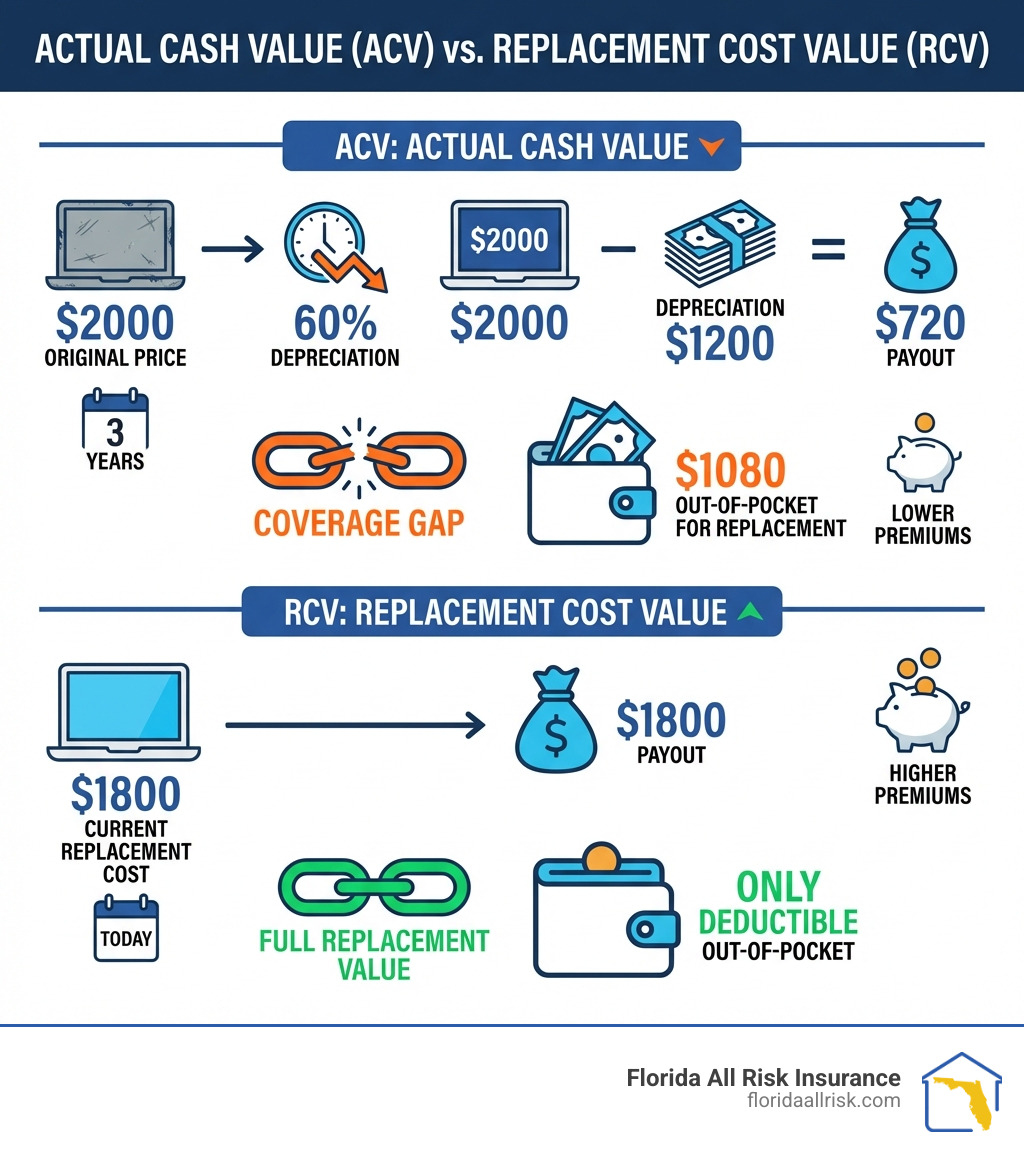
Imagine your laptop, bought three years ago for $2,000, is stolen from your St. Petersburg home. A similar new laptop today costs $1,800. Your insurance company estimates laptops typically have a five-year lifespan.
Here’s the ACV calculation:
- Replacement Cost: $1,800
- Calculate Depreciation:
- Expected lifespan: 5 years
- Age: 3 years
- Percentage used: 60%
- Depreciation: $1,800 × 60% = $1,080
- Calculate ACV:
- ACV = $1,800 – $1,080 = $720
Under an actual cash value policy, you’d receive $720 (minus your deductible). To buy a new laptop at $1,800, you’d pay $1,080 out-of-pocket plus your deductible.
A Practical Example of an ACV Calculation (Roof)
Let’s apply this to a common Florida scenario: a damaged roof. Suppose your 15-year-old asphalt shingle roof is destroyed by a hurricane. The roofer quotes $20,000 to replace it today. Your insurance company determines that this type of roof has an expected lifespan of 25 years.
- Replacement Cost: $20,000
- Calculate Depreciation:
- Expected lifespan: 25 years
- Age: 15 years
- Percentage of life used: 15 / 25 = 60%
- Depreciation Amount: $20,000 x 60% = $12,000
- Calculate ACV:
- ACV = $20,000 (Replacement Cost) – $12,000 (Depreciation) = $8,000
In this case, your actual cash value policy would pay $8,000 (minus your deductible). You would be responsible for the remaining $12,000 to get a new roof installed. This is a primary reason why roof coverage is one of the most contentious parts of Florida homeowners insurance.
How Depreciation is Determined
Insurance companies calculate depreciation using several methods:
- Depreciation Schedules: Insurers maintain schedules assigning expected lifespans to various property types
- Straight-Line Depreciation: Value decreases evenly over the item’s expected life. This is the most common and simplest method, as shown in the examples above.
- Condition Before Loss: Well-maintained items may depreciate less than those showing significant wear. This is a crucial, subjective factor. If you can provide maintenance records showing your 15-year-old roof was meticulously cared for, you might successfully argue that its ‘effective age’ is lower, thus reducing the depreciation amount.
- Obsolescence: Technology items may depreciate faster due to newer models becoming available, a factor separate from simple age or wear.
- Market Trends: Current used-item market values influence calculations, especially for items like vehicles or collectibles.
The goal of an actual cash value policy is to pay the value of the damaged item at the time of loss, considering its age and condition. Learn more from the NAIC explainer on ACV vs RCV coverage.
ACV vs. RCV: A Head-to-Head Comparison
Understanding the difference between an actual cash value policy (ACV) and Replacement Cost Value (RCV) is crucial for any property owner. RCV coverage pays the amount of money it would take to repair or rebuild your current home with the same or similar materials based on today’s prices, without deducting for depreciation. This means you receive the full cost to replace the item regardless of its age or condition, minus your deductible.
Here is a direct comparison:
| Feature | Actual Cash Value (ACV) Policy | Replacement Cost Value (RCV) Policy |
|---|---|---|
| Payout Calculation | Replacement Cost – Depreciation | Full Replacement Cost (no depreciation deducted) |
| Premium Cost | Lower (due to lower potential payout) | Higher (due to higher potential payout) |
| Out-of-Pocket Expense | Potentially significant (to cover the depreciation gap) | Generally lower (only deductible, potentially some upgrades) |
| Best For Whom | Those on a tight budget, owners of older/low-value items, secondary properties | Those seeking fuller financial protection, high-value items, primary residences, those in high-risk areas |
Pros and Cons of an Actual Cash Value Policy
An actual cash value policy has its advantages, primarily related to cost, but it also comes with notable drawbacks.
Pros of an Actual Cash Value Policy:
- Lower Premiums: Because the potential payout from the insurer is lower (due to depreciation), the cost of your insurance policy can be less expensive. This makes ACV coverage appealing to people who want to keep their insurance costs low.
- Budget-Friendly: If you are on a tight budget, an actual cash value policy can provide essential coverage at a more affordable price point, especially for secondary homes or investment properties.
- Sufficient for Low-Value Items: For items that have little value or are easily replaceable at a low cost, an ACV payout might be perfectly adequate.
- Flexibility for Older Items: If you have many older items that you do not necessarily plan to replace with brand new versions, an ACV policy might align with your intentions.
Cons of an Actual Cash Value Policy:
- Payout Gap: The most significant disadvantage is that an actual cash value policy may not provide a payout that is sufficient to fully replace your damaged, lost, or stolen property with a brand-new version. You will likely face out-of-pocket expenses to cover the difference.
- High Out-of-Pocket Costs: If a major loss occurs, you could end up paying thousands of dollars to replace depreciated items or repair damages, even after receiving your insurance payout.
- May Not Fully Restore Property: Especially for dwelling components like roofs, an ACV payout might only cover a fraction of the cost to replace it, leaving you with a significant repair bill or a less durable replacement.
- Potential for Disputes Over Value: Determining depreciation can sometimes lead to disagreements between policyholders and insurers, as the “condition” of an item can be subjective.
Pros and Cons of Replacement Cost Value (RCV)
Replacement Cost Value (RCV) policies offer a different approach, prioritizing more complete restoration over lower premiums.
Pros of Replacement Cost Value:
- Fuller Replacement: RCV policies pay the cost to repair or replace your damaged property using materials of a like kind and quality, without deducting for depreciation. This means you can replace a 10-year-old item with a brand new one of similar quality.
- Financial Security: You get the reassurance of knowing that if a significant loss occurs, you will have support to restore your property closer to its pre-loss condition, without the same level of financial strain that can come with ACV.
- Peace of Mind: This coverage offers greater financial protection, allowing you to more easily replace lost items and rebuild your life after a disaster.
- Easier Recovery: With RCV, you are not scrambling as much to make up the difference between your payout and the cost of new items, which can simplify the recovery process.
Cons of Replacement Cost Value:
- Higher Premiums: Because RCV offers a higher potential payout, the premiums for these policies are generally higher than for ACV policies.
- May Require Proof of Replacement for Full Payout: Some RCV policies operate on a two-part payment system. They might initially pay out the ACV, and then issue a second payment for the remainder (the depreciation holdback) once you provide proof that you have actually replaced or repaired the item. This two-part payment process is a critical detail to understand. The initial check for the ACV allows you to begin repairs or start shopping for a replacement. The second payment, known as the ‘recoverable depreciation,’ is only released after you’ve completed the work and submitted receipts to the insurance company. This system is designed to ensure that the policyholder actually uses the funds to restore their property as intended. However, it also means you may need to front the money for the depreciation gap temporarily. Some policies have a time limit (e.g., 180 days) by which you must complete the repairs to claim the recoverable depreciation, so it’s vital to act promptly.
Beyond Standard RCV: Exploring Other Options
For even greater protection, especially in areas like Florida that are prone to natural disasters, there are improved versions of RCV coverage that you can discuss with an agent:
- Extended Replacement Cost: This is an add-on that provides an additional percentage (typically 20% to 50%) of coverage above your dwelling’s base replacement cost limit. It is designed to help if rebuilding costs surge after a widespread disaster (for example, a hurricane) due to increased demand for labor and materials. The value of Extended Replacement Cost cannot be overstated in a post-disaster environment. After a major hurricane hits a populated area in Florida, the demand for building materials (lumber, shingles, drywall) and skilled labor (roofers, contractors) skyrockets. This ‘demand surge’ can inflate rebuilding costs by 20%, 30%, or even more, far exceeding a standard policy limit. Without this extension, you could find yourself underinsured even with an RCV policy, simply due to market conditions. For example, if your home is insured for $300,000 and you have 25% extended replacement cost, you could receive up to $375,000 for rebuilding, subject to policy terms.
- Guaranteed Replacement Cost: This is one of the most comprehensive options, agreeing to pay the cost to rebuild your home as it was before an incident, even if it exceeds your policy limit, when available. This can be valuable if construction costs rise unexpectedly. However, guaranteed replacement cost coverage is not available in every state or from every insurance company, and it is becoming increasingly rare and expensive, especially in high-risk states like Florida.
- Modified Replacement Cost: Often offered for older homes with unique or ornate features that would be prohibitively expensive to replace exactly, modified replacement cost focuses on “functional replacement.” This means it pays to rebuild or repair with current-day materials and construction methods that serve the same function, rather than an exact replica of the original, which might include standard molding, drywall, and modern fixtures. This is a compromise that allows owners of historic or custom homes to get functional, modern repairs without paying the extreme premium for a true like-for-like replacement of materials that may no longer be available.
These advanced options can be particularly important for businesses as well. To learn more about protecting your business assets, visit Florida All Risk Insurance’s Commercial Property Insurance page.
Making the Right Choice: When to Choose ACV or RCV
Deciding between an actual cash value policy and RCV requires careful consideration of several factors:
- Budget: How much can you afford in annual premiums?
- Risk Tolerance: Are you comfortable with potential out-of-pocket expenses after a loss?
- Value of Belongings: Do you have high-value, newer items or mostly older property?
- Mortgage Requirements: Many lenders require RCV coverage for dwelling structures
- Personal Savings: Can you cover the depreciation gap under an ACV policy?
Scenarios Where an Actual Cash Value Policy Might Be a Smart Move
An actual cash value policy can be suitable when:
- Tight Budget: Keeping premiums low is your top priority
- Secondary Properties: For rental or vacation homes with less valuable possessions
- Older Items: Your home has older items you wouldn’t replace with new versions
- High Savings: You have funds to cover the difference between ACV payout and replacement costs
- Minimal Belongings: You have few personal possessions
When Replacement Cost is the Wiser Investment
RCV coverage is often wiser for:
- Primary Residence: Ensure you can rebuild without severe financial strain
- High-Value Belongings: Expensive electronics, furniture, or art need full replacement coverage
- Low Risk Tolerance: You want peace of mind against significant out-of-pocket expenses
- Mortgage Requirements: Lenders often mandate RCV coverage
- Disaster-Prone Areas: In Florida, with hurricane and storm risks, rebuilding without major financial burden is crucial
For comprehensive protection, consider pairing homeowners coverage with flood protection. Learn more on Florida All Risk Insurance’s Flood Insurance page.
Frequently Asked Questions about Property Valuation
We often get asked similar questions about ACV and RCV. Here are some of the most common, along with straightforward answers you can use when reviewing your own policy.
How do I know if my policy uses ACV or RCV?
The simplest way to determine whether your policy uses ACV or RCV is to check your home insurance declarations page. This summary document outlines your coverage types and limits. Look for wording such as “replacement cost” or “actual cash value” under both dwelling and personal property sections.
If the information is not clearly stated, the best course of action is to contact your insurance agent directly. They can explain the specifics of your policy, including how personal property and dwelling coverage are valued. It is common for personal property to be covered by an actual cash value policy, while the dwelling structure itself is covered by RCV, but you should always confirm the details of your own contract.
Can I negotiate an ACV settlement from my insurer?
Yes, you can negotiate an ACV settlement if you believe the initial offer is too low. Insurance adjusters determine claim costs, subtracting depreciation for ACV calculations, but their initial assessment may not always reflect the most accurate depreciated value.
Here is how you can approach it:
- Provide Evidence of Value: Gather receipts, photos, and any records of maintenance or upgrades for the damaged item. This helps show its original value and condition.
- Request the Insurer’s Depreciation Schedule: Ask your insurer for a copy of the depreciation schedule they used for your specific item. This can help you understand their calculation and identify any discrepancies.
- Get an Independent Appraisal: For larger or more valuable items, consider getting an independent appraisal to provide an outside estimate of the item’s actual cash value.
- Highlight Condition: Emphasize the good condition of the item prior to the loss, if applicable, to argue for less depreciation.
Can I upgrade my policy from ACV to RCV?
Absolutely. Most insurance companies allow you to upgrade your personal property coverage from an actual cash value policy to Replacement Cost Value by adding an endorsement to your policy. This will increase your premium, but it provides significantly more protection. You can typically make this change at your policy renewal, but many insurers will allow a mid-term change as well. It’s a conversation worth having with your agent, especially if you’ve recently acquired new, valuable items or if your financial situation has changed, allowing you to afford the higher premium for greater peace of mind. For dwelling coverage, especially on older homes, insurers may be more restrictive and might require an inspection before agreeing to switch an ACV roof provision to RCV.
Does ACV apply to auto insurance policies?
Yes, an actual cash value policy is the norm in auto insurance when it comes to physical damage coverage. If your vehicle is totaled or stolen, an ACV auto policy will typically pay the current market price for that specific make, model, and year of the vehicle, considering its age, mileage, and condition. It does not pay the cost of a brand-new car.
Because vehicles depreciate quickly, this is also why “gap insurance” is often recommended for new car purchases or leases. Gap insurance is designed to cover the difference between what you owe on a car loan and the car’s actual cash value, which can become significant in the first few years of ownership.
To understand your options for protecting your vehicle and how ACV would work for your auto policy, visit Florida All Risk Insurance’s Auto Insurance page.
Conclusion
Navigating the intricacies of an actual cash value policy versus Replacement Cost Value is critical for securing your financial well-being. While an actual cash value policy offers lower premiums, it comes with higher out-of-pocket expenses due to depreciation. RCV provides more comprehensive protection and peace of mind at a higher premium.
The choice depends on your circumstances, budget, risk tolerance, and asset value. For most Florida homeowners, especially those with primary residences and valuable belongings, RCV often ensures full recovery after a loss.
Navigating these options can be complex, which is why working with an independent agency like Florida All Risk Insurance is beneficial. We help you understand your options, compare policies from multiple carriers, and find the perfect balance of coverage and cost. To ensure adequate property protection, it’s crucial to have the right Florida Homeowners Insurance.
Don’t wait for disaster to find you’re underinsured. Contact us today to Get a Quote and review your coverage with one of our expert agents. We’re committed to helping our neighbors in St. Petersburg and across Florida find coverage that truly meets their needs.
Florida All Risk Insurance
Address: 333 3rd Ave N Suite 300, Saint Petersburg, FL 33701
Phone: (727) 877-2280
Email: [email protected]