

Do you need workers compensation insurance: 1 Crucial 2026
Introduction: Decoding Workers’ Comp for Your Business
Do you need workers compensation insurance? The short answer is: if you have employees, almost certainly yes. Most states require workers’ compensation insurance as soon as you hire your first employee, and the penalties for non-compliance can be severe—including fines, stop-work orders, and personal liability for workplace injuries.
Quick Answer: Workers’ Compensation Requirements at a Glance
| Your Situation | Do You Need Coverage? |
|---|---|
| You hire your first employee (most states) | Yes |
| You’re a sole proprietor with no employees | Generally no (except for licensing in some trades) |
| You have part-time or seasonal workers | Yes (same as full-time employees) |
| You work with independent contractors | Depends on proper classification |
| You’re a corporate officer or LLC member | Varies by state and industry |
| You operate in construction (California, Florida) | Yes (often from the first employee) |
Workplace injuries happen. A slip, a fall, a repetitive motion injury—any of these can result in medical bills, lost wages, and potential lawsuits. Workers’ compensation insurance is a no-fault system designed to protect both employees and employers. It covers medical care and lost wages for injured workers while shielding business owners from devastating lawsuits.
But the rules aren’t simple. Requirements vary dramatically by state, industry, and business structure. The definition of “employee” can be surprisingly broad, and misclassifying workers as independent contractors carries serious legal and financial risks.
The stakes are high. According to the National Safety Council, the average workers’ compensation claim costs $42,000. Without insurance, that’s coming directly out of your pocket—along with potential penalties that can be twice what you would have paid in premiums, or $1,500 per employee in California.
Many Florida business owners face confusion about when coverage is truly required. Construction businesses face different rules than retail shops. Corporate officers may be exempt in some cases but not others. And the line between employee and independent contractor has become increasingly blurred and heavily scrutinized.
I’m Jason Miller, and I’ve spent over 20 years helping Florida businesses steer these exact questions, including determining whether do you need workers compensation insurance for your specific situation. At Florida All Risk Insurance, I’ve worked with thousands of business owners to ensure they have the right protection in place—before an accident happens.
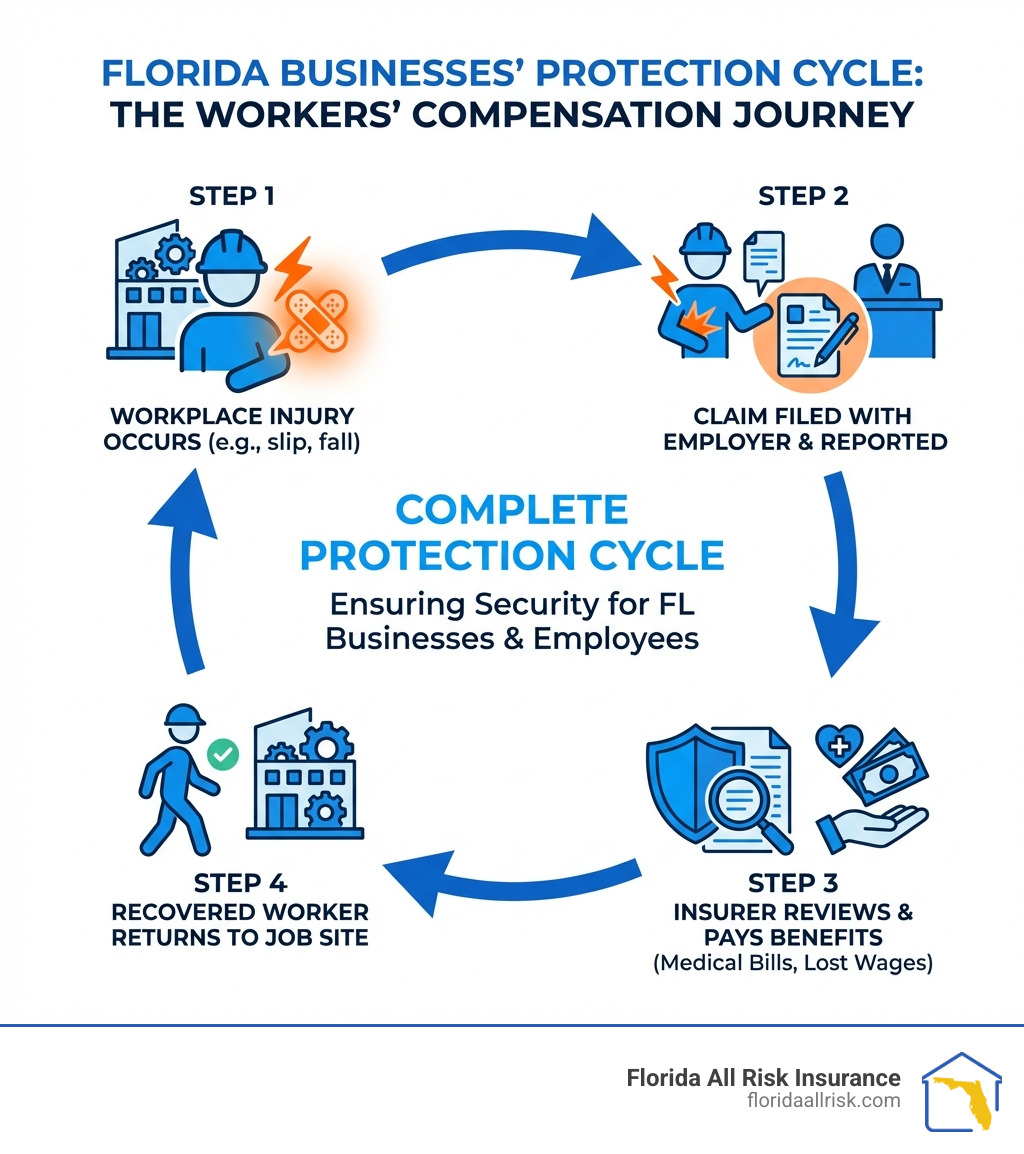
Quick look at do you need workers compensation insurance:
Who Needs Workers’ Comp? The Fundamental Rules for Employers
Navigating the landscape of workers’ compensation can feel like trying to find your way through a maze blindfolded. But at its core, the requirement for workers’ compensation insurance hinges on one crucial factor: employees. If your business employs even one person, the question of “do you need workers compensation insurance” shifts from a debate to a legal mandate in most places.
The moment you hire your first employee, a timer starts ticking. While the exact threshold varies by state, many, including Florida, have clear guidelines. This isn’t just about protecting your team; it’s about safeguarding your business’s future. An unforeseen workplace injury could lead to astronomical medical bills, lost wages, and potentially devastating lawsuits if you’re not properly insured.
Your business structure also plays a role. Whether you operate as an LLC, S-corp, C-corp, or partnership can influence how workers’ comp applies to owners and officers. Understanding these nuances is key to protecting your personal and business assets. It’s not just about meeting a legal requirement; it’s about smart risk management.
Do you need workers compensation insurance for all employee types?
When we talk about employees, it’s easy to picture full-time staff. However, the legal definition of an employee for workers’ compensation purposes is often much broader. If you’re asking, “do you need workers compensation insurance for part-time, seasonal, or even family members on your payroll?”, the answer is almost always a resounding yes.
In Florida, and across many states, workers’ compensation laws typically don’t distinguish between full-time, part-time, or seasonal employees. If someone is on your payroll and working for your business, they are generally considered an employee, and you are legally obligated to provide coverage. This means that your summer intern, your weekend cashier, or even your cousin helping out during a busy period, all fall under the umbrella of requiring workers’ compensation coverage.
The U.S. Department of Labor provides a comprehensive overview of Workers’ Compensation laws, highlighting the importance of understanding who qualifies as an employee. Ignoring these classifications can lead to severe penalties, turning a well-intentioned but uninsured helping hand into a significant liability.
Are Business Owners and Sole Proprietors Exempt?
This is where things can get a little tricky, especially for small business owners and startups. If you’re a sole proprietor or a partner in a partnership with no employees, you might assume you don’t need workers’ compensation for yourself. And often, you’d be right. Generally, sole proprietors and partners are not automatically covered by workers’ compensation laws and are often exempt from mandatory coverage for themselves.
However, this exemption comes with caveats. In some cases, such as certain trades requiring contractor licenses, even a sole proprietor without employees might need to show proof of workers’ comp coverage to obtain or maintain their license. For example, some states require this for construction contractors, even if they’re a one-person operation.
For corporate officers or members of LLCs, the situation can vary. In Florida, corporate officers in non-construction industries with fewer than four employees can often opt out of coverage for themselves. However, they might also choose to be covered voluntarily. This “election of coverage” can be a smart move, as it provides them with the same benefits as employees if they suffer a work-related injury, saving them from having to rely solely on personal health insurance, which may not cover work-related incidents.
The decision of whether to cover yourself, even if exempt, boils down to risk assessment. While personal health insurance covers general health needs, it typically excludes injuries sustained during work. Workers’ comp specifically addresses work-related medical expenses, lost wages, and rehabilitation, offering a more custom safety net for on-the-job incidents. We often advise our clients to carefully weigh the risks and benefits of opting for coverage, even when not legally required.
The Independent Contractor Puzzle: A High-Stakes Classification
Perhaps one of the most complex areas in workers’ compensation is the distinction between an employee and an independent contractor, often referred to as “1099 workers.” Many businesses engage independent contractors to gain flexibility and potentially reduce overhead, including avoiding workers’ compensation premiums. However, misclassifying a worker as an independent contractor when they are legally an employee is a high-stakes gamble with severe consequences.
State and federal agencies are increasingly scrutinizing these classifications, and the penalties for misclassification can be substantial, including back taxes, fines, and being held responsible for workers’ compensation benefits if the misclassified worker is injured.
The core of distinguishing between an employee and an independent contractor lies in control:
- Behavioral Control: Does your business control or have the right to control what the worker does and how the worker does their job?
- Financial Control: Does your business control the business aspects of the worker’s job, such as how the worker is paid, whether expenses are reimbursed, or who provides tools/supplies?
- Relationship of the Parties: Are there written contracts describing the relationship? Does the worker receive benefits? Is the relationship permanent? Is the worker performing a key aspect of your business?
Many states, including Florida, often use a variation of the “ABC test” or a multi-factor test to determine worker status. The presumption is often that a worker is an employee unless proven otherwise. If an agency determines you’ve misclassified a worker, you could face state audits, significant legal penalties, and be liable for any injuries they sustained. This is why understanding the nuances is critical when considering “do you need workers compensation insurance” for those you engage. For a deeper dive into this intricate topic, our 1099 Workers’ Comp Complete Guide offers valuable insights.
Florida Focus: Workers’ Compensation Requirements in the Sunshine State
Now that we’ve covered the general principles, let’s zoom in on what truly matters to our clients in St. Petersburg and across Florida. The Sunshine State has its own unique set of rules and regulations when it comes to workers’ compensation, managed primarily by the Florida Division of Workers’ Compensation, under the Department of Financial Services. These rules dictate not only who needs coverage but also how it’s enforced and the specific industry standards that apply.
Florida’s system is designed to ensure that injured workers receive prompt medical care and wage replacement benefits, while employers are protected from costly lawsuits. However, compliance is not optional. The state takes its workers’ compensation laws very seriously, with strict enforcement and significant penalties for non-compliance. Understanding these Florida-specific nuances is paramount for any business operating here.
Florida’s Employee Thresholds by Industry
Florida’s workers’ compensation requirements are not a one-size-fits-all scenario. They vary significantly depending on your industry and the number of employees you have. This is a critical detail for every Florida business owner to grasp when asking, “do you need workers compensation insurance?“
- Construction Industry: This is perhaps the strictest category. If your business is in the construction industry, you are required to carry workers’ compensation insurance if you have one or more employees. This includes corporate officers, even if they’re the only employees. The high-risk nature of construction work mandates this lower threshold to protect workers and mitigate risks.
- Non-Construction Industry: For most other businesses—retail, hospitality, professional services, etc.—the threshold is higher. You are required to have workers’ compensation insurance if you have four or more employees. This count typically includes corporate officers and LLC members unless they have filed for a specific exemption.
- Agricultural Industry: Agriculture also has its own distinct rules. Employers in this sector must carry workers’ compensation insurance if they have six or more regular employees or twelve or more seasonal workers who work for 30 days or more.
These thresholds apply to all types of employees, whether full-time, part-time, or seasonal. For the most up-to-date and official information on Florida’s specific requirements, you can always refer to Florida’s official coverage requirements from the Department of Financial Services.
Special Considerations for Florida’s Construction Businesses
Florida’s construction industry is a vibrant and essential part of our economy, but it also faces some of the most stringent workers’ compensation requirements. Due to the inherent dangers and high-risk nature of construction work, the state has implemented stricter rules to protect workers and ensure accountability.
As mentioned, any construction business in Florida with one or more employees is legally mandated to carry workers’ compensation insurance. This applies whether you’re building skyscrapers or repairing a residential roof. Furthermore, there are specific considerations for subcontractors. Even if you hire a subcontractor, you might be held responsible for their workers’ compensation coverage if they don’t have their own. This is why many general contractors require their subcontractors to provide proof of coverage, often demanding specific limits and naming the general contractor as an additional insured.
Proof of coverage is also often required for obtaining permits and maintaining licensing with various state and local boards. Without proper workers’ comp, your construction business could face delays, fines, and even project shutdowns. Given the complexities and the potential for high-cost claims in this sector, understanding your Workers’ Comp Rate Florida is crucial for accurate budgeting and competitive bidding. We specialize in helping Florida construction businesses steer these unique challenges to secure comprehensive and compliant coverage.
How to Obtain a Workers’ Comp Exemption in Florida
While most employers in Florida are required to carry workers’ compensation, there are specific circumstances under which certain individuals can obtain an exemption. This primarily applies to owners, corporate officers, and LLC members, but it’s not a universal pass.
For corporate officers of non-construction businesses (those with fewer than four employees), and for certain LLC members, you may be eligible to file for an exemption from coverage for yourself. This means you would not be counted towards the employee threshold for mandatory coverage, nor would you be covered by the policy if you were injured.
To obtain an exemption, eligible individuals must apply online through the Florida Department of Financial Services. The process involves submitting an application and ensuring you meet all the specific criteria. It’s not a one-and-done deal; exemptions often have renewal requirements, and it’s your responsibility to keep them current.
It’s vital to understand the consequences of working with an invalid or expired exemption. If you’ve opted out of coverage for yourself and then suffer a work-related injury, you would typically not be eligible for workers’ comp benefits. More critically, if your exemption is found to be invalid and you were supposed to be covered, your business could face penalties for being underinsured or uninsured, in addition to the personal financial burden of your injury. Always consult with us to ensure your exemption status is valid and appropriate for your business needs.
The High Stakes of Non-Compliance: What Happens If You Skip Coverage?
Ignoring the question of “do you need workers compensation insurance” can lead to catastrophic consequences for your business. It’s not just a minor oversight; it’s a direct violation of state law that carries severe legal, financial, and even reputational repercussions. For a business in Florida, being caught without required workers’ compensation coverage can quickly spiral into financial ruin, business closure, and in some egregious cases, even criminal liability. It’s a risk simply not worth taking.

Financial Penalties and Stop-Work Orders
The state of Florida takes a very dim view of businesses operating without mandatory workers’ compensation insurance. The financial penalties alone can be staggering. While specific figures can vary, fines are typically substantial. For instance, some states impose penalties that can be twice the amount of the workers’ compensation premiums the employer would have paid during the period of non-compliance. In addition to fines, Florida’s Division of Workers’ Compensation has the authority to issue stop-work orders.
A stop-work order forces your business to cease all operations immediately until you can prove you have obtained the required coverage. Imagine the impact on your cash flow, your projects, and your employees if your doors are suddenly forced shut. This immediate halt to operations can lead to significant business interruption costs, lost revenue, and damage to your reputation that can be incredibly difficult to recover from. In severe cases, particularly if non-compliance is willful or repeated, it can even lead to misdemeanor or felony charges, potentially resulting in jail time for business owners.
Personal Liability for Workplace Injuries
Beyond state-imposed fines and stop-work orders, the most terrifying consequence of not having workers’ compensation insurance is the personal liability you would face if an employee is injured on the job. Without a policy, all costs associated with a work-related injury fall directly onto your shoulders. This means you would be personally responsible for:
- Medical Bills: From emergency room visits and surgeries to ongoing physical therapy and prescription medications, these costs can quickly reach hundreds of thousands of dollars. The average workers’ compensation claim costs $42,000, according to the National Safety Council data on claim costs. Imagine paying that out of your personal bank account!
- Lost Wages: You would be responsible for compensating your injured employee for the income they lose while recovering and unable to work.
- Disability Benefits: If the injury results in a temporary or permanent disability, you could be on the hook for long-term disability payments.
- Civil Lawsuits: Without workers’ comp, your employees retain the right to sue you directly for negligence, pain and suffering, and other damages. A single lawsuit could wipe out your business and personal assets.
This level of personal financial exposure is a risk no Florida business owner should be willing to take. Workers’ compensation insurance acts as a crucial shield, protecting your business and personal wealth from these potentially bankrupting costs.
What Happens to an Employee If Their Employer Is Uninsured?
While the penalties for uninsured employers are severe, we also need to consider the devastating impact on the injured employee. If an employer fails to carry required workers’ compensation insurance, the employee is left in a precarious and often desperate situation.
In Florida, if an employer is uninsured and an employee is injured, the worker generally has two main avenues, neither of which is ideal:
- State Uninsured Employers’ Funds: Florida has mechanisms in place to assist injured workers whose employers were illegally uninsured. However, accessing these funds can be a complex, lengthy, and frustrating process. Benefits may be delayed, and the worker might face significant financial hardship while waiting for their claim to be processed.
- Legal Action Directly Against the Employer: The injured employee can pursue legal action directly against the uninsured employer. This often means a civil lawsuit to recover medical expenses, lost wages, and other damages. While this can eventually lead to compensation for the employee, it puts an immense burden on them to steer the legal system, often while dealing with their injury.
The lack of insurance can lead to delayed medical care, personal financial hardship for the worker, and significant stress during an already difficult time. It also complicates their return to work, as the structured support and rehabilitation services often provided by workers’ comp carriers are absent. This highlights not just the legal necessity but also the moral obligation of employers to ensure they have the proper coverage.
So, Do You Need Workers Compensation Insurance? A Practical Checklist
After exploring the complexities and potential pitfalls, the ultimate question remains: “do you need workers compensation insurance for your Florida business?” The answer is rarely a simple yes or no. It requires a thoughtful self-assessment and a clear understanding of your operations, your team, and Florida’s specific regulations.
Think of workers’ compensation insurance as a cornerstone of responsible risk management. It provides not just legal compliance but also immense peace of mind, knowing that if an unfortunate workplace accident occurs, both your employees and your business are protected. Being proactive in securing this coverage is a testament to your commitment to your team’s well-being and your business’s longevity.
Here’s a practical checklist to help you determine if you need workers compensation insurance:
- Do I have one or more employees (full-time, part-time, or seasonal)? In Florida, if you’re in construction, one employee triggers the requirement. For non-construction, it’s four or more. Agricultural businesses have specific thresholds.
- Is my business in a state or industry (like construction) with a zero-employee threshold? Florida’s construction industry is a prime example where even one employee means mandatory coverage.
- Are my “1099 contractors” truly independent according to my state’s legal tests? Remember the behavioral, financial, and relationship control factors. Misclassification is a huge risk.
- Does my state require business owners or corporate officers to be covered unless they formally file for an exemption? In Florida, corporate officers in non-construction businesses can often opt out, but it requires a formal exemption.
- Do I want to protect my business from a potentially bankrupting lawsuit? Even if not legally required, covering yourself or your business can be a wise financial decision to avoid personal liability.
Beyond mere compliance, having workers’ compensation insurance offers tangible benefits: it boosts employee morale by demonstrating your commitment to their safety, it can help attract top talent who value comprehensive benefits, and it improves your business’s reputation as a responsible employer. Furthermore, many contracts, especially for larger projects, will require you to show proof of workers’ compensation insurance. For a more comprehensive understanding of this vital coverage, refer to our Workers’ Compensation Insurance Complete Guide.
Conclusion: Making the Right Choice for Your Business and Team
The question of “do you need workers compensation insurance” is a critical one for every Florida business owner. As we’ve seen, it’s a complex landscape shaped by state laws, industry specifics, and the intricate definitions of “employee” versus “independent contractor.” Yet, the message is clear: for most businesses with employees, workers’ compensation insurance isn’t just a good idea—it’s a legal necessity and a fundamental shield against financial catastrophe.
We’ve covered the varying employee thresholds in Florida for construction, non-construction, and agricultural industries, the high-stakes puzzle of independent contractor classification, and the severe financial and legal penalties that await uninsured employers. From hefty fines and stop-work orders to personal liability for medical bills and lost wages, the risks of non-compliance far outweigh the cost of premiums. It’s not just about protecting your bottom line; it’s about fulfilling a moral obligation to your team.
At Florida All Risk Insurance, based right here in St. Petersburg, Florida, we understand these complexities intimately. As an independent agency, we provide personalized service, helping you steer through these intricate rules and find the right coverage from a wide range of carriers. We’re here to ensure your business is not only compliant but also robustly protected against the unexpected. Don’t leave your business’s future to chance.
Protect your business and your team today. Explore your options and ensure you have the right coverage in place before an incident occurs. For Florida businesses, understanding these specific state rules is the first step toward comprehensive protection.
Protect your business today with a comprehensive workers’ comp policy.
Get a personalized workers’ comp quote for your Florida business.
Contact Us
Address: 123 Main Street, Saint Petersburg, FL 33701
Phone: (727) 555-1234
Email: [email protected]

