

The Fair Market Value Policy Explained: How to Determine Value and Why It Matters
Understanding Fair Market Value: A Critical Concept for Florida Homeowners
Fair market value policy is the foundation for determining what your property, assets, and belongings are truly worth in an open market between a willing buyer and a willing seller. Whether you’re filing an insurance claim, donating property for a tax deduction, or settling a legal dispute, understanding fair market value (FMV) protects you financially and ensures you receive fair compensation. The concept of fair market value is not merely a suggestion; it is a rigorous standard used by the Internal Revenue Service (IRS), insurance adjusters, and the court system to ensure that financial transactions are conducted with integrity. In Florida, where property values can fluctuate significantly due to seasonal demand and environmental factors, having a clear fair market value policy is essential for protecting your equity and ensuring that you are not left vulnerable during a claim or legal dispute.
In the Sunshine State, the Florida Office of Insurance Regulation (OIR) plays a pivotal role in overseeing how insurers apply these policies. Florida’s unique landscape—prone to hurricanes and rapid real estate appreciation—makes the fair market value policy a frequent point of discussion during the claims process. Homeowners must be aware that their policy’s interpretation of FMV can be the difference between a full recovery and a significant financial setback. Furthermore, the Florida Homeowner Claims Bill of Rights ensures that policyholders have the right to receive a fair and honest adjustment of their claims, which inherently relies on an accurate determination of fair market value. This regulatory framework is designed to prevent insurers from arbitrarily devaluing assets, especially in the wake of catastrophic events like Hurricane Ian or Idalia, where market conditions can become volatile and traditional valuation metrics may be strained.
Quick Answer: What is a Fair Market Value Policy?
- Definition: The highest price an asset would sell for in an open, unrestricted market between knowledgeable parties acting independently, with neither under pressure to transact
- Key Components: Willing buyer, willing seller, reasonable knowledge of facts, no compulsion to act, arm’s length transaction
- Common Uses: Insurance claims (determining payouts), tax deductions (charitable donations), legal proceedings (divorce, estates), property assessments
- Florida Relevance: Crucial for homeowners insurance claims, especially in property damage scenarios where actual cash value is calculated
Fair market value differs from simple “market value” or “appraised value” because it assumes specific conditions: both parties are informed, acting in their own interest, free from duress, and given reasonable time to complete the transaction. This standard protects consumers from unfair valuations in insurance settlements, tax assessments, and legal disputes. In the context of Florida’s high-stakes real estate market, these distinctions are not just academic; they represent the actual dollars returned to a homeowner after a loss.
For Florida homeowners, FMV matters most when filing insurance claims after hurricanes, floods, or other disasters. Your policy’s fair market value determines whether you receive adequate compensation to rebuild or replace damaged property. It also impacts property tax assessments, estate planning, and charitable donation deductions. Without a firm grasp of how these values are calculated, homeowners in coastal regions like Pinellas County or inland communities like The Villages may find themselves underinsured against the rising costs of construction and materials.
Without understanding FMV, you risk:
- Accepting lowball insurance settlements that don’t cover actual replacement costs
- Overpaying property taxes based on inflated government assessments
- Missing out on legitimate tax deductions for high-value charitable contributions
- Facing significant financial disputes in divorce or estate proceedings
The Canada Revenue Agency defines fair market value as “the highest price, expressed in terms of money, that a property would bring, in an open and unrestricted market, between a willing buyer and a willing seller who are both knowledgeable, informed, and prudent, and who are acting independently of each other.” This definition, while Canadian, reflects the universal standard used across North America, including in Florida insurance and legal contexts.
I’m Jason Miller, and I’ve been helping Florida families steer complex insurance policies for over 20 years. Throughout my career, understanding the fair market value policy has been essential to ensuring my clients receive proper compensation for their claims and adequate coverage for their homes and assets. This guide will walk you through everything you need to know about FMV, from basic definitions to practical applications in insurance, taxation, and legal matters.
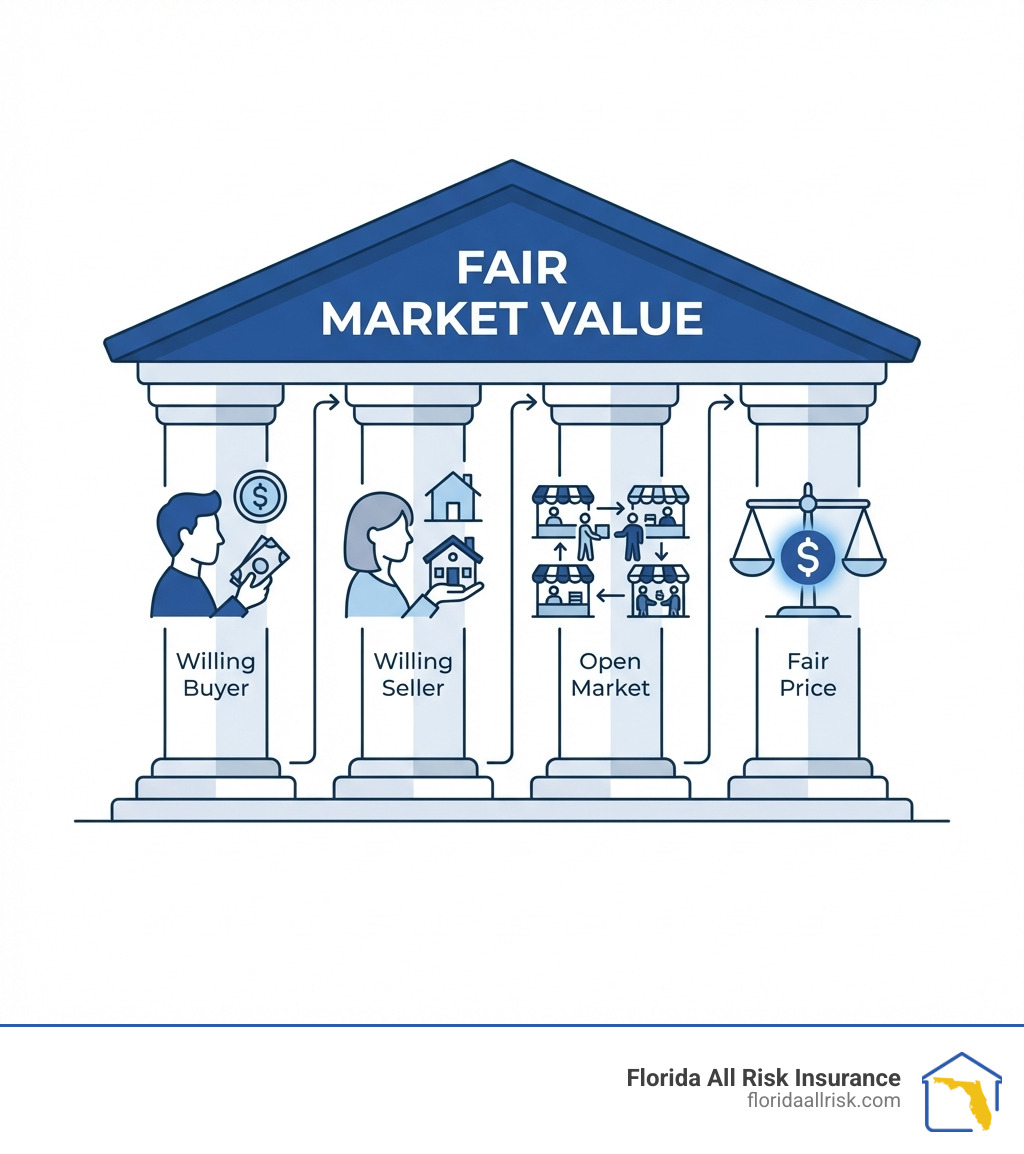
Fair market value policy terms at a glance:
What is Fair Market Value (FMV)? Core Concepts Explained
At its heart, Fair Market Value (FMV) is a concept that seeks to establish a theoretical, yet practical, price for an asset. It’s not just any price; it’s the price that balances the interests of both a buyer and a seller, assuming ideal conditions. This makes it a crucial standard in countless financial and legal scenarios, from buying a home to settling an estate.
Defining FMV: The “Willing Buyer, Willing Seller” Standard
The most widely accepted definition of FMV revolves around the “willing buyer, willing seller” standard. This means:
- Highest Price: It’s the maximum amount an asset would fetch.
- Open and Unrestricted Market: The sale occurs in a competitive environment where multiple potential buyers exist.
- Willing Buyer and Willing Seller: Neither party is forced to buy or sell. They are acting voluntarily.
- Knowledgeable, Informed, and Prudent: Both parties have a reasonable understanding of the asset’s characteristics, its market, and relevant facts. They are making rational decisions.
- Acting Independently/At Arm’s Length: The buyer and seller are not related or unduly influenced by each other. There’s no personal connection or special relationship distorting the price.
- No Compulsion to Act: Neither party is under any pressure (e.g., financial distress, urgent relocation) that would compel them to accept a less-than-ideal price or pay an inflated one.
This definition, articulated in U.S. case law like United States v. Cartwright and used by tax authorities like the IRS, is the bedrock of FMV. The Appraisal Foundation’s Uniform Standards of Professional Appraisal Practice (USPAP) further refines this, stating value is “the most probable price… for which the specified property rights should sell after reasonable exposure in a competitive market under all conditions requisite to a fair sale.” This robust standard ensures that the valuation is as objective and unbiased as possible.
How FMV Differs From Market Value and Appraised Value
While often used interchangeably, FMV, market value, and appraised value have distinct meanings. Understanding these differences is key to navigating financial and legal situations.
| Attribute | Fair Market Value (FMV) | Market Value | Appraised Value |
|---|---|---|---|
| Assumptions | Willing, knowledgeable, prudent parties; arm’s length; no compulsion; reasonable time for transaction. | Price asset would trade for in the open market under current conditions. | An appraiser’s professional opinion of value. |
| Context | Legal, tax, insurance, charitable giving, business valuation. | General commercial transactions, daily trading. | Specific valuation for a purpose (e.g., mortgage, insurance). |
| Objectivity | High – based on theoretical ideal conditions. | Reflects actual, sometimes imperfect, market dynamics. | Subjective opinion of a qualified expert. |
| Primary Use | Establishing a defensible value for non-standard transactions or legal contexts. | Real-time pricing for readily traded assets. | Official estimation for specific financial needs. |
| Key Differentiator | Idealized conditions and knowledgeable parties. | Actual transactional price, possibly influenced by external pressures. | A professional’s judgment, often based on FMV principles. |
As you can see, market value is simply the price an asset would trade for right now, which might be influenced by external pressures or incomplete information. Appraised value, while often aiming to determine FMV, is ultimately the opinion of a single expert. FMV, in contrast, lays out a set of ideal conditions to arrive at the most equitable price.
Key Factors That Influence an Asset’s FMV
Determining FMV isn’t a one-size-fits-all calculation. Many factors can sway the final figure, requiring careful consideration:
- Asset Condition: The physical state of the asset. A well-maintained home will have a higher FMV than one needing extensive repairs.
- Scarcity: Rare or unique items tend to command higher prices.
- Market Demand: How many buyers are actively seeking this type of asset? High demand generally pushes FMV up.
- Restrictions on Use: If an asset’s use is limited (e.g., land zoned only for agriculture, or a conservation easement), its FMV might be lower than its unrestricted potential.
- Location: For real estate especially, “location, location, location” is paramount. A property in a desirable St. Petersburg neighborhood will have a higher FMV than a similar property in a less sought-after area.
- Economic Trends: Broader economic conditions, interest rates, and inflation can all impact asset values.
- Replacement Cost: What would it cost to replace the asset with a new one? This is particularly relevant for insurance claims.
- Highest and Best Use: For real estate, this considers the most profitable use of the property, even if it’s currently used differently. This can be a point of contention, as the Ontario Court of Appeal noted in a case where FMV was interpreted differently based on current versus highest and best use.
- Date of Valuation: Market conditions change, so the specific date FMV is determined is critical.
How FMV is Determined Across Different Asset Types
FMV isn’t just for houses; it applies to virtually any asset you own. The methods for determining it, however, vary significantly depending on what’s being valued.

Valuing Real Estate
For many Florida homeowners, real estate is their most significant asset. Determining its FMV is crucial for sales, purchases, property tax assessments, and insurance.
- Comparable Sales Method (Sales Comparison Approach): This is the most common method. It involves comparing the subject property to recently sold similar properties (comparables) in the same area. Adjustments are made for differences in features, condition, and location. For example, if a neighbor’s identical home sold for $400,000 last month, that’s a strong indicator of your home’s FMV. In Florida, this often requires looking at specific micro-markets, such as waterfront versus non-waterfront properties in Pinellas County.
- Income Capitalization Approach: Used primarily for income-producing properties (like rental homes or commercial buildings), this method converts the property’s expected future income into a current value.
- Cost Approach (Replacement Cost Less Depreciation): This method estimates the cost to rebuild the property new, then subtracts depreciation due to age, wear and tear, and obsolescence. This often sets an upper limit on value. In Florida, the cost approach is particularly relevant for newer constructions or specialized properties, such as those built with specific hurricane-resistant materials or stilt homes in coastal zones. Appraisers must account for the high cost of labor and materials in the current Florida market, which can fluctuate based on regional demand and supply chain availability.
FMV is also critical in property tax assessments in Florida. If you believe your property tax assessment is too high, you can appeal it, often by presenting evidence that your home’s FMV is lower than the assessor’s valuation. In cases of eminent domain, where the government takes private property for public use, FMV determines the “just compensation” due to the property owner. State law outlines how FMV is determined in such cases, helping ensure citizens receive fair treatment.
When considering your Florida Homeowners Insurance, understanding your home’s FMV can help you choose appropriate coverage limits, ensuring you’re adequately protected in case of a total loss.
Valuing Businesses, Stocks, and Bonds
Whether you’re selling a business, transferring shares, or donating securities, FMV plays a vital role.
- Businesses: Valuing a business involves looking at its financial statements, earnings capacity, assets, liabilities, and even intangible assets like goodwill. For closely held corporations, this can be complex, often requiring expert analysis of the company’s economic outlook and position within its industry.
- Stocks and Bonds:
- Publicly Traded Securities: For stocks and bonds actively traded on an exchange, FMV is usually the average of the highest and lowest selling prices on the valuation date. If no sales occurred, specific rules apply, often involving weighted averages of bid and asked prices from nearby dates.
- Closely Held Corporations: Valuing shares in a private company is much harder. It typically involves looking at the company’s financial health, earnings power, industry, and comparable public companies. Tax authorities provide frameworks for these complex valuations, especially for tax purposes.
Valuing Personal Property and Collectibles
From your grandmother’s antique jewelry to your everyday car, personal belongings also have an FMV.
- Household Goods and Used Clothing: For tax deductions, the IRS states that FMV is what a willing buyer would pay for similar items in the condition they are donated, not the original purchase price. Generally, only items in “good used condition or better” are deductible, unless a single item over $500 is appraised.
- Jewelry, Art, and Antiques: These often require specialized expert appraisers due to their unique nature, provenance (history of ownership), and artistic value. An insurance appraisal might differ from an FMV for a charitable donation.
- Cars, Boats, and Aircraft: For vehicles, guides like the Kelley Blue Book are commonly used to determine FMV, distinguishing between trade-in value, private party sale value, and dealer retail. For insurance claims, this is paramount.
Valuing Life Insurance Policies
This might surprise some, but life insurance policies can also have an FMV, particularly for tax and estate planning.
- Cash Surrender Value (CSV): For permanent life insurance policies (like whole life or universal life), there’s typically a cash surrender value, which is what the policyholder would receive if they canceled the policy. Often, the FMV of a permanent policy is considered to be its CSV.
- Beyond CSV: However, the FMV can be higher than the CSV, especially if the insured’s health has deteriorated significantly since the policy was issued. In such cases, the policy becomes more valuable to a potential buyer (e.g., for a life settlement), and its FMV might approach the death benefit. Factors like conversion provisions and current pricing of similar policies also play a role. Actuarial calculations are often needed to determine the precise FMV in these complex situations.
Practical Applications: Where a Fair Market Value Policy is Crucial
Understanding the fair market value policy isn’t just academic; it has real-world implications across your financial life. From safeguarding your home to managing your taxes, FMV is a cornerstone of fair and equitable transactions.
The Role of a Fair Market Value Policy in Insurance
For us at Florida All Risk Insurance, FMV is a daily conversation. When disaster strikes, whether it’s a hurricane hitting St. Petersburg or a car accident, your insurance payout often hinges on the FMV of your damaged property.
- Claim Payouts: Insurance companies use FMV to determine how much they’ll pay for a damaged or lost item. For example, if your car is totaled, the payout will be its FMV right before the accident, not what you originally paid for it or what a brand-new replacement would cost.
- Actual Cash Value (ACV): Many policies, especially for older items, pay out based on Actual Cash Value (ACV), which is typically the FMV minus depreciation. This is why understanding The Lowdown on ACV: How Actual Cash Value Policies Work is so important for our clients.
- Coverage Limits: Knowing the FMV of your home and belongings helps us recommend appropriate coverage limits for your Homeowners Insurance in Pinellas County, Florida. Underinsuring could leave you with significant out-of-pocket costs after a major loss, while overinsuring means paying for coverage you don’t need.
- Total Loss: In a total loss scenario (e.g., your home is completely destroyed), the payout will be based on the FMV of your home, up to your policy limits, unless you have specific replacement cost coverage.
Taxation and Charitable Giving
The IRS is very interested in FMV, especially when it comes to tax deductions.
- Non-Cash Donations: If you donate property (not cash) to a qualified charity, you can often deduct its FMV. However, the IRS has strict rules to prevent overvaluation.
- IRS Publication 561: This crucial guide, available on the IRS website, details how to determine the value of donated property. It outlines methods for valuing everything from used clothing to real estate. You can find this essential IRS guidance on Determining the Value of Donated Property directly from the source.
- Appraisal Requirements: For deductions exceeding $5,000 (or $500 for certain clothing/household items not in good condition), a qualified appraisal and Form 8283 are generally required. The appraisal must be conducted by a qualified appraiser and include specific information like the property’s condition, the valuation method used, and the appraiser’s qualifications.
- Penalties for Overvaluation: The IRS takes overstating value seriously. Penalties can be significant, ranging from 20% to 40% of the tax underpayment if the claimed value is substantially or grossly overstated. We always advise our clients to obtain independent valuations to support their tax credits.
Legal Proceedings: Divorce, Estates, and Eminent Domain
FMV is a critical component in various legal contexts to ensure fairness and proper distribution.
- Divorce Settlements: In Florida, marital assets are often divided equitably. Determining the FMV of assets like real estate, businesses, retirement accounts, and personal property (jewelry, vehicles, household goods) is essential for fair distribution. Expert appraisals are frequently required for complex assets.
- Estate Planning: For inheritance tax purposes, the FMV of assets in an estate must be determined as of the date of death. This affects the tax liability and the distribution to heirs.
- Eminent Domain: As mentioned earlier, when the government exercises its power of eminent domain to acquire private property for public use, the property owner is entitled to “just compensation,” which is based on the FMV of the property. This ensures that Florida citizens are not unfairly deprived of their property’s worth.
Navigating the Fair Market Value Policy: Appraisals and Disputes
Determining FMV, especially for unique or complex assets, often requires professional expertise. Even with clear definitions, disputes can arise, making careful documentation and clear contractual language vital.
The Crucial Role of Qualified Appraisers
A qualified appraiser is your best friend when it comes to establishing FMV. They bring objectivity, expertise, and a structured approach to valuation.
- IRS Definition: The IRS defines a qualified appraiser as an individual with verifiable education and experience in valuing the specific type of property. They must regularly prepare appraisals for compensation and cannot be an “excluded individual” (e.g., the donor, donee, or someone involved in the transaction).
- Professional Standards: Appraisers adhere to professional standards, such as the Uniform Standards of Professional Appraisal Practice (USPAP) set by The Appraisal Foundation. These standards ensure that valuations are consistent, credible, and defensible.
- Impartiality: A key aspect of a qualified appraiser’s role is their impartiality. Their opinion is independent, not influenced by the desires of the buyer, seller, or any other interested party.
- Expert Testimony: In legal disputes, qualified appraisers often provide expert testimony to support their valuations, helping courts make informed decisions.
Understanding a Qualified Fair Market Value Policy Appraisal
When you obtain an appraisal for FMV, especially for tax purposes, it needs to be comprehensive. The IRS outlines specific information that must be included in a qualified appraisal:
- A detailed description of the property, sufficient to identify it.
- The physical condition of any tangible property.
- The date (or expected date) of contribution.
- Any agreements or understandings related to the use, sale, or disposition of the property.
- The name, address, and taxpayer identification number of the appraiser and their employer/firm.
- The qualifications of the appraiser (background, experience, education, professional memberships).
- A statement that the appraisal was prepared for income tax purposes.
- The date (or dates) on which the property was valued.
- The appraised FMV on the date (or expected date) of contribution.
- The method of valuation used (e.g., income approach, comparable sales, replacement cost less depreciation).
- The specific basis for the valuation, such as comparable sales transactions.
Avoiding Disputes: Ensuring Clarity in Contracts
One of the most common reasons for disputes over FMV is ambiguous language in contracts. We’ve seen it happen in real estate deals, business transfers, and even lease agreements with purchase options.
- Contractual Definitions: When drafting agreements, it’s crucial to explicitly define what “fair market value” means in that specific context. Does it refer to the property’s current use, or its “highest and best use” (i.e., its potential for redevelopment)? If the intention is for an “as is” valuation, state it clearly. If it’s for highest and best use, consider incorporating a definition from USPAP, possibly with modifications specific to your transaction.
- Dispute Resolution Mechanisms: To avoid costly litigation, it’s prudent to include a clear dispute resolution mechanism in contracts that rely on FMV. This could involve agreeing to appoint a single independent appraiser, or having each party appoint an appraiser and then using a third appraiser to reconcile differences or average their valuations. This proactive approach can save significant time and money.
Conclusion
The fair market value policy is far more than a dry financial term; it’s a fundamental concept that underpins fairness and equity in countless aspects of our lives, from personal finances to complex legal and tax matters. For us at Florida All Risk Insurance, understanding and applying FMV is integral to protecting our clients, ensuring they receive just compensation for claims, and have appropriate coverage for their most valuable assets. In the complex world of Florida insurance, the fair market value policy serves as a vital safeguard for homeowners. By establishing a clear, objective standard for valuation, it ensures that you are treated fairly by insurance companies, tax authorities, and the legal system alike. Whether you are recovering from a storm or planning your estate, a firm grasp of FMV is your best defense against financial loss.
We’ve explored how FMV is defined by a “willing buyer, willing seller” standard, how it differs from simple market or appraised value, and the myriad factors that influence it. We’ve dug into how FMV is determined for diverse assets like real estate, businesses, personal property, and even life insurance policies. Most importantly, we’ve highlighted its crucial practical applications in insurance claims, taxation, charitable giving, and legal proceedings like divorce and eminent domain in our home state of Florida. Understanding these nuances is particularly important in unique Florida communities, where property values can be influenced by everything from sinkhole activity to proximity to the Gulf of Mexico.
Navigating the nuances of FMV often requires the expertise of qualified appraisers and meticulous attention to detail in contracts. By understanding these principles, you empower yourself to make informed decisions and safeguard your financial well-being. It is important to remember that fair market value is a dynamic figure; it changes as the market evolves, interest rates shift, and local demand fluctuates. Regularly reviewing your insurance coverage in light of current FMV is a proactive step every homeowner should take to avoid being caught off guard by a “valuation gap” during a total loss scenario.
Ready to ensure your assets are properly valued and protected? Explore our home insurance options for The Villages, FL to see how we can help. For a personalized consultation, contact us today and let our team assist you in securing the comprehensive coverage you deserve. Don’t wait until disaster strikes – take action now to protect your most valuable investments with a policy that truly reflects their fair market value. Our team is dedicated to providing the clarity and expertise needed to navigate the often-confusing world of property valuation and insurance law in the Sunshine State.
Whether you’re looking to update your current coverage or shopping for a new policy, our experienced agents can guide you through the process of determining appropriate coverage limits based on your property’s fair market value. Visit our website to learn more about how we can help you save on homeowners insurance while ensuring you have the protection you need. By staying informed and working with professionals who prioritize your interests, you can ensure that your fair market value policy works for you, not against you.
Contact Us:
Florida All Risk Insurance
789 Sunshine Ave, Saint Petersburg, FL 33701
(727) 555-1234
[email protected]

