Temporary Car Insurance Florida: Smart, Legal Ways to Get Short-Term Coverage
Introduction: The Myth and Reality of Short-Term Coverage in the Sunshine State
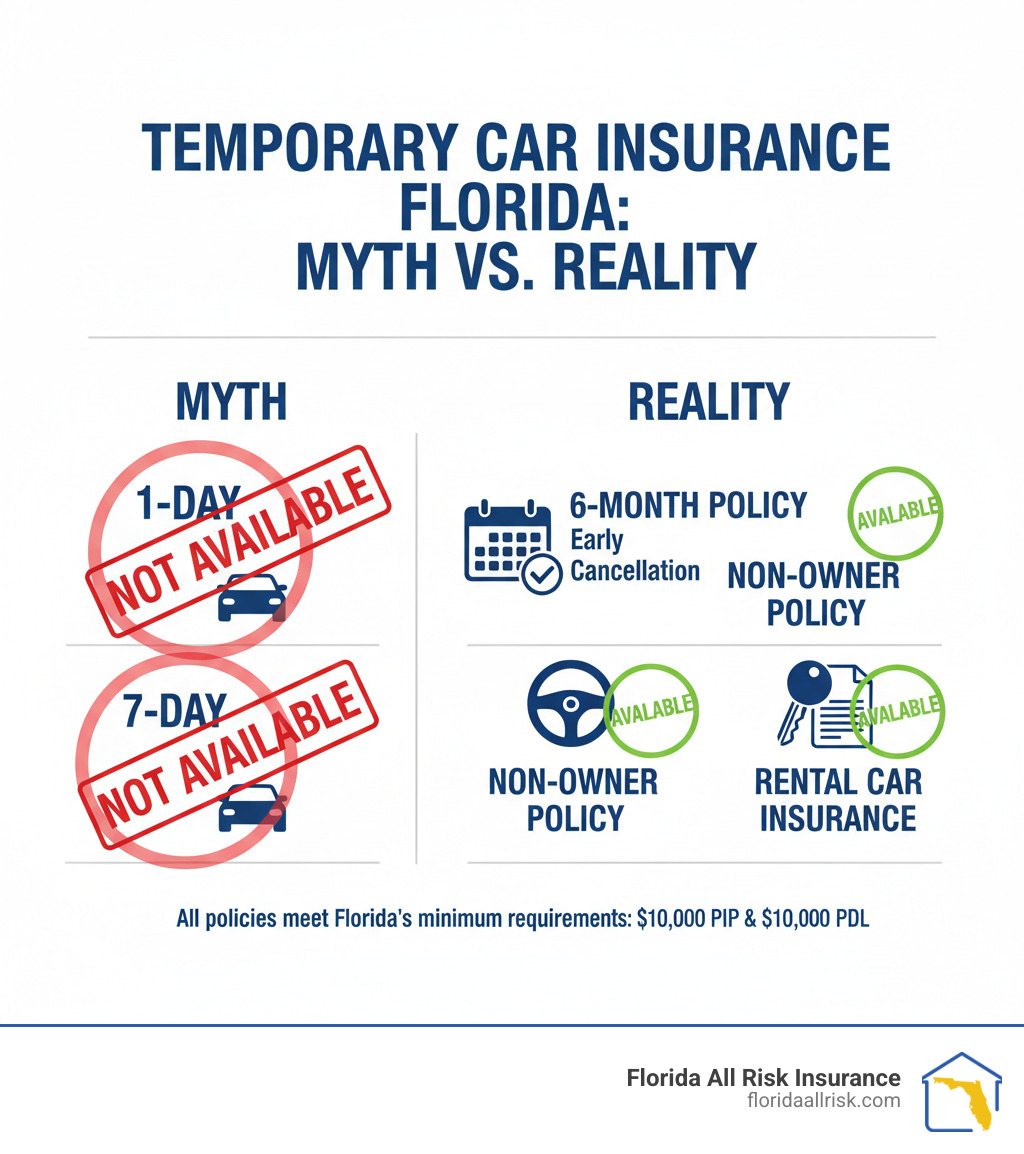
Temporary car insurance Florida is a common search, but true temporary policies for a day, week, or month don’t exist from major insurers in the state. The insurance industry isn’t structured for such short-term risks, and Florida law mandates continuous coverage for registered vehicles. However, there are legitimate workarounds to get the protection you need.
Quick Answer: Your Options for Short-Term Coverage in Florida
- Standard Policy + Early Cancellation: Buy a 6-month policy (the minimum term) and cancel it early for a prorated refund. This is the most common solution for car owners needing coverage for 1-5 months.
- Non-Owner Insurance: If you don’t own a car but drive borrowed or rental vehicles, a non-owner policy provides liability coverage that follows you as a driver. In Florida, the car owner’s PIP generally applies first; a non-owner policy can also help satisfy certain filing needs (such as an SR-22) if required.
- Rental Car Insurance: For very short-term needs (a few days), purchase coverage directly from the rental company.
- Pay-Per-Mile Insurance: For infrequent drivers who own a vehicle, usage-based policies provide continuous coverage at a potentially lower cost.
Any policy placed on a registered Florida vehicle must meet the state minimums: at least $10,000 Personal Injury Protection (PIP) and $10,000 Property Damage Liability (PDL).
Florida’s unique lifestyle—from snowbirds and vacationers to college students home for the summer—creates a real need for flexible auto insurance. The problem is that underwriting short-term risk is expensive for insurers, and state regulations are built around continuous coverage to ensure all drivers are financially responsible. This can be frustrating when you only need protection for a brief period.
Fortunately, legal alternatives exist that provide the short-term protection you need without leaving you exposed to Florida’s strict penalties. The key is to work within the system, whether by strategically canceling a standard policy, opting for non-owner coverage, or using rental insurance.
Driving without the required PIP and PDL coverage on a registered vehicle can lead to license suspension, hefty fines, and reinstatement fees up to $500. A coverage gap can also cause your future premiums to increase by 20% or more.
I’m Jason Miller, and with over 20 years of experience, I’ve helped thousands of Florida drivers find cost-effective solutions for their temporary car insurance Florida needs. This guide will walk you through the best strategies for your situation.
Florida’s Legal Landscape: What Your Short-Term Coverage Must Include
Before exploring any temporary car insurance Florida workarounds, it’s crucial to understand the state’s legal requirements. Florida operates under a “no-fault” insurance system, meaning your own insurance pays for your initial medical expenses after an accident, regardless of who is at fault. This system is designed to speed up claims but comes with strict mandates for all drivers.
The foundation of this system is a concept known as “tort exemption.” In exchange for the rapid payment of benefits from your own PIP coverage, your ability to sue an at-fault driver for non-economic damages (like pain and suffering) is limited. You can only step outside the no-fault system and pursue a lawsuit if your injuries meet a certain legal threshold, such as significant and permanent loss of a bodily function, permanent injury, or death. This makes carrying only the minimum insurance a significant financial gamble.
The Florida Department of Highway Safety and Motor Vehicles (FLHSMV) enforces a continuous coverage requirement through a sophisticated electronic system called the Florida Automobile Insurance Verification System (FAIVS). When you purchase a policy, your insurer is legally required to report it to this database. Likewise, if your policy is canceled or lapses for non-payment, the insurer reports that as well. This allows the state to verify insurance status in real-time, meaning lapses are detected automatically and almost instantly. The penalties for non-compliance are severe, including driver’s license and vehicle registration suspension, plus reinstatement fees that can reach $500. More details can be found on the FLHSMV insurance requirements page.
Understanding Florida’s Minimum Insurance Requirements
Every auto policy in Florida, including any short-term solution, must include two specific types of coverage:
-
Personal Injury Protection (PIP): This is the core of the no-fault system. You must carry a minimum of $10,000 in PIP coverage. It covers 80% of your medical bills and 60% of lost wages up to the policy limit, regardless of who caused the accident. It also covers your children, household members, and passengers without their own PIP. To receive the full benefit, you must seek medical treatment within 14 days of an accident. For more on this, see our guide on Personal Injury Protection insurance.
-
Property Damage Liability (PDL): You are also required to have a minimum of $10,000 in PDL coverage. This pays for damage you cause to someone else’s property in an at-fault accident, such as their car, a fence, or a building.
Notably, Florida does not require Bodily Injury Liability (BIL) for most drivers, which covers injuries you cause to others. However, it is highly recommended. If you are at fault in an accident and the other party’s injuries exceed their $10,000 PIP coverage, they can sue you personally for remaining medical bills, lost wages, and pain and suffering. Without BIL coverage, your personal assets are at risk. When seeking temporary car insurance Florida, adding BIL is a wise investment for your financial protection and should be strongly considered alongside the required PIP and PDL.
The Consequences of a Coverage Lapse
A coverage lapse is any period, even a single day, when a registered vehicle is uninsured. The consequences are automatic and costly:
- License and Registration Suspension: The FLHSMV will suspend your driving privileges and vehicle registration upon detecting a lapse.
- Reinstatement Fees: To restore your license, you must provide proof of new insurance and pay fees starting at $150 for a first offense, rising to $500 for subsequent offenses.
- Higher Future Premiums: A lapse is a major red flag for insurers. Drivers with a recent lapse can expect premium increases of 20% or more, a penalty that can last for three to five years.
- SR-22 Requirement: For serious violations, like causing an accident while uninsured, you may be required to file an SR-22 certificate, which leads to significantly higher insurance rates.
Maintaining continuous coverage is essential. The penalties and long-term costs of a lapse far outweigh any potential savings from dropping your insurance for a short period. The goal is to find a cost-effective way to stay legally protected.
The Best Solutions for Temporary Car Insurance Florida
While you can’t buy a one-week or one-month policy from a major insurer, several legitimate workarounds provide the short-term coverage you need. The key is to find the right strategy for your situation, whether you own a car or not.
For Car Owners: The Standard Policy Workaround
If you own a car and need coverage for one to five months—for example, if you’re a snowbird or a student home for the summer—the most common solution is the “buy and cancel” strategy.
Here’s a step-by-step guide to using this strategy effectively:
- Shop Around: Get quotes from several reputable insurers for a standard six-month policy.
- Inquire About Fees: Before committing, explicitly ask the agent or check the policy documents for the cancellation procedure and associated fees. Ask if they use a flat fee or a “short-rate” penalty. A short-rate penalty means you’ll pay slightly more for the coverage you used than a simple prorated amount, as the insurer recoups some of its initial administrative costs.
- Purchase and Pay: Buy the policy. Some insurers may require the full six-month premium upfront, while others allow monthly payments. Paying in full can sometimes simplify the refund process.
- Set a Reminder: Mark your calendar for the date you plan to cancel the policy. Do not simply stop paying, as this will result in a lapse for non-payment, which is damaging to your insurance history.
- Cancel Properly: Contact the insurer on your chosen date to formally cancel the policy.
- Confirm the Refund: Follow up to ensure you receive the prorated refund for the unused premium, minus any disclosed fees.
By law, the insurer must give you a prorated refund for the unused portion of your premium. For example, if a six-month policy costs $1,104 and you cancel after three months, your cost would be roughly $552, minus any cancellation fees. A single, planned cancellation will not harm your driving record or insurance score, but a pattern of frequent cancellations or allowing a policy to lapse for non-payment will lead to higher rates in the future. You can explore what to include in your policy with our guide to auto insurance coverage options.
Pay-Per-Mile and Usage-Based Insurance
For those who own a car but drive infrequently, pay-per-mile or usage-based insurance (UBI) is an excellent alternative. These are not temporary policies, but they align costs with your actual driving habits.
This type of insurance combines a low monthly base rate with a per-mile charge. A small telematics device plugged into your car’s OBD-II port or a smartphone app tracks your mileage. However, many UBI programs go beyond just mileage. They often function as a form of behavior-based insurance, also monitoring driving habits such as:
- Hard Braking and Rapid Acceleration: Frequent aggressive maneuvers can increase your rate.
- Time of Day: Driving late at night is statistically riskier and may be priced higher.
- Speed: Consistently driving above the speed limit can negatively impact your score.
- Cornering: Hard cornering can be another indicator of risky driving.
Good driving habits can lead to significant discounts on your base rate, while the per-mile charge covers your road exposure. This is ideal for people who work from home, use public transit, or have a vehicle they only use on weekends. It provides continuous, legal coverage with the flexibility to pay more during high-use months and less during low-use months, without the need to cancel a policy. Some drivers have privacy concerns about telematics. Reputable insurers are transparent about the data they collect and how it’s used. To learn more, check out our guide on pay as you drive insurance in Florida.
Short-Term Options for Non-Car Owners
What if you need insurance but don’t own a car? Whether you’re borrowing a friend’s vehicle, renting frequently, or in between cars, there are affordable solutions that cover you as a driver.
How to get temporary car insurance Florida with a Non-Owner Policy
A non-owner car insurance policy is an excellent solution for those who drive but don’t own a vehicle. It’s a liability policy that follows you, the driver, rather than being tied to a specific car.
A non-owner policy typically provides liability coverage—primarily Property Damage Liability (PDL) and often Bodily Injury Liability (BIL)—when you are driving vehicles you don’t own. It generally does not include PIP. In Florida, PIP benefits usually come from the policy on the car you are occupying. If you do not own a vehicle, the car owner’s PIP typically responds first after an accident. This makes non-owner coverage a strong complement to protect you from liability claims while the vehicle’s own policy addresses PIP.
Non-owner insurance is ideal for frequent renters, regular borrowers, or anyone needing to file an SR-22 (or, in some cases, an FR-44) without owning a car. It helps you maintain continuous insurance history and stay protected from the financial fallout of at-fault property damage or injuries to others. It is not a substitute for the required coverage on a vehicle you own or have registered in your name.
It’s important to know that a non-owner policy does not cover physical damage to the car you are driving. For that, you would rely on the car owner’s collision coverage or a damage waiver from a rental company. The average cost for a non-owner policy in Florida is around $999 per year (about $83/month), making it a very affordable way to stay legal and protected. For more details, read our guide to non-owner car insurance in Florida.
Rental Car Insurance Considerations
For very short-term needs, like a weekend trip, buying insurance at the rental counter is a practical option. Rental companies offer a Collision Damage Waiver (CDW), which covers damage to the rental car, and Supplemental Liability Protection (SLP) for additional liability coverage.
The cost typically ranges from $46 to $57 per day. While expensive for long periods, it’s often cheaper than other options for a rental of just a few days. Before you buy, check your personal auto policy or credit card benefits, as they may offer some form of rental coverage. However, as the Insurance Information Institute explains, credit card coverage is usually secondary and rarely includes liability protection. If you have no other auto insurance, declining the rental company’s liability coverage is a major financial risk.
Permissive Use: Borrowing a Car
If you need to borrow a friend or family member’s car for a very short, infrequent trip, you may be covered under their policy’s permissive use clause. This provision extends the owner’s insurance to someone they’ve given permission to drive their car.
This is perfect for a one-off errand but has significant limitations. It is not intended for regular or routine use. If you live with the car owner or borrow the vehicle frequently, you must be listed as a driver on their policy. Furthermore, if you have an accident, the claim goes on the owner’s insurance record, which could cause their rates to increase.
Comparing Costs and Navigating Special Situations
Choosing the right option for temporary car insurance Florida depends on your specific needs and budget. The best solution for a snowbird is different from that for a college student or a weekend renter. This table breaks down the most common scenarios.
| Solution | Best For | Typical Duration | Average Cost | Key Considerations |
|---|---|---|---|---|
| Standard Policy (Canceled Early) | Car owners needing 1-5 months of coverage | 6 months (then canceled) | $552 for 3 months (plus fees) | Most common workaround. Refunds for unused premium. Check for cancellation fees (flat or short-rate). Ensures full compliance with Florida minimums. |
| Non-Owner Policy | Drivers without a car, frequent renters/borrowers | 6-12 months | $999/year (~$83/month) | Provides liability coverage (PDL and often BIL) when driving cars you don’t own. PIP typically comes from the vehicle you are occupying. Does NOT cover damage to the borrowed/rented car. Good for SR-22 filings. Generally cheaper than standard policies. |
| Rental Agency Insurance | Very short-term rental needs (days/weeks) | Daily/Weekly | $46-$57/day | Convenient, purchased at the counter. Covers damage to rental car (CDW/LDW) and often offers supplemental liability. Can be expensive for longer periods. Check if personal policy or credit card offers some coverage first. |
| Pay-Per-Mile Insurance | Car owners who drive very infrequently | Ongoing | Varies based on mileage + base rate | Requires telematics device. Offers cost savings for low-mileage drivers. Not strictly “temporary” but aligns with temporary usage. Privacy considerations. |
| Permissive Use (borrowing a car) | Occasional, infrequent borrowing | As needed | Free (covered by owner’s policy) | Only for infrequent use with owner’s permission. Owner’s policy is primary. Accident impacts owner’s record/premiums. Not for regular driving by household members. |
| Adding/Removing a Driver (on existing policy) | Temporary inclusion of a driver (e.g., student) | Flexible | Varies (can increase or decrease premium) | Ideal for adding a college student home for summer or temporarily removing them while away. Must be done through your existing insurer. |
Special Coverage Needs: Students, Snowbirds, and Military
College students returning home for breaks need to be added back to their family’s auto policy. It’s far more cost-effective to add them for just the summer than to keep them on the policy year-round if they don’t have a car at school. Always communicate these changes to your insurer to ensure proper coverage and maximize savings. If a student is away at a college more than 100 miles from home without a car, they typically qualify for a “distant student” discount. If they will not be driving at all during the semester, you might be able to temporarily remove them from the policy. However, if they plan to drive when they visit, keeping them on the policy with the discount is the safer option. For more tips, see our page on auto insurance for young drivers.
Snowbirds and seasonal residents who spend more than 90 cumulative days in Florida during any 365-day period are typically considered residents for registration purposes and are required to register their vehicle in the state. This, in turn, means obtaining Florida-compliant insurance (PIP and PDL). The 90-day rule is strict, and it’s crucial to track your time in the state. Even if your car is parked in a garage for an extended period, it must remain insured as long as it’s registered in Florida. Letting coverage lapse will trigger automatic penalties from the FLHSMV.
Military personnel stationed temporarily in Florida face unique challenges. If you are on temporary duty orders, you may be able to keep your vehicle registered and insured in your home state, provided your coverage meets Florida’s minimum requirements. However, if you become a Florida resident or are stationed here for an extended period, you will need to switch to a Florida policy. The “buy and cancel” method for a standard six-month policy is a viable option if your stay is less than six months. Additionally, some insurance companies that specialize in serving military members offer more flexible policies and understand the needs of service members on the move.
Avoiding Risks and Scams
Be wary of companies offering “one-day” or “weekly” car insurance. These are often scams. Reputable insurers do not offer these products in Florida. Here are some red flags:
- Rates that seem too good to be true.
- Unlicensed insurers. Always verify an insurer is licensed with the Florida Office of Insurance Regulation (see the Florida Office of Insurance Regulation).
- Policies that don’t meet Florida’s minimums. A policy on a registered Florida vehicle must include $10,000 in PIP and $10,000 in PDL, or it is invalid and leaves you legally uninsured.
To protect yourself, stick with well-known insurance providers or work with a trusted independent agency. A legitimate company will be transparent about its licensing, coverage, and fees. We can help you find affordable car insurance in Florida from reputable carriers.
Frequently Asked Questions about Temporary Auto Insurance
Here are straight answers to the most common questions about temporary car insurance Florida.
Can I get car insurance for just one day in Florida?
No, major insurers do not sell one-day auto insurance policies in Florida. The closest options are purchasing daily coverage from a rental car company (costing $46-$57/day) or, for a quick, one-time errand, being covered as a “permissive user” on the car owner’s policy. Neither is a solution for regular driving.
What happens if I have a lapse in car insurance coverage in Florida?
A coverage lapse has serious consequences. The FLHSMV can suspend your driver’s license and vehicle registration, requiring you to pay reinstatement fees up to $500. Furthermore, insurers view a lapse as a sign of high risk, which can cause your future premiums to increase by 20% or more for several years. It’s a costly mistake that far outweighs any short-term savings.
Does using a temporary insurance solution affect my driving record?
No, the type of policy you have does not affect your driving record. Your record is impacted by your actions, such as at-fault accidents or traffic tickets. However, a lapse in coverage will negatively affect your insurance history. Insurers track coverage gaps and will charge you higher rates in the future as a result. Maintaining continuous coverage with any legitimate solution is key to protecting both your driving record and your wallet.
Conclusion: Your Next Steps for Short-Term Coverage in Florida
While true temporary car insurance Florida policies are not available, you have several effective and legal workarounds. The right strategy—whether it’s buying and canceling a standard policy, using a non-owner policy, or purchasing rental insurance—depends on your unique circumstances.
What’s most important is to maintain continuous coverage that meets Florida’s minimum requirements of $10,000 in PIP and $10,000 in PDL for any registered vehicle. The penalties for driving uninsured are severe and include license suspension, steep fines, and significantly higher future premiums. Planning ahead is the best way to avoid these risks and find the most cost-effective solution for your needs.
At Florida All Risk Insurance, we specialize in navigating Florida’s complex insurance market. As an independent agency in St. Petersburg, we shop multiple carriers to find you competitive rates and coverage tailored to your situation—whether you need protection for a few months or a few days.
Ready to move forward?
- Get covered fast: Get a personalized auto insurance quote online now.
- Prefer to speak with a licensed agent? Call us at (727) 498-5554 for friendly, one-on-one guidance.
For a deeper dive, visit our complete guide to temporary car insurance in Florida.
Contact Us
Florida All Risk Insurance
Address: 700 Central Ave, St. Petersburg, FL 33701
Phone: (727) 498-5554
Email: [email protected]