

Why Tampa’s Booming Business Scene Needs Solid Protection
Tampa small business insurance is the non-negotiable foundation for sustainable growth in one of Florida’s most dynamic and rapidly expanding metropolitan areas. From the busy downtown core and the historic streets of Ybor City to the thriving commercial hubs in Westshore and the suburbs of Hillsborough County, Tampa is a magnet for entrepreneurs. Its diverse economy, anchored by robust sectors like construction, healthcare, hospitality, logistics, and a burgeoning tech scene, makes it a prime location for launching and scaling a new business.
However, this vibrant opportunity comes with a unique and complex risk profile. As a Florida business, you face threats that go far beyond typical operational challenges. The constant risk of hurricanes and tropical storms brings the potential for catastrophic property damage and business interruption. The state’s litigious environment means a simple customer slip-and-fall can escalate into a costly lawsuit. This combination of environmental and legal exposure makes a comprehensive insurance strategy not just a good idea, but an essential component of your business plan.
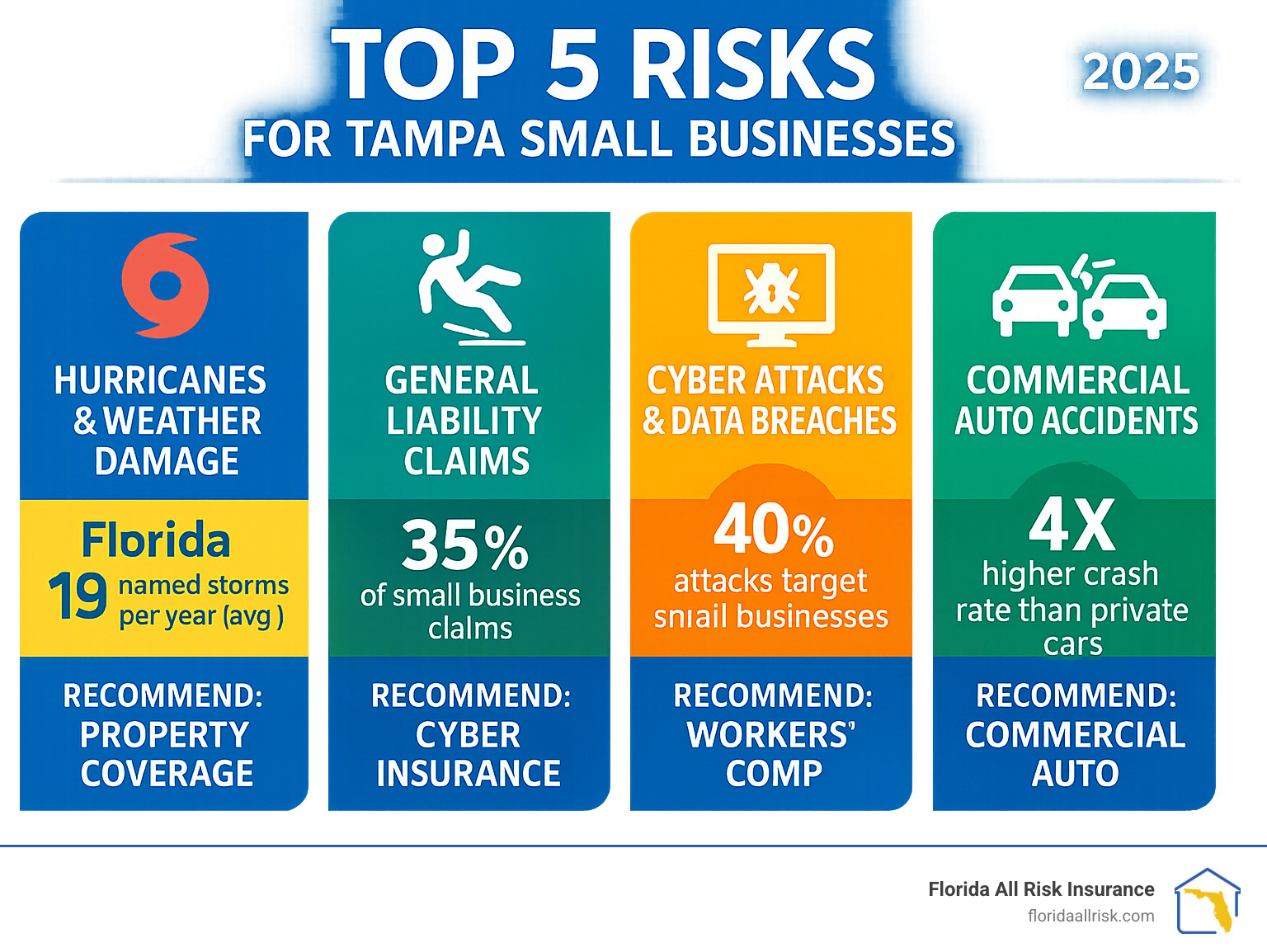
A Glimpse at Essential Tampa Small Business Insurance Coverage:
- General Liability Insurance – Averaging around $49/month, this is your first line of defense against claims of bodily injury to customers or damage to their property. It’s the bedrock policy that most commercial landlords and many client contracts will require.
- Workers’ Compensation – With an average cost of $54/month, this is legally mandated for most Tampa businesses with employees. It covers medical expenses and lost wages for work-related injuries, protecting both your team and your business from devastating financial fallout.
- Professional Liability (E&O) Insurance – For service-based businesses, this coverage is critical. Averaging $71/month, it protects you from claims of negligence, errors, or omissions in the professional services you provide.
- Commercial Auto Insurance – If your business owns, leases, or uses vehicles for work, this is required by Florida law. It covers liability and property damage in the event of an accident, with specific minimums for Personal Injury Protection (PIP) and property damage.
- Cyber Liability Insurance – In our digital age, this is no longer optional. With over 40% of cyber-attacks targeting small businesses, this policy is vital for covering the immense costs of a data breach, from forensic analysis to customer notifications and regulatory fines.
The challenge for any Tampa entrepreneur is navigating this landscape to find the right blend of coverage. You need a shield strong enough to withstand Florida’s unique risks without constricting your budget for growth. Whether you’re a general contractor overseeing a new build, a restaurant owner delighting tourists, or a tech consultant advising global clients, your insurance needs are specific. A generic, one-size-fits-all policy will leave dangerous gaps.
I’m Jason Miller, a second-generation insurance professional with over 20 years of dedicated experience helping Florida businesses thrive. I’ve personally guided thousands of Tampa entrepreneurs through the complexities of Tampa small business insurance, translating confusing jargon into clear strategy and ensuring they secure competitive rates for superior, customized protection.
Simple Tampa small business insurance glossary:
- what does general liability insurance cover
- general liability insurance cost
- business insurance for llc
Navigating Tampa Small Business Insurance Requirements
Launching a business in the vibrant Tampa market is an exhilarating venture, but building it on a secure foundation is paramount. Think of business insurance not as an expense, but as a critical investment in your company’s longevity and resilience. While some coverages are mandated by Florida law, a comprehensive strategy includes additional policies that are essential for long-term stability and peace of mind.
Mandatory Insurance in Florida: The Non-Negotiables
Florida’s state government imposes strict insurance requirements, and non-compliance can lead to severe penalties, including stop-work orders and hefty fines. Understanding these legal obligations is the first step in protecting your business.
Workers’ Compensation Insurance is a cornerstone of Florida business law. It is legally required for any non-construction business with four or more employees, including both full-time and part-time workers (corporate officers count). For the high-risk construction industry, the rule is even stricter: you must secure coverage as soon as you hire your very first employee. This insurance is a grand bargain; it provides employees with medical care, disability benefits, and coverage for lost wages if they are injured on the job. In return, it generally protects your business from direct lawsuits by the injured employee, a principle known as “exclusive remedy.” For a detailed breakdown, the state’s Workers’ Compensation Requirements in Florida page is an essential resource.
Commercial Auto Insurance is another legal mandate for any business that owns, leases, or uses vehicles for work purposes. Florida law requires a minimum of $10,000 in personal injury protection (PIP), which covers medical expenses for you and your passengers regardless of fault, and $10,000 in property damage liability (PDL), which covers damage you cause to another person’s property. Critically, this requirement extends beyond company-owned fleets. If your employees use their personal vehicles for business errands—like making deliveries or visiting clients—your business could be held liable in an accident. This is where hired and non-owned auto insurance becomes vital, providing liability protection for vehicles you don’t own. Explore the nuances in our guide to Commercial Auto Insurance.
Essential Coverage for Comprehensive Protection
Beyond what’s legally required, several other policies form the backbone of a truly robust Tampa small business insurance portfolio. These coverages address the most common and potentially devastating risks that businesses face daily.

General Liability Insurance is the fundamental policy every business needs. It protects against third-party claims of bodily injury (e.g., a customer slips and falls in your store), property damage (e.g., your employee accidentally breaks a client’s expensive equipment), and personal and advertising injury (e.g., libel, slander, or copyright infringement in your marketing). With an average cost of just $49 per month in Tampa, it’s an incredibly affordable way to shield your business from lawsuits that can easily run into six figures. Most commercial lease agreements in Tampa will mandate this coverage. Our Tampa General Liability Insurance page offers a deeper dive for local businesses.
Professional Liability Insurance, also known as Errors & Omissions (E&O), is indispensable for any business that provides services or advice for a fee. It protects you from claims of negligence, mistakes, or failure to deliver services as promised, resulting in a client’s financial loss. For Tampa’s accountants, IT consultants, architects, real estate agents, and marketing professionals, this is a lifeline. A simple oversight could lead to a major lawsuit. With an average cost of $71 per month, E&O covers your legal defense costs, settlements, and judgments.
Cyber Liability Insurance has rapidly shifted from a niche product to an absolute necessity. The 2023 Florida Small Business Profile highlights the millions of small businesses that are prime targets for cybercriminals. With over 40% of cyber attacks aimed at small businesses due to their often-weaker security, the risk is immense. A single data breach can trigger crippling expenses, including forensic investigations, legal fees, regulatory fines, customer notification and credit monitoring services, and public relations efforts to repair your damaged reputation. If your business stores any customer data—from email addresses to credit card numbers—cyber liability is non-negotiable.
Commercial Property Insurance is the policy that protects your physical assets. This includes your building (if you own it), office furniture, computers, equipment, inventory, and signage. It covers losses from common perils like fire, theft, wind damage, and vandalism. Standard property policies do not cover flooding, which must be purchased separately—a critical consideration in coastal Tampa. Whether you own your space or lease it, this insurance ensures you have the funds to repair or replace your essential assets and get back to business quickly after a disaster. Finding the right Business Property Insurance Companies is key to securing comprehensive asset protection.
Together, these policies create a multi-layered shield, allowing you to focus your energy on innovation, customer service, and growth, confident that your Tampa venture is well-protected.
Decoding the Cost of Business Insurance in Tampa
Understanding the cost of Tampa small business insurance is a crucial step in financial planning and budgeting. While it’s impossible to name a single price, as premiums are highly customized, you can gain clarity by learning about the key factors that influence your rates and the typical cost benchmarks for core coverages in the Tampa market.
Key Factors That Influence Your Premiums
Insurers are in the business of assessing risk. The higher your perceived risk, the higher your premium will be. Here are the primary factors they evaluate:
- Industry and Operations: Your line of work is the biggest determinant of cost. A high-risk industry like construction or roofing, with significant physical hazards, will naturally have higher workers’ compensation and general liability premiums than a low-risk home-based consulting business.
- Business Size and Employee Count: The larger your operation, the greater your exposure. More employees mean a higher likelihood of a workers’ compensation claim. Higher annual revenue can lead to higher general liability premiums, as it indicates a larger scale of operations and potentially larger losses in a lawsuit.
- Location Within Tampa: Your physical address matters. A business located in a designated flood zone near the coast will face significantly higher property insurance rates. Similarly, a retail store in a high-traffic, high-crime area may see higher liability and property premiums than one in a quiet suburban strip mall.
- Claims History: Your track record is a powerful predictor for insurers. A business with a clean history and no prior claims will earn favorable rates. Conversely, a history of frequent or severe claims signals higher risk and will lead to increased premiums. For workers’ compensation, this is formalized in an Experience Modification Rate (E-Mod), which directly adjusts your premium up or down based on your loss history compared to industry averages.
- Coverage Limits and Deductible: The amount of protection you buy directly impacts the price. Higher coverage limits (e.g., a $2 million liability policy vs. a $1 million one) will cost more but offer greater protection. Your deductible—the amount you pay out-of-pocket on a claim before insurance kicks in—also plays a key role. A higher deductible lowers your premium but increases your financial responsibility in the event of a claim.
- Business Structure: How your business is legally structured (sole proprietorship, partnership, LLC, S-Corp) can sometimes influence pricing, particularly for liability coverages, as it relates to how your personal and business assets are separated.
Average Costs for Tampa Small Business Insurance
While your final cost will be custom to your specific business, these average monthly costs for small businesses in Tampa provide a helpful baseline for budgeting:
| Insurance Type | Average Monthly Cost in Tampa |
|---|---|
| General Liability | $49 |
| Workers’ Compensation | $54 |
| Professional Liability/E&O | $71 |
These figures highlight the affordability of foundational protection. For less than the cost of a daily coffee, a general liability policy can protect your business from a lawsuit that could otherwise force you to close your doors. Your actual rates will be determined by the risk factors above. For a more detailed analysis, see our complete breakdown of General Liability Insurance Cost.
Smart Ways to Save: Bundling and Proactive Risk Management
You don’t have to choose between robust protection and an affordable price. Several smart strategies can help you lower your premiums without compromising on coverage.
- Bundle with a Business Owner’s Policy (BOP): A BOP is one of the best deals in insurance for eligible small businesses. It combines general liability and commercial property insurance into a single, convenient package, often at a discount of 10-15% compared to buying the policies separately. Many BOPs also include business interruption insurance as part of the bundle.
- Prioritize Workplace Safety: A strong safety culture pays dividends. Implementing and documenting a formal safety program, conducting regular employee training, and maintaining a clean safety record can earn you significant discounts, especially on your workers’ compensation policy. This demonstrates to insurers that you are a lower-risk partner.
- Improve Security Measures: Proactively protecting your property can lower your premiums. Installing a monitored alarm system, security cameras, and a fire suppression system can lead to discounts on your commercial property insurance. Likewise, implementing strong cybersecurity practices—like multi-factor authentication, employee training, and regular data backups—can help reduce your cyber liability premium.
- Implement Strong Risk Management Protocols: Insurers reward businesses that actively manage their risks. This includes using formal contracts with clients and subcontractors, having clear and well-documented operational procedures in an employee handbook, and performing regular maintenance on equipment to prevent breakdowns and accidents.
Finally, the most effective way to ensure you’re not overpaying is to work with an independent insurance agency. We can shop your policy across multiple top-rated carriers to find opportunities for Cheap Business Insurance that still delivers the comprehensive protection your Tampa business needs. An annual policy review is also essential to ensure your coverage adapts as your business grows and evolves.
Tailoring Coverage for Tampa’s Key Industries
A generic insurance policy is a recipe for disaster in a market as diverse as Tampa. Different industries face vastly different risks, and effective Tampa small business insurance must be customized to address these specific exposures. A contractor’s biggest risks are worlds apart from a tech startup’s. Here’s how we tailor protection for some of Tampa’s most prominent sectors.

Construction and Contractors
Tampa’s booming construction scene is a high-hazard, high-regulation environment. Standard policies are inadequate for the complex risks involved.
- Workers’ Compensation: This is non-negotiable and mandatory from the moment you hire your first employee in construction. The physical nature of the work makes this coverage absolutely critical.
- General Liability Insurance: Essential for covering third-party injuries on a dynamic worksite or accidental property damage to a client’s home. We provide specialized Contractors General Liability Insurance Tampa that can be custom to include coverage for your completed operations.
- Builder’s Risk Insurance: This specialized property policy protects a structure while it is under construction, covering losses from fire, wind, theft, and vandalism to the building and materials on site.
- Inland Marine Insurance (Tools and Equipment Coverage): Protects your valuable tools and machinery from theft or damage, whether they are on a job site, in transit, or in storage. This is crucial for protecting your most important assets.
- Surety Bonds: Not insurance, but a related requirement. Many public works projects and large private contracts require performance bonds to guarantee you will complete the job as specified. The City of Tampa’s guide to contractor license registrations outlines many of these obligations.
Hospitality: Restaurants, Bars, and Hotels
Tampa’s vibrant tourism and hospitality sector deals with high public traffic and unique liabilities.
- General Liability: The foundation for any hospitality business, covering slip-and-fall accidents, customer property damage, or claims of food poisoning.
- Liquor Liability Insurance: This is absolutely essential for any business that sells or serves alcohol. Florida’s “dram shop” laws can hold you liable if you serve an intoxicated patron who then causes injury or damage. This policy is separate from general liability and is a must-have.
- Food Spoilage Coverage: Reimburses you for thousands of dollars in inventory lost due to a power outage or equipment failure, such as a broken walk-in freezer.
- Business Interruption Insurance: Particularly vital during hurricane season, this coverage replaces lost income and covers ongoing expenses (like rent and payroll) if a covered peril, like a fire or major storm, forces you to temporarily close your doors.
- Employment Practices Liability Insurance (EPLI): The hospitality industry often has high employee turnover, increasing the risk of claims related to wrongful termination, discrimination, or harassment. EPLI protects your business from these potentially damaging employee lawsuits.
Professional and Tech Services
For Tampa’s rapidly growing sector of consultants, IT firms, and other professional service providers, the greatest risk is often the advice or service itself.
- Professional Liability (E&O) Insurance: This is your most important coverage. It acts as your lifeline against claims that your professional error, omission, or negligent advice caused a client to suffer a financial loss. It covers your legal defense, settlements, and judgments.
- Cyber Liability Coverage: Critical for any business that handles, stores, or transmits sensitive client data. A breach can be catastrophic. Tech E&O policies often bundle professional and cyber liability together for comprehensive protection against both service failures and data security failures.
- General Liability Insurance: While your main risks may be digital, you still need protection for traditional liabilities. This covers events like a client tripping over a cord in your office or damage to a client’s laptop during a consultation. Understanding What does General Liability Insurance cover? is key to building a complete plan.
- Media Liability: If your business creates content (blogs, videos, social media), this policy can protect against claims of copyright infringement, defamation, or invasion of privacy.
Healthcare and Wellness Practices
Tampa is a major hub for healthcare, from large hospitals to small private practices, medspas, and therapy clinics. These businesses have unique patient-facing risks.
- Medical Malpractice Insurance: This is the healthcare equivalent of E&O, protecting licensed professionals and their businesses from claims of negligence or errors in patient care that result in harm.
- General Liability Insurance: Crucial for covering non-medical risks, such as a patient slipping and falling in the waiting room or reception area.
- Cyber Liability with HIPAA Coverage: Healthcare providers are prime targets for data breaches. A specialized cyber policy is needed to cover the immense costs and regulatory fines associated with a breach of protected health information (PHI) under HIPAA.
- Commercial Property & Equipment Breakdown: Protects your physical office, waiting room furniture, and critical diagnostic or treatment equipment from damage or failure.
How to Secure the Right Coverage: A Step-by-Step Guide
Finding and securing the right Tampa small business insurance doesn’t have to be an overwhelming task. By following a structured approach, you can efficiently steer the process and build a protection plan that perfectly fits your business needs and budget.
Step 1: Assess Your Business Risks and Needs
Before you can shop for solutions, you must first understand your problems. A thorough risk assessment is the critical first step. Don’t just think about obvious risks; consider all angles of your operation. Ask yourself key questions:
- Premises Risk: Do clients or customers visit my physical location (office, store, worksite)? This points to a need for General Liability.
- Professional Risk: Do I provide advice, services, or designs for a fee? Could a mistake on my part cause a client a financial loss? This indicates a need for Professional Liability (E&O).
- Employee Risk: Do I have employees? If so, Workers’ Compensation is likely mandatory.
- Data Risk: Do I collect, store, or handle any sensitive customer or employee data (names, addresses, credit cards, health information)? This makes Cyber Liability essential.
- Auto Risk: Do I or my employees use vehicles for any business purpose? This requires Commercial Auto coverage.
- Asset Risk: What physical assets are essential to my business (building, inventory, computers, specialized equipment)? This highlights the need for Commercial Property insurance.
- Contractual Risk: Review your commercial lease and any major client contracts. They often contain specific insurance requirements, including minimum coverage limits and the need to list the other party as an “additional insured.”
Step 2: Gather Your Business Information
To receive fast and accurate insurance quotes, you’ll need to have key business details organized and ready. Insurers need this information to accurately assess your risk profile. Be prepared to provide:
- Basic Information: Business name, legal structure (LLC, S-Corp, etc.), and physical Tampa address.
- Operational Details: A clear and detailed description of your business operations. The more specific you are, the better an agent can classify your business for accurate rating.
- Financial & Staffing Data: Your projected or current annual revenue, total number of employees (full-time and part-time), and annual payroll information.
- Vehicle Information: For commercial auto quotes, you’ll need the year, make, model, and Vehicle Identification Number (VIN) for any company vehicles, as well as driving records for all employees who will be operating them.
- Claims History: A record of any insurance claims your business has filed in the past 3-5 years.
- Existing Policies: Details of any current or prior insurance policies, including coverage limits and premiums.
Step 3: Finding the Best Tampa Small Business Insurance Agent
This is one of the most important decisions you’ll make. You have a few options, but one provides a distinct advantage.
- Captive Agent: Represents only one insurance company. They can be knowledgeable about their company’s products but cannot offer you competitive quotes from the broader market.
- Direct Insurer: Buying online directly from a carrier can seem fast, but you are on your own to assess your risks and choose coverages, which can lead to dangerous gaps.
- Independent Agent: This is your best choice. An independent agent or broker works for you, not an insurance company. They represent multiple carriers, allowing them to shop the market on your behalf to find the best combination of coverage and price. Crucially, a local agent understands Tampa’s unique risk landscape—from hurricane preparedness to local contractor licensing—and can provide invaluable guidance. Working with Independent Business Insurance Agents gives you choice, expert advice, and a long-term partner who can help you manage your risk and advocate for you during a claim.

Step 4: Compare Quotes, Understand Exclusions, and Bind Coverage
Once your agent presents you with quotes, don’t just look at the price. Carefully review each policy option, paying close attention to:
- Coverage Limits: The maximum amount the insurer will pay for a covered claim.
- Deductibles: The amount you must pay out-of-pocket before coverage begins.
- Exclusions: The specific perils or situations the policy does not cover. For example, most property policies exclude flood and earthquake damage.
Ask your agent to explain the trade-offs. A cheaper policy might have a very high deductible or a critical exclusion that leaves you vulnerable. Once you’ve selected the best policy, your agent will “bind” the coverage, making it active. They can then immediately issue a Certificate of Insurance (COI) as proof of coverage to satisfy landlords, clients, or licensing bodies. Finally, schedule an annual review with your agent to ensure your insurance continues to meet the needs of your growing business.
Beyond Insurance: Tampa’s Small Business Support System
A robust Tampa small business insurance portfolio is your defensive shield, but proactive growth requires a strong offensive strategy. Fortunately, Tampa and Hillsborough County have a rich and supportive ecosystem of organizations dedicated to helping entrepreneurs succeed. Leveraging these free and low-cost resources can provide a significant competitive advantage.
-
The Small Business Development Center (SBDC) at University of South Florida: This is an invaluable resource. The SBDC offers no-cost, confidential business consulting and low-cost training on a vast range of topics, including creating a business plan, developing a marketing strategy, financial analysis, and accessing capital. Their consultants are experienced professionals who can provide personalized guidance.
-
The Tampa Bay Chamber: A cornerstone of the local business community, the Chamber provides unparalleled networking opportunities. It also runs specific programs for small businesses, such as the Small Business of the Year Awards and various workshops and advocacy campaigns that give small business owners a collective voice.
-
Hillsborough County Small Business Support: Navigating local government requirements can be daunting. The county’s Economic Development department offers practical assistance with licensing, permitting, and training. They are a key resource for understanding the specific regulations you need to follow to operate legally.
-
SCORE Tampa: If you’re looking for mentorship, SCORE is the place to go. This volunteer organization connects you with experienced business executives and entrepreneurs who provide free mentorship, workshops, and an extensive library of resources. Getting advice from someone who has already steerd the challenges you’re facing can be priceless.
-
The City of Tampa Economic & Urban Development: The city itself offers a variety of guides, incentives, and programs designed to help businesses get started and grow within the city limits. This includes assistance with zoning, permits, and information on local business development initiatives.
-
Embarc Collective: For tech and high-growth startups, Embarc Collective is a major hub in Tampa Bay. It provides coaching, resources, and a community of fellow innovators to help startups scale and succeed.
For broader guidance, the U.S. Small Business Administration (SBA) business guide is an authoritative source for every stage of the business lifecycle, while FEMA’s preparedness resources for businesses offer critical insights on creating a disaster resilience plan—a must for any Florida business.
By integrating these support systems with a well-structured insurance portfolio, you create a comprehensive safety net that empowers you to take calculated risks, innovate, and focus on building a resilient and prosperous business.
Conclusion: Protecting Your Tampa Venture for the Long Haul
Building a successful business in Tampa’s dynamic and competitive landscape is a significant achievement. It’s a journey filled with opportunity, but one that is also exposed to real and substantial risks. A comprehensive Tampa small business insurance strategy is not a bureaucratic hurdle; it is the very foundation that allows you to pursue growth with confidence and peace of mind.
From legally mandated coverages like workers’ compensation and commercial auto to essential protections like general liability, professional liability, and cyber insurance, each policy plays a distinct and vital role in safeguarding your assets, your employees, and your future. The key to effective protection lies in customization. The unique risks of Tampa—from hurricane threats to industry-specific liabilities—demand a custom insurance solution, not an off-the-shelf product.
Whether your business is in construction, hospitality, technology, or healthcare, a one-size-fits-all approach will inevitably leave you exposed. Partnering with a knowledgeable independent insurance agent who understands the local Tampa market is the most effective way to steer this complexity. An independent agent gives you access to a wide range of carriers, ensuring you receive the optimal blend of comprehensive coverage and competitive pricing.
Don’t leave your hard work and investment vulnerable. Take the decisive step to secure your company’s future today.
Contact Us
Ready to build the robust protection your business deserves? Contact our team of Florida-based specialists for a personalized risk assessment and a no-obligation quote.
Florida All Risk Insurance
Address: 9800 4th Street N, Suite 200, Saint Petersburg, FL 33702
Phone: (727) 555-1234
Email: [email protected]

