Tampa commercial liability insurance: Smart Guide 2025
Why Tampa Businesses Need Smart Commercial Liability Protection
Tampa commercial liability insurance is the essential shield that protects your business from the financial fallout of costly lawsuits and unexpected claims. In a thriving and competitive market like Tampa, with its bustling tourism, major port, and burgeoning tech scene, the opportunities for growth are immense—but so are the risks. Whether you’re a small retail shop in Hyde Park, a restaurant in Ybor City, a contractor working on the latest downtown development, or a growing tech company, the right liability coverage is what stands between your hard-earned success and potential financial ruin.
Quick Answer for Tampa Business Owners:
- General Liability: This is your foundational coverage. It protects against claims of bodily injury (like a customer slip-and-fall), property damage your business may cause, and personal/advertising injury (like slander or copyright infringement). The average cost in Florida is around $49/month, but this varies widely by industry.
- Required Coverage: In Florida, certain coverages are mandated by law. You’ll need Workers’ Compensation if you have four or more employees (just one in the construction industry). If your business owns vehicles, Commercial Auto insurance is also required.
- Key Benefits: Beyond paying settlements, this insurance covers expensive legal defense costs, even if a lawsuit is baseless. It also covers medical payments for minor injuries to prevent larger claims, ensuring business continuity by protecting your assets.
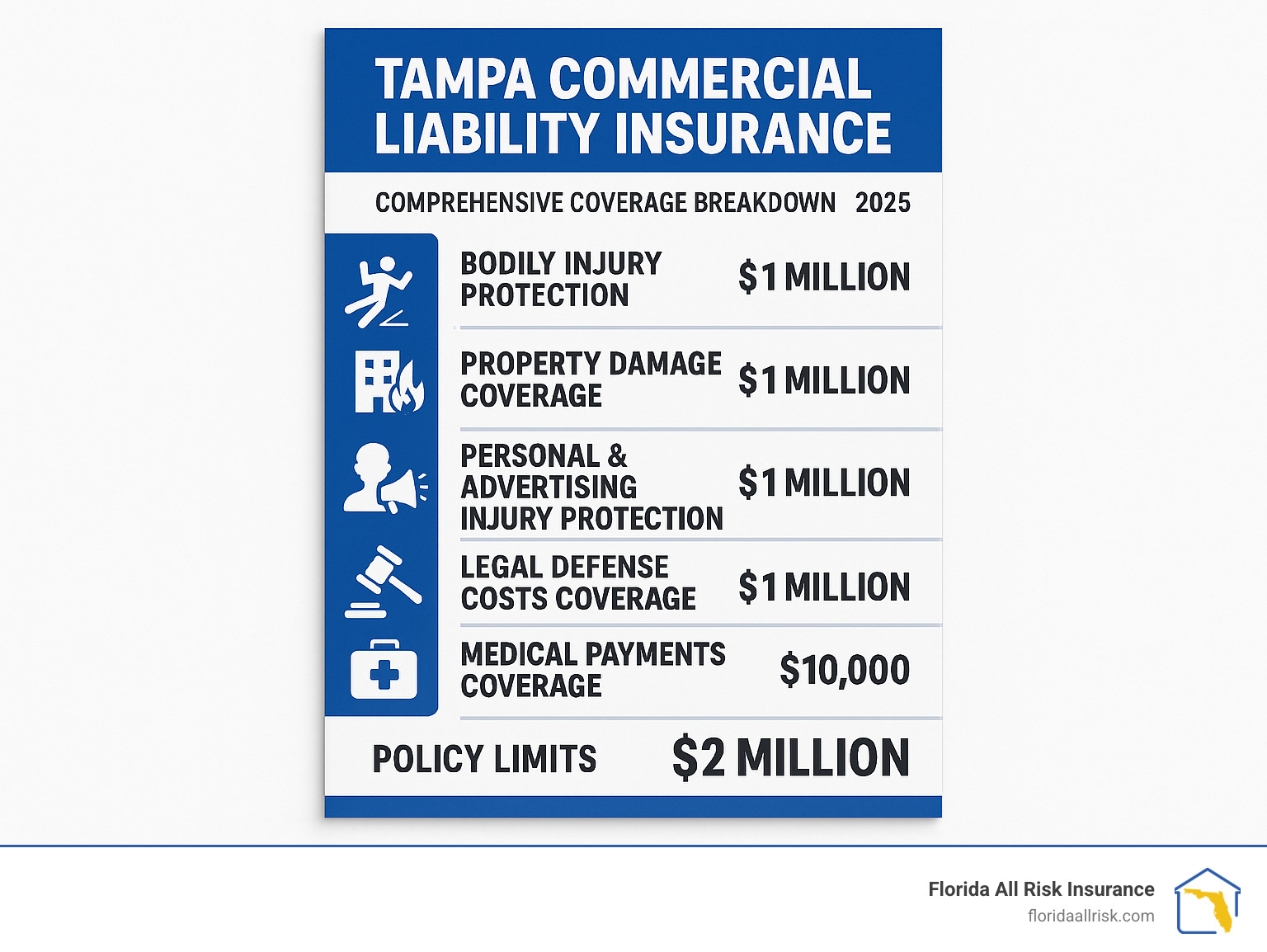
- Coverage Limits: The standard policy is typically $1 million per occurrence and $2 million in aggregate (the total amount the policy will pay in a year). However, many contracts and leases in Tampa will require higher limits.
- Industries at High-Risk: While all businesses need coverage, those in construction, retail, hospitality, healthcare, and professional services face heightened liability exposures in the Tampa Bay area.
Tampa is a fantastic city for entrepreneurs, but success brings exposure. A single slip-and-fall accident on a wet floor can lead to tens of thousands of dollars in medical bills and legal fees. A simple mistake by an employee that damages a client’s expensive equipment can devastate your cash flow. A competitor’s false advertising claim can threaten not just your finances but your reputation. For a modest monthly investment, commercial liability insurance can be the difference between weathering a storm and closing your doors for good. Furthermore, commercial leases, client contracts, and city permits often require proof of coverage, making it an essential tool for growth and operational legitimacy.
About the Author
I’m Jason Miller, an insurance professional with over 20 years of experience helping Florida businesses secure Tampa commercial liability insurance. My team at Florida All Risk Insurance has guided thousands of Tampa entrepreneurs, ensuring they get the right coverage at competitive rates.
Tampa commercial liability insurance terms to learn:
- Tampa small business insurance
- business insurance for small businesses
- buy business insurance online
Understanding Your Tampa Commercial Liability Insurance Needs
Running a business in Tampa means you’re exposed to a wide spectrum of liability risks every single day. Tampa’s booming economy, fueled by sectors from logistics and healthcare to tourism and technology, creates incredible opportunities. However, every customer interaction, client meeting, and product sold increases the chance for something to go wrong. Tampa commercial liability insurance acts as a critical financial lifeline, creating a protective barrier between your business assets and costly claims that could otherwise drain your bank account and halt your operations.
This foundational coverage provides invaluable peace of mind, allowing you to focus on innovation, customer service, and growth instead of constantly worrying about the financial impact of potential lawsuits. The scope of this protection is broad; What does General Liability Insurance cover? The answer might surprise you with its breadth.
What is Tampa commercial liability insurance?
Think of General Liability Insurance (CGL) as your business’s all-purpose shield against the most common and potentially devastating lawsuits from third parties (i.e., non-employees). It activates when your business operations are accused of causing harm to others. The core components include:
- Bodily Injury: This covers liability for physical harm to a third party. A classic example is a customer slipping on a wet floor in your Tampa storefront, but it also includes incidents like a piece of equipment falling and injuring a visitor at your warehouse or a food poisoning claim at your restaurant.
- Property Damage: This protects you if your business or employees damage someone else’s property. For instance, a landscaping crew accidentally breaks a client’s window in a Carrollwood home, or a tech consultant spills coffee on a client’s server during an on-site visit.
- Personal and Advertising Injury: Many business owners overlook this vital coverage. It protects you from less tangible harms, including claims of slander (spoken defamation), libel (written defamation), copyright infringement, or misappropriation of advertising ideas. If a competitor alleges you stole their slogan or used their copyrighted images in your marketing campaign, this coverage would defend you.
- Legal Defense and Settlements: This is arguably one of the most valuable aspects. Your policy covers the cost of hiring attorneys, court fees, and other legal expenses to defend your business against a covered claim—regardless of whether the lawsuit has merit. If a claim results in a settlement or judgment against you, your insurance pays these costs up to your policy limits, potentially saving your business from bankruptcy.
For a comprehensive overview, see our guide on general liability insurance.
Common Risks Covered for Tampa Businesses
Tampa’s diverse business landscape, from the industrial areas near the port to the bustling retail corridors of South Tampa, creates unique liability exposures. Here are some common risks that a CGL policy addresses:
- Slip-and-fall accidents: These are consistently among the top liability claims for any business with a physical presence. A customer tripping over a loose mat, slipping on a freshly mopped floor, or falling on an uneven sidewalk outside your entrance can lead to significant medical and legal costs.

- Customer property damage: Seemingly minor incidents can escalate quickly. A contractor’s ladder falling and damaging a neighbor’s fence, a cleaning service breaking an expensive vase in an office, or a valet scratching a luxury car can all result in major repair bills and claims.
- Product liability: Any business in the supply chain—manufacturing, distributing, or selling products—can face claims if an item causes injury or damage. This includes restaurants serving contaminated food, retailers selling defective electronics, or a local artisan whose product causes an allergic reaction.
- Reputational harm: In our hyper-connected world, an off-the-cuff remark about a competitor or a poorly-vetted marketing campaign can escalate into a legal battle over defamation, libel, or false advertising.
- Copyright infringement: A frequent pitfall for small businesses. Using unlicensed stock photos from a Google search, playing copyrighted music in your establishment without a license, or borrowing a bit too heavily from a competitor’s website design can lead to expensive legal action.
Your policy typically provides protection for both on-premises and off-premises incidents. This means you’re covered whether an accident happens at your Tampa office, a client’s location in St. Petersburg, or at a trade show you’re attending.
Occurrence vs. Claims-Made Policies: What Tampa Businesses Should Know
Understanding the structural difference between occurrence and claims-made policies is crucial for avoiding dangerous coverage gaps. The distinction lies in what triggers the policy to respond.
| Feature | Occurrence Policy | Claims-Made Policy |
|---|---|---|
| Coverage Trigger | The policy in effect when the incident occurred responds. | The policy in effect when the claim is first reported responds. |
| Claim Reporting | You can report the claim at any time in the future. | The claim must be reported during the active policy period (or an extended reporting period). |
| Best For | Most businesses, especially those with long-tail risks like construction or manufacturing (e.g., a defect isn’t discovered for years). This is the standard for General Liability. | Professional service providers (for their Professional Liability/E&O), such as doctors, lawyers, and architects. |
| Cost | Generally higher, stable premiums. | Lower initial cost that increases over time as the potential for past acts grows. |
Occurrence policies offer lifetime coverage for incidents that happen during the policy period, regardless of when the claim is eventually filed. This provides robust, long-term protection. Claims-made policies are more restrictive; they only cover claims that both occur and are reported during the active policy period (or after a specified retroactive date). This structure requires maintaining continuous coverage to avoid gaps. If you cancel a claims-made policy or switch to an occurrence form, you must purchase an Extended Reporting Period (ERP), commonly known as tail coverage, to protect against future claims arising from past incidents. Most Tampa businesses will, and should, have an occurrence policy for their general liability needs.
Decoding Your Policy: Key Components and Costs
Investing in Tampa commercial liability insurance is more than just paying a premium; it requires understanding the structure of your policy to ensure it truly protects you. Key components like coverage limits, deductibles, and endorsements work together to define the scope of your financial protection. Knowing these details helps you budget effectively, satisfy contractual obligations, and avoid devastating surprises when it’s time to file a claim.
Having the right insurance is fundamentally different from just having any insurance. Gaps in coverage, insufficient limits, or misunderstood exclusions often become painfully apparent only after an incident occurs. We make it a priority to walk clients through each policy element, ensuring they understand what they’re paying for and the precise protection they’re receiving.
For deeper insights, see our guide: How much General Liability Insurance do I need?
Typical Coverage Limits for Tampa Businesses
Most small to medium-sized Tampa businesses start with the industry-standard liability limits: $1 million per occurrence and a $2 million aggregate limit. The “per-occurrence” limit is the maximum amount the insurer will pay for a single incident or claim. The “aggregate” limit is the total maximum amount the insurer will pay for all claims combined during the policy year.
However, this standard is not a one-size-fits-all solution. Your specific needs might demand more. Contractual requirements are a primary driver of higher limits. A commercial lease in a high-end location like Water Street Tampa or a client contract with a large corporation or government entity may stipulate minimum limits of $2 million, $5 million, or even more per occurrence. To meet these needs without replacing your primary policy, businesses often purchase a Commercial Umbrella Policy. This is a cost-effective way to add extra layers of liability protection (in $1 million increments) on top of your existing General Liability and Commercial Auto policies.
Assessing your risk exposure is key. A freelance consultant working from home has a vastly different risk profile than a large construction company with multiple active job sites. We help you analyze factors like foot traffic, the nature of your operations, and contractual obligations to find the sweet spot between adequate protection and affordable cost, ensuring you have enough coverage without overpaying.
Key Factors Influencing Your Tampa Commercial Liability Insurance Cost
While the average Florida business pays around $49 monthly for General Liability, your premium is a unique calculation based on your specific risk profile. Insurers weigh several key factors to determine your rate:
- Industry and Risk Classification: This is the most significant factor. A roofing contractor in a hurricane-prone area faces inherently higher risks than a software developer working remotely, and premiums will reflect this disparity.
- Business Size and Revenue: Larger operations with higher annual revenue and more employees generally have more public interaction and thus greater exposure to potential claims, which influences cost.
- Claims History: Your loss history is a strong predictor of future claims. A clean record with no prior claims can lead to preferred pricing and credits, while a history of frequent or severe claims will increase your premiums.
- Location within Tampa: While less impactful than industry, your specific location can play a role. Businesses in high-traffic commercial districts or areas with higher crime statistics may see slightly different rates.
- Policy Structure (Limits and Deductible): The coverage limits you choose directly impact the price—higher limits cost more. Additionally, choosing a higher deductible (the amount you agree to pay out-of-pocket per claim) can lower your monthly premium, but it also means you take on more initial financial risk.
For a detailed breakdown of what goes into your pricing, explore our insights on General Liability Insurance Cost.
Is Commercial Liability Insurance Tax-Deductible?
Yes, there’s good news for your bottom line. In most cases, Tampa commercial liability insurance premiums are considered a tax-deductible business expense by the IRS. They fall under the category of ordinary and necessary business expenses, as this protection is essential for the normal operation and financial health of a business.
This tax benefit effectively reduces the net cost of your insurance. However, tax laws can be complex and are subject to change. It is crucial to keep meticulous records of your insurance payments. We always recommend that our clients consult with a qualified tax professional or CPA to ensure they are maximizing their deductions correctly and maintaining full compliance with IRS regulations. For official guidance, you can reference IRS Publication 535, which covers deductible business expenses.
Essential Insurance Beyond General Liability for Tampa Companies
While Tampa commercial liability insurance is the foundational cornerstone of your risk management plan, it doesn’t cover every exposure. A truly comprehensive strategy requires multiple layers of specialized coverage. For many small businesses, combining policies into a Business Owner’s Policy (BOP) can be an efficient and cost-effective solution. A BOP typically bundles General Liability with Commercial Property insurance (protecting your building and contents) and Business Interruption insurance (covering lost income after a disaster), often at a lower price than buying each policy separately.
Different policies are designed to protect against different types of risk. You’ll need Workers’ Compensation for employee injuries, Commercial Auto for vehicle-related incidents, and Professional Liability for mistakes related to your services. Each policy fills a specific and critical gap in your overall protection strategy, creating a safety net that allows your business to operate with confidence.
For guidance on building the right insurance portfolio for your unique needs, see our resource on Business Insurance for Small Businesses.
Industry-Specific Requirements in Tampa
Tampa’s dynamic economy is home to a wide array of industries, each with its own unique risks and corresponding insurance needs.
- Construction: Tampa’s booming development means construction businesses face high risks. Florida law is strict, requiring workers’ compensation for even one employee in this sector. The city of Tampa requires certified contractors and tree service workers to carry both general liability and workers’ comp. Specialized coverages like builder’s risk and contractor’s pollution liability are also common. Our Contractors General Liability Insurance Tampa program is tailored for these specific needs.
- Hospitality: Restaurants, bars, and hotels are central to Tampa’s tourism economy. These businesses need liquor liability coverage to protect against claims arising from serving alcohol. Hotels and event venues, with a constant stream of guests and large gatherings, often require higher liability limits and specialized event coverage.
- Healthcare: Medical facilities, from large hospitals to small clinics, must carry professional liability insurance, better known as malpractice insurance, to protect against claims of negligence or errors in patient care. As an example, in Florida, Advanced Practice Registered Nurses must carry medical malpractice insurance to maintain their license.
- Real Estate and Professional Services: Professionals in Tampa’s hot real estate market, as well as accountants, consultants, and lawyers, need Errors & Omissions (E&O) insurance. This is a form of professional liability that protects against claims of negligence, bad advice, or failure to perform services that result in a client’s financial loss.
- Technology: Tampa’s growing tech hub means more companies are handling sensitive data. Cyber Liability Insurance is essential to cover costs associated with data breaches, including notification, credit monitoring, and legal defense.
Protecting Your Assets: Workers’ Comp and Commercial Auto
Two coverages are not just recommended but are often legally required for Tampa businesses: Workers’ Compensation and Commercial Auto insurance.
Workers’ Compensation Insurance is mandatory in Florida for most businesses with four or more employees (full-time or part-time), and for construction businesses with just one employee. It is a no-fault system that provides medical benefits and lost wages for employees who are injured or fall ill on the job. In return, it protects your business from direct lawsuits by injured employees, making it a crucial protection for both your team and your company.
Commercial Auto insurance is required for any vehicles owned and operated by your business. A personal auto policy will not cover accidents that occur while the vehicle is being used for business purposes. If your employees use their personal cars for work-related tasks (like making deliveries or visiting clients), you also need Hired and Non-Owned Auto (HNOA) coverage. This is a critical endorsement that protects your business if an employee has an accident while on company business in their own vehicle. We help businesses in Tampa and St. Petersburg, FL navigate these complex requirements.
How Commercial Liability Protects Tampa Landlords
If you own commercial property in Tampa, your tenants’ liability insurance is a critical part of your own risk management strategy. It is standard practice for commercial leases to require tenants to carry their own general liability insurance. This policy acts as the first line of defense if a customer is injured within the tenant’s leased space, preventing the claim from immediately targeting the landlord’s policy.
This also provides vital property protection. If a tenant’s operations cause damage to your building (e.g., a kitchen fire, a burst pipe from their equipment, or damage during a move-in), their liability coverage can be tapped to pay for the necessary repairs. Smart landlords go a step further and require additional insured status on their tenants’ policies. This endorsement extends some of the tenant’s coverage to you, the landlord, providing a direct defense if you are named in a lawsuit stemming from the tenant’s actions. This strategy of risk transfer is fundamental to protecting your investment and helps keep your own insurance costs down. Understanding commercial lease liability insurance requirements is key for both landlords and tenants to create a secure and well-defined relationship.
How to Secure and Manage Your Coverage
Getting the right Tampa commercial liability insurance should be a straightforward and empowering process, not a confusing one. The key is to be proactive and methodical, understanding the steps involved before you find yourself in urgent need of coverage for a new contract or lease.
The Step-by-Step Process to Getting Insured
- Assess Your Risks and Needs: Before seeking quotes, take a comprehensive look at your daily operations. Do customers visit your premises? Do you handle sensitive client data or valuable property? Do your employees drive for work? Do you manufacture or sell products? Understanding your unique exposures is the foundational first step to determining the types and amounts of coverage you need.
- Gather Key Business Documents: To get accurate quotes quickly, organize your essential information beforehand. This includes your legal business name and address, Federal Tax ID (EIN), number of full-time and part-time employees, estimated annual revenue and payroll, and a detailed description of your business operations. Having this ready will streamline the application process.
- Partner with an Independent Insurance Agent: Unlike captive agents who represent only one company, an independent agent works for you. They can shop your coverage needs across multiple A-rated carriers to find the best combination of coverage, service, and price. They act as your advocate and advisor, helping you navigate the complexities of the insurance market.
- Compare Quotes Holistically: When you receive quotes, look beyond just the price. The cheapest policy might have significant coverage gaps, high deductibles, or restrictive exclusions that leave you vulnerable. We help you perform an apples-to-apples comparison of limits, deductibles, endorsements, and carrier financial strength ratings.
- Review Policy Details Thoroughly: Before you commit, we’ll review the policy proposal with you line by line. It’s crucial that you understand what is covered, what is excluded, and what your responsibilities are in the event of a claim. This is the time to ask questions and clarify any confusing language.
- Bind Coverage and Get Your COI: Binding coverage is the final step where you agree to the policy terms and make your first payment. Once bound, your protection becomes active. You can then immediately request a Certificate of Insurance to prove your coverage to landlords, clients, or licensing boards.
Our Tampa Small Business Insurance Guide 2025 walks through this process in even more detail.
Obtaining and Using a Certificate of Insurance (COI)
A Certificate of Insurance (COI) is a one-page document that serves as proof that you have active insurance coverage. It’s a snapshot of your policy, summarizing the types of coverage, policy limits, and expiration dates. You will frequently need to provide a COI for:
- Client Contracts: Many businesses, especially larger corporations, will require a COI from all vendors and contractors before work can begin.
- Landlord and Lease Requirements: Nearly all commercial leases in Tampa will require you to provide a COI and maintain coverage for the duration of the lease.
- Vendor Agreements and City Permits: Partners, subcontractors, and certain municipal permits or licenses may also require proof of liability insurance.
Requesting a COI from us is a quick and easy process, and we can typically provide one within hours of your request. When managing COIs, you may encounter two key concepts: an additional insured endorsement, which officially extends your policy’s protection to another party (like a client or landlord), and a waiver of subrogation, an endorsement where your insurer agrees not to seek reimbursement from that other party if they pay a claim caused by that party’s negligence. We help you manage these complex requests and track expiration dates to ensure your business operations continue without interruption.
The Importance of Annual Policy Reviews
Insurance is not a “set it and forget it” purchase. Your business is constantly evolving, and your insurance coverage must evolve with it. An annual policy review with your agent is critical to prevent dangerous coverage gaps. During a review, you should discuss changes in your business over the past year, such as increased revenue, new employees, a new location, new services or products, or large equipment purchases. These changes can impact your risk profile and may require adjustments to your coverage limits or the addition of new policies to ensure you remain fully protected.
Conclusion: Your Next Step to a Secure Tampa Business
Navigating the complexities of the commercial insurance landscape is a non-negotiable step in safeguarding your business’s future and enabling its growth. By taking a proactive approach to understanding your specific risks and securing the right Tampa commercial liability insurance, you build a resilient enterprise that is prepared to thrive in Tampa’s dynamic and competitive market.
Throughout this guide, we’ve covered the essentials: what general liability insurance is and why it’s the bedrock of your protection, the common risks it covers for Tampa businesses, how to decode key policy components and costs, and the other vital coverages like workers’ comp and commercial auto that create a complete safety net. Remember, proactive risk management isn’t just about regulatory compliance or satisfying a contract; it’s about giving yourself the confidence and peace of mind to focus on what you do best—running and growing your business.
At Florida All Risk Insurance, our role as an independent agency is to be your long-term partner in this process. We provide personalized service, expert advice, and access to a wide range of top-rated carriers, ensuring you receive a customized coverage plan at competitive rates. We are committed to protecting our valued Tampa clients and their hard-earned success.
Ready to secure your business? Explore our General Liability coverage options to find the perfect fit for your needs.
Don’t leave your business exposed to a single claim that could undo years of hard work. Request a personalized quote today and take the first and most important step towards comprehensive, reliable protection.
Contact Us
Choosing the right insurance can feel overwhelming, but you don’t have to do it alone. At Florida All Risk Insurance, we are your trusted partners in protecting what matters most to your Tampa business.
As an independent agency, we shop multiple carriers to find you the best Tampa commercial liability insurance at competitive rates. We take the time to understand your needs and explain your options in plain English.
Ready to get started? Contact us today.
Florida All Risk Insurance
1234 Central Avenue, Saint Petersburg, FL 33705
Phone: (727) 555-0123
Email: [email protected]
Our office hours are Monday through Friday, 8:30 AM to 5:00 PM. We are happy to schedule appointments that fit your busy schedule.