General liability Florida: Your 2024 Ultimate Shield
Why General Liability Florida Coverage Is Essential for Your Business
General liability Florida insurance is the foundational safety net that protects your business from the potentially devastating financial fallout of third-party injury claims, property damage lawsuits, and reputational harm. In Florida’s vibrant and fast-paced economy, where tourism, construction, and a thriving service sector create countless daily interactions with the public, this coverage is not just a good idea—it’s an essential component of a sound business strategy. While not universally mandated by state law, this coverage is frequently required by clients, landlords, and licensing boards, making it the single most common and critical type of business insurance purchased in the Sunshine State.
Quick Answer: General Liability Florida Essentials
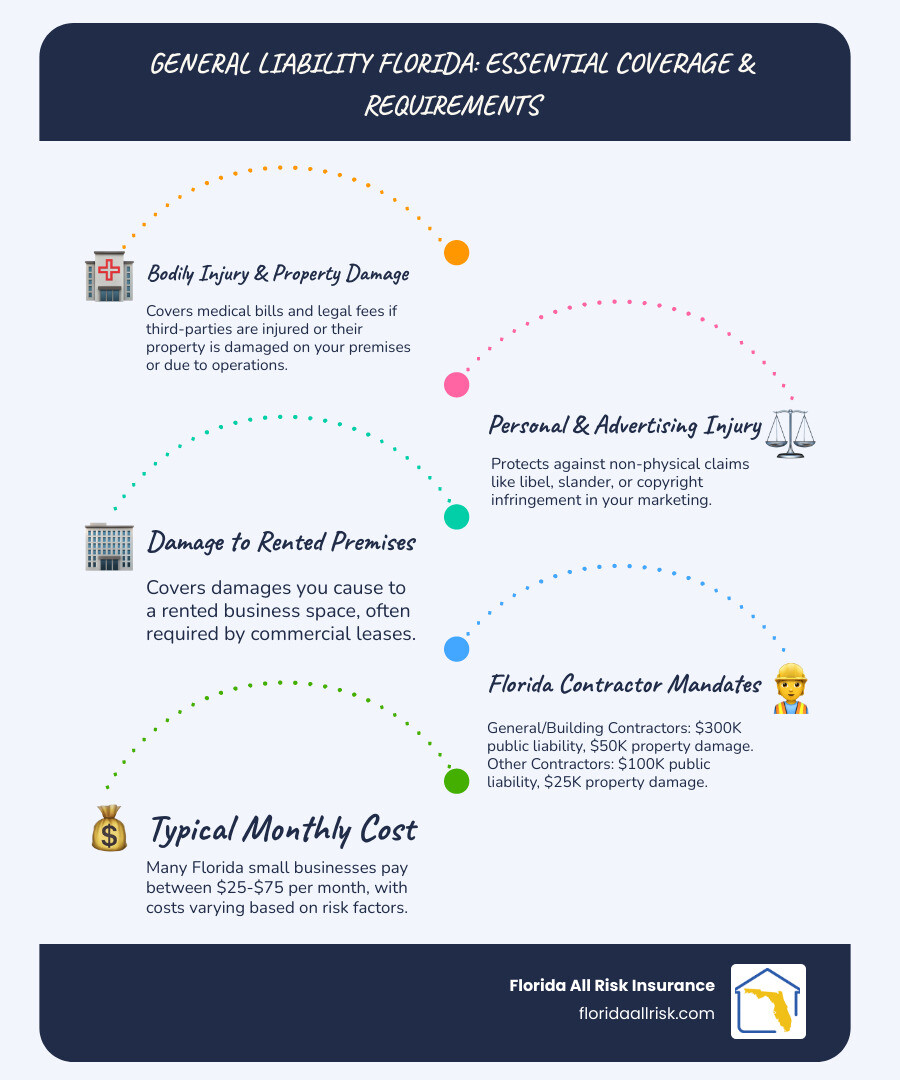
- What it covers: This policy is your shield against claims of bodily injury to non-employees, damage to another person’s property, and personal or advertising injury (like libel, slander, or copyright infringement). It also includes coverage for damage to premises you rent.
- Is it required? While the state of Florida doesn’t mandate it for every business, it’s a de facto requirement in many situations. Contracts, commercial leases, and specific professional licensing boards (especially for contractors) will almost always demand proof of coverage.
- Contractor requirements: The state has specific minimums for licensed contractors: $300,000 for public liability and $50,000 for property damage for general and building contractors; $100,000 for public liability and $25,000 for property damage for most other specialty contractors.
- Average cost: Costs are highly variable, but many small businesses in Florida can secure a policy for an average of $25-$75 per month, depending on their industry, size, and risk exposure.
- Who needs it: Virtually any business that interacts with the public needs this coverage. This includes construction trades, retail stores, restaurants, professional services, landscapers, consultants, and nearly all customer-facing businesses.
Florida’s economy is a powerhouse, driven by 2.8 million small businesses that employ over 3.6 million people. Whether you’re operating a Tampa landscaping company, a Miami fitness studio, a Jacksonville accounting firm, or a Key West tour boat, a single unforeseen accident can trigger a lawsuit that threatens the very existence of your enterprise. A customer slips on a freshly mopped floor. Your employee accidentally damages a client’s expensive equipment. A competitor alleges your new advertisement copied their slogan. Without the right insurance, the legal defense fees alone could be enough to shut your doors for good.
I’m Jason Miller, and as a second-generation insurance professional with over 20 years of dedicated experience serving Florida’s business community, I’ve guided thousands of clients through the complexities of General liability Florida requirements. My mission is to find affordable, robust protection tailored to the unique risks you face. I believe in making insurance simple and transparent, empowering you to focus on what you do best: growing your business with confidence and peace of mind.
General liability Florida definitions:
What General Liability Insurance Covers for Florida Businesses
General liability insurance, often referred to as Commercial General Liability (CGL), is a fundamental policy designed to protect your business from a wide range of claims, including those for causing third-party bodily injury, property damage, and other related risks. It acts as your primary line of defense against the common accidents, mishaps, and lawsuits that can arise during the course of your normal business operations.
Bodily Injury and Property Damage
This is the cornerstone of any general liability policy. If a customer, vendor, or any other third party is injured on your business premises or as a direct result of your operations, this coverage is designed to pay for their medical expenses, and crucially, your legal defense costs if a lawsuit is filed. Similarly, it covers the cost to repair or replace someone else’s property if you or one of your employees accidentally damages it. For instance, if a painter in Tampa accidentally spills a can of paint on a client’s antique hardwood floors, or a tourist slips on a wet floor in your Miami café, this coverage would be triggered to handle the claim.
Let’s explore a few more scenarios specific to our sunny state where this coverage would be a business-saver:
- Bodily Injury Example: A client visiting your St. Petersburg real estate office trips over a poorly placed power cord for a computer and fractures their wrist. Your General liability Florida policy would respond to cover their medical bills and any legal fees if they decide to sue for negligence.
- Property Damage Example: Your landscaping crew is working at a waterfront home in Sarasota. An employee accidentally backs the company truck into a custom-built gate, causing significant damage. Your policy would cover the cost of repairing or replacing the gate. Or, consider an IT consultant in a Tallahassee office who accidentally spills coffee on a client’s server during a maintenance visit, shorting it out. General liability steps in to cover the replacement cost of the damaged hardware.
These third-party claims, encompassing everything from initial medical expenses to protracted and expensive lawsuits, can escalate rapidly. They pose a significant threat to your business’s financial stability and long-term plans. Having robust General liability Florida coverage means that our agency can help shield your business from these unexpected financial shocks, allowing you to operate with confidence.
Personal and Advertising Injury
The risks your business faces are not always physical. This crucial part of the policy protects you against claims of non-physical damages. This can include libel (written defamation), slander (spoken defamation), copyright infringement in your advertising materials, invasion of privacy, or wrongful eviction. If a competitor claims your new marketing campaign for your Orlando-area business is confusingly similar to their trademarked slogan, or a former client alleges you made defamatory statements about them on a social media platform, this part of your policy helps cover your legal defense and potential settlements.
Consider these modern-day business risks:
- Reputational Harm (Slander/Libel): In a competitive market, a rival business posts false and damaging reviews about your services online, causing a measurable drop in customers. If you are accused of doing the same, your general liability policy can help cover the costs of defending your business against a slander or libel lawsuit.
- Copyright Infringement: In the rush to launch a new promotional campaign for your South Florida business, your marketing team unknowingly uses a copyrighted photograph or piece of music without securing the proper license. The copyright holder discovers this and sues for infringement. This coverage can protect your business from the resulting legal fees and potential settlement costs, which can be substantial.
- Wrongful Eviction: If you own a commercial property and are accused by a tenant of wrongfully evicting them, violating their rights under the lease, your policy could help cover the legal costs associated with defending against that claim.
This often-overlooked component of General liability Florida is increasingly vital in today’s digital-first world, where a single misstep in an online ad or a public disagreement can quickly spiral into a significant legal and financial challenge. It highlights how comprehensive general liability protection extends far beyond just physical slip-and-fall accidents.
Damage to Premises Rented to You
If you rent your business space—be it an office, a retail storefront, a warehouse, or a workshop—this coverage provides essential protection for damages you might cause to the property you occupy but do not own. It typically covers losses caused by fire, but can also include damage from lightning, explosions, or other specified perils. This coverage is critical for satisfying the insurance requirements that are a standard part of nearly all commercial lease agreements across Florida.
Think about these common situations:
- Fire Damage: A small electrical fire starts in the back room of your rented retail space in Fort Myers, causing significant smoke and structural damage to the building. Your landlord’s insurance policy will likely cover the repairs, but their insurance company could then sue your business (a process called subrogation) to recoup those costs. This coverage would protect your business from that lawsuit.
- Short-term Rentals: Your business decides to rent a booth at a large trade show in Orlando or a pop-up shop space in a trendy Miami neighborhood for a weekend. This coverage can extend to protect you from accidental damage you might cause to that temporary space, such as damaging a wall while setting up your display.
- Satisfying Commercial Leases: Most commercial landlords in Florida will not sign a lease without proof that you carry this specific coverage. It protects their financial investment in the property from accidents that occur under your tenancy. Without it, finding a suitable commercial space can be nearly impossible.
This component of General liability Florida insurance is a silent but powerful guardian for any business operating out of a leased property, ensuring that an accidental mistake doesn’t result in a massive, business-ending bill for repairing a space you don’t even own.
Florida’s Legal Landscape: Is General Liability Required?
One of the most frequent and important questions we hear from Florida business owners is whether general liability insurance is legally mandated. The answer is nuanced, as it depends heavily on your specific industry, your contractual obligations, and even your geographic location within the state.
State vs. Contractual Requirements
While the state of Florida does not have a universal statute requiring every business to carry general liability insurance, it is often a non-negotiable requirement to operate successfully in the real world. Many potential clients, especially larger corporations or government entities, will refuse to sign a contract with your business unless you can provide proof of adequate liability coverage. Similarly, virtually all commercial landlords will require you to have a policy in place before they will hand over the keys to a leased space.
This means that even though the state government in Tallahassee isn’t mandating a policy for every business, the practical demands of the marketplace make it a de facto requirement. Consider these common scenarios:
- Client Contracts: We frequently review contracts for our clients, particularly those in fields like IT consulting, marketing, and event planning. These contracts almost always contain specific insurance clauses that mandate minimum General liability Florida coverage limits, often $1 million or more. Without this coverage, you are automatically disqualified from bidding on or winning the job.
- Commercial Leases: As an independent agency based in St. Petersburg, we’ve reviewed countless commercial property leases from across the state. A standard clause in these leases requires the tenant to carry general liability insurance and to name the landlord as an ‘additional insured’ on the policy. This protects the property owner from being held liable for accidents arising from your business operations.
- Local Ordinances: While a statewide mandate is absent, some Florida cities and counties have their own local business licensing requirements that may include proof of general liability insurance for certain types of businesses, such as those operating in public spaces or providing specific services.
The Role of the Certificate of Insurance (COI)
How do you prove you have this coverage? The answer is a Certificate of Insurance (COI). A COI is a one-page document that summarizes your insurance policy, including the policy number, effective dates, and coverage limits. It is the standard proof of insurance in the business world. When a client or landlord asks for your insurance, they are asking for a COI. Having the ability to quickly and easily provide this document is crucial for securing contracts and leases, demonstrating your professionalism and preparedness.
Specific Requirements for Florida Contractors
For the construction industry, the rules are much more black and white. The Florida Construction Industry Licensing Board (CILB) requires contractors to show proof of liability insurance to obtain and maintain their state license. This is not a suggestion; it is a legal prerequisite to operate. The specific minimum limits are:
- General and Building Contractors: Must carry a minimum of $300,000 for public liability (bodily injury) and $50,000 for property damage.
- All Other Contractor Categories: This includes a wide range of trades like plumbers, electricians, HVAC technicians, and roofers. They must carry a minimum of $100,000 for public liability and $25,000 for property damage.
Failure to maintain this coverage can result in fines, license suspension, and even the inability to pull permits for jobs. For contractors, General liability Florida isn’t just a good idea; it’s the law.

How It Differs from Other Required Florida Insurance
It’s vital for business owners to understand that general liability is distinct from other types of insurance that are legally mandated in Florida. Each policy covers a different set of risks, and a comprehensive protection plan often requires all of them.
- Workers’ Compensation: This essential coverage protects your employees if they suffer a work-related injury or illness. In Florida, state law requires businesses in non-construction industries with four or more employees (full-time or part-time) to carry workers’ compensation insurance. For the high-risk construction industry, this requirement applies even if you have just one employee. It covers medical bills, lost wages, and rehabilitation costs for your injured workers, while general liability covers injuries to non-employees (third parties).
- Commercial Auto Insurance: If your business owns, leases, or rents vehicles, you must have commercial auto insurance. Florida’s minimum requirements for auto liability coverage are $10,000 in property damage liability per accident and $10,000 in personal injury protection (PIP). A personal auto policy will typically exclude coverage for business use, so a dedicated commercial auto policy is necessary. This policy covers liability from auto accidents, whereas general liability covers incidents on your premises or related to your operations.
Imagine a scenario where your employee, driving a company van, gets into an accident that injures another driver and also damages a client’s fence. The commercial auto policy would address the vehicle damage and injuries from the crash, workers’ comp would cover your employee’s injuries, and the general liability policy might be triggered if the operational aspect of the job led to the fence damage. This illustrates why a multi-policy approach is often necessary for complete protection.
The Cost of Protection: Understanding General Liability Florida Premiums
The cost of a general liability policy is not a one-size-fits-all number. Insurance carriers perform a detailed underwriting process, evaluating several key factors to determine a premium that accurately reflects your business’s unique risk profile. Trying to get a quick, generic answer for “how much will my policy cost?” is like asking “how much does a house in Florida cost?” – the answer depends entirely on the location, size, and features.
Key Factors Influencing Your Premium
Several core variables impact your final insurance cost. Understanding these factors can not only demystify your premium but also help you identify ways to manage your insurance budget more effectively.
- Industry & Operations: This is the most significant factor. A high-risk business, such as a roofing contractor or a demolition company, will naturally pay more than a low-risk, home-based graphic designer. The more physical interaction your business has with the public or their property, and the more inherently dangerous your work is, the higher your perceived risk and premium will be.
- Business Location: Premiums can vary based on your specific city or county in Florida. This is driven by data on local claim frequency, crime rates, and even weather patterns. For example, a business in a densely populated, high-traffic area of downtown Miami might have different rates than a similar business in a quieter, suburban part of North Florida. Insurers use territory-based data to price risk.
- Claims History: A business with a history of frequent liability claims will be viewed as a higher risk by underwriters and will likely face higher premiums at renewal. Conversely, a clean claims record is one of your best assets, as it demonstrates a commitment to safety and can help keep your costs stable or even lead to preferred pricing.
- Coverage Limits: This is a straightforward calculation: the more coverage you buy, the more it will cost. A policy with a $2 million per occurrence / $4 million aggregate limit will have a higher premium than one with a $1 million / $2 million limit. We always recommend evaluating your contracts and potential worst-case scenarios to choose limits that provide adequate protection without being excessive.
- Number of Employees & Payroll: More employees can mean more exposure to potential liability incidents. While employees themselves are covered by workers’ comp, their actions can lead to third-party claims. Insurers often use payroll or number of employees as a metric to gauge the overall size and activity level of your business, which correlates with risk.
- Deductible: The deductible is the amount you agree to pay out-of-pocket on a claim before your insurance coverage begins. Choosing a higher deductible (e.g., $2,500 instead of $500) will lower your annual premium. However, you must be financially prepared to cover this amount if a claim occurs. It’s a balance between upfront savings and your ability to absorb a potential future expense.
Average Cost of General Liability Florida Coverage
While costs are highly individualized, industry data provides a general benchmark. In 2024, the national median cost for general liability insurance hovered around $60 per month. Florida-specific data from various providers suggests that many small, low-risk businesses can find coverage in a similar range. For instance, some sources indicate that 50% of their customers pay between $25 and $45 per month for a basic general liability policy. When looking at broader Business Owner’s Policies (BOPs), which bundle general liability with property insurance, the average cost for Florida businesses was around $75 per month, or approximately $905 annually.
It is crucial to remember that these are just averages. A roofer in South Florida will pay significantly more than a freelance writer in Gainesville. The only way to determine your exact cost is to get a customized quote based on your specific business details.
How to Get the Best Value
Securing the right coverage isn’t just about finding the lowest price; it’s about finding the best value. Here are some strategies:
- Bundle Your Policies: Insurers often offer significant discounts for bundling multiple policies, like a Business Owner’s Policy (BOP) that combines general liability and commercial property insurance.
- Implement a Risk Management Plan: Documented safety procedures, employee training programs, and a clean, well-maintained premises can make you a more attractive risk to insurers and potentially lower your premiums.
- Work with an Independent Agent: As an independent agency, we aren’t tied to a single carrier. We can shop the market on your behalf, comparing quotes from multiple top-rated insurance companies to find the most competitive rates for the coverage you need.
Who Needs General Liability? High-Risk Industries in the Sunshine State
While virtually every business can benefit from the protection of General liability Florida insurance, it is absolutely indispensable for certain industries that face a higher level of daily risk. For these businesses, operating without robust liability coverage is not just a gamble—it’s a near certainty that a costly claim will eventually occur. Even if not legally mandated for all, the financial protection and peace of mind it offers are invaluable.
Construction and Skilled Trades
This is perhaps the most obvious high-risk category. Contractors, landscapers, plumbers, electricians, roofers, and other skilled trades are constantly interacting with client property and often work in dynamic, potentially hazardous environments. This creates a significant and constant potential for both property damage and bodily injury claims.
- Property Damage Risk: Imagine a roofing company’s crew in Fort Lauderdale accidentally dropping a bundle of shingles, damaging a customer’s expensive car parked below. Or a painter in Tampa whose overspray from a paint sprayer drifts onto a neighbor’s property, coating their windows and patio furniture. These are not just theoretical situations; they are real-world occurrences that can lead to claims costing tens of thousands of dollars.
- Bodily Injury Risk: A landscaping crew in a Jacksonville suburb might accidentally hit an underground power line, creating a dangerous situation. An electrician’s faulty wiring in a new home could lead to a fire long after the job is complete, resulting in a massive lawsuit for bodily injury and property loss. For these professions, General liability Florida insurance is as essential as their tools, and as we’ve discussed, it’s often required for licensing.
Retail, Restaurants, and Hospitality
Any business that invites the public onto its premises has a high degree of premises liability risk. Florida’s massive tourism and hospitality sector is particularly vulnerable, given the constant flow of unfamiliar visitors who may be less attentive to their surroundings.
- Slip, Trip, and Fall: This is the classic liability claim. A customer slipping on a spilled drink in your St. Petersburg restaurant, a tourist tripping over a misplaced display rack in your boutique, or a hotel guest falling on a wet, freshly mopped floor in the lobby can all lead to significant bodily injury claims and lawsuits.
- Foodborne Illness: For restaurants, cafes, and food trucks, a single claim of food poisoning or a severe allergic reaction due to cross-contamination can result in a lawsuit that damages both your finances and your reputation.
- Liquor Liability: If your establishment serves alcohol, your standard general liability policy may not cover alcohol-related incidents. You will likely need a separate liquor liability policy or endorsement, which covers claims arising from serving an intoxicated person who then causes harm to others. This is a critical consideration for bars and restaurants in entertainment districts like those in Miami or Orlando.
Professional Services
Even office-based professionals who believe their risk is minimal need to seriously consider general liability. While they may not face the same physical hazards as a construction worker, accidents can and do happen in any business environment.
- Client Property Damage: A client could trip over a computer cord in your real estate office and break their wrist. An assistant at your accounting firm might accidentally spill a cup of coffee on a client’s expensive laptop during a tax preparation meeting, destroying the device and potentially the data on it.
- Premises Liability: Even if you work from a home office, if clients ever visit you there, your homeowner’s insurance will likely not cover a business-related injury. A dedicated general liability policy is needed to cover that exposure.
- Advertising Injury: A marketing agency could be sued for copyright infringement, or a business consultant could be accused of slandering a competitor in a public presentation. These non-physical risks are covered under the personal and advertising injury portion of the policy.
Event Planners and Entertainment
Florida is a premier destination for weddings, corporate conferences, festivals, and private parties. Businesses that plan, manage, or service these events face a unique combination of risks.
- Venue Damage: An event planner is responsible for the venue during the event. If a guest accidentally starts a fire or a vendor damages the flooring, the planner’s general liability policy would be called upon to respond to the venue owner’s claim.
- Guest Injury: At a large outdoor festival, a temporary stage could collapse, or inadequate crowd control could lead to injuries. The event organizer’s insurance is the primary line of defense against the inevitable lawsuits that would follow such an incident.
- Vendor Management: Planners often hire numerous vendors (caterers, DJs, security). It’s crucial to ensure these vendors have their own liability insurance and to be named as an additional insured on their policies, but the planner’s own policy provides a critical backstop.
Conclusion: Your Shield in the Sunshine State
For the nearly 3 million small businesses that form the powerful engine of Florida’s economy, proactive risk management is not just a recommended best practice—it is a fundamental survival strategy. General liability Florida insurance stands as the foundational shield, the first line of defense protecting your hard-earned assets from the everyday accidents, unexpected lawsuits, and contractual demands that can arise without warning. It is the policy that allows you to operate with confidence, knowing that a single mishap won’t derail your entire enterprise.
Beyond simply satisfying legal and contractual necessities, embracing comprehensive General liability Florida coverage provides a series of powerful benefits that actively contribute to your success. It creates a framework for sustainable growth built on four key pillars:
- Financial Security: It protects your business’s cash flow and assets from being depleted by unexpected legal defense costs, medical bills, and court-ordered settlements.
- Contractual Compliance: It unlocks opportunities by allowing you to meet the stringent insurance requirements of commercial landlords, major clients, and government contracts.
- Professional Credibility: It enhances your professional image, demonstrating to clients, partners, and employees that you are a responsible, prepared, and trustworthy business operator.
- Confident Growth: It provides a crucial safety net, empowering you to take on larger projects, hire more employees, and expand your operations without being paralyzed by the fear of what-ifs.
Navigating the insurance marketplace can be daunting. The unique challenges of doing business in Florida—from hurricane season disruptions to the risks inherent in a tourism-driven economy—require local expertise. As an independent insurance agency based right here in St. Petersburg, Florida All Risk Insurance lives and breathes this market. We don’t work for one insurance company; we work for you. We leverage our relationships with a wide range of top-rated carriers to find a policy that is custom-fit to your specific business needs and budget. Our goal is to simplify the complex world of insurance, ensuring you have the right coverage at the right price, without gaps or overlaps.
Don’t leave the future of your business to chance. An accident can happen in an instant, but the consequences can last a lifetime. Take the proactive step to secure your dream today.
Contact us for a no-obligation consultation to review your business’s unique liability risks and current coverage.
Get a comprehensive quote for your small business insurance needs.
Contact Us
Florida All Risk Insurance
123 Main Street, Saint Petersburg, FL 33701
Phone: (727) 555-0100
Email: [email protected]