Understanding the SR-22: What It Is and Why It Matters
An sr22 form is not an insurance policy; it’s a certificate of financial responsibility. In practice, it’s a filing your insurance company submits to the state to prove you carry at least the minimum required liability coverage at all times. If a court or your state’s DMV tells you to file an SR-22, it means you’ve been classified as a higher-risk driver and must demonstrate continuous insurance for a set period.
Here are the fundamentals at a glance:
- What it is: A certificate filed by your insurer with the DMV to verify you have active auto liability insurance.
- Who needs it: Drivers deemed high-risk, often due to a DUI/DWI, driving without insurance, an at-fault crash while uninsured, a license suspension, or multiple serious violations.
- How to get it: Request the filing through your insurer. There’s typically a modest one-time filing fee.
- How long it’s required: Commonly three years, but timelines vary by state and by offense.
- Cost impact: The filing fee is minimal; the premium increase stems from the underlying violation.
- Most important rule: Any lapse in coverage usually triggers a new suspension immediately.
Receiving an SR-22 requirement can feel intimidating, but it’s essentially a monitoring tool the state uses while you work back to full driving privileges. During the SR-22 period, your insurer must notify the DMV if your policy cancels or lapses, so staying continuously insured is critical.
For Florida drivers, there’s an additional wrinkle: some serious violations (most notably a DUI) require an FR-44 instead of an SR-22. An FR-44 is similar in function to an SR-22 but typically mandates much higher liability limits. We’ll explain that difference in detail later so you can confidently determine which requirement applies to you.
At Florida All Risk Insurance, we’ve helped thousands of drivers in the Sunshine State navigate SR-22 and FR-44 filings. Our goal is to make the process clear and manageable while keeping your coverage compliant with state rules.
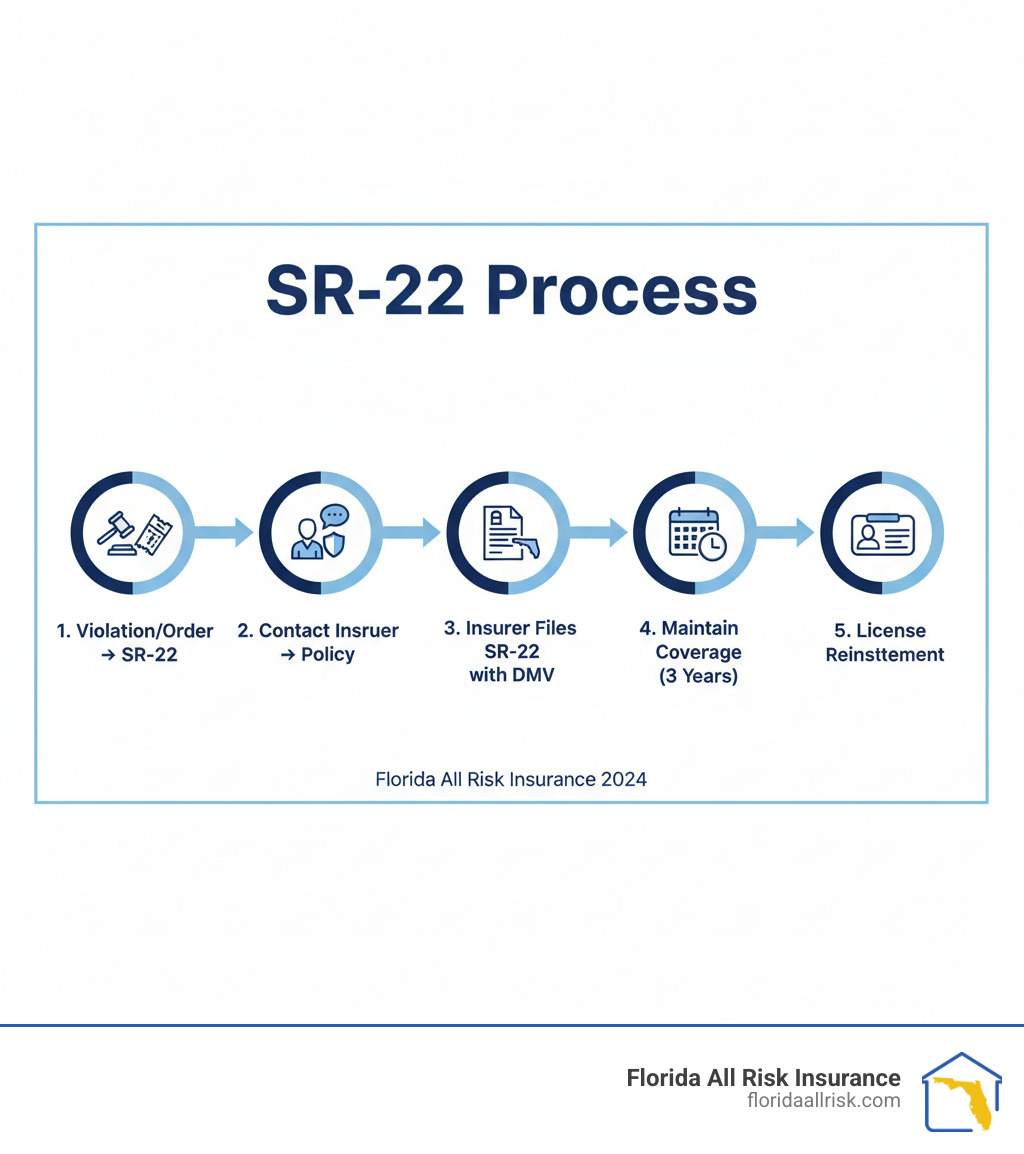
A quick way to think about the process is “file, maintain, remove.” Your insurer files the certificate, you maintain uninterrupted coverage during the required period, and then, once eligible, you have the filing removed. If you keep those three steps in mind and plan ahead for payments and renewals, you’ll minimize surprises and stay on track toward reinstatement.
What Is an SR-22 and Why Is It Required?
An sr22 form is a certificate of financial responsibility your insurer files with the state’s Department of Motor Vehicles (DMV) or equivalent agency. The filing affirms that you carry at least the minimum liability limits required by law and that your insurer will alert the state if your policy cancels or lapses. It’s not a separate policy—it’s an endorsement or filing attached to your standard auto policy.
States use SR-22 monitoring to promote public safety and accountability. If you’ve had a serious violation or failed to meet financial responsibility laws, an SR-22 serves as the state’s verification that you’re insured now and staying insured going forward. It acts as a leash, ensuring that drivers who have proven to be a higher risk to the public are continuously covered in case of another incident. This system protects other drivers on the road by guaranteeing that a source of funds is available to cover damages. For a plain-language overview of drunk driving risks and penalties, see the National Highway Traffic Safety Administration’s guidance on impaired driving for context and safety best practices.
- Authoritative resource on impaired driving consequences: National Highway Traffic Safety Administration’s overview of drunk driving at https://www.nhtsa.gov/risky-driving/drunk-driving
- Florida-specific insurance requirements and financial responsibility information: Florida Department of Highway Safety and Motor Vehicles at https://www.flhsmv.gov/driver-licenses-id-cards/insurance-requirements/
This filing is often a prerequisite to license reinstatement or to maintain a hardship/restricted license while you complete any court-ordered conditions.
Common Reasons for an SR-22 Mandate
While triggers vary by state, an sr22 form is generally required for incidents that signal elevated risk or noncompliance with insurance laws. Common reasons include:
- DUI or DWI convictions. This is one of the most frequent triggers. A conviction for driving under the influence of alcohol or drugs demonstrates a significant lapse in judgment and a high risk to public safety. In Florida, these offenses often lead to an FR-44 rather than an SR-22, which mandates even higher liability limits.
- Driving without insurance. If you’re caught operating a vehicle without the legally required minimum liability coverage, the state will almost certainly require an SR-22 to reinstate your license. This proves you have corrected the issue and ensures you remain insured.
- At-fault accidents while uninsured. Causing an accident that results in injury or property damage without having insurance to cover the costs is a serious offense. In addition to being personally liable for the damages, you will be required to file an SR-22 to get your driving privileges back.
- License suspension or revocation. Many administrative actions can lead to a suspension and a subsequent SR-22 requirement. This includes accumulating too many points on your driving record, failing to appear in court for a traffic ticket, or other serious infractions that result in the state revoking your license.
- Repeat traffic offenses. A pattern of irresponsible driving, such as multiple speeding tickets, reckless driving citations, or other moving violations within a short period, can flag you as a habitual offender. The state may then require an SR-22 to monitor your insurance status.
- Failure to satisfy a judgment or pay child support. In some states, financial irresponsibility in other areas can affect your driving privileges. Failing to pay a court-ordered judgment resulting from a car accident or being delinquent on child support payments can lead to a license suspension and an SR-22 requirement for reinstatement.
For more detail on SR-22 basics, consumer-focused resources such as the SR-22 Insurance FAQs at https://www.dmv.org/insurance/sr-22-insurance-faqs.php can help you understand common scenarios and terms. Note that DMV.org is an informational resource, not a state agency.
Who Needs to File an SR-22?
You must file an sr22 form if the state DMV or a court orders it. You’ll typically receive an official letter with instructions or a judge will specify the requirement in court. It’s commonly required for high-risk drivers, suspended or revoked drivers seeking reinstatement, and those applying for hardship or restricted licenses to drive to work, school, or medical appointments.
The specifics vary by state, including how long the filing must remain on your policy and when the clock begins (date of conviction, date of suspension, or date of reinstatement). Confirm the details with your DMV or the court clerk so you know precisely what’s expected and for how long.
The Complete Guide to Your SR-22 Form

If you need an sr22 form, your insurance company will handle the filing after adding the SR-22 endorsement to your auto policy. Most insurers submit the certificate electronically to your state’s DMV system. Once filed, the DMV records show you as compliant, provided your policy stays active and meets minimum required limits.
State rules control liability minimums, the length of time you must maintain the filing, and the acceptable filing methods. For example, Texas commonly requires 30/60/25 minimum liability limits ($30,000 bodily injury per person, $60,000 per accident, $25,000 property damage), while other states have different thresholds. Be sure to confirm your state’s minimums and whether any special requirements apply to your situation.
The golden rule is continuous coverage. If your policy lapses for any reason—missed payment, cancellation, or nonrenewal—the insurer must file an SR-26 to notify the state that your coverage ended. That notice usually results in an automatic license suspension. Set up auto-pay, calendar reminders, and policy alerts to avoid a costly interruption.
How Do I Obtain an SR-22 Form?
Start by asking your current auto insurance provider if they offer SR-22 filings. Many major carriers do; they can endorse your existing policy and submit the certificate. If your current insurer doesn’t offer SR-22s—or if your policy is nonrenewed due to the violation—you can seek a provider that specializes in high-risk policies. When shopping, be upfront about your SR-22 requirement so quotes reflect the correct filing and liability limits.
Expect to provide:
- Your full name, driver’s license number, and date of birth
- Your address and contact information
- Vehicle year/make/model and VIN (unless purchasing a non-owner policy)
- Desired liability limits and any required endorsements
- The state where the SR-22 must be filed (including out-of-state needs if applicable)
Once your policy is active, the insurer typically files the SR-22 within a few business days. Some states process filings quickly; others can take longer to update your record. If you’re on a tight timeline to reinstate your license, notify your agent or insurer so they can prioritize the filing and confirm when processing is complete in the state system.
What Is the Cost of an SR-22 Form?
There are two main cost components:
- Filing fee. A one-time administrative fee charged by your insurer to file the form, usually $15–$50.
- Reinstatement or administrative fees charged by the state. Separate from the SR-22 filing fee, these DMV fees can be $100 or more, depending on the state and violation.
Some insurers may charge the SR-22 fee again at renewal, while others charge only once. Your premium will likely be higher because of the underlying violation, not because the filing itself is expensive. If you’re comparing options, you can review rate information and coverage basics at https://floridaallrisk.com/auto-insurance-rates-florida/ to understand how liability limits, deductibles, and driver factors influence premiums.
How Does an SR-22 Affect Insurance Premiums?
The SR-22 filing does not directly increase your rate; it’s the incident that led to the filing that causes the jump. Insurers categorize drivers who need an SR-22 as higher-risk. Your individual increase depends on:
- Nature and severity of the offense. A DUI/DWI typically causes a larger rate increase than a compliance lapse.
- Driver profile. Age, years licensed, and prior violations or claims matter. A previously clean record can soften the impact over time.
- Rating factors allowed in your state. Where permitted, factors such as garaging location, annual mileage, vehicle type, and in some states credit-based insurance scores can affect price.
- Coverage selection. Higher liability limits and optional coverages (like comprehensive and collision) can increase premiums, while higher deductibles can reduce them.
- Insurer appetite. Carriers price risk differently. Some have dedicated high-risk programs that may be more competitive for SR-22 drivers.
The violation may remain on your driving record for three to five years (sometimes longer), which can influence premiums even after the SR-22 filing is no longer required. Drivers often review rates at renewal to ensure their pricing reflects any improving factors, such as a clean record since the incident.
Strategies to Manage Higher Premiums
While a rate increase is often unavoidable, you can take proactive steps to manage the cost of your insurance during the SR-22 period:
- Shop with specialists: Not all insurance companies are comfortable with SR-22 filings. Seek out insurers that specialize in high-risk or non-standard auto insurance. They often have more competitive pricing for these situations.
- Take a defensive driving course: Many states and insurers offer a premium discount for completing an approved defensive driving or traffic school course. This also demonstrates your commitment to safer driving.
- Improve your credit-based insurance score: In states where it’s permitted, insurers may use a credit-based insurance score to help determine rates. Paying bills on time and managing debt responsibly can positively impact your score and potentially lower your premium over time.
- Choose a higher deductible: If you have comprehensive and collision coverage, opting for a higher deductible (e.g., $1,000 instead of $500) will lower your premium. Just be sure you can afford the deductible out-of-pocket if you need to file a claim.
- Drive a modest vehicle: The type of car you drive significantly affects insurance costs. A less expensive, older car with a good safety rating is cheaper to insure than a high-performance sports car or luxury vehicle.
- Ask about all available discounts: Don’t assume you don’t qualify for discounts. Ask your agent about potential savings for things like paying your premium in full, bundling auto and home/renters insurance, or having safety features in your car.
Managing Your SR-22: Duration, Lapses, and Removal
Filing your sr22 form is the first step. Your next priority is maintaining it for the full required term. Think of this period as a probation-like timeframe during which you demonstrate consistent compliance. Because your insurer must notify the state about any lapse, proactive management is essential: set up auto-pay, keep your address and payment method current, and monitor renewal notices closely.
How Long Is an SR-22 Required?
There’s no one-size-fits-all answer, as the requirement period is dictated by state law and the specific offense. The duration can vary significantly. For instance:
- Typical Duration: Many states, including Illinois and Ohio, often require an SR-22 for three years for common violations like a first-time DUI or driving without insurance.
- Shorter Durations: Some states may have shorter periods. Texas, for example, generally requires an SR-22 to be maintained for two years from the date of the conviction.
- Longer Durations: For more severe or repeat offenses, the period can be longer. Some states may mandate a five-year filing period.
Crucially, the “start date” can also differ. The clock might begin on the date of your conviction, the date your license was suspended, or the date your license is officially reinstated. This detail is vital—miscalculating it could lead you to remove the filing prematurely. Always verify your specific start and end dates with your state’s DMV or the court that issued the order. If you move to a new state during the monitoring period, you must notify both your insurer and the new state’s DMV. You will likely need to continue complying with the original state’s requirement until the term is complete.
What Happens if an SR-22 Policy Lapses?
A lapse in coverage has immediate and severe consequences. There is no grace period. The moment your policy is canceled for non-payment or any other reason, your insurer is legally obligated to file an SR-26 form with the DMV. This form electronically notifies the state that you no longer have the required insurance.
Once the state processes the SR-26, a domino effect begins:
- Automatic License Suspension: Your driver’s license is typically suspended again, effective immediately.
- Notification: You will receive a formal notice of suspension in the mail.
- System Updates: Law enforcement databases are updated, meaning a simple traffic stop could result in a citation (or arrest) for driving on a suspended license, a much more serious charge.
To get reinstated, you will have to start the process over again, which involves purchasing a new policy, having your new insurer file another SR-22, and paying another round of state reinstatement fees. Even worse, many states will reset the clock on your SR-22 requirement, meaning you’ll have to maintain the filing for the full term (e.g., three years) starting from the new reinstatement date.
To prevent these costly disruptions, consider:
- Automatic payments with a backup payment method
- Email and text alerts for billing and renewal
- Early renewal check-ins with your agent or insurer if anything in your policy is changing
How Can an SR-22 Be Removed?
When you’ve satisfied the full requirement period, removal is straightforward but not automatic. You must take action. Follow these steps:
1) Confirm Eligibility: Before doing anything, contact your state’s DMV or the court to confirm that your SR-22 period has officially ended and you have no other outstanding requirements or fines.
2) Contact Your Insurer: Once you have confirmation, call your insurance agent or company and request that they remove the SR-22 endorsement from your policy. They will stop filing the certificate at your next renewal (or midterm, if allowed).
3) Verify Removal: After the filing is removed, it’s wise to check your driving record or contact the DMV again to verify that their system reflects that the requirement has been fulfilled. This ensures there are no administrative errors that could cause problems later.
Once removed, you may no longer be categorized as a high-risk driver, and your premium could decrease significantly at your next renewal. Many drivers evaluate their coverage at that time to align limits, deductibles, and optional protections with their budget and risk tolerance.
SR-22 Variations and Special Circumstances
Financial responsibility requirements come in a few forms, and the correct filing depends on your state and violation. Florida stands out because certain serious offenses require an FR-44 instead of an SR-22.
Understanding the distinctions helps you avoid misfilings and delays with reinstatement, especially if you live in Florida or recently moved. Make sure your coverage meets your state’s current minimums and any elevated limits tied to your violation.
SR-22 vs. FR-44: The Florida Distinction
Most states use the sr22 form for post-violation monitoring. Florida and Virginia, however, implemented the FR-44 for certain severe violations, primarily those involving alcohol or drugs. The rationale behind this stricter requirement is to ensure that drivers who have committed high-risk offenses carry insurance limits substantial enough to cover the potentially catastrophic damages from a serious accident. It shifts a greater financial burden onto the high-risk driver and their insurer, better protecting the public.
The key difference is the mandatory liability limits. While an SR-22 only requires proof of the state’s minimum liability coverage, an FR-44 demands much more. The required limits are:
- In Florida: 100/300/50, which means $100,000 for bodily injury per person, $300,000 for bodily injury per accident, and $50,000 for property damage.
- In Virginia: 50/100/40, which means $50,000 for bodily injury per person, $100,000 for bodily injury per accident, and $40,000 for property damage (for offenses after 1/1/2022).
Because these limits are significantly higher than standard minimums, FR-44 policies are considerably more expensive. Your court order or DMV notice will specify which form you need. If you’re unsure, your insurance agent can confirm and build a compliant policy.
What Is a Non-Owner SR-22?
If you need an sr22 form but don’t own a vehicle, a non-owner policy is the solution. This is a special type of car insurance that provides liability coverage for you as a driver whenever you operate a vehicle you do not own. It allows you to meet the state’s SR-22 requirement and reinstate your license without being tied to a specific car.
A non-owner SR-22 policy typically includes bodily injury and property damage liability, but it does not include comprehensive or collision coverage because there is no specific vehicle to protect. It’s important to understand its limitations:
- It’s secondary coverage: If you borrow an insured car and cause an accident, the car owner’s insurance is primary. Your non-owner policy would only kick in if the damages exceed the owner’s policy limits.
- It excludes certain vehicles: It does not cover any vehicle you own, one registered to your spouse, or any vehicle that is regularly available for your use (such as a roommate’s car you drive daily or a company car).
This can be a practical and affordable option if you need to reinstate your license and only drive occasionally by borrowing or renting cars. If you later purchase a vehicle, you must contact your insurer immediately to convert your non-owner policy to a standard owner's policy and transfer the SR-22 endorsement. To explore whether a non-owner policy fits your needs, see https://floridaallrisk.com/non-owner-car-insurance-florida/ for coverage fundamentals and eligibility considerations.
Can an SR-22 Be Filed for a Different State?
Yes. Cross-state filings are common in two situations:
- Out-of-state violations. If you live in Florida but receive a DUI in another state that requires an SR-22, you will need your Florida-based insurer to file the SR-22 with that other state’s DMV. This is called an “out-of-state filing.”
- Moving during the requirement period. If you have an SR-22 requirement in one state and then move to another, you must continue to satisfy the original state’s requirement. Your insurer can typically handle this, provided they are licensed to do business in both states. The new state will usually honor the filing and grant you a license based on your compliance.
Because states differ in what they require and how they track compliance, clear communication with your insurer is essential if your situation spans more than one state. Ask your agent to verify which state holds the requirement, the accepted filing type, and whether your policy limits meet the applicable minimums.
Frequently Asked Questions about Financial Responsibility Forms
It’s easy to get confused by the different financial responsibility forms like SR-22, SR-21, and FR-44. Here are clear answers to some of the most common questions.
What is the Difference Between an SR-22 and an SR-21?
These forms serve very different purposes. An sr22 form is about the future, while an SR-21 is about the past.
- An SR-22 is a certificate of future financial responsibility. It proves you have insurance now and commits you to keeping it for a set period.
- An SR-21 is proof of insurance at the time of an accident. In states like Indiana, it’s filed after a collision to verify you were covered when it happened. Failure to file a valid SR-21 can lead to a license suspension.
You won’t have to choose between them; the situation dictates which form is required.
What are SR-11 and SR-60 Forms in Texas?
Texas uses some unique forms that are not interchangeable with an sr22 form.
- The SR-11 (Release of Liability) certifies that a judgment or claim against you from an accident has been fully paid or settled.
- The SR-60 (Affidavit for Reinstatement) is used to reinstate driving privileges after a suspension, typically after two years have passed since an accident with no pending legal action.
Both forms are part of Texas’s specific administrative process for handling post-accident financial responsibility. For more information, the Texas Department of Insurance is an excellent resource.
Do I Need to Carry the SR-22 Form in My Car?
No, you do not need to carry a physical copy of the SR-22 form in your car.
The sr22 form is filed electronically by your insurance company directly with the state DMV. The record of your compliance is stored in the state’s system, which is accessible to law enforcement. You must, however, always carry your standard proof of insurance card, which your insurer provides. This card proves you have an active policy, which is what an officer will ask for during a traffic stop.
Conclusion: Taking the Next Step with Confidence
Navigating an sr22 form requirement can feel complex at first, but the path forward is straightforward once you understand the essentials. The state is asking for proof of continuous liability coverage for a defined period, and your insurer supplies that proof by filing the certificate and notifying the DMV if anything changes. Your role is to keep your policy active, pay on time, and maintain safe-driving habits while the filing is in effect.
Over time, consistent compliance works in your favor. Many drivers see premiums stabilize or decline after the filing is removed, especially if they avoid additional violations or claims. If you’re in Florida, understanding whether your situation requires an SR-22 or an FR-44 (and the corresponding liability limits) keeps you from running into administrative snags or unexpected costs.
If you have questions about state timelines, minimum liability limits, non-owner options, or cross-state filings, a conversation with a knowledgeable agent can save time and prevent missteps. A clear plan—covering how to file, how to prevent lapses, and when to remove the filing—helps you move through the process with confidence.
Ready to move forward? Call (727) 344-1911 now to speak with a licensed agent who can help you file quickly and correctly, or visit https://floridaallrisk.com/get-a-quote/ to get your personalized SR-22 or FR-44 quote in minutes.
Prefer to compare options? Explore coverage choices and pricing at https://floridaallrisk.com/insurance_products/auto-insurance/ and get a fast, no-obligation quote at https://floridaallrisk.com/get-a-quote/ so you can reinstate driving privileges with confidence.
Contact Us
Florida All Risk Insurance
6101 34th St N, Saint Petersburg, FL 33714
Phone: (727) 344-1911
Email: [email protected]
Website: https://floridaallrisk.com/
We serve clients throughout Florida from our office in St. Petersburg. For general inquiries or documentation requests related to SR-22 or FR-44 filings, please contact us using the details above.