

Small farm insurance cost: Top 5 Ways to Save
Understanding Small Farm Insurance Cost: What You Need to Know
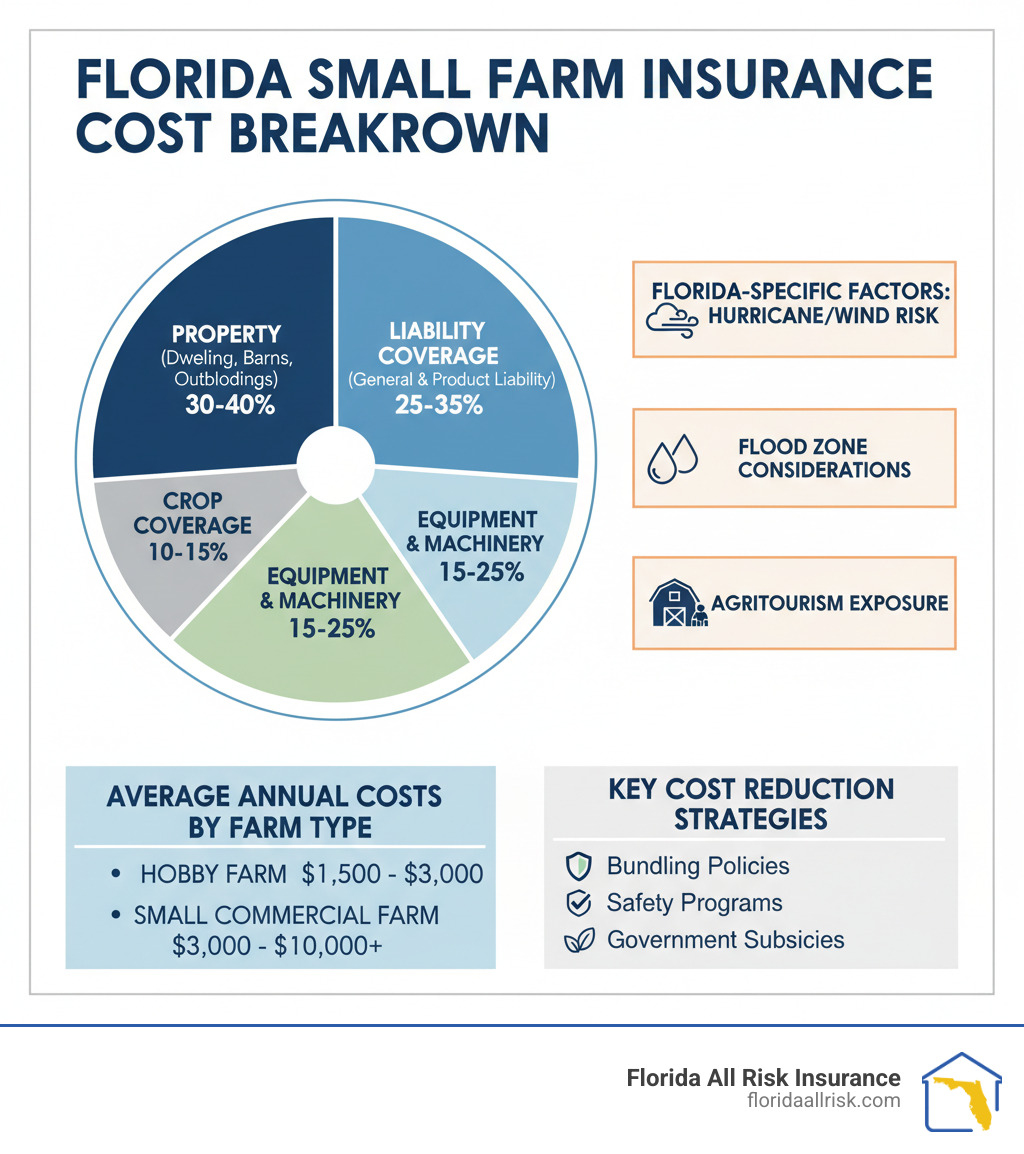
Small farm insurance cost varies widely, but understanding the key drivers can help you budget effectively. For Florida farmers, premiums are custom to the specific risks of your operation. Here’s a general overview:
Quick Cost Overview:
- Hobby farms (under $10,000 annual revenue): $1,500 – $3,000/year
- Small commercial farms: $3,000 – $10,000+/year
- Cost by acreage:
- Under 100 acres: $2,000 – $3,000/year
- 100-500 acres: $2,500+/year
- 500-1,500 acres: $3,500+/year
- Over 1,500 acres: $5,000+/year
Key Cost Factors:
- Farm size and acreage
- Type of operations (crops, livestock, agritourism)
- Location and risk exposure (hurricanes, floods)
- Value of buildings and equipment
- Liability coverage limits
- Claims history
Unlike standard homeowners insurance, which excludes business activities, specialized farm insurance is designed to cover the unique exposures of agricultural operations—from your barn and tractor to your livestock and visitor liability. There’s no simple answer to “how much will it cost?” because every premium is calculated based on factors specific to your farm. A 50-acre organic vegetable farm in Central Florida faces different risks and costs than a 200-acre cattle operation in the Panhandle.
This guide will give you the knowledge to make informed decisions, understand what you’re paying for, and find opportunities to save money while maintaining comprehensive protection for your livelihood.
Key Factors That Influence Your Small Farm Insurance Cost
Every farm is different, so every policy must be customized to your specific situation. Insurance companies calculate your premium by assessing what could go wrong and how much it would cost to fix. Understanding these factors helps you make informed decisions about your coverage and manage your small farm insurance cost.
More info about Business Insurance for Small Businesses
How Farm Size and Acreage Affect Premiums
Your farm’s size is a primary factor for insurers. More land often means more buildings, equipment, and potential liability. However, acreage alone doesn’t tell the whole story.
Insurers often use acreage tiers as a starting point:
- Farms under 100 acres might see annual premiums from $2,000 to $3,000.
- Operations between 100 and 500 acres often pay upward of $2,500 per year.
- Farms from 500 to 1,500 acres are likely looking at $3,500 or more annually.
- Operations exceeding 1,500 acres can see premiums climb well over $5,000 per year.
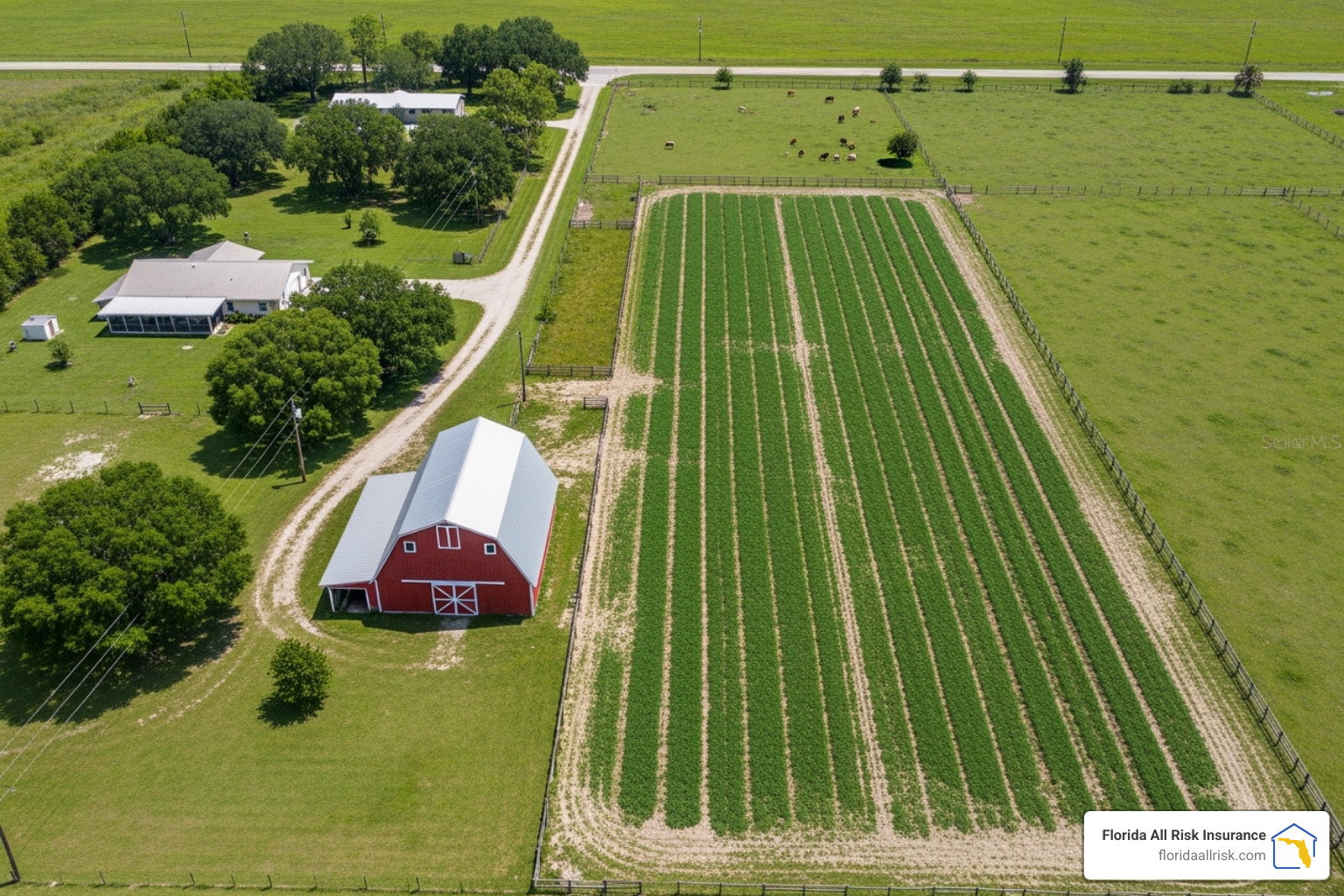
More important than raw acreage is how you use the land. A 50-acre property with agritourism events and specialty crops will cost more to insure than 50 acres of simple pastureland. The intensity of your farming activities directly influences your risk assessment. Additionally, the property value—the total worth of your home, barns, sheds, greenhouses, and infrastructure like irrigation systems—is a major component. Higher replacement costs lead to higher premiums.
The Impact of Your Farm’s Operations
Two farms of identical size can have vastly different premiums based on their operations. The type of agriculture you practice introduces unique risks.
-
Crop farming risks depend on the crop type and value. High-value specialty produce carries more risk than standard row crops. Vulnerability to perils like hail, wind, and drought also affects cost.
-
Raising livestock introduces risks like disease, theft, and animal-related injuries. The number, type, and value of your animals are key factors. A small flock of chickens is a lower risk than a herd of prize-winning cattle, which may need to be individually scheduled on your policy.
-
Agritourism activities like U-pick operations, farm tours, and corn mazes significantly increase your liability exposure. Every visitor represents a potential accident, requiring higher liability limits and increasing your premium.
-
Selling products directly to consumers at farm stands, farmers’ markets, or online creates product liability exposure. If a customer gets sick from your produce, you could face a lawsuit. Your policy must specifically cover this risk.
More info about Business Liability Insurance
Why Location Matters, Especially in Florida
Your farm’s location has a profound impact on your premium, and Florida presents unique challenges.
-
Hurricanes and Windstorms: Florida’s exposure to severe weather is a primary concern for insurers. Policies often have specific wind deductibles or limitations due to the high risk of wind damage.
-
Flood Zones: Much of Florida is in designated flood zones. Since flood damage is almost always excluded from standard farm policies, a separate flood insurance policy is essential for at-risk properties.
-
Proximity to Emergency Services: Being close to a fire station or fire hydrants can lower your premiums, as faster emergency response times can reduce the severity of a loss. Remote farms may see higher rates.
-
Local Liability Trends: Insurance rates can vary by county based on the local legal climate and claims history. Some regions have higher litigation rates, which can drive up premiums for everyone in that area.
More info about High Risk Commercial Property Insurance
Deconstructing Your Policy: Coverage Costs Explained
A farm insurance policy is a package of different protections, each addressing specific risks. The cost of each component adds up to your total premium. Understanding these pieces helps you invest your insurance dollars wisely.
The Cost of Insuring Farm Structures
Your buildings—dwelling, barns, sheds, and greenhouses—represent a significant part of your farm’s value. The cost to insure them depends on several factors.
First is the number and size of your buildings. More structures mean higher coverage needs. The valuation method you choose is also critical. Replacement Cost Value (RCV) pays to rebuild with new materials at current prices, costing more in premiums but providing full replacement. Actual Cash Value (ACV) pays the depreciated value, resulting in lower premiums but a potential gap if you need to rebuild. The age, construction materials (steel vs. wood), and condition of your buildings also play a major role. Well-maintained structures with modern wiring and fire-resistant materials generally cost less to insure.
More info about Commercial Property Insurance
How Much Does Livestock Insurance Cost?
Livestock insurance covers the death or injury of your animals from covered perils like fire, lightning, storms, or attacks. The cost is typically calculated as a percentage of each animal’s value. For horses, rates often range from 2.5% to 5% of the horse’s total value annually. A $5,000 horse insured at a 3% rate would cost about $150 per year.
Basic policies cover specific named perils, but you can purchase broader coverage for risks like accidental shooting, vehicle collisions, and theft. If you have high-value animals, such as a prize-winning bull or a breeding horse, you should schedule them individually on your policy. This lists each animal with its specific value, ensuring you’re fully protected. For practical advice on managing livestock, Small Farm Canada offers excellent recommendations for managing livestock.
Insuring Farm Machinery and Equipment
Your tractors, combines, and tools are essential assets. Equipment coverage protects them from damage, breakdown, or theft. A common rule of thumb for estimating the cost is around $15 for every $1,000 in equipment value. A $100,000 tractor might cost roughly $1,500 per year to insure. This rate varies based on the equipment’s age, type, and vulnerability to theft.
You can insure equipment in two ways. With scheduled coverage, you list each high-value item individually with its specific value. With blanket coverage, you set a single total limit that covers all your equipment collectively, which is useful for a large inventory of smaller tools. Farm trucks or other vehicles driven on public roads for business require a separate Commercial Auto Insurance policy.
Understanding Farm Liability Insurance Costs
Liability coverage is your financial shield against lawsuits and is arguably the most critical protection you can carry.
-
General Liability covers incidents like a visitor slipping and falling on your property or your fence damaging a neighbor’s car. It’s the foundation of your liability protection.
-
Product Liability is essential if you sell any farm products directly to consumers. It protects you if someone becomes ill from your product. Claims can arise from contaminated produce or allergic reactions, and this coverage can save your farm from bankruptcy.
The cost of liability coverage is tied to your coverage limits, which typically start at $500,000 and can go up to $5,000,000 or more. Higher limits cost more but offer greater protection. If you host agritourism events, have employees, or sell products widely, you need higher limits. A single serious injury lawsuit can easily exceed $500,000.
More info about Commercial General Liability Insurance for Small Business
Hobby Farm vs. Commercial Farm: A Cost Comparison
One of the most important distinctions in farm insurance is whether your operation is a hobby or a commercial business. Insurers determine this based on your annual income, acreage, and intent. Are you farming for personal enjoyment or as a business with an expectation of profit? The answer fundamentally changes your policy type and your small farm insurance cost.
A hobby farm is typically a smaller operation run for pleasure or supplemental income, while a commercial farm is operated as a for-profit business. The line can be blurry, but understanding the difference is crucial for getting the right protection.
| Feature | Hobby Farm Insurance | Commercial Farm Insurance |
|---|---|---|
| Typical Annual Cost | $1,500 – $3,000 | $3,000 – $10,000+ |
| Primary Policy Type | Homeowners policy with a “farm endorsement” or a separate hobby farm policy. | Comprehensive farm package policy. |
| Income Limit | Typically under $10,000 in gross annual farm revenue. | No income limit; designed for businesses. |
| Liability Scope | Covers incidental farming activities and limited public exposure. | Covers full business operations, product liability, and higher public risk. |
| Equipment Coverage | Limited coverage for small tractors and tools. | Comprehensive coverage for high-value, commercial-grade machinery. |
Estimating Your Hobby Farm Insurance Cost
If your farm generates less than about $10,000 annually in gross revenue, you likely fall into the hobby farm category. It’s important to know that your standard homeowners insurance policy will not cover these activities, as most policies explicitly exclude business and farm operations.
For a basic hobby farm, you can expect to pay around $1,500 per year for appropriate coverage. This is usually structured as a “limited farm endorsement” added to your homeowners policy or as a standalone hobby farm policy. This extends your liability coverage to your farming activities and provides some protection for outbuildings, small equipment, and a limited number of animals. The actual cost will vary based on the value of your dwelling, the type and number of animals, and the value of your equipment. A simple endorsement may not be enough if you have significant livestock or expensive equipment, so a full discussion with your agent is essential.
More info about Insurance for Small Businesses
Calculating Your Commercial Small Farm Insurance Cost
Once farming becomes a primary source of income or is operated with a clear business plan, you need a full commercial farm insurance policy. These are comprehensive packages designed to protect a business with all its complexities.
For a commercial small farm, annual premiums typically range from $3,000 to $10,000 or more. The wide range reflects the diversity of commercial operations. The cost is driven higher by significantly greater liability exposure. Selling products requires robust product liability coverage. Having employees means you’ll need Workers Comp. Using heavy machinery and engaging in agritourism also demand substantially higher liability limits. These policies also cover things hobby farm policies don’t, like equipment breakdown and business interruption. The higher cost is an essential business expense to protect what you’ve built.
Strategic Savings: How to Lower Your Premiums
While farm insurance is a necessary expense, there are practical steps you can take to manage your premiums without sacrificing critical protection. It’s a balance of smart shopping, proactive risk management, and understanding your options.
Can Bundling Home and Farm Insurance Lead to Savings?
Yes, bundling is often one of the easiest ways to save on your small farm insurance cost. Many insurers offer a “farmowners” policy that combines your homeowners coverage with your farm property and liability coverage into a single package. This can lead to multi-policy discounts of 10-20% on your total premium. Beyond the savings, it simplifies your life with one policy, one bill, and one agent. A well-structured farmowners policy also helps eliminate dangerous coverage gaps that can occur between separate policies. Working with an independent agency that can compare carriers is key to finding the best bundle.
More info about Finding the Right Insurance Agency
Government Programs and Subsidies
The U.S. Department of Agriculture (USDA) offers several programs that can make insurance more affordable, particularly for crop and revenue protection.
- Federal Crop Insurance: This program is highly subsidized by the federal government, making premiums more affordable. It protects against yield losses from natural causes like drought, flood, or disease.
- Whole-Farm Revenue Protection (WFRP): This insures the revenue of your entire farm under one policy, ideal for diversified operations with multiple crops and livestock.
- Micro Farm Program: As detailed in the Official Micro Farm Program Fact Sheet, this program is designed for smaller, diversified farms with up to $350,000 in approved revenue, offering a streamlined way to get whole-farm coverage. These policies must be purchased through an authorized agent.
Actionable Tips to Reduce Your Small Farm Insurance Cost
Your own actions can have a big impact on your premiums. Insurers often reward proactive risk management.
- Increase Your Deductible: A higher deductible—the amount you pay out-of-pocket on a claim—can lower your premium by 10% or more. Ensure you can comfortably afford the deductible you choose.
- Implement a Safety Program: A documented safety program, including regular equipment maintenance logs and safety procedures, shows insurers you’re serious about risk management.
- Maintain a Good Claims History: A history free of frequent claims signals to insurers that you’re a lower risk, which often translates to lower premiums.
- Install Security and Safety Features: Fencing, locked gates, fire extinguishers, smoke detectors, and security cameras can deter theft and reduce fire risk, potentially earning you discounts.
- Review Your Policy Annually: Your farm changes. Meet with your agent annually to adjust coverage, remove assets you no longer own, and ensure your policy still fits your needs. This prevents overpaying or being underinsured.
Common Exclusions to Be Aware Of
Knowing what your policy doesn’t cover is as important as knowing what it does.
- Flood and Earthquake: These are almost always excluded and require separate policies. This is critical for Florida farmers, where flood risk is a major concern.
- Intentional or Illegal Acts: Insurance is for unforeseen accidents, not deliberate actions or illegal activities.
- Custom Farming Work: Performing services for other farms for a fee (e.g., baling hay, plowing fields) is typically excluded and requires a specific endorsement or separate policy.
- Pollution Liability: Incidents like manure spills or pesticide drift are often excluded and require a special add-on.
Frequently Asked Questions about Small Farm Insurance
When you’re researching small farm insurance cost, you probably have some specific questions about what’s covered, what’s not, and how different scenarios affect your premium. We hear these questions all the time from Florida farmers, and we want to make sure you have clear, honest answers. Let’s tackle the most common ones.
How much is property insurance per acre for a farm?
This is one of the most common questions we get, and the answer might surprise you: there is no flat rate for insurance per acre. It’s not like buying carpet where you simply multiply the square footage by a price. The cost is based on the value of what’s on that acre—not the land itself.
Think about it this way: an acre with a $200,000 barn packed with equipment and supplies will cost far more to insure than an acre of empty pasture or woodland. The land itself typically has minimal insurance value because it won’t be destroyed by fire or wind—it’s what you’ve built on it and what you’re doing with it that matters.
Your premium calculation considers factors like the type of land use (are you growing high-value specialty crops or just grazing cattle?), the presence of irrigation systems, fencing, greenhouses, and other improvements. Location-based risks play a huge role too—your Florida farm faces hurricane exposure that a farm in Kansas doesn’t, and that significantly impacts your cost. So while acreage gives insurers a general sense of scale, it’s truly about the assets and risks associated with each specific acre, not just the square footage.
Do I need a separate policy for farm vehicles?
The answer here is: it depends on how the vehicle is used and how it’s titled. This is one area where we see a lot of confusion, and unfortunately, it’s also where we sometimes see claims get denied because of coverage gaps.
A personal truck that you occasionally use to haul feed for your hobby farm or pick up supplies at the farm store might be adequately covered under your personal auto policy. However, a heavy-duty truck used exclusively for farm business—especially if it’s titled in the farm’s name, has commercial plates, and is regularly driven on public roads—will almost certainly require a separate Commercial Auto Insurance policy.
Here’s where it gets important: tractors and other farm machinery are typically covered under your farm property policy when they’re on your premises or being transported. But that coverage usually stops when they’re being driven on public roads. If you drive your tractor down a county road to reach another field and have an accident, your farm policy might not cover it.
The key is to be completely transparent with your agent about how you use every vehicle. We’d rather help you get the right coverage upfront than have you find a gap when you’re filing a claim. It’s crucial to clarify this with your agent to avoid a denied claim that could cost you thousands.
What is not typically covered by a small farm insurance policy?
Understanding what your policy doesn’t cover is just as important as knowing what it does. We’ve already discussed some major exclusions earlier in this guide—flood, earthquake, and intentional acts—but there are some other common gaps you should know about.
Certain animal diseases often aren’t covered, especially if they’re not specifically listed as a covered peril in your policy. For example, a widespread disease outbreak affecting your herd might not be covered unless you have specific livestock mortality coverage that includes disease.
Mysterious disappearance of livestock is another one. If your cattle simply vanish without evidence of theft (no broken fences, no witnesses, no signs of predators), your policy might not pay. Insurers need proof that a covered peril occurred.
Normal wear and tear is never covered. Your 20-year-old barn roof that finally gives out from age isn’t an insurable event—it’s expected maintenance. Insurance covers sudden, accidental losses, not gradual deterioration.
Drone or aircraft liability is increasingly relevant for modern farmers who use drones for crop monitoring or aerial photography. This exposure is often excluded unless specifically added to your policy.
Custom farming work you do for other farms—like baling their hay for a fee or plowing their fields—is typically excluded from your standard farm liability coverage and requires a specific endorsement or separate policy.
We always encourage our clients to read their policies carefully or, better yet, ask us to walk them through the exclusions. A 30-minute conversation can save you from a massive financial surprise down the road. That’s what we’re here for—to make sure you truly understand what you’re buying and that it actually protects what matters most to your operation.
Conclusion: Protecting Your Florida Farm’s Future
Your small farm is a testament to your hard work. Protecting it with the right insurance is a fundamental investment in its longevity and your peace of mind. As we’ve seen, the small farm insurance cost is a complex equation, but by understanding the key factors, implementing smart risk management, and exploring all your options, you can secure robust protection that fits your budget.
Navigating this landscape can be challenging, but you don’t have to do it alone. At Florida All Risk Insurance, we are an independent agency that works for you, not the insurance companies. We specialize in crafting custom insurance solutions for Florida’s unique agricultural community and will shop multiple carriers to find the policy that best protects your livelihood.
Ready to secure your investment? Get a personalized quote for your small farm today and let us help you build a policy that works for you.
To learn more about securing your operation, explore our comprehensive guide to insurance for small businesses.
Contact Us
If you have questions about small farm insurance cost or want to explore your coverage options, we’re here to help. As your local independent agency, we’re committed to understanding your farm’s unique needs and finding the right protection.
Florida All Risk Insurance
Address: 700 Central Ave, Suite 300, Saint Petersburg, FL 33701
Phone: (727) 577-2886
Email: [email protected]
Contact us today to speak with a knowledgeable agent who understands Florida agriculture. We can meet at your farm to walk the property or handle everything over the phone and email for your convenience. Our goal is to make getting the right insurance simple, so you can get back to what you do best.

