Small Business Health Coverage: The Essentials
Let’s face it—navigating health insurance for your small business can feel like trying to solve a puzzle while running a marathon. As a small business owner in Florida, you’ve got enough on your plate without becoming an insurance expert overnight.
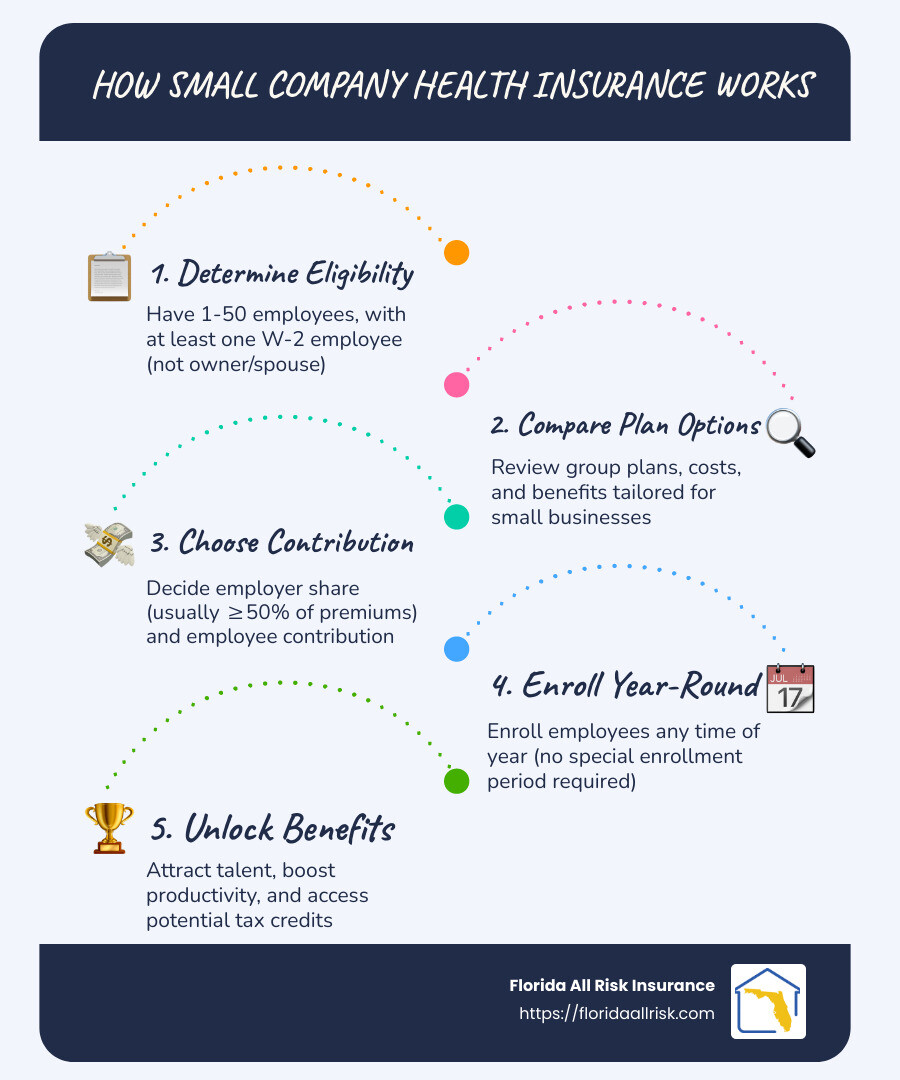
Small company health insurance is essentially group coverage that brings your team under one health plan umbrella. It allows businesses with 1-50 employees to provide valuable health benefits while sharing costs between employer and employees. This isn’t just another expense—it’s an investment in your company’s future.
Small Business Health Insurance Snapshot:
- Eligibility: Requires at least 1 full-time employee (not owner/spouse)
- Cost: Average $286 per person monthly ($1,432 for 5 employees)
- Employer Contribution: Typically at least 50% of employee premiums
- Enrollment: Available year-round (no special enrollment period)
- Tax Benefits: Credits available for businesses with fewer than 25 employees
I’ve worked with countless Florida small business owners who were surprised to find they had more options than they realized. While your larger competitors might have entire departments dedicated to benefits administration, you’re likely wearing multiple hats—CEO, HR manager, and sometimes even the person who fixes the coffee machine.
The silver lining? You have flexibility. From traditional group health plans to more innovative solutions like Health Reimbursement Arrangements (HRAs), today’s market offers options that can work with almost any budget and team structure.
Why should you consider offering health benefits? Beyond the obvious advantage of keeping your team healthy (and at work), providing coverage delivers multiple benefits:
First, it helps you attract and keep talented people. In today’s competitive job market, health benefits often make the difference between a candidate accepting your offer or your competitor’s.
Second, employees with access to healthcare tend to be more productive and satisfied. They’re not worrying about how they’ll afford medical care or missing work for preventable health issues.
Third, don’t overlook the tax advantages. Employer contributions to health insurance are tax-deductible, potentially saving your business significant money.
Finally, offering health benefits helps build the kind of company culture that makes people proud to work for you. It shows you care about their wellbeing beyond just what they contribute to your bottom line.
One of the best-kept secrets about small company health insurance? Unlike individual plans, you can shop for and implement group coverage any time of year. There’s no need to wait for an open enrollment period—you can start the process whenever it makes sense for your business.
I’m Jason Miller, and having spent over two decades helping Florida businesses steer their insurance options, I’ve seen how the right health coverage can transform a small company’s trajectory.
Ready to explore your options? Check out these resources to deepen your understanding of small company health insurance:
- buy business insurance
- benefits of health benefits
- what is a self funded group health insurance plan
What Is “Small Company Health Insurance”?
When we talk about small company health insurance, we’re referring to health coverage specifically designed for businesses with 1-50 full-time equivalent employees. Think of it as a partnership between you (the employer) and your team members to ensure everyone has access to quality healthcare.
Unlike individual health insurance that employees might purchase on their own, group plans come with some significant advantages. For starters, these plans must accept all eligible employees regardless of their health history or pre-existing conditions—that’s the “guaranteed issue” protection that gives everyone peace of mind.
Most small businesses share costs with their team, typically covering at least 50% of employee premiums while team members pay the rest and any additional costs for family coverage. One of the biggest perks? You can shop for and enroll in small company health insurance any time of year—no need to wait for those annual enrollment windows that restrict individual buyers.
The financial benefits extend beyond just coverage. Premium contributions you make as an employer are generally tax-deductible business expenses, helping your bottom line while you take care of your team.
As Rob Schaust, Vice President & Partner of a small business that recently implemented group coverage, told us: “UnitedHealthcare quickly put together a comprehensive offering of types and tiers to cover my team’s gamut of needs. We had our insurance in place within a few business days of employees choosing their plan.”
Why “small company health insurance” matters
Offering health benefits isn’t just a nice gesture—it’s becoming essential for small businesses that want to thrive in today’s competitive landscape.
When it comes to hiring and keeping great people, health insurance often makes all the difference. I’ve heard countless stories from Florida business owners like the one who shared, “When we added health insurance last year, our employee retention jumped by 30%. The investment has more than paid for itself in reduced hiring and training costs.”
Think about productivity, too. When your team members have access to regular healthcare, they’re more likely to get those preventive check-ups, manage any ongoing health conditions, and ultimately miss fewer days due to illness. A healthier team means a healthier business.
There’s also strength in numbers. Group plans spread risk across multiple people, which typically creates more stable premiums compared to what your employees might find on their own. This collective approach often delivers better value than if each team member purchased individual coverage.
For small businesses competing against larger companies for talent—especially here in Florida’s growing economy—offering comparable health benefits helps level the playing field. It tells potential hires that although you may be smaller, you value their wellbeing just as much as the big corporations do.
Key ACA definitions
Navigating small company health insurance means getting comfortable with some important Affordable Care Act (ACA) terminology:
A Small Employer under ACA guidelines typically means a business with 1-50 full-time equivalent employees, though some states extend this definition to include companies with up to 100 team members.
When counting your workforce, you’ll need to calculate Full-Time Equivalents (FTEs). This includes both full-time employees (those working 30+ hours weekly) and the equivalent number of part-time employees. To figure out the part-time portion, add the total monthly hours worked by part-timers and divide by 120.
All small group health plans must cover ten categories of Essential Health Benefits (EHBs), including things like emergency services, prescription drugs, maternity care, mental health services, and preventive wellness care. This comprehensive approach ensures your team has access to all the basics they need.
Most insurers require that a certain percentage of your eligible workforce—typically around 70%—enrolls in the group plan. This Minimum Participation requirement helps create a balanced risk pool.
When comparing plans, you’ll see them categorized in Metal Tiers—Bronze, Silver, Gold, or Platinum. These aren’t just fancy names; they tell you what percentage of healthcare costs the plan covers (60%, 70%, 80%, or 90%, respectively). Generally, Bronze plans have lower premiums but higher out-of-pocket costs, while Platinum plans offer the opposite.

Do You Qualify? Headcount, Rules & Deadlines
Figuring out if your business can get small company health insurance doesn’t have to be complicated. Let’s walk through what you need to know in plain English.
To qualify for group health coverage, your business needs a few basic elements in place. First, you need at least one W-2 employee who isn’t you (the owner) or your spouse. This is the minimum requirement that makes your business eligible for group coverage.
Your business also needs a physical location in Florida (or whatever state you’re buying coverage in). This might seem obvious, but it’s an important detail that insurers verify. You’ll also need to meet what’s called the “participation requirement” – typically, about 70% of your eligible employees need to enroll in the plan.
“When we first looked into group coverage, I was worried about getting enough employees to participate,” says Maria, a Tampa bakery owner. “But once they saw the value compared to individual plans, we easily met the requirement with 8 out of 10 staff members joining.”
A wonderful advantage of small company health insurance is that you can enroll anytime during the year. Unlike individual health insurance with its limited enrollment windows, you can set up your business coverage whenever it makes sense for your company – whether that’s at the start of your fiscal year, after a successful quarter, or when you reach a certain company milestone.
For more details specific to Florida businesses, check out our comprehensive guide to business health insurance.
How many employees trigger requirements?
Understanding when health insurance becomes mandatory versus optional is important for planning your business growth.
The magic number is 50. Once your business reaches 50 full-time equivalent employees (FTEs), you cross into what the Affordable Care Act calls an “Applicable Large Employer” or ALE. At this point, offering health insurance becomes mandatory rather than voluntary.
Calculating your FTE count takes a bit of math. Each employee working 30+ hours weekly counts as one FTE. For part-timers, you add up their monthly hours and divide by 120 to get their FTE equivalent. Then you combine these numbers to see where you stand.
If you have 48 FTEs, offering health insurance remains your choice. Hit 51 FTEs, and you’re now required to provide coverage that meets ACA standards or face potential penalties. These penalties aren’t small change – they can run into thousands of dollars per employee annually.
“We carefully monitored our headcount as we approached 50 employees,” shares John, who owns a landscaping business in Orlando. “We actually decided to implement group coverage when we hit 45 employees, which gave us time to find the right plan before it became mandatory.”
Legal must-dos for small company health insurance
Once you decide to offer small company health insurance, several legal requirements come into play that help protect both your business and your employees.
First, you must offer coverage to all employees working 30+ hours weekly. You can’t pick and choose based on health conditions or other factors, though you can implement waiting periods for new hires (up to 90 days maximum).
Your plan falls under ERISA (Employee Retirement Income Security Act), which means you need to provide a Summary Plan Description to all participants. This document explains, in plain language, what the plan covers and how it works. If your plan grows to include 100+ participants, you’ll also need to file Form 5500 annually.
If your business has 20 or more employees, COBRA regulations require you to offer continuation coverage to employees who lose their benefits due to qualifying events like job termination or reduced hours. Smaller Florida businesses need to follow the state’s “mini-COBRA” provisions, which provide similar protections custom to smaller employers.
You’ll also need to provide various notices to your team, including a Summary of Benefits and Coverage that clearly explains what the plan covers and what employees can expect to pay for different services.
“The paperwork seemed overwhelming at first,” admits Sarah, who runs a graphic design firm in St. Petersburg. “Working with Florida All Risk Insurance made it manageable – they provided templates for all the required notices and walked us through each step of the compliance process.”
These requirements exist to protect your employees and ensure they understand their benefits. While they may seem like problems, they ultimately help create transparency and trust between you and your team.

Plan Types Decoded: HMO, PPO, HDHP & More
Looking for small company health insurance can feel like trying to decode a secret language. All those acronyms! Let’s break down these plan types in plain English so you can find what works for your team.
Health insurance plans differ mainly in how they handle networks, doctor choices, and cost-sharing. Each type has its own personality, much like your employees.
The HMO (Health Maintenance Organization) is your structured, budget-friendly option. Think of it as the organized planner of health plans. With an HMO, employees must choose a primary care doctor who coordinates all their care and provides referrals to specialists. The trade-off for these restrictions? Lower premiums and predictable copays that won’t surprise your budget.
PPOs (Preferred Provider Organizations) offer more freedom but at a higher cost. They’re the “choose your own trip” of health plans. Employees can see specialists without referrals and even visit out-of-network doctors (though they’ll pay more for this privilege). This flexibility comes with higher premiums, making PPOs better suited for businesses that prioritize choice over cost.
EPOs (Exclusive Provider Organizations) strike a middle ground. They require in-network care like HMOs but don’t demand referrals to see specialists. Consider them the compromise candidate—more flexible than HMOs but more affordable than PPOs.
POS (Point of Service) plans blend HMO and PPO features. They require a primary care doctor like HMOs but offer some out-of-network coverage like PPOs. They’re the hybrid vehicle of the insurance world—versatile but sometimes complex.
HDHPs (High Deductible Health Plans) pair lower premiums with higher initial out-of-pocket costs. In 2023, these plans must have deductibles of at least $1,500 for individuals or $3,000 for families. The magic happens when you pair them with Health Savings Accounts (HSAs), allowing employees to save tax-free money for medical expenses.
“When we presented multiple plan options to our team,” shared a St. Petersburg accounting firm owner, “we were surprised that many younger employees preferred the HDHP with HSA option. They liked the lower premiums and the opportunity to save for future healthcare needs.”
Matching plans to budgets
Money matters when choosing small company health insurance. Your perfect plan balances what your business can afford with what your employees need.
Premium costs represent your most predictable expense. For small businesses, these average about $286 per employee monthly, typically split between employer and employees. Most insurers require employers to contribute at least 50% of employee-only coverage. A helpful approach: determine your total monthly budget, then divide by eligible employees to see what you can realistically offer per person.
Deductibles work like a seesaw with premiums—when one goes up, the other comes down. Higher deductibles mean lower monthly premiums but more upfront costs when employees need care. Consider your team’s financial situation carefully. Young, healthy employees might prefer lower premiums even with higher deductibles, while those with ongoing health needs might value lower deductibles despite higher premiums.
Out-of-pocket maximums provide a safety net, capping the total amount employees might pay in a year. A lower maximum offers greater security but increases premiums. This feature matters most to employees managing chronic conditions or those with young families who visit doctors frequently.
Health Savings Accounts (HSAs) deserve special attention. When paired with qualifying HDHPs, they offer remarkable benefits. Employees can contribute pre-tax dollars, let that money grow tax-free, and withdraw it tax-free for qualified medical expenses. Even better, these accounts belong to employees forever—they’re not “use it or lose it” like FSAs.
A Florida construction company found a clever solution: “We implemented a dual-option strategy, offering both a traditional PPO and an HDHP with HSA. To make the HDHP more attractive, we contribute $50 monthly to each employee’s HSA. Nearly 60% of our staff chose this option, which saved us about 15% on our total insurance costs.”
Ancillary add-ons your team will love
While medical coverage forms the heart of your small company health insurance package, adding a few extras can significantly boost employee satisfaction without breaking the bank.
Dental insurance typically covers preventive care at 100%, basic procedures at 80%, and major procedures at 50%. At just $25-50 per employee monthly, it’s a relatively affordable benefit that employees use regularly. Many employers make this optional with employees covering the cost, but even offering access to group rates provides value.
Vision insurance covers eye exams, glasses, contacts, and sometimes discounts on procedures like LASIK. At only $5-15 per employee monthly, it’s among the most affordable benefits you can offer. Even as a voluntary (employee-paid) benefit, the group rates make it attractive.

Life insurance provides financial security that many employees wouldn’t arrange on their own. Basic group term life (typically offering 1-2 times annual salary) often includes accidental death and dismemberment coverage. At approximately $10-25 per employee monthly, it’s a meaningful way to show you care about employees’ families and long-term security.
Disability insurance helps protect employees’ income when they can’t work due to illness or injury. Short-term disability (STD) covers temporary situations, while long-term disability (LTD) provides extended protection for serious conditions. This benefit helps retain employees during challenging times and demonstrates your commitment to their wellbeing beyond the workplace.
Wellness programs can include health risk assessments, fitness incentives, smoking cessation programs, and nutritional counseling. Beyond potentially reducing healthcare costs, these programs show employees you’re invested in their overall health, not just covering them when they’re sick.
“Adding dental and vision coverage cost us less than a 10% increase over our medical premiums, but the positive employee feedback was enormous,” shared a Florida retail business owner. “These benefits are tangible—employees use them regularly and see immediate value.”
Bundling ancillary benefits with your medical plan often results in administrative simplification and potential premium discounts. At Florida All Risk Insurance, we help you design a comprehensive benefits package that maximizes value while respecting your budget constraints.
Dollars & Sense: Premiums, Tax Credits, Cost Control
Let’s talk money—because at the end of the day, that’s what most small business owners worry about when considering health insurance. The financial picture of small company health insurance involves several moving parts, but I promise it’s not as complicated as it might seem at first glance.
For perspective, the typical small business health plan covers about 5 people and runs approximately $1,432 per month in total premiums. That breaks down to roughly $286 per person monthly—though your actual costs will vary based on several factors unique to your business.
“When I first looked at offering health insurance, the numbers seemed overwhelming,” admits Janice, a Tampa boutique owner. “But breaking it down employee by employee made it much more digestible.”
Most carriers expect employers to contribute at least 50% toward employee-only premiums. So if Maria’s premium costs $500 monthly, you’d cover $250 and she’d be responsible for the other $250, plus any additional costs if she wants to add dependents to her plan.
Geography plays a significant role in your premiums—Florida rates differ from those in Georgia or California. Your workforce demographics matter too; an older team typically means higher premiums. And naturally, plans with richer benefits command higher price tags.
One interesting insight comes from a St. Petersburg tech company that decided to boost their contribution from the minimum 50% to 75%: “It cost us about $12,000 more annually, but our recruitment success skyrocketed and turnover plummeted. Sometimes you have to spend money to make money.”
For the most current information about Small Business Health Options Program (SHOP) tax credits, the official Healthcare.gov employer resource is always up-to-date and reliable.
Small business health care tax credit
Here’s a pleasant surprise many small business owners don’t know about: you might qualify for a substantial tax credit that makes offering small company health insurance much more affordable.
This isn’t pocket change we’re talking about—eligible businesses can receive up to 50% of their premium contributions back as a tax credit. Even better? It’s fully refundable, meaning you’ll get the money even if you don’t owe taxes.
To qualify, your business needs to check a few boxes:
- Have fewer than 25 full-time equivalent employees
- Pay average annual wages under $56,000 per employee
- Contribute at least 50% toward employee-only premiums
- Purchase coverage through SHOP or through a SHOP-certified agent like us at Florida All Risk Insurance
The smallest businesses get the biggest benefit. If you have 10 or fewer employees earning average wages of $27,000 or less, you’ll qualify for the maximum credit. As your team size or average wages increase, the credit gradually decreases.
Let me put this in real dollars: A local craft brewery with 10 employees making an average of $25,000 annually was spending $40,000 on health insurance premiums. They qualified for a $20,000 tax credit—cutting their effective health insurance cost in half!
“The tax credit was honestly the tipping point for us,” shared one Florida restaurant owner. “Without it, we probably would have delayed offering benefits for another year or two. With it, the math just made sense.”
The credit is available for two consecutive tax years, giving you time to adjust to the expense before the training wheels come off. I always recommend chatting with your tax professional to get specific numbers for your situation.
Smart savings strategies
Beyond tax credits, there are several savvy approaches to keep small company health insurance affordable while still providing valuable coverage.
HDHP + HSA Combination pairs a high-deductible health plan (lower premiums) with Health Savings Accounts (amazing tax benefits). Many Florida businesses find success by contributing a small amount to employee HSAs each month—it costs less than offering a low-deductible plan but helps employees cover out-of-pocket expenses. Employees love the triple tax advantage: tax-deductible contributions, tax-free growth, and tax-free withdrawals for qualified expenses.
Level-Funding Arrangements represent a middle ground between traditional insurance and self-funding. You pay a fixed monthly amount based on expected claims, but if your employees stay healthier than projected, you could receive a partial refund at year-end.
“Switching to a level-funded plan was a game-changer for us,” explains a Jacksonville accounting firm owner. “We saved about 15% on premiums the first year, and got a $7,500 refund when our claims came in lower than expected. It’s like being rewarded for having a healthy team.”
Wellness Incentives can reduce long-term costs while improving employee health. Simple programs that reward preventive care, fitness activities, or smoking cessation not only potentially qualify for carrier discounts but also reduce absenteeism and boost productivity. One Sarasota employer told me their wellness program participants used 30% fewer sick days than non-participants.
Defined Contribution approaches give you budget predictability. Rather than promising to pay a percentage of premiums (which can increase unpredictably), you set a specific dollar amount to contribute—say $350 per employee monthly. Employees can then choose from multiple plan options, “buying up” to richer plans if they want to and can afford the difference.
Network Optimization means being strategic about the provider networks in your chosen plans. While broad networks offer more choice, narrow network plans can cost 15-20% less. The key is ensuring the network includes the doctors and hospitals your employees actually use.
For more strategies on keeping employee health insurance affordable, visit our dedicated resource page.
At Florida All Risk Insurance, we specialize in finding the sweet spot between coverage quality and affordability. Every business has unique needs, and we’re here to help you steer the options specific to your situation.
Choosing & Enrolling in the Right Plan
Finding the perfect small company health insurance plan doesn’t need to be overwhelming. Think of it like buying a car—you need to understand what features matter most to your team before making such an important investment.
Needs Assessment:
Before diving into plan options, take some time to understand what your workforce really needs. Are most of your employees young singles or family-focused? Do they live scattered across Florida or all in one area? Are they generally healthy or managing chronic conditions?
I recently worked with a Tampa bakery owner who finded that while she was focused on low premiums, her employees were actually more concerned about keeping their current doctors. This simple insight completely changed which plans made their shortlist.
Broker vs. SHOP Marketplace:
You have two main paths to finding coverage:
Working with a licensed insurance broker (like us at Florida All Risk Insurance) gives you a personal guide through the process. We’ll show you options from multiple carriers, explain the fine print, and stick around to help when questions come up during the year. The best part? Our services come at no additional cost to you—we’re paid by the insurance companies.
Alternatively, the SHOP Marketplace offers a more do-it-yourself approach with standardized plans that qualify for small business tax credits. While the online tools make comparison shopping easier, you’ll have fewer carrier options in many parts of Florida.
Most small businesses I work with find that having an experienced broker in their corner provides better value and less stress than going it alone. As one client told me, “Having someone translate all the insurance jargon into plain English was worth its weight in gold.”
Digital Tools for Comparison:
Whether you’re working with us or exploring independently, take advantage of digital resources that make comparison shopping easier:
- Plan comparison tools that show more than just the premium differences
- Provider search tools to make sure your employees’ doctors are covered
- Prescription checkers to verify medication coverage
For more guidance on selecting the right plan for your business, check out our plan selection resource center.
Step-by-step enrollment process for small company health insurance
Once you’ve decided to offer health benefits, here’s what the journey from decision to coverage looks like:
1. Request and Compare Quotes
This starts with sharing some basic information about your business—location, industry, and how many people you employ. You’ll also need to provide a census with employee details (names, birthdates, and dependent information if you’re covering families).
With this information, we can gather proposals from multiple carriers. I always recommend looking beyond just the bottom-line premium to understand what you’re actually getting—network size, deductibles, copays, and prescription coverage can vary dramatically between similarly priced plans.
2. Select Your Plan(s)
Now comes decision time. Will you offer one plan or give employees choices? How much will you contribute toward premiums? Will new hires need to wait before coverage kicks in? Would adding dental or vision coverage make your benefits package more attractive?
A restaurant owner in St. Petersburg recently told me, “Offering both a basic plan and a premium option let my staff choose what worked for their individual situations. Some wanted the security of lower out-of-pocket costs, while others preferred keeping their premiums as low as possible.”
3. Complete Application Documents
This is where the paperwork begins—employer applications, employee enrollment forms, and business verification documents. If you’re switching from another carrier, we’ll need information about your current coverage too.
4. Underwriting and Approval
The carrier reviews everything to make sure participation requirements are met (typically 70% of eligible employees need to enroll). Once approved, they’ll issue final rates and plan documents with your confirmed effective date.
5. Employee Onboarding
This crucial step helps your team understand and appreciate their new benefits. We’ll help you conduct enrollment meetings (either in person or virtually), distribute required documents like the Summary of Benefits and Coverage, and make sure everyone knows how to find in-network providers and use their benefits.
6. Ongoing Administration
After launch, you’ll need systems for handling employee changes—new hires, departures, and life events like marriages or new babies that might change coverage needs. We’ll be there to help with all of this, including preparing for your annual renewal.
The whole process typically takes 2-4 weeks from start to finish. With the right partner, it can be surprisingly smooth.
Using HRAs & ICHRAs
If traditional group plans don’t quite fit your needs, Health Reimbursement Arrangements (HRAs) offer a flexible alternative approach to small company health insurance.
Traditional HRA
Think of a traditional HRA as a special employer-funded account that reimburses employees for qualified medical expenses. It’s typically paired with a group health plan and can help offset deductibles or cover expenses your health plan doesn’t include.
The best part? These reimbursements are tax-free for both you and your employees—a win-win for everyone’s bottom line.
Individual Coverage HRA (ICHRA)
The newer ICHRA (pronounced “ick-rah”) takes this flexibility even further. Instead of offering a one-size-fits-all group plan, you provide tax-free allowances that employees use to buy individual health insurance that fits their specific needs.
This approach works beautifully for businesses with:
- Employees scattered across different locations
- A mix of full-time and part-time workers
- Team members with varying health needs
- A desire for more predictable benefit costs
I recently helped a web design firm with employees in three different Florida cities implement an ICHRA. The owner shared, “Instead of trying to find one plan that sort-of worked for everyone, each employee now has coverage perfectly custom to their location and needs. Our costs are completely predictable, and the administrative headaches of managing a group plan disappeared.”
Setting up an ICHRA involves determining who’s eligible and how much you’ll contribute (you can offer different amounts to different classes of employees), establishing plan documents, communicating the benefit to your team, and creating a system for processing reimbursements.
The flexibility is remarkable—there are no minimum or maximum contribution requirements, and you can offer the benefit to businesses of any size. The only requirement is that employees must maintain qualified individual health insurance coverage.
For more detailed information on reimbursement arrangements, check out the official Healthcare.gov employer resources.
Frequently Asked Questions about Small Company Health Insurance
How much will it cost my business each month?
When small business owners ask about costs, I always remind them that small company health insurance pricing isn’t one-size-fits-all. Like buying a car, your final price depends on the model you choose and the features you need.
The typical small business plan costs around $286 per employee each month. So if you’re covering a team of five, you’re looking at approximately $1,432 in total monthly premiums. As the employer, you’ll generally need to contribute at least 50% toward your employees’ coverage (not including dependents).
Several factors influence your specific rates:
- The age of your employees (this has a significant impact)
- Your Florida location (premiums vary by county)
- The plan design you select (deductibles, copays, network type)
- Which insurance carrier you choose
- Your industry classification (some industries have higher rates)
I recently spoke with a Florida retail business owner who shared her experience: “When we first looked into group coverage, we were quoted between $350-500 per employee monthly. By adjusting our plan design and deductible levels, we found options closer to $300 per employee, which fit our budget.”
There are several ways to keep costs manageable. You might offer multiple plan options so employees can “buy up” if they want richer coverage. Wellness programs sometimes qualify for premium discounts. Level-funded plans can provide potential premium refunds if your group has lower-than-expected claims. And don’t forget tax credits—qualifying small businesses can receive credits for up to 50% of premium costs.
For a personalized estimate based on your specific business situation, we’d be happy to provide a no-obligation consultation. Every business is unique, and seeing your actual numbers is often reassuring.
Can I apply any time of year?
Yes! This is one of the most welcome surprises for small business owners exploring small company health insurance. Unlike individual health insurance with its strict annual enrollment windows, you can purchase group coverage for your business any month of the year.
You can start coverage on the first day of any month you choose. Typically, you’ll need to complete the enrollment process by the 15th of the month before your desired start date. This flexibility allows you to implement benefits when it makes the most sense for your business.
A St. Petersburg business owner recently told me: “We decided to implement health benefits to coincide with our company’s anniversary in March. It was refreshing not to be constrained by arbitrary enrollment windows.”
When choosing your timing, consider:
- Aligning with your fiscal year for easier budgeting
- Avoiding implementation during your busiest business periods
- Allowing 2-3 weeks for employee education and enrollment
- Planning ahead for renewal (usually 2-3 months before your anniversary date)
While you can apply anytime, insurance carrier rates are typically filed annually, so premium levels generally remain stable throughout the calendar year. This predictability helps with budgeting and planning—no need to worry about mid-year rate hikes.
What if I only have two employees?
I hear this question frequently, and I’m always happy to deliver good news: small company health insurance is absolutely available for businesses with as few as two people. You just need to meet a few basic requirements.
The most important qualification is having at least one W-2 employee who isn’t an owner or an owner’s spouse. You’ll also need appropriate business licensing and tax documentation, and you must meet minimum participation requirements (typically 70% of eligible employees need to enroll).
Let me break down some common scenarios:
- A business with an owner and one staff member: You qualify if that staff member enrolls
- A husband-wife business with one additional employee: You qualify if the non-spouse employee enrolls
- Two unrelated business partners with no employees: Unfortunately, you wouldn’t qualify for group coverage (you’d need individual plans instead)
A Florida accounting firm owner recently shared his experience: “With just myself and one full-time assistant, I assumed group coverage wasn’t an option. Florida All Risk Insurance explained that we could indeed qualify, and the coverage has been a key factor in retaining my valued employee.”
Very small groups (sometimes called “micro-groups”) do have some special considerations. Some carriers offer simplified underwriting processes. Premium costs might be slightly higher per person than for larger groups. Alternative options like Individual Coverage Health Reimbursement Arrangements (ICHRA) might be worth exploring. And don’t forget about tax credit eligibility, which can significantly offset your costs.
If you’re running a very small business, don’t assume group coverage is out of reach. We’ve helped countless two-person companies find affordable, quality coverage that works for their unique situation.
Conclusion
Navigating small company health insurance can feel like charting unfamiliar waters, but it doesn’t have to be overwhelming. With the right guidance, your Florida small business can find coverage that works for both your bottom line and your team’s wellbeing.
At Florida All Risk Insurance, we’ve guided countless small businesses through this journey. As a St. Petersburg-based independent agency, we understand the unique challenges Florida businesses face when providing health benefits.
“The relief on my employees’ faces when we announced our new health plan was worth every penny,” shared one Tampa restaurant owner we recently helped. “I only wish we’d done it sooner.”
What makes our approach different? We take the time to understand your business, your team, and your budget before recommending solutions. There’s no one-size-fits-all when it comes to small company health insurance – your manufacturing company in Jacksonville has different needs than a tech startup in Miami.
Remember these essential points as you consider your options:
Even the smallest businesses can qualify for group coverage – you only need one W-2 employee who isn’t an owner or owner’s spouse. And unlike individual health insurance, you can enroll your business any time of year – no need to wait for special enrollment periods.
Don’t overlook potential tax incentives. Qualifying small businesses can receive credits covering up to 50% of premium costs, dramatically improving affordability. And with options ranging from traditional group plans to innovative HRAs, there’s likely a solution that fits your unique situation.
Perhaps best of all, working with an experienced broker like Florida All Risk Insurance costs you nothing extra – our compensation is already built into insurance premiums regardless of how you purchase coverage.
Whether you’re offering health benefits for the first time or looking to optimize existing coverage, we’re here to help steer the complexities. Our team understands the real-world challenges Florida small businesses face and can guide you to solutions that balance quality coverage with budget realities.
Your employees are more than just workers – they’re the heart of your business. Investing in their health shows you value their contribution while potentially improving productivity, reducing absenteeism, and boosting retention.
For more information about group health coverage options for your Florida small business, visit our group health resource center or contact us directly for a personalized consultation.