

Small Business Insurance in Florida: Why It’s Critical for Your Success
Small business insurance in Florida provides the financial backstop that keeps your company resilient when something goes wrong—whether that’s a customer injury, a data breach, a hurricane, or a lawsuit. Getting your coverages right isn’t just about checking a box for a landlord or a contract. In a state with unique weather, regulatory, and industry risks, it’s about protecting your cash flow, your assets, and the future you’re building.
Florida’s business environment is dynamic and diverse. A beachside restaurant in Clearwater faces a different risk profile than a tech consultancy in Orlando or a general contractor in Naples. On the Gulf and Atlantic coasts, wind and water exposures dominate property planning; inland, severe storms, theft, and liability claims are still everyday realities. The right insurance plan adapts to your industry, location, and business size—and evolves as you grow.
I’m Jason Miller, an insurance professional with more than 20 years of experience helping Florida business owners understand their requirements and build practical, cost-conscious protection. My team at Florida All Risk Insurance focuses on real-world risk reduction—clarifying what’s legally required, what’s financially essential, and where specialized protection makes sense.
In this guide, you’ll learn:
- Which coverages Florida law requires and which policies most businesses consider essential to operations
- How a Business Owner’s Policy (BOP), professional liability, cyber, and other options fit together
- What drives the cost of coverage in Florida—and ways to manage premiums without creating dangerous gaps
- Industry-specific considerations for construction, hospitality, retail, and professional services
- How to request and use Certificates of Insurance (COIs), plus practical steps to streamline claims and compliance
By the end, you’ll have a clear, Florida-specific roadmap to small business insurance that helps you meet requirements, satisfy contracts, and recover quickly when the unexpected happens.
Mandatory vs. Essential: Understanding Florida’s Insurance Requirements
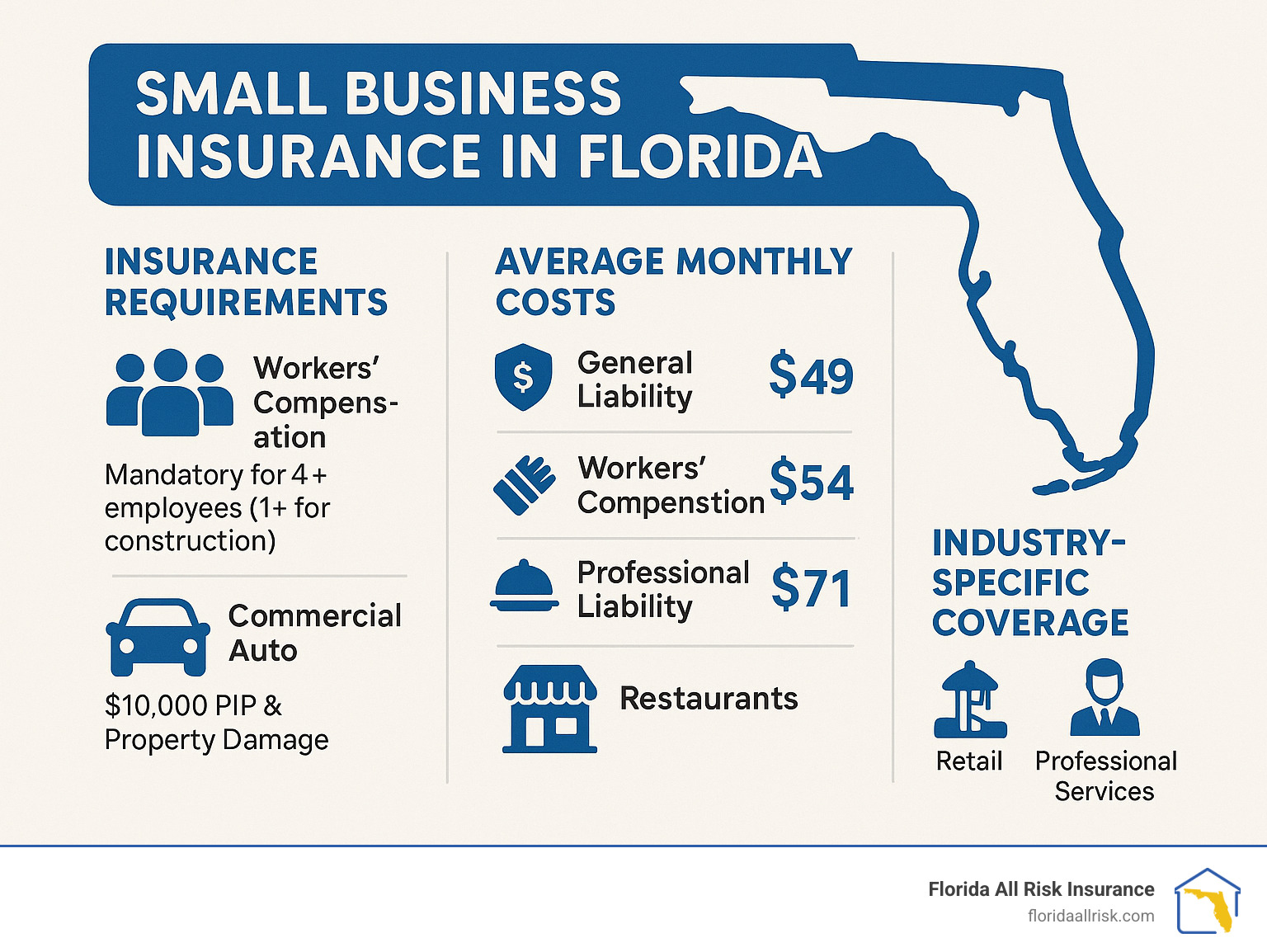
Florida business owners need to distinguish between insurance that state law requires and coverage that’s essential for practical risk management. Non-compliance with mandates can lead to fines, stop‑work orders, or license issues. Beyond the legal minimums, additional policies often determine whether a single incident becomes a brief setback or a business‑ending event.
Legally Required Small Business Insurance in Florida
Two major categories often apply.
-
Workers’ Compensation Insurance: This coverage pays medical bills, a portion of lost wages, and related benefits when employees are injured or become ill due to their work.
- Non‑construction businesses: Required with four or more employees (full‑time or part‑time).
- Construction industry: Required with one or more employees due to liftd jobsite risks.
- Agricultural businesses: Required for 6 or more regular employees or 12 or more seasonal employees who work more than 30 days in a season.
- Exemptions: Many sole proprietors and certain officers in non‑construction industries can elect exemptions. Construction industry officer exemptions are more limited and must meet specific ownership and filing criteria. Out‑of‑state contractors working in Florida generally must secure Florida‑compliant coverage. For current details, review guidance from the Florida Division of Workers’ Compensation.
-
Commercial Auto Insurance: If your business owns, leases, or regularly uses vehicles, you’ll need commercial auto coverage. Florida’s minimums include $10,000 Personal Injury Protection (PIP) and $10,000 Property Damage Liability (PDL). Bodily Injury Liability is not currently required by state law for private passenger autos, but many contracts, lenders, and job sites require it—and the financial risk of an at‑fault crash often justifies higher limits.
- Hired and Non‑Owned Auto (HNOA): If employees drive their own cars for work (bank runs, deliveries, site visits), or you rent vehicles occasionally, consider HNOA for liability protection. Personal auto policies typically exclude business use.
These are floor requirements, not goalposts. Given the potential costs of medical claims, vehicle crashes, and lawsuits, most Florida businesses carry higher limits and add complementary policies for a more complete protection plan.
Universally Essential Insurance Policies
While not always mandated by law, the following coverages are foundational for most Florida small businesses:
-
General Liability Insurance for Small Business: Covers third‑party bodily injury, property damage, and personal and advertising injury. Landlords, lenders, and clients frequently require it in leases and contracts. If a customer slips in your lobby or you accidentally damage a client’s property onsite, this policy is your first line of defense.
-
Commercial Property Insurance: Protects buildings, business personal property (equipment, furniture, inventory), and improvements from perils such as fire, theft, and wind. In Florida, windstorm exposure is a central concern. Many policies carry special wind or named‑storm deductibles, often a percentage of property values. Flood is not covered by standard property policies; consider separate flood insurance for adequate protection.
-
Umbrella/Excess Liability: Provides an extra layer of liability coverage above your general liability, auto, and employers’ liability limits. It’s a cost‑effective way to handle low‑frequency, high‑severity events—such as a major injury claim or multi‑vehicle crash.
Your required and essential policies will depend on your headcount, vehicle use, location, and contract obligations. A brief coverage review each year helps ensure you remain compliant and appropriately protected as your operations evolve.
Decoding Your Policy Options: A Guide to Key Coverages
Beyond foundational liability and property insurance, Florida companies often need specialized policies custom to their operations and regulatory environment. Understanding how these coverages work—and how they interact—helps you avoid gaps and needless overlap.
Business Owner’s Policy (BOP)
A Business Owner’s Policy bundles three core protections in a single package—often at a lower cost than buying them separately:
- General Liability Insurance
- Commercial Property Insurance
- Business Income (Business Interruption) Insurance
Business income coverage replaces lost income and helps pay ongoing expenses (like rent and payroll) when your operations are suspended due to a covered peril, such as fire or certain wind events. Review waiting periods (often 48–72 hours) and consider endorsements that extend coverage to utility service interruptions or dependent properties you rely on for revenue.
BOPs are typically available to small to mid‑sized businesses with relatively straightforward risk profiles—think retail shops, offices, small manufacturers, and restaurants. If your exposures are more complex (e.g., heavy construction, specialized healthcare), a custom package policy may be more appropriate.
Professional Liability (Errors & Omissions)
If you provide advice, design, or fee‑based services, professional liability (E&O) is critical protection against allegations that your work caused a financial loss. Even baseless claims can be expensive to defend. This coverage is common for accountants, engineers, IT consultants, marketing agencies, architects, and real estate professionals. It typically covers defense costs, settlements, and judgments (up to your limits), subject to policy terms and exclusions.
Cyber Insurance
Cyber risk affects companies of every size, and small businesses are frequent targets. Cyber insurance can help pay for forensic investigations, legal defense, notification and credit monitoring for affected individuals, data restoration, extortion payments, PR support, and regulatory penalties where insurable by law. Florida’s data‑breach rules (including the Florida Information Protection Act) require swift notification to affected individuals—currently within 30 days of determining a breach in many scenarios. For best‑practice guidance, explore the widely used NIST Cybersecurity Framework.
If you accept credit cards, maintain sensitive client data, or rely on online systems to operate, cyber insurance is a practical necessity. Pair it with basics like multi‑factor authentication (MFA), frequent data backups, and regular staff training to reduce both incidents and premiums.
Employment Practices Liability Insurance (EPLI)
EPLI covers claims such as wrongful termination, discrimination, harassment, and retaliation. Claims can arise from current, former, or even prospective employees. Small firms are not immune; a single allegation can be costly to defend. EPLI policies often include risk management resources like HR hotlines and template policies that help prevent issues before they become claims.
Commercial Umbrella/Excess Liability
An umbrella or excess policy adds higher limits above your general liability, commercial auto, and employers’ liability (part of workers’ compensation) coverage. If a catastrophic event exceeds your underlying limits, the umbrella can respond. This is an efficient way to manage severity risk, particularly for businesses with higher public foot traffic, fleet exposure, or operations on third‑party premises.
Inland Marine and Equipment Coverage
Contractors, photographers, caterers, and mobile service providers often need coverage for tools and equipment while in transit or on job sites. Inland marine policies protect movable property that’s away from your primary premises—filling a gap that standard property policies may not fully cover.
Builder’s Risk
For construction and renovation projects, builder’s risk covers structures under construction, materials, and supplies against perils like fire, theft, and vandalism during the build. It can be written in the name of the owner, the contractor, or both (as appropriate) and custom to the project timeline.
Flood Insurance (Separate from Property Insurance)
Standard commercial property insurance generally excludes flood. In Florida, flood risk exists well beyond designated high‑risk zones. You can purchase flood coverage through the FEMA National Flood Insurance Program or private markets, sometimes with higher limits or broader features. Consider business income from flood where available.
Ordinance or Law Coverage
If a covered loss triggers code upgrades under Florida’s building codes, ordinance or law coverage helps pay the additional costs to demolish undamaged portions of the structure, remove debris, and rebuild to current code. Without it, you may face significant out‑of‑pocket expenses after a major loss.
Water Backup, Equipment Breakdown, and Utility Services
- Water/sewer backup endorsements cover damage from backed‑up drains or sump overflows—events not always covered by base property policies.
- Equipment breakdown responds to sudden mechanical or electrical failures of critical systems like HVAC, boilers, refrigeration, or point‑of‑sale equipment.
- Utility services endorsements can extend property and business income coverage to certain off‑premises utility outages.
Business Insurance for LLCs
Business Insurance for LLCs is just as necessary as coverage for other structures. An LLC separates personal and business liabilities, but it does not protect the business itself. To shield your company’s assets—bank accounts, equipment, receivables—you still need the appropriate liability and property policies. For liability basics, see business liability insurance.
The Cost of Protection: What Influences Small Business Insurance in Florida?
Insurance costs are highly individualized, but understanding the major rating factors helps you budget confidently and identify places to save without sacrificing protection.
Key Factors That Affect Premiums
- Industry and operations: Jobsite hazards, public foot traffic, professional liability exposure, and product risks all influence rates. Roofers and liquor‑serving establishments tend to be higher risk than office‑based consultancies.
- Payroll and headcount: Workers’ compensation is payroll‑based. More employees, or riskier job classifications, typically mean higher premiums.
- Location and property characteristics: Coastal proximity, construction type (frame vs. masonry), roof age, wind uplift ratings, and elevation all matter in Florida. Wind mitigation features can improve pricing and insurability.
- Claims history: A clean claims record often yields better terms. For workers’ compensation, your experience modification factor (ex‑mod) directly increases or decreases premiums based on your recent claims performance compared to industry peers.
- Coverage limits and deductibles: Higher limits cost more but offer better protection against large losses. Increasing deductibles (including hurricane/named‑storm percentage deductibles) can reduce premiums—balance savings with what you could pay out of pocket.
- Risk controls: Security systems, fire suppression, driver training, telematics, cyber hygiene (MFA, backups), and safety programs can lower the frequency and severity of losses and may open up credits.
Average Insurance Costs in Florida
Every policy is customized, but typical baseline averages for low‑risk Florida businesses are:
- General liability insurance: around $49 per month
- Workers’ compensation insurance: about $54 per month
- Professional liability insurance: typically around $71 per month
High‑risk trades and coastal properties will pay more; home‑based, low‑hazard professionals may pay less. The only way to know your cost is to request a custom quote based on your operations, location, and coverage choices.
Practical Ways to Manage Costs Without Creating Gaps
- Bundle with a BOP when eligible to capture package credits
- Review class codes and job duties for accuracy (especially on workers’ compensation audits)
- Implement written safety, fleet, and cyber programs
- Maintain roofs and building systems; complete wind mitigation improvements where feasible
- Reassess property valuations annually to align with current replacement costs and avoid coinsurance penalties
- Compare higher deductibles to potential claim frequency to find a sustainable balance
Insurance in Action: Needs for Common Florida Professions
Florida’s economy is broad and fast‑moving. Each sector faces a distinct pattern of day‑to‑day exposures and catastrophic risks. Here’s how coverage typically maps to real‑world operations.

Construction and Contracting
- Essential coverage: Workers’ Compensation (mandatory with 1+ employees), General Liability, and Commercial Auto
- Recommended add‑ons:
- Builder’s Risk: Materials and structures during construction or renovation
- Inland Marine/Equipment Floater: Tools and equipment in transit or on job sites
- Surety Bonds: Often required for public projects
- Umbrella: Extra protection for severe injury/property damage claims
- Florida tip: Track subcontractor insurance carefully. Require additional insured status, primary and non‑contributory wording, and waivers of subrogation where appropriate. Keep Certificates of Insurance up to date to avoid unexpected liability and workers’ comp exposure.
Restaurants, Bars, and Food Service
- Essential coverage: General Liability, Commercial Property, Workers’ Compensation
- Recommended add‑ons:
- Liquor Liability: If you serve or sell alcohol
- Spoilage: Perishable stock lost to outages or equipment failure
- Equipment Breakdown: Refrigeration, HVAC, cooking equipment
- Business Income: Especially important for hurricane and power‑outage scenarios
- Florida tip: Consider utility services and food contamination endorsements. Maintain backup power and temperature monitoring to reduce claims and downtime.
Retail Stores and E‑Commerce
- Essential coverage: General Liability, Commercial Property, Workers’ Compensation
- Recommended add‑ons:
- Cyber: Payment card data, online accounts, ransomware
- Product Liability: If you sell products that could cause injury or damage
- Crime Coverage: Theft by outsiders or employees
- Florida tip: If you store inventory in multiple locations (including off‑site storage or 3PL warehouses), confirm limits and locations are scheduled correctly. Consider flood for ground‑level stock at risk.
Professional Services (Consultants, Accountants, Real Estate Agents, Engineers)
- Essential coverage: Professional Liability (E&O) and General Liability
- Recommended add‑ons:
- Cyber: Sensitive client information, email compromise, wire fraud
- Hired & Non‑Owned Auto: Business use of personal vehicles
- Umbrella: Additional limits for premises and auto exposures
- Florida tip: Contracts may require specific E&O limits, additional insured status, or waiver of subrogation. Review requirements carefully before you sign.
Health, Wellness, and Personal Services
- Essential coverage: General Liability, Commercial Property, Workers’ Compensation
- Recommended add‑ons:
- Professional Liability: For services that rely on skill and advice (salons, trainers, therapists)
- Cyber: Appointment systems and stored client data
- Equipment Breakdown: Specialized equipment like sterilizers or treatment devices
Transportation and Delivery
- Essential coverage: Commercial Auto, Motor Truck Cargo (as applicable), General Liability
- Recommended add‑ons:
- Umbrella/Excess: Larger liability limits for severe accidents
- Inland Marine: Handheld scanners, tools, portable equipment
- Cyber: Routing systems, driver tablets, customer data
- Florida tip: Review driver vetting, MVR checks, telematics, and distracted‑driving policies—these reduce losses and can improve renewal pricing.
Home‑Based and Micro‑Businesses
- Essential coverage: General Liability; consider a BOP if you maintain inventory or equipment at home
- Recommended add‑ons:
- Professional Liability: For service‑based businesses
- Cyber: Even basic email compromise can be costly
- Property Endorsements: Business property is often limited or excluded by homeowners policies—schedule equipment and inventory appropriately
Across all industries, Florida’s wind and water exposures deserve special attention. Standard property policies exclude flood—evaluate your flood risk with tools from the NOAA National Hurricane Center and consider a separate flood policy through NFIP or private markets.
Navigating the Process: From COIs to Compliance and Cost Savings
Securing the right coverage is simpler when you understand the moving parts: what proof of insurance you’ll need, how to align policies with contracts, and which steps can meaningfully control costs.
Certificates of Insurance (COIs): What They Are and How to Use Them
A Certificate of Insurance is a one‑page snapshot that proves you have active coverage—showing policy types, effective dates, limits, and insurers. Landlords, clients, general contractors, and municipalities commonly request COIs before granting access to sites, issuing permits, or releasing payments.
- How to get a COI: After your policies are active, request a COI from your agent; many carriers and agencies also offer self‑service portals for quick turnaround.
- Additional insured and special wording: Contracts frequently require the certificate holder to be listed as an additional insured and may specify primary and non‑contributory wording, waivers of subrogation, or specific form numbers. COIs alone don’t change coverage—endorsements must be added to your policies to make those requirements enforceable.
- Track subcontractors: If you hire subs, collect their COIs and verify key endorsements. Reconfirm before each job and maintain records—this helps prevent unintended liability or workers’ comp exposure.
Practical Risk Controls That Pay Off
- Property resilience: Maintain roofs, clear drains, and secure signage and outdoor fixtures. Document wind mitigation features and complete cost‑effective upgrades where possible.
- Business continuity: Maintain an emergency plan, cross‑train on essential tasks, and back up data regularly. Clarify decision‑making roles for closures and reopenings.
- Cyber hygiene: Use MFA, strong password policies, endpoint protection, and regular phishing training. Segment networks where feasible.
- Fleet safety: Adopt a written policy, check Motor Vehicle Records, use telematics, and prohibit device use while driving.
- HR practices: Keep updated handbooks, documented training, and consistent hiring and termination procedures. EPLI carriers often provide sample policies and HR hotlines.
For official Florida guidance on property insurance dynamics and consumer resources, the Florida Department of Financial Services and the Florida Office of Insurance Regulation publish helpful overviews and updates.
Filing Claims: Steps That Speed Recovery
- Prioritize safety and mitigate damage: Take reasonable steps to prevent further loss (board‑up, temporary repairs). Save receipts.
- Document everything: Photos, videos, inventory lists, and serial numbers support your claim.
- Notify promptly: Report the claim quickly with accurate details to your carrier or agent.
- Keep records: Track expenses, lost income, and communications with adjusters and vendors.
- Coordinate contractors: Use licensed providers, obtain written estimates, and align scope with adjuster guidance.
Smart Ways to Save Without Sacrificing Protection
- Bundle policies with a BOP if eligible
- Right‑size limits and deductibles to your cash flow and risk tolerance
- Maintain strong safety and maintenance programs
- Review policy valuations to avoid coinsurance penalties
- Conduct annual coverage reviews as equipment, staff, and revenue change
- Work with an independent agent who can compare options across multiple carriers and find fit for your risk profile
Helpful Resources
- Florida workers’ compensation employer requirements: Florida Division of Workers’ Compensation
- Florida commercial property and hurricane considerations: Florida Department of Financial Services
- Small business planning and risk management: U.S. Small Business Administration
- Cybersecurity best practices: NIST Cybersecurity Framework
- Flood awareness and coverage: FEMA National Flood Insurance Program
Your Partner in Protection
Selecting the right small business insurance in Florida is about more than meeting legal requirements—it’s about building a resilient company that can withstand everyday mishaps and major events. With Florida’s unique regulatory landscape and wind and water exposures, the details matter: policy wording, endorsements, deductibles, and contract requirements can all influence how well you recover after a loss.
Our approach is straightforward: explain your options clearly, tailor coverage to your operations and budget, and help you keep policies aligned with evolving risks and client or landlord requirements.
Ready to Protect What You’ve Built?
Get a personalized quote and guidance custom to your industry, location, and contracts. We’ll help you compare options from top-rated carriers and assemble a coverage plan that makes sense for your goals and cash flow.
Get a personalized quote today
Contact Us
Florida All Risk Insurance
Address: 7024 Central Avenue | Saint Petersburg, FL 33707
Email: [email protected]

