

Why Business Insurance for Small Business is Your Most Important Investment
Business insurance for small business is a financial safety net that protects your company from unexpected costs arising from lawsuits, property damage, cyber incidents, or employee injuries. Even one claim can threaten cash flow, delay growth, and, in extreme cases, force a closure. The right policy mix turns a potentially business-ending event into a manageable inconvenience.
As a Florida small business owner, your daily reality includes unique exposures: hurricane and wind risks, storm-related business interruption, rapidly evolving cyber threats, and contractual requirements from landlords, vendors, and clients. While forming an LLC helps separate business and personal assets, it doesn’t pay for legal defense, replace stolen equipment, or cover a customer’s medical bills. Insurance fills those gaps so you can stay focused on serving customers and growing your company.
Quick Answer: What is Business Insurance for Small Business?
Business insurance provides financial protection against common risks. Essential types for most small businesses include:
- General Liability Insurance: Covers customer injuries, property damage, and advertising claims.
- Professional Liability Insurance: Protects against claims of negligence or errors in your services.
- Workers’ Compensation: Required in most states, it covers employee injuries.
- Commercial Property Insurance: Protects your building, equipment, and inventory.
- Business Owner’s Policy (BOP): Bundles general liability and property coverage for savings.
- Cyber Liability Insurance: Crucial for businesses that handle customer data or online payments.
Choosing the right combination is not one-size-fits-all. A retail shop’s needs differ from those of a consulting firm or a contractor. Coverage can be customized by industry, location, operations, and growth plans. You can also add specialized protections—like business interruption or commercial auto—based on your risk profile and contract requirements.
I’m Jason Miller, owner of Florida All Risk Insurance. With over 60 years of combined family experience, my team and I have helped Florida businesses steer this state’s unique insurance market for over 20 years. We understand the challenges you face and are here to help you secure the right business insurance for small business.
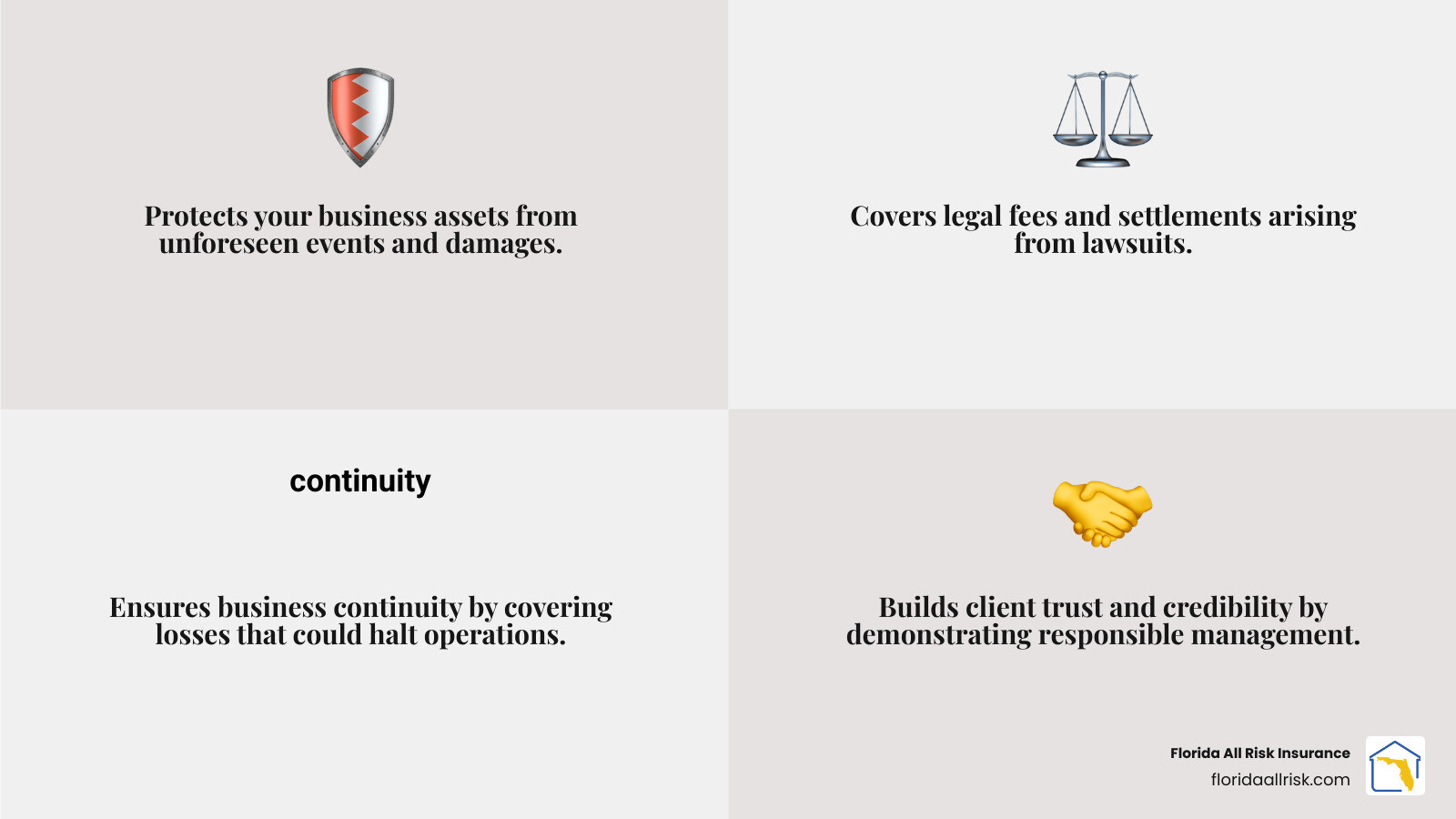
Understanding the Core Types of Business Insurance
Every business needs a solid foundation to manage risk. The right policies can mean the difference between a manageable setback and a business-ending disaster. Below are the core coverages most small businesses should evaluate.
How General Liability Insurance Protects Your Business
Imagine a customer slips in your shop, or your equipment damages a client’s property. General Liability Insurance (GLI) is the cornerstone of business insurance for small business, protecting you from claims of bodily injury, property damage, and personal and advertising injury (such as libel or slander) arising from your operations.
What GLI typically helps with:
- Third-party bodily injury and associated medical payments
- Damage to a customer’s property caused by your business activities
- Personal and advertising injury (e.g., slander, libel)
- Legal defense and settlement costs up to policy limits
GLI is also frequently required in leases, vendor contracts, and professional agreements. With an average monthly premium of just $68 in 2024, it’s a comparatively small investment to prevent devastating lawsuits. For more details, see our guides on What Does General Liability Insurance Cover? (https://floridaallrisk.com/what-does-general-liability-insurance-cover/ and Commercial General Liability Insurance for Small Business (https://floridaallrisk.com/commercial-general-liability-insurance-for-small-business/.
Tip: Review your liability limits against your contractual obligations and customer base. If you host events, work at client sites, or have high foot traffic, higher limits may be appropriate. Some businesses also consider an umbrella policy to extend liability protection above primary policy limits.
What Professional Liability Insurance Covers and Who Needs It
Also known as Errors and Omissions (E&O) insurance, Professional Liability Insurance (PLI) covers financial harm to a client caused by your advice or services—even if you did your best and followed standard practices.
PLI typically addresses:
- Alleged negligence or failure to meet professional standards
- Errors or omissions in your work
- Inaccurate advice or misrepresentation
- Legal defense and settlements up to policy limits
This coverage is essential for consultants, accountants, real estate agents, designers, therapists, and any business that sells expertise. Many contracts require it for professional services. The average monthly premium was $62 in 2024. Independent contractors can learn more in our guide to Professional Liability Insurance for Independent Contractors (https://floridaallrisk.com/professional-liability-insurance-for-independent-contractors/.
Good to know: PLI is often written on a claims-made basis, meaning the policy must be active when a claim is made (not just when the alleged work occurred). Ask your agent about retroactive dates and tail coverage if you switch carriers or retire.
General Liability vs. Professional Liability Insurance
Understanding the difference is key, as many businesses need both.
- General Liability covers physical risks: bodily injury, property damage, and advertising injury. Think “slip and fall.”
- Professional Liability covers financial risks from your professional services: mistakes, negligence, or bad advice. Think “faulty consultation.”
GLI protects against accidents related to your physical operations, while PLI protects against losses caused by your professional expertise. If you interact with clients both in person and through advisory services, carrying both is common.
How Workers’ Compensation Protects Employers and Employees
If you have employees, Workers’ Compensation insurance is typically required by law. It provides a safety net for both your team and your business. When a work-related injury or illness occurs, it covers medical expenses, a portion of lost wages, and rehabilitation costs. In tragic cases, it provides death benefits to the employee’s family.
For employers, workers’ comp usually bars most employee lawsuits related to work injuries, reducing legal exposure. In Florida, it’s required for most businesses with four or more employees (or one in construction). Owners can often elect to be included or excluded depending on entity type. The average monthly cost in 2024 was $86. Protect your team and your business by visiting our page to Buy Workers Compensation Policy (https://floridaallrisk.com/buy-workers-compensation-policy/.
Practical tip: Invest in safety training and document procedures. Demonstrable safety programs can support better rates and fewer claims.
How Commercial Property Insurance Protects Your Assets
Your building, equipment, and inventory are the lifeblood of your business. Commercial Property Insurance protects these tangible assets from covered perils like fire, theft, and certain storms.

This policy typically covers:
- Your building (if owned) and improvements you’ve made
- Business personal property: computers, machinery, inventory, furniture
- Some outdoor property (e.g., signs, fences), subject to limits
Key choices include replacement cost vs. actual cash value, and endorsements for equipment breakdown, spoilage, or off-premises property. In Florida, windstorm coverage is critical, and flood is typically excluded and requires a separate flood policy. Without adequate limits—and accurate valuation—a single fire or hurricane could force a permanent closure. Protect your hard-earned assets by exploring our guide on Commercial Property Insurance (https://floridaallrisk.com/commercial-property-insurance/.
Coverage tip: Conduct a simple inventory and keep receipts and photos. After a loss, documentation speeds claims and helps ensure you receive the right settlement.
Essential and Specialized Business Insurance for Small Business
Beyond the core policies, some coverages are legally required or highly recommended based on your operations, contracts, and risk tolerance. We can help you identify what’s right for your business.
Legally Required Types of Business Insurance
Certain coverages are non-negotiable. Federal law commonly requires businesses with employees to have Workers’ Compensation, Unemployment Insurance, and, in some jurisdictions, Disability Insurance. Requirements vary by state, industry, and headcount.
In Florida, for example:
- Workers’ Compensation is mandatory for most businesses with four or more employees (or just one in construction).
- Commercial Auto Insurance is required if your business owns, leases, or regularly uses vehicles for work.
Failing to comply can lead to penalties, stop-work orders, and liability for uncovered claims. The U.S. Small Business Administration provides a helpful overview to get business insurance (https://www.sba.gov/business-guide/launch-your-business/get-business-insurance), and our team can provide specific insights on Florida Small Business Insurance (https://floridaallrisk.com/florida-small-business-insurance/. For comprehensive state-by-state requirements, the National Federation of Independent Business offers a detailed comparison of workers' compensation laws.
The Business Owner’s Policy (BOP): A Smart Bundle
A Business Owner’s Policy (BOP) conveniently bundles essential coverages into a single, often more affordable, policy. A typical BOP combines:
- General Liability Insurance
- Commercial Property Insurance
- Business Income Insurance (replaces lost income if you’re forced to close temporarily due to a covered event)
BOPs are designed for many small and midsize businesses with relatively straightforward risk profiles. You can often add endorsements for equipment breakdown, cyber, or outdoor signage. The average monthly premium in 2024 was $141, making it a practical foundation for many businesses.
Example: A café with a storefront, seating area, and point-of-sale system might choose a BOP for liability, property, and business income, then add endorsements for food spoilage and equipment breakdown.
Why Cyber Liability Insurance is Crucial for Online and Modern Businesses
If your business uses computers, stores customer data, emails invoices, or processes payments online, Cyber Liability Insurance is increasingly a necessity. Cyber incidents can be costly, time-consuming, and damaging to your reputation. According to the FBI’s Internet Crime Complaint Center, cybercrime losses exceeded $10 billion in 2022, with small businesses being frequent targets.
Cyber coverage often includes:
- Forensic investigation to determine the scope of an incident
- Customer notification and credit monitoring services where required
- Legal defense, regulatory fines where insurable, and third-party claims
- Business interruption and data restoration costs after a covered attack
Even very small businesses are targets, especially those using remote work tools and cloud services. One compromised password or vendor breach can create cascading issues. Learn more in our High Risk Small Business Insurance Guide (https://floridaallrisk.com/high-risk-small-business-insurance-guide/.
Other Important Coverages to Consider
Your business might need additional specialized policies to address unique risks and contractual obligations.
-
Commercial Auto Insurance: A personal auto policy generally won't cover vehicles used for business. This insurance protects company-owned or leased vehicles against accidents and liability. We can help you find Affordable Commercial Vehicle Insurance (https://floridaallrisk.com/affordable-commercial-vehicle-insurance/.
-
Business Interruption Insurance: Often part of a BOP, this vital coverage replaces lost income and covers operating expenses (rent, payroll) if a covered event like a hurricane forces you to close temporarily. Learn more in our guide on Commercial Property and Business Interruption Insurance (https://floridaallrisk.com/commercial-property-and-business-interruption-insurance/.
-
Product Liability Insurance: If you manufacture, distribute, or sell products, this policy covers you if a product causes injury or damage. It's crucial for anyone selling goods, from artisans to distributors. See our Product Liability Insurance Complete Guide (https://floridaallrisk.com/product-liability-insurance-complete-guide/ for details.
Additional options to ask about based on your operations include Employment Practices Liability (claims alleging discrimination or wrongful termination), Inland Marine (for tools and equipment that travel), and Commercial Umbrella (to extend liability limits across several policies). An independent agent can help prioritize these add-ons according to your budget and exposure.
Navigating the Cost and Purchase of Your Policy
Understanding the cost and purchase process helps you secure robust protection without overpaying. Here’s how insurers think about risk and how you can prepare.
What Factors Influence the Cost of Business Insurance?
Your premium for business insurance for small business is calculated based on your unique risk profile. Key factors include:
- Industry Risk: A construction company faces higher risks than a freelance writer.
- Business Location: Coastal Florida businesses may have higher property insurance costs due to hurricane risk. Urban areas might have higher liability risks.
- Number of Employees and Payroll: More employees increase potential claims for workers’ comp and general liability.
- Annual Revenue and Receipts: Higher revenue often correlates with more activity and greater exposure.
- Coverage Limits and Deductibles: Higher limits increase premiums; higher deductibles can reduce them.
- Claims History: Frequent or severe claims indicate elevated future risk and can increase premiums.
- Type of Work and Subcontracting: Operations like tree removal or roofing carry more risk than office clerical work. Using subcontractors can shift or add exposure depending on certificates of insurance.
For a detailed breakdown, see our page on General Liability Insurance Cost (https://floridaallrisk.com/general-liability-insurance-cost/.
Ways to manage cost without compromising protection:
- Bundle policies: A BOP can be more cost-effective than buying property and liability separately.
- Optimize deductibles: Choose deductibles you can comfortably afford in a claim.
- Invest in safety: Written procedures, training, and documented maintenance can reduce losses.
- Maintain good housekeeping and security: Fire suppression, alarms, and cyber hygiene may qualify you for credits.
- Review annually: Adjust limits and endorsements as your business evolves to avoid paying for coverage you no longer need—or missing coverage you now require.
Key Steps to Purchasing Business Insurance for Small Businesses
Follow these steps to simplify the buying process and avoid gaps:
1) Assess Your Risks: Map your daily operations, customer touchpoints, data flows, and dependencies (vendors, key equipment, power, internet). Note contract requirements from landlords, clients, or lenders.
2) Find a Reputable Agent: An independent agency like Florida All Risk Insurance works for you, not a single carrier. We shop the market to find the best fit for your needs and budget. Learn Why You Should Work With an Independent Insurance Agency (https://floridaallrisk.com/why-you-should-work-with-an-independent-insurance-agency/.
3) Gather Necessary Information: Accurate, complete details enable accurate quotes and smoother underwriting. See the checklist below.
4) Compare Quotes and Policies: Don’t choose on price alone. Review coverage limits, deductibles, exclusions, endorsements, and conditions. Your agent can help you understand the fine print and negotiate where appropriate.
5) Review and Finalize: Read all documents before binding coverage. Understand reporting requirements, responsibilities after a loss, and how to request Certificates of Insurance (COIs). Keep copies of policies and endorsements accessible.
6) Plan for Renewal: Mark your calendar 60–90 days ahead of renewal to review changes and shop options if needed.
What Information Is Needed to Get a Business Insurance Quote?
To get an accurate quote for business insurance for small business, have the following information ready:
- Business name, address, and legal structure (LLC, corporation, sole proprietorship)
- Industry and a description of your operations
- Years in business and relevant experience
- Number of employees (full-time, part-time, and 1099 contractors) and estimated payroll
- Current and projected annual revenue or receipts
- A list of business assets (building, equipment, inventory) and their values
- Any vehicles used for business (year, make, model, VINs) and driver information
- Leases, major contracts, or professional agreements with insurance requirements
- Previous insurance policies and claims history (typically last 3–5 years)
Having this ready will speed up the process. To start, visit our page for Business Insurance Quotes Tampa (https://floridaallrisk.com/business-insurance-quotes-tampa/.
Can Business Insurance Premiums Be Tax-Deductible?
Yes, in many cases, business insurance premiums are considered an ordinary and necessary business expense and may be tax-deductible. This can lower your taxable income, reducing the net cost of coverage. This generally applies to general liability, professional liability, workers’ comp, commercial property, and other common policies. However, tax rules are nuanced and can change. We strongly recommend consulting with a qualified tax professional to confirm deductibility for your specific situation. For general guidance, you can review the Small Business Guide to Commercial Insurance (https://www.insurance.ca.gov/01-consumers/105-type/95-guides/09-comm/SmallBusinessCommercialInsurance.cfm) and IRS Publication 535: Business Expenses (https://www.irs.gov/publications/p535).
Managing and Maintaining Your Coverage for Long-Term Protection
Purchasing insurance is the first step. Managing your policies over time helps ensure your protection evolves with your business.
How Often Should You Reassess Your Business Insurance?
Your business insurance for small business is not a “set it and forget it” purchase. We recommend a full review at least once a year. You should also contact your agent promptly after any significant changes, including:
- Hiring employees or changing payroll materially
- Purchasing new property, vehicles, or expensive equipment
- Expanding operations, opening a new location, or moving
- Offering new products or services or entering new markets
- Signing leases or contracts with insurance requirements
- A significant change in revenue or customer concentration
Proactive updates help prevent coverage gaps and ensure compliance with contract obligations.
Claims Readiness and Documentation
- Keep an up-to-date inventory of assets with photos, serial numbers, and receipts.
- Establish and train staff on incident reporting procedures.
- Document safety protocols and maintenance schedules.
- Know how to contact your carrier and agent 24/7.
If a loss occurs, take reasonable steps to prevent further damage, document the incident thoroughly, and notify your agent promptly. Early communication helps expedite claims and minimize disruptions.
The Value of an Independent Insurance Agent
When buying business insurance for small business, working with an independent agent offers distinct advantages. At Florida All Risk Insurance, we act as your long-term partner and trusted advisor.
Here’s the value we provide:
- Personalized Advice: We take the time to understand your business and tailor coverage to your risk profile and budget.
- Access to Multiple Carriers: We partner with a broad network of insurers and shop the market for you.
- Custom Coverage & Competitive Rates: We help align limits, endorsements, and deductibles so you don’t pay for extras you don’t need—or overlook critical protections.
- Claims Assistance: If you need to file a claim, we guide you through the process and advocate on your behalf.
- Long-Term Partnership: We provide ongoing support and annual reviews to adjust your coverage as your business evolves.
Based in St. Petersburg, we understand the unique challenges Florida businesses face, from hurricane preparedness to coastal property exposures. To learn more, visit our page on Independent Business Insurance Agents (https://floridaallrisk.com/independent-business-insurance-agents/. Your business deserves protection that’s as unique as you are.
Conclusion: Secure Your Venture’s Future Today
Investing in the right business insurance for small business is one of the most important decisions you can make as an owner. It’s not just an expense; it’s a foundational strategy that safeguards your hard work, your employees, and your future growth from unforeseen events. By understanding your risks, selecting appropriate coverage, and partnering with a knowledgeable advisor, you can build a safety net that lets you operate with confidence.
From general liability and professional liability to property, cyber, and specialized policies, your program can be precisely tailored to how you work—and how you plan to grow. The result is stability when the unexpected happens and the freedom to focus on customers, team, and strategy.
Ready to protect your business? Get a free, no-obligation quote today: https://floridaallrisk.com/get-a-quote/
Want to keep learning? Explore our complete guide on insurance for small businesses: https://floridaallrisk.com/insurance-for-small-businesses/
Contact Us
We know that choosing the right business insurance for small business can feel overwhelming. At Florida All Risk Insurance, we focus on building genuine relationships with Florida business owners who need clear guidance and comprehensive protection.
Our team brings over 60 years of combined experience in the Florida insurance marketplace. As an independent agency in St. Petersburg, we understand the unique risks you face, from hurricane season to industry-specific liabilities. We shop our network of reputable carriers on your behalf to find customized coverage at competitive rates.
Florida All Risk Insurance
Address: 700 94th Ave N Ste. 300, Saint Petersburg, FL 33702
Phone: (727) 522-7777
Email: [email protected]
We look forward to becoming your trusted insurance partner.

