

Essential Business Insurance for Personal Trainers
Why Personal Trainers Can’t Afford to Skip Business Insurance
Business insurance for personal trainers protects fitness professionals from the financial fallout of client injuries, property damage claims, and professional negligence lawsuits. In an industry built on physical transformation and high-intensity movement, the margin for error is razor-thin. Whether you are helping a client hit a new personal record in a deadlift or guiding a senior through mobility exercises, the inherent risks of physical exertion are always present.
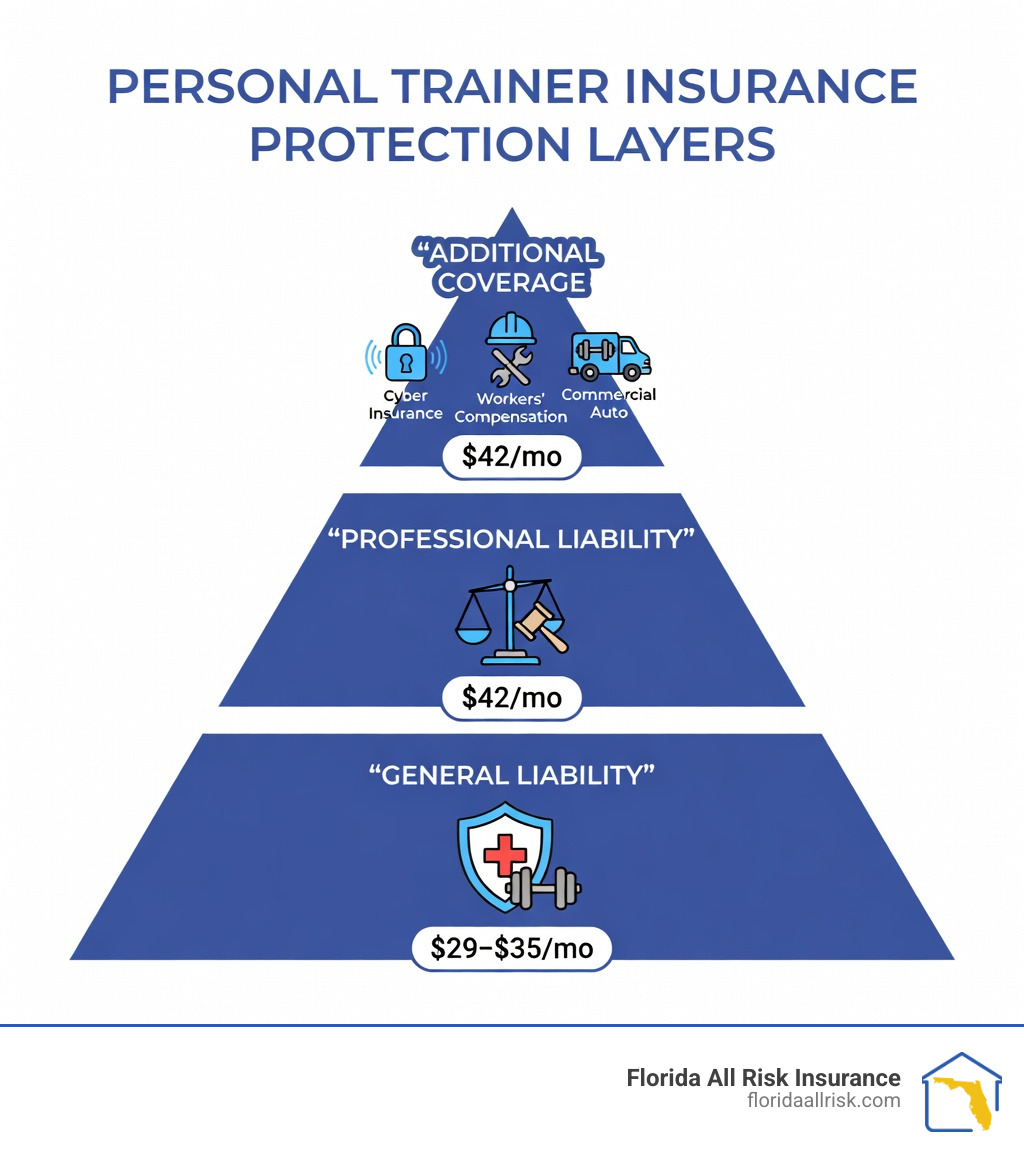
Essential Coverage Types for Fitness Professionals:
- General Liability Insurance – Covers client injuries (slips, falls, equipment accidents) and property damage at your training location.
- Professional Liability Insurance (E&O) – Protects against claims that your specific advice, instruction, or programming caused harm or failed to deliver promised results.
- Business Owner’s Policy (BOP) – Bundles liability and property coverage at a discount, ideal for trainers with dedicated studio space or significant equipment investments.
- Workers’ Compensation – Required by Florida law if you hire employees; it covers medical expenses and lost wages for workplace injuries.
- Cyber Insurance – Essential for modern trainers who store client payment information, health histories, and contact data digitally.
Average Monthly Costs for Coverage:
- General Liability: $29-$35/month ($350-$810/year)
- Professional Liability: $42/month ($500/year)
- Business Owner’s Policy: $59/month ($702/year)
The fitness industry thrives on transformation and dedication, but it also carries serious risks. Every session you lead—whether it’s a one-on-one strength training workout in Saint Petersburg, a high-energy boot camp in a public park, or a virtual yoga class streamed to a global audience—exposes you to potential liability. A client could trip over a resistance band and sprain their ankle. They might follow your nutrition advice and have an allergic reaction. Or they could claim that your programming caused a chronic injury months down the road.
These aren’t hypothetical scenarios. In 2020 alone, fall-related injuries accounted for 33% of all nonfatal emergency department visits across the United States, and the fitness environment—with its weights, equipment, and physical exertion—amplifies these risks significantly. One lawsuit could wipe out years of hard-earned income and destroy the reputation you’ve worked so hard to build.
I’m Jason Miller, and with over 20 years of experience helping Florida businesses navigate complex insurance decisions, I’ve seen how the right business insurance for personal trainers can mean the difference between a minor setback and a business-ending catastrophe. At Florida All Risk Insurance, we specialize in crafting affordable, comprehensive coverage packages tailored to the unique risks fitness professionals face every day. We understand that your business is your passion, and our goal is to ensure that one accident doesn’t end your career.
Why Business Insurance for Personal Trainers is Non-Negotiable
When we talk to trainers in Saint Petersburg or across Florida, we often hear, “I’m careful, I don’t need insurance.” While your technique might be flawless and your attention to detail unmatched, you cannot control every variable in a gym environment. The primary reason personal trainers need insurance is the high-risk nature of physical activity. According to the CDC, fall-related injuries account for a significant portion of emergency room visits annually. In a gym setting, these risks are amplified by heavy equipment, slick surfaces from sweat, and high-intensity movements that push the human body to its limits.
If a client is injured under your supervision, you could be held liable for their medical expenses, lost wages, and pain and suffering. Even a “minor” sprain can lead to thousands of dollars in medical bills. If you don’t have Business Insurance for Small Businesses, those costs come directly out of your pocket, potentially draining your personal savings and business capital.
Beyond physical injuries, personal trainers are also vulnerable to claims of professional negligence. This falls under the umbrella of professional indemnity. If a client follows your customized workout plan and suffers a long-term injury, they may allege that your instruction was flawed, that you failed to properly screen them for pre-existing conditions, or that you pushed them beyond a safe limit. Even if you have done everything correctly, the cost of hiring a legal team to defend your name can be astronomical. Legal defense costs are often the most expensive part of a claim, even if the case is eventually dismissed.
Furthermore, client expectations and industry standards have shifted. Most reputable gyms and fitness centers now require proof of insurance before allowing you to operate on their premises as an independent contractor. Without a certificate of insurance (COI), you’re essentially locked out of the best career growth opportunities and high-end facilities. Insurance isn’t just a safety net; it’s a professional credential that signals to clients and partners that you are a serious, responsible business owner.
In the litigious landscape of Florida, having a robust policy is a strategic necessity. The National Safety Council highlights that workplace and service-related injuries are on the rise, making it more important than ever to have a buffer between your assets and a potential lawsuit. By securing business insurance for personal trainers, you are not just buying a policy; you are buying the freedom to focus on your clients’ results without the constant shadow of financial ruin hanging over your head.
Essential Types of Coverage for Your Fitness Business
Understanding the “alphabet soup” of insurance policies can be a workout in itself. However, we break it down into the core layers that every trainer needs to consider to build a fortress of protection around their livelihood. In the competitive Florida fitness market, having the right coverage isn’t just about safety; it’s about professional credibility.
General Liability Insurance: The Foundation of Protection
General liability insurance is the most common policy for fitness professionals. It protects you against “third-party” claims involving bodily injury or property damage. Think of this as your “oops” coverage. What Does General Liability Insurance Cover? It covers accidents that occur during your business operations but aren’t necessarily related to your professional advice.
For example, if a client trips over a kettlebell you left on the floor and breaks their wrist, your Commercial General Liability Insurance would cover their medical bills and your legal defense if they sue. It also covers damage to property that doesn’t belong to you. If you are a mobile trainer and you accidentally knock over an expensive piece of art at a client’s home, or if you drop a heavy dumbbell and crack the specialized flooring of a rented studio space, this policy steps in to pay for the repairs. Without this, a single moment of inattention could result in a five-figure repair bill or medical settlement.
Professional Liability Insurance for Personal Trainers
While general liability covers accidents, professional liability (also known as Errors and Omissions or E&O) covers the “professional” aspect of your job. This insurance is critical because it protects you against claims that your specific training advice or instruction caused harm.
The Insurance Information Institute notes that professional liability is essential for anyone providing a service or advice. For a trainer, if you suggest a weight load that is too heavy for a client’s current level and they suffer a herniated disc, this falls under professional liability. It bridges the gap between a physical accident and a mistake in professional judgment. In the eyes of the law, you are an expert; if your expert advice leads to an injury, Business Liability Insurance is what keeps you from losing your home or savings to a settlement.
Workers’ Compensation and Commercial Auto
As your fitness business grows, your risks change. If you hire other trainers or even a part-time administrative assistant, Workers’ Compensation is usually required by Florida law. This covers medical costs and lost wages for your employees if they are injured on the job—such as a trainer straining their back while spotting a heavy lift. With 190,000 medically consulted workplace injuries occurring in professional services in 2020 alone, this isn’t a risk to take lightly. Failing to carry workers’ comp can lead to massive state fines and personal liability for employee injuries.
Additionally, many trainers in Saint Petersburg are mobile. If you travel to clients’ homes or various gyms in your own vehicle, you should consider commercial auto insurance. Most people don’t realize that standard personal auto policies often exclude coverage for accidents that occur during business-related activities. If you’re involved in a crash while driving between training sessions, your personal policy might deny the claim, leaving you personally responsible for the damage to your vehicle and any third-party injuries. This is especially critical in high-traffic areas like Tampa Bay, where the risk of a collision is statistically higher.
Understanding the Cost of Business Insurance for Personal Trainers
One of the most common questions we get at Florida All Risk Insurance is: “How much is this going to cost me?” The good news is that business insurance for personal trainers is surprisingly affordable compared to the level of protection it provides. You can often protect your entire career for less than the cost of a single new pair of high-end lifting shoes each month.
On average, a standard general liability policy for a solo trainer can cost between $350 and $810 per year. That breaks down to roughly $29 to $65 per month. However, several factors influence your specific premium:
- Location: Operating in high-traffic urban areas like Saint Petersburg, Tampa, or Miami can impact costs compared to more rural areas. Florida’s litigation environment also plays a role in state-wide rates, as certain jurisdictions are known for higher settlement amounts.
- Revenue and Client Volume: The more clients you see, the higher the statistical probability of a claim. High-volume businesses represent a higher “exposure” for the insurance company, which can lead to slightly higher premiums.
- Services Offered: Risk is relative. A wellness coach who primarily does mobility work or stretching will likely pay less than a trainer who specializes in CrossFit, aerial yoga, aquatic fitness, or professional athlete coaching. Activities involving water or gymnastics apparatus often have higher premiums or specific exclusions due to the increased risk of catastrophic injury.
- Claims History: A clean record with no prior lawsuits is your best friend when looking for a low General Liability Insurance Cost. Insurance companies reward low-risk professionals with better rates.
- Coverage Limits and Deductibles: Choosing a policy with a $2 million aggregate limit will cost more than a $1 million limit, but it provides double the protection. Similarly, a higher deductible (the amount you pay out of pocket before insurance kicks in) can lower your monthly premium.
To find the best value, we always recommend comparing quotes from an independent agency. Because we aren’t tied to just one carrier, we can shop around to find the best rate for your specific niche, whether you are a yoga instructor, a powerlifting coach, or a general fitness professional. We look for “sweet spots” in the market where certain carriers offer discounts for specific certifications or professional memberships.
Specialized Coverage: Online Training and Business Owner’s Policies
The modern fitness landscape has moved beyond the four walls of a gym. This shift requires modern insurance solutions that address digital risks and property protection.
Protecting Your Digital Brand with Cyber Insurance
The rise of virtual training has introduced digital risks that didn’t exist a decade ago. If you store client credit card information, health histories, or contact details on your computer or in the cloud, you are a target for cyberattacks. Personal trainers often handle sensitive data, including medical histories and HIPAA-related information, which are highly valued by hackers.
Cyber insurance helps cover the costs of notifying clients after a data breach, as well as legal fees, public relations efforts to save your reputation, and data recovery efforts. For online trainers, this is just as important as General Liability Insurance for Small Business. If a virus exposes your clients’ credit card data, the fallout can be more expensive than a physical injury claim. In the digital age, your data is just as much an asset as your physical equipment.
The Benefits of a Business Owner’s Policy (BOP)
If you have your own space or a significant amount of gear, a Business Owner’s Policy (BOP) is often the smartest move. A BOP is a “package deal” designed for small business owners that typically combines general liability insurance with commercial property insurance at a discounted rate.
This is ideal for trainers who own their own studio or have invested thousands in squat racks, treadmills, and free weights. According to our Business Insurance Florida Complete Guide, a BOP can also include “Business Interruption Insurance.” This is a lifesaver if your training space is forced to close due to a covered peril, such as a fire or a severe Florida storm. It helps replace your lost income while you get back on your feet, ensuring your business survives even when you can’t train. For Florida trainers, this coverage is particularly relevant given our history of hurricanes and tropical storms that can disrupt business operations for weeks at a time.
Product Liability for Trainers
Many personal trainers supplement their income by selling products, such as resistance bands, supplements, or branded apparel. If a client has an adverse reaction to a supplement you sold them or if a resistance band snaps and causes an eye injury, you could be held liable for a defective product. Product liability insurance, often included in a general liability policy or added as an endorsement, protects you from these specific claims. It is a vital consideration for any trainer looking to diversify their revenue streams beyond just hourly coaching.
Risk Management and Frequently Asked Questions
While insurance is your primary safety net, effective risk management can help prevent claims from happening in the first place. This includes maintaining equipment, using comprehensive liability waivers, and staying within your scope of practice. Below are some of the most common questions we receive from fitness professionals regarding their coverage.
Do I need separate insurance if I work at a gym?
Yes, absolutely. This is one of the biggest misconceptions in the industry. While many gyms have their own liability insurance, those policies are designed to protect the gym’s interests, not necessarily yours. If a client sues you specifically for advice you gave (professional liability), the gym’s policy might not cover your individual legal defense. Furthermore, if you are an independent contractor rather than a W-2 employee, you are likely not covered by their policy at all. Having your own policy ensures you are protected regardless of where you are training, whether it’s at a big-box gym, a boutique studio, or a client’s garage.
How do I get a Certificate of Insurance (COI)?
A Certificate of Insurance is a document provided by your insurance company that proves you have active coverage. Most gym owners will require you to provide a COI—and often ask to be named as an “Additional Insured”—before you can start training clients on their floor. When you work with Florida All Risk Insurance, we can usually get you a COI quickly, and many of our carriers allow you to download them instantly from an online portal, ensuring you never miss a business opportunity due to paperwork delays.
Does insurance cover virtual or online training sessions?
Most modern personal trainer policies include coverage for virtual training, but it is not always automatic. You must ensure that your policy does not have a “professional services exclusion” for digital content. Coverage usually applies to live, one-on-one, or group sessions where you can provide direct supervision. It’s also important to note that many policies exclude “publicly accessible” materials, like a YouTube video that anyone can watch without a specific client-trainer agreement. Always check with your agent to ensure your specific online format—whether it’s Zoom, a custom app, or pre-recorded modules—is fully covered.
What are common exclusions in these policies?
While insurance covers a lot, it doesn’t cover everything. Common exclusions for personal trainers include:
- Abuse and Molestation: This often requires a separate endorsement or a specific policy add-on.
- Underage Clients: Some basic policies exclude training anyone under 18 without a specific rider.
- High-Risk Activities: Stunts, tumbling, professional sports coaching, or extreme obstacle course training may be excluded.
- Intentional Acts: Insurance will not cover you if you intentionally cause harm or damage to a person or property.
- Nutrition Advice: If you provide detailed meal plans without being a registered dietitian, some policies may exclude claims related to nutritional advice.
What should I do if a client gets injured?
First, ensure the client receives immediate medical attention. Document the incident thoroughly, including the time, location, exercises being performed, and any witnesses. Do not admit fault or offer to pay for medical bills out of pocket, as this can complicate your insurance claim. Contact your insurance agent as soon as possible to report the incident. Early reporting allows the insurance company to begin their investigation and protect your interests from the start.
Conclusion
Navigating business insurance for personal trainers can feel overwhelming, but it is a fundamental step in transitioning from a fitness enthusiast to a professional business owner. By securing the right mix of general liability, professional indemnity, and specialized coverages like cyber or equipment insurance, you create a fortress around your career. This protection allows you to focus on what you do best: helping your clients reach their peak physical potential without the constant fear of a “what if” scenario.
Florida All Risk Insurance, based in Saint Petersburg, Florida, specializes in helping local entrepreneurs find the perfect balance of coverage and affordability. As an independent agency, we have access to a wide variety of carriers, ensuring that your personal training business gets a tailored policy that fits your unique needs. Whether you are training on the beaches of Pinellas County, working in a downtown studio, or coaching clients virtually from your home office, having a local expert in your corner makes all the difference. We understand the Florida market and the specific risks that come with operating a business in the Sunshine State.
Don’t let an unforeseen accident derail your fitness journey. Whether you’re looking for business insurance for painters or specific fitness coverage, we can help you understand the liability insurance for business cost and find a plan that works. Even if you need niche coverage like electrical contractor public liability insurance, our team has the expertise to guide you through the process.
Take the proactive step today to secure your future and give your clients the peace of mind they deserve. A small investment in insurance today can save your business from a catastrophic loss tomorrow.
Get a personalized business insurance quote today to protect your training career.
Contact a Florida All Risk agent to learn more about our comprehensive small business solutions.
Contact Us
Florida All Risk Insurance
136 4th St N Ste 221
Saint Petersburg, FL 33701
Phone: 727-471-0000
Email: [email protected]
Website: https://floridaallrisk.com/

