

Rental property flood insurance: Avoid 2025 Risks
The Unseen Risk: Why Your Renters Insurance Isn’t Enough
Many renters in Florida are unclear about rental property flood insurance. Here’s a quick summary of what you need to know:
- Standard renters insurance does NOT cover flood damage. This is a common and costly misconception.
- Your landlord’s insurance policy protects the building, but never your personal belongings.
- Floods are the most common natural disaster and can happen anywhere, not just in coastal areas.
- Even one inch of floodwater can cause thousands of dollars in damage to your furniture, electronics, and other possessions.
- You can buy a separate flood insurance policy specifically to protect your personal items as a renter.
Flooding is the most frequent and expensive natural disaster in the United States, yet many people mistakenly believe their standard renters insurance will cover them. The truth is, these policies almost universally exclude damage from floods, leaving renters to face devastating out-of-pocket expenses when disaster strikes.
I’m Jason Miller, and with over 20 years in the Florida insurance market, I’ve seen this scenario play out too many times. From my family’s 60+ years of insurance expertise, my goal is to help renters understand and steer their coverage needs, including comprehensive rental property flood insurance.
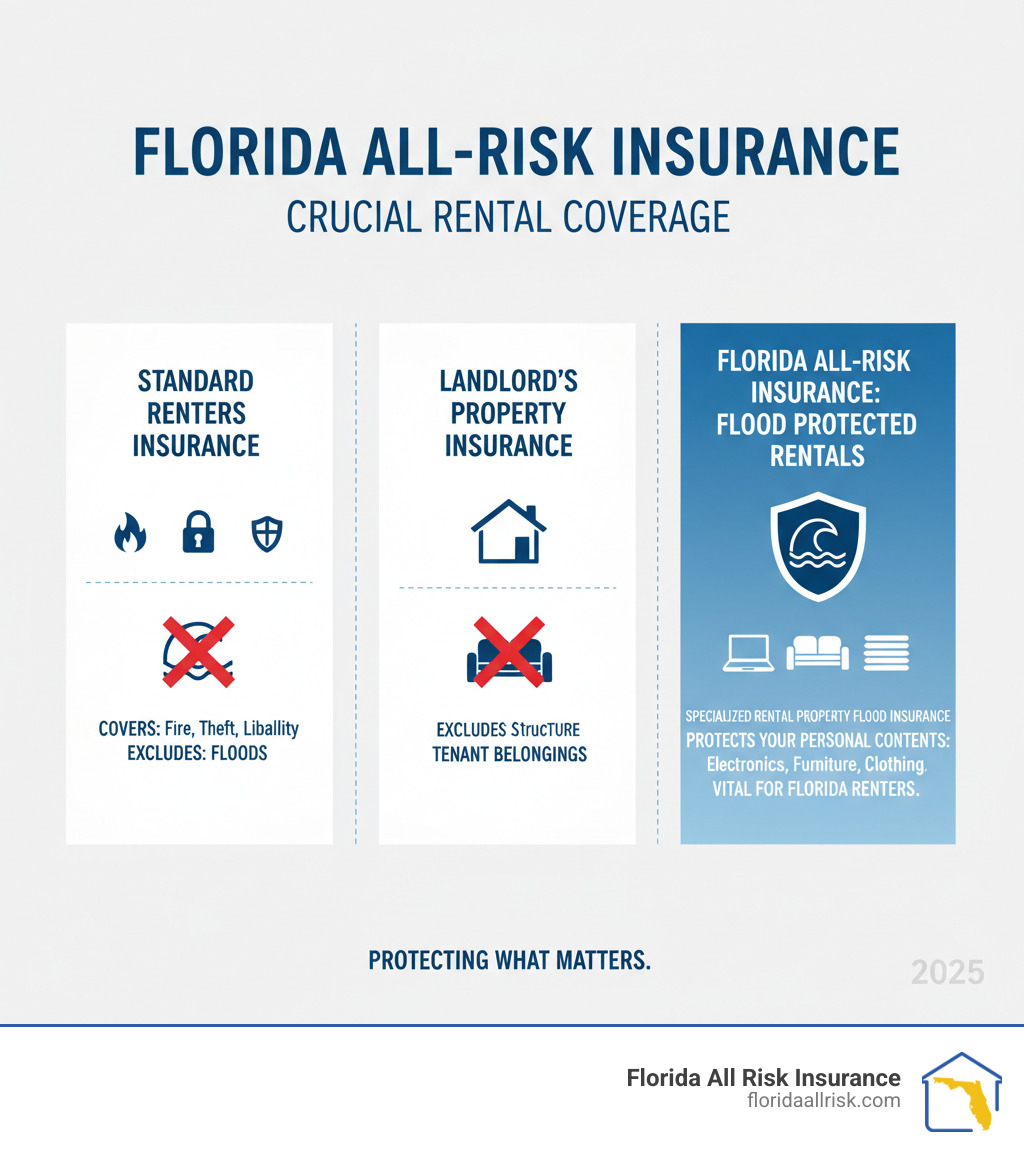
As an independent agency based in St. Petersburg, we know that Florida’s beautiful weather can also bring heavy rains and hurricanes, making flood risk a real concern for everyone, including renters. Imagine a storm causes local flooding, and just an inch of water seeps into your ground-floor apartment. Without rental property flood insurance, you would be solely responsible for replacing your ruined furniture, electronics, and clothing. It’s a financial burden that can be avoided with proactive protection. You can learn more about comprehensive coverage options by visiting our guide on Florida Homeowners Insurance 2025.
The Coverage Gap Explained
It’s crucial to understand two key facts. First, your landlord’s flood insurance policy is designed to protect their investment—the physical structure of the building. This includes the foundation, walls, and essential systems like plumbing and electrical. It does not extend to any of your personal property inside the unit. If a flood occurs, their policy will not help you replace your couch, computer, or clothes. For more details on this, property owners can review our Landlord Flood Insurance Guide 2025.
Second, your own standard renters insurance policy contains a critical exclusion for flood damage. While it protects you from perils like fire, theft, and liability, it will not cover damage from external water sources like storm surges, overflowing rivers, or heavy rainfall. This gap between what your landlord’s policy covers (the building) and what your renter’s policy covers (theft/fire, but not floods) leaves your personal belongings completely vulnerable. Without a specific flood policy, you are uninsured for the most common natural disaster.
What is Renters Flood Insurance and How Does It Work?
Since your landlord’s policy and your standard renters policy won’t cover flood damage to your belongings, the solution is a dedicated rental property flood insurance policy. This is a separate policy designed specifically to protect your personal property from flood damage.
In insurance terms, a “flood” is defined as an overflow of water onto land that is normally dry. This can result from heavy rainfall, a storm surge, or an overflowing river. When this external water enters your rental and damages your possessions, a flood insurance policy provides the financial safety net to help you recover. At its core, renters flood insurance is a “contents-only” policy. It focuses solely on your personal property—clothing, furniture, electronics, kitchenware—rather than the building itself.
The most common way to get this coverage is through the National Flood Insurance Program (NFIP), but a growing private market also offers competitive options. You can learn more about the federal program by visiting the official FEMA page on What is the National Flood Insurance Program (NFIP)?.
The National Flood Insurance Program (NFIP) for Renters
The NFIP is a federal program managed by the Federal Emergency Management Agency (FEMA). It was created to make flood insurance available in communities that agree to adopt and enforce floodplain management ordinances. The good news for renters is that if your community participates in the NFIP—as most in Florida do—you are eligible to purchase a policy. You don’t need to own the property or get your landlord’s permission.
For renters, the NFIP offers a contents-only policy that specifically covers your personal belongings. This is exactly what you need, as you don’t own the building. It’s a common myth that you only need flood insurance if you live in a high-risk flood zone. However, floods can happen anywhere it rains. In fact, nearly 30% of all NFIP claims come from outside high-risk flood areas, a statistic that highlights the widespread nature of flood risk. For more information on how the program works, you can explore our page on FEMA Flood Insurance.
Private Flood Insurance: An Alternative to the NFIP
While the NFIP is the traditional source for flood insurance, the private flood insurance market has expanded significantly, offering renters another valuable option. Private carriers are insurance companies, not a federal program, and they use their own methods to assess risk and price policies. This competition can lead to several benefits for renters.
Why consider a private policy? Here are a few reasons:
- Higher Coverage Limits: The NFIP caps contents coverage at $100,000. If your personal property is worth more, a private policy may offer higher limits.
- Shorter Waiting Periods: NFIP policies typically have a 30-day waiting period. Some private insurers can offer coverage that begins much sooner.
- Competitive Rates: Depending on your specific risk profile, you might find a lower premium with a private insurer, as they use different rating models than the NFIP.
- Greater Flexibility: Private policies may include additional coverages, such as for temporary living expenses if you’re displaced by a flood, which the standard NFIP policy does not.
As an independent agency, Florida All Risk Insurance can help you compare quotes from both the NFIP and private carriers. We’ll help you weigh the pros and cons to find the best rental property flood insurance for your needs and budget. To learn more about finding the right policy in our state, check out our insights on the Best Flood Insurance Florida.
Understanding Your Rental Property Flood Insurance Options

Once you decide to get rental property flood insurance, it’s important to understand the details of what you’re buying. Knowing what’s covered, what’s excluded, and how claims are paid will help you make the best choice for your financial security. For official details, we always recommend consulting Official information from FloodSmart.gov.
What Does Rental Property Flood Insurance Cover?
A renter’s flood insurance policy is designed to protect your personal belongings from damage caused by floodwaters. This coverage helps you repair or replace the items that make your rental a home. While policies can vary, especially between the NFIP and private insurers, they generally cover your personal property, including:
- Clothing, furniture, and electronics
- Curtains and window treatments
- Portable appliances, such as microwaves
- Washers and dryers
- Food in your freezer
- Carpeting that is not permanently installed
It’s important to be aware of coverage limits. NFIP policies for renters provide up to $100,000 for personal belongings. However, coverage for items in a basement or below the lowest liftd floor is often limited to essential appliances like washers, dryers, and freezers. Additionally, special limits apply to certain valuables. For instance, items like artwork, furs, or jewelry may have a combined limit of around $2,500. For more specifics on coverage in our state, visit our guide on Flood Insurance Coverage Florida.
What is NOT Covered by a Renter’s Flood Policy?
Understanding the exclusions in your policy is just as important as knowing what’s covered. A renter’s flood policy will not cover:
- The building structure: The walls, floors, and foundation are your landlord’s responsibility.
- Property outside the building: This includes decks, fences, landscaping, and swimming pools.
- Temporary living expenses: If a flood forces you from your home, the cost of a hotel or temporary rental is typically not covered by an NFIP policy, though some private policies may offer it.
- Vehicles: Flood damage to your car is covered by the comprehensive portion of your auto insurance policy.
- Financial losses: Currency, precious metals, and valuable papers like stock certificates are excluded. Loss of income from a home-based business is also not covered.
- Preventable damage: Damage from moisture, mildew, or mold that could have been avoided by the property owner is generally not covered.
- Sewer backup: This is only covered if it’s a direct result of widespread flooding. An isolated plumbing issue is not covered by flood insurance.
Eligibility, Cost, and the Purchasing Process
Getting rental property flood insurance is more straightforward than you might think. Understanding who is eligible, how costs are determined, and the steps to purchase a policy will empower you to protect your belongings effectively. A great starting point for understanding your risk is the FEMA Flood Zone Map.
Who Can Buy Flood Insurance and Where?
The good news is that flood insurance is widely accessible. If you are a renter in a community that participates in the National Flood Insurance Program (NFIP), you are eligible to purchase a contents-only flood policy. The vast majority of communities in Florida, including St. Petersburg, are part of the NFIP, making this protection available to most renters in the state. You do not need to live in a designated high-risk flood zone to qualify. In fact, this is a critical point, as nearly 30% of all NFIP flood claims come from properties located outside of high-risk areas, proving that floods can and do happen anywhere.
How is the Cost of Rental Property Flood Insurance Determined?
The premium for your rental property flood insurance is based on several key factors. While NFIP rates are standardized, private insurers use their own models. In general, the cost is influenced by:
- Flood Zone: Your rental unit’s location in a designated flood zone is a primary factor.
- Coverage Amount: The total amount of contents coverage you choose to purchase.
- Deductible: The amount you pay out-of-pocket before insurance kicks in. A higher deductible typically leads to a lower premium.
- Unit Elevation: For NFIP policies, the elevation of your rental unit can significantly impact the rate.
- Building Characteristics: The age and construction type of the building can also be a factor.
Finding affordable coverage is a top priority for many renters. For a detailed breakdown of costs in our state, our guide on How Much Does Flood Insurance Cost in Florida? is an excellent resource.
How to Purchase Rental Property Flood Insurance
Purchasing a policy is a simple process, and our team at Florida All Risk Insurance is here to help.
- Contact an Insurance Agent: The easiest first step is to reach out to an authorized insurance agent. Many, like us, can write policies through the NFIP and private carriers.
- Get a Quote: Provide your agent with basic information about your rental and an estimate of the value of your belongings. They will generate a quote with your premium and coverage options. You can Get a Flood Insurance Quote directly from our website.
- Review Your Policy: Carefully review the policy details, including coverage limits, your deductible, and any exclusions. Ask your agent to clarify anything you don’t understand.
- Be Aware of the Waiting Period: This is critical. Most NFIP policies have a 30-day waiting period before coverage takes effect. You cannot wait until a storm is approaching to buy a policy. It’s essential to plan ahead and secure your coverage well in advance.
If your current agent doesn’t offer flood insurance, you can use online tools like the one on FloodSmart.gov to Find a provider. Our independent agents are experts in the Florida market and can help you compare all available options to find the right fit.
Frequently Asked Questions about Renter’s Flood Insurance
We hear many questions about flood insurance from renters across Florida. Here are answers to some of the most common concerns we address to help you better understand your coverage needs.
Do I need flood insurance if I don’t live on the ground floor?
Yes, it is highly recommended that you have flood insurance even if you live in an upper-floor apartment. A flood that impacts the lower levels of your building can still have a major effect on you. Essential utility systems like electrical panels, water heaters, and HVAC units are often located in basements or on the ground floor. If these systems are damaged, the entire building can lose power and become uninhabitable.
Furthermore, severe flooding can make your unit inaccessible, forcing you to evacuate and leave your belongings behind. In some cases, flooding can even compromise a building’s structural integrity. During major storms in Florida, authorities may issue mandatory evacuation orders for entire areas, regardless of what floor you live on. Rental property flood insurance ensures your possessions are protected even if you are forced to leave them behind.
What’s the difference between Actual Cash Value (ACV) and Replacement Cost?
Understanding this distinction is key to knowing how your claim will be paid.
- Actual Cash Value (ACV) pays you for the depreciated value of your damaged item. For example, if your five-year-old laptop is destroyed, ACV would pay you what a five-year-old laptop is worth today, not what you originally paid for it.
- Replacement Cost Value (RCV) pays you the amount needed to buy a brand-new item of similar kind and quality, without deducting for depreciation. This coverage allows you to replace your old laptop with a new one.
Most NFIP flood insurance policies for a renter’s personal property pay out on an ACV basis. This is a critical detail to be aware of when selecting your policy. Some private insurers may offer RCV coverage for contents, so it’s important to ask your agent about your options.
Is federal disaster assistance a substitute for flood insurance?
No, federal disaster assistance is absolutely not a substitute for having a flood insurance policy. Relying on it is a significant financial gamble for several reasons. First, federal assistance is only available if the President declares a major disaster, and many severe floods do not meet this threshold. If there’s no declaration, there’s no assistance.
Second, most federal disaster aid comes in the form of low-interest loans that you must repay. This means you would be taking on new debt to replace your lost belongings. Finally, the assistance that does come as a grant is typically minimal and intended only to cover essential, immediate needs—not to restore you to your pre-flood financial condition. An insurance policy, by contrast, is a contract that pays you a benefit to recover your losses, which you do not have to pay back. For reliable protection, rental property flood insurance is your first and best line of defense. You can learn more from FEMA about the What is the National Flood Insurance Program (NFIP)?.
How do I document my belongings for a flood insurance claim?
Creating a home inventory is one of the most important steps you can take to prepare for any insurance claim, including one for flood damage. This documentation provides proof of ownership and value, which can significantly speed up the claims process. Start by going room by room and listing your possessions. For valuable items, note the make, model, serial number, and purchase price. The best method is to create a visual record. Use your smartphone to take photos and videos of your belongings, making sure to open drawers and closets to capture everything. Narrate the video, describing the items and their condition. Once you’ve created your inventory, store it in a safe, accessible place outside your home, such as a cloud storage service (like Google Drive or Dropbox), a secure personal website, or on a flash drive kept in a safe deposit box. Don’t just leave the only copy on your laptop, which could be destroyed in the flood. Regularly updating this inventory, perhaps once a year or after making significant purchases, ensures it remains accurate and will be a lifesaver when you need it most.
Protect Your Belongings Today
Living in Florida offers a wonderful lifestyle, but it also requires being prepared for the unexpected, especially floods. As a renter, it’s easy to assume you’re covered, but the reality is that your personal property is likely vulnerable. The good news is that protecting your belongings with a dedicated flood policy is both straightforward and affordable.
Don’t wait for the water to rise. The cost of replacing everything you own—from your couch and TV to your clothes and computer—can be financially overwhelming. A dedicated rental property flood insurance policy is the only way to ensure you’re truly protected. At Florida All Risk Insurance, we are an independent agency, which means we work for you, not a single insurance company. This allows us to provide personalized service and shop a wide range of carriers to find custom coverage at competitive rates. To understand the full benefits of this approach, visit Why You Should Work With an Independent Insurance Agency.
Ready to secure your peace of mind? Get a personalized flood insurance quote today and learn how affordable it can be to protect your property.
For a comprehensive look at flood insurance costs in our state, visit our guide on How Much Does Flood Insurance Cost in Florida?.
Contact Us
We hope this guide has shed some light on the importance of rental property flood insurance and cleared up some common misconceptions. Understanding your risks and options is the first step toward true peace of mind.
If you still have questions, or if you’re ready to explore personalized options for protecting your belongings, our friendly team at Florida All Risk Insurance is here to help. We believe in making insurance simple and understandable, and we’re always ready to listen to your needs and find the perfect fit for you.
Don’t hesitate to reach out! You can connect with us directly:
- Address: We’re conveniently located at 7901 4th St. N STE 300, Saint Petersburg, FL 33702.
- Phone: Give us a call at (727) 522-7777. We love hearing from our community!
- Email: Prefer to write? Send us an email at [email protected], and we’ll get back to you promptly.
We look forward to helping you secure your financial future against the unexpected.

