

Rental car insurance Florida: Don’t Get Duped 2025
Navigating Florida’s Roads: Your Ultimate Guide to Rental Car Insurance
{alt=”A scenic view of a rental car driving on a coastal Florida highway, like the Overseas Highway to Key West, with palm trees and ocean in the background, symbolizing freedom, adventure, and the need for peace of mind through insurance. The image evokes themes of Florida tourism, potential rental car confusion, financial risk, and making informed decisions.”}
Rental car insurance Florida can feel like a maze of acronyms and high-pressure sales pitches when you’re just trying to hit the road. Whether you’re a tourist exploring the Sunshine State or a local whose car is in the shop, understanding what coverage you actually need—and what you might already have—can save you hundreds of dollars and prevent a financial disaster.
Quick Answer: What You Need to Know
- Florida law requires rental companies to provide minimum liability coverage ($10,000 PIP and $10,000 PDL).
- You are NOT required to buy extra insurance from the rental company.
- Check first if your personal auto insurance or credit card already provides rental coverage.
- Optional coverages at the counter can cost $30-$50+ per day.
- You are financially responsible for damages beyond the state minimums if you decline extra coverage.
The stakes are real. Florida’s heavy tourist traffic and unpredictable weather contribute to high accident rates. A minor fender-bender can cost thousands, and a serious accident can lead to claims far exceeding the state’s minimum coverage. Rental agents often use this to sell you coverage that may duplicate what you already have.
I’m Jason Miller, and with over 20 years of experience helping Florida drivers with complex insurance decisions, I can help you understand how your personal auto policy applies to Rental car insurance Florida situations. My goal is to help you make a confident choice at the rental counter without the stress.

{alt=”An infographic titled ‘Do You Need to Buy Rental Car Insurance in Florida?’ presents a decision flowchart. Step 1 instructs users to check if their personal auto policy includes collision and comprehensive coverage for rentals. Step 2 directs them to verify if their credit card offers primary or secondary rental coverage. Step 3 prompts an evaluation of whether state minimums are sufficient or if supplemental liability is needed. Step 4 advises users to decide on rental counter options only after reviewing their existing coverage. This infographic helps renters understand their insurance options and guides them to an informed decision, aligning with Florida All Risk Insurance’s goal of providing comprehensive coverage details.”}
Understanding Florida’s Mandatory Car Insurance Requirements
When you rent a car in Florida, the vehicle comes with some insurance because state law requires it. But understanding what that coverage includes—and what it doesn’t—is crucial for your financial safety.
Florida is a “no-fault” state. This means that after an accident, your own insurance is responsible for your initial medical expenses, regardless of who caused the crash. This system, which applies to every vehicle on Florida roads including rentals, is designed to ensure quick payment for injuries. However, the low coverage limits can be a major pitfall.
The two key components of this mandatory coverage are:
-
Personal Injury Protection (PIP): This is your primary medical safety net. It covers 80% of necessary medical expenses, 60% of lost wages, and includes a $5,000 death benefit, all up to a total limit of $10,000. A critical detail is that to be eligible, you must seek initial medical treatment within 14 days of the accident. Furthermore, unless a medical professional diagnoses you with an “Emergency Medical Condition” (EMC), your PIP medical benefits are capped at just $2,500. If you have a Florida auto policy, your own PIP is typically primary. If you don’t (for example, if you’re visiting from out of state), the rental car’s PIP becomes your primary coverage. While $10,000 sounds substantial, it can be exhausted by a single ambulance ride and emergency room visit.
-
Property Damage Liability (PDL): This covers damage you cause to someone else’s property, like their car, a fence, or a building. The state requires a minimum of $10,000 in PDL coverage on all rental vehicles.
So, by law, every rental car in Florida includes $10,000 in PIP and $10,000 in PDL. This is baked into your rental fee and makes it legal for you to drive the car without your own personal auto insurance.
However, these minimums, mandated by Florida Insurance Requirements, are often dangerously low. Imagine causing a chain-reaction accident on I-4 near Orlando during peak tourist season. You rear-end a new SUV, pushing it into a late-model sedan. The repair bill for the SUV is $18,000, and the sedan needs $8,000 in repairs. The total property damage is $26,000. The rental’s $10,000 PDL would pay first, but you would be personally liable for the remaining $16,000. This doesn’t even include potential “loss of use” fees the other owners could claim. This is why understanding your options is so important. The state-mandated minimums keep you legal, but they don’t necessarily keep you financially safe. Our Liability Car Insurance Florida page explains how higher limits can protect your personal assets when state minimums aren’t enough.
Decoding the Rental Counter: Optional Insurance Packages Explained
You’ve made it to the rental counter, and the agent asks, “Would you like to add our protection package today?” This is where many travelers, tired and eager to start their vacation, either overpay for redundant coverage or decline everything and hope for the best.
Rental agents are often trained to upsell these optional coverages. While the daily costs seem small, they can add $30 to $50 per day to your bill—or $210 to $350 for a week-long rental. Let’s decode what you’re actually being offered.
| Coverage Type | What It Covers | Who It Protects | Typical Daily Cost |
|---|---|---|---|
| Loss Damage Waiver (LDW) / Collision Damage Waiver (CDW) | Damage to the rental car itself from collision, theft, or vandalism. | You, from paying for damage to the rental vehicle. | $9 – $30 |
| Supplemental Liability Insurance (SLI) | Bodily injury and property damage you cause to others, beyond the state minimums. | You, from large financial claims if you injure someone or damage their property. | $15 – $20 |
| Personal Accident Insurance (PAI) | Medical and ambulance expenses for you and your passengers. | You and your passengers if injured in an accident. | $5 – $10 |
| Personal Effects Coverage (PEC) | Theft or damage to personal belongings inside the rental car. | Your and your companions’ personal items. | $4 – $8 |
Collision Damage Waiver (CDW) vs. Loss Damage Waiver (LDW)
This is the most common and expensive add-on. It’s a waiver, not insurance, where the rental company agrees not to charge you for damage to, or theft of, their vehicle. The more comprehensive LDW often includes “loss of use” fees (revenue lost while the car is being repaired) and administrative charges, which a basic CDW might not. However, these waivers are voided by reckless driving, driving under the influence, or violating the rental agreement (like driving on unpaved roads or allowing an unauthorized person to drive). Damage to tires, windshields, the undercarriage, and the vehicle’s interior is also frequently excluded. Always read the fine print to see what isn’t covered.
Supplemental Liability Insurance (SLI)
Remember Florida’s required $10,000 Property Damage Liability? That barely covers a minor accident today. SLI is crucial protection that increases your liability coverage, often to $1,000,000. It protects your personal assets—your home, savings, and future earnings—from being targeted in a lawsuit after a serious at-fault accident. This coverage is especially vital for international visitors whose home auto insurance won’t apply in the U.S., or for renters who don’t own a car and lack a personal auto policy. Even for those with a personal policy, SLI can provide peace of mind by acting as a high-limit buffer.
Personal Accident Insurance (PAI) & Personal Effects Coverage (PEC)
These are often bundled. PAI covers medical expenses for you and your passengers, while PEC covers personal belongings stolen from the car. Before buying, check your existing policies. Your health insurance and your auto policy’s Medical Payments (Med Pay) coverage likely already do what PAI does, often with better terms. Similarly, your homeowner’s or renter’s insurance usually covers personal property against theft, even when you’re traveling. This coverage typically has a deductible and higher limits than PEC, which might only offer $500-$1,500 of total coverage with low sub-limits for valuable items like electronics or jewelry. A quick call to your insurance agent can prevent you from paying twice for the same protection.
Beyond the Counter: Using Your Existing and Third-Party Coverage
The secret rental agents won’t tell you is that you might already have the coverage they’re selling. Before adding $30-$50 per day to your bill, evaluate your existing policies. Your personal auto insurance, credit card benefits, or a third-party policy can often provide the same protection for less. It’s important to know if your coverage is primary (pays first) or secondary (pays after another policy is exhausted).
Does Your Personal Auto Insurance Cover Rentals?
For most Florida drivers who own an insured car, the answer is yes. Your personal auto insurance typically follows you, not just your car. This means your collision, comprehensive, and liability coverages usually extend to a rental vehicle used for personal travel within the U.S. and Canada.
However, there are crucial details to confirm. Your policy’s deductible will still apply. If you have a $500 deductible and cause $3,000 in damage to the rental, you’ll pay the first $500. Also, filing a claim could impact your future insurance rates. Before you rent, call your agent—or give us a call at Florida All Risk Insurance—and ask these specific questions:
- Do my liability, collision, and comprehensive coverages extend to rental cars?
- Does my policy cover administrative fees, towing, and “loss of use” charges from the rental company? These can add up to hundreds or thousands of dollars and are not always covered.
- Does my coverage apply to the type of vehicle I’m renting (e.g., a large van or truck)?
- What is my deductible?
For those who rent often but don’t own a car, a Non-Owner Car Insurance Florida policy is an excellent way to get liability protection. You can learn more on our Auto Insurance Coverage Options page.
How Credit Card Rental Car Insurance Works in Florida
Many travel and premium credit cards offer complimentary rental car protection, but the details are critical.
- Secondary vs. Primary: Most card coverage is secondary. This means it only pays after your personal auto insurance has paid out; it typically just reimburses your deductible. Some premium cards offer primary coverage, which is far more valuable as it pays first, allowing you to avoid filing a claim with your personal insurer.
- What’s Covered (and What’s Not): Card benefits almost always cover collision damage and theft of the rental car (acting as a CDW/LDW). They almost never cover liability for injuries or damage you cause to others. You still need liability coverage from another source.
- Exclusions: Coverage is often denied for luxury or exotic cars, large passenger vans, trucks, and long-term rentals (typically over 15 or 30 days).
To activate this benefit, you must decline the rental company’s CDW/LDW in its entirety and pay for the whole rental with that specific card. Accepting any part of the rental company’s damage waiver can void your credit card’s protection. Call the number on the back of your card (American Express, VISA, or Mastercard) to verify your benefits before you travel.
Third-Party Rental Insurance Providers
A third option is to buy a standalone policy from a company specializing in rental car insurance. These providers often offer primary coverage for damage to the vehicle at a lower daily rate (sometimes starting around $11/day) than the rental counter. This is an excellent option if you lack personal auto insurance or want to avoid using it. When shopping for a policy, look for one that offers primary coverage and explicitly includes “loss of use” and administrative fees to ensure you’re fully protected.
Your Smart Renter’s Guide to Rental Car Insurance in Florida
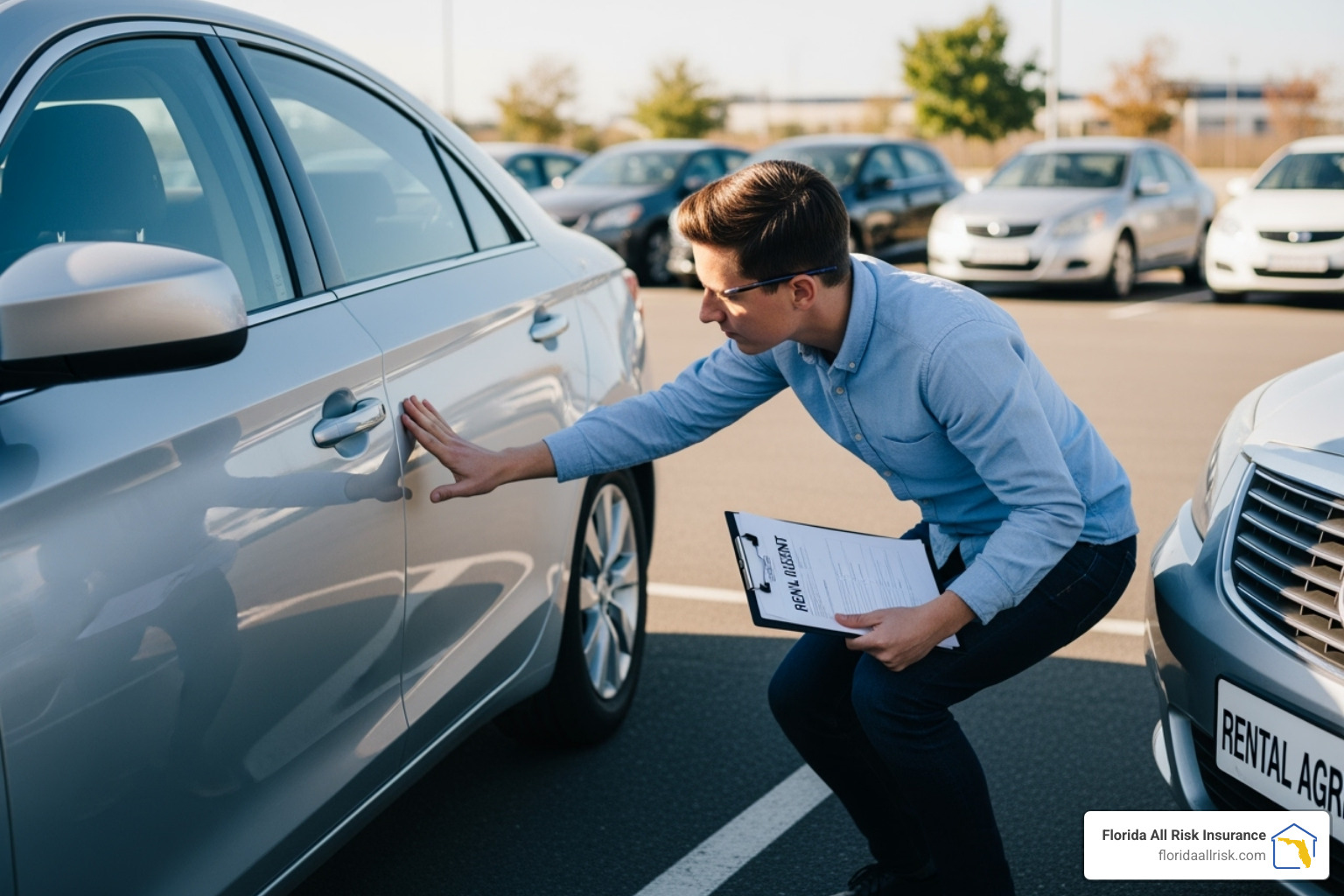
{alt=”A person carefully inspecting the exterior of a rental car for scratches and dents before signing the rental agreement, emphasizing proactive protection and documentation to avoid disputes.”}
You’ve done your homework on Rental car insurance Florida, and now you’re at the counter. The next few minutes are critical. A proactive approach can save you from a nightmare of disputed charges and insurance headaches.
Before You Leave the Rental Lot
This is your most important line of defense. Don’t rush it.
- Inspect the Vehicle: Walk around the entire car, checking every panel, bumper, mirror, and the roof for scratches, dents, or chips.
- Document Everything: Use your phone to take photos and a video of the car’s condition, paying close attention to any pre-existing damage. Make sure the rental agent notes any damage on your rental agreement before you sign. Get it in writing.
- Check Tires and Windshield: Note any low tire tread, bulges, or cracks and chips in the glass. These are common sources of post-rental charges.
- Test the Features: Check the headlights, turn signals, windshield wipers, and especially the air conditioning.
- Review the Agreement: Read the contract before you sign. Verify the insurance, fuel policy, and mileage limits match what you were quoted.
- Confirm All Fees: Ask for a detailed breakdown of the base rate, taxes, surcharges, and any add-ons to avoid surprises on your final bill.
Avoiding Common Deceptive Practices
Stay vigilant for upselling tactics and hidden fees.
- “Mandatory” Insurance: Florida law only requires the rental company to provide basic PIP and PDL. You are not legally required to buy their optional packages. If an agent insists, they are being misleading.
- Hidden Fees: Ask about fees for additional drivers, underage drivers (under 25), and early or late returns.
- Toll Programs: Rental company toll passes are convenient but expensive. They often charge a high daily fee on top of the actual toll cost. If you have your own SunPass or E-ZPass, ask if you can use it.
- Fuel Options: The cheapest option is almost always to refuel the car yourself at a gas station near the airport before returning it. Keep the receipt.
- File a Complaint: If you feel you’ve been misled, file a complaint with the Florida Attorney General’s Office at www.myfloridalegal.com or the Better Business Bureau.
What to Do After a Rental Car Accident
Accidents happen. Knowing these steps can protect you legally and financially.
- Prioritize Safety: Check for injuries and call 911 immediately if anyone is hurt. If it’s safe, move the vehicles out of traffic.
- Call the Police: Always get an official police report, even for a minor accident. It’s crucial for insurance claims involving a rental car.
- Gather Information: Exchange names, contact info, driver’s license numbers, and insurance details with all other parties involved. Get contact info from any witnesses.
- Document the Scene: Take photos of the damage to all vehicles, their positions, skid marks, and the surrounding area.
- Notify the Rental Company: Report the accident to the rental agency as soon as possible (usually required within 24 hours). Follow their instructions precisely.
- Contact Your Insurer: If you are using personal auto or credit card coverage, call your provider to start the claims process.
Frequently Asked Questions about Rental Car Insurance in Florida
Navigating Rental car insurance Florida can be confusing. Here are quick answers to the most common questions we hear at Florida All Risk Insurance.
Can I legally rent a car in Florida without having my own personal auto insurance?
Yes, you can. Rental companies are required by law to include Florida’s minimum liability coverage with every rental: $10,000 in Personal Injury Protection (PIP) and $10,000 in Property Damage Liability (PDL). This makes it legal for you to drive the car off the lot.
However, these minimums are very low. If you cause an accident with damages exceeding these amounts, you are personally responsible for the difference. For this reason, if you don’t have a personal auto policy, it’s wise to purchase Supplemental Liability Insurance (SLI) from the rental company or a third-party provider.
How much does rental car insurance typically cost per day in Florida?
Costs vary, but you can expect to be offered several options at the counter that add up quickly.
- Loss/Collision Damage Waiver (LDW/CDW): $9 – $30 per day.
- Supplemental Liability Insurance (SLI): $15 – $20 per day.
- Personal Accident/Effects Coverage (PAI/PEC): $5 – $15 per day.
Accepting a full protection package can cost between $30 and $50+ per day, potentially adding hundreds of dollars to a week-long rental. This is why checking your existing coverage from personal auto or credit card policies before you rent is the most effective way to save money.
Is my credit card’s rental insurance enough for a rental in Florida?
It’s rarely enough on its own. While many credit cards offer a rental car benefit, it comes with significant limitations:
- It Doesn’t Cover Liability: Credit card insurance almost never includes liability protection. It won’t cover costs if you injure someone or damage their property. You would only have the state-mandated $10,000 in PDL, leaving you exposed to major financial risk.
- It’s Usually Secondary: Most card benefits are secondary, meaning they only reimburse your personal auto insurance deductible after you file a claim with your own insurer. Only a few premium cards offer primary coverage.
- There Are Exclusions: Coverage often excludes luxury cars, vans, trucks, and rentals longer than 15 or 30 days.
To use the benefit, you must decline the rental company’s CDW/LDW and pay for the rental with the card. Always call the number on the back of your card (e.g., American Express, VISA, or Mastercard) to confirm the specific terms before relying on it.
What insurance do international visitors need when renting a car in Florida?
This is a critical question, as auto insurance from another country almost never provides coverage in the United States. International visitors will have the state-mandated minimum PIP and PDL included in their rental. However, due to the low limits, it is highly recommended that they purchase both a Loss Damage Waiver (LDW) and Supplemental Liability Insurance (SLI) from the rental counter or a third-party provider. SLI is especially important, as a serious at-fault accident could lead to a devastating lawsuit with no other liability policy to fall back on. Some premium travel credit cards may offer primary LDW/CDW coverage, which is a great benefit, but they will not provide liability protection.
Does rental car insurance cover flat tires, lost keys, or running out of gas?
Typically, no. The main insurance products like LDW and SLI do not cover these types of operational issues. LDW/CDW specifically excludes damage to tires and glass in many contracts. If you lose the keys or lock them in the car, you will be responsible for the full, often expensive, cost of replacement and locksmith services. To cover these incidents, rental companies sell a separate Roadside Assistance Protection plan for a few extra dollars per day. This optional add-on can be worthwhile for peace of mind, as it covers the cost of service calls for flat tires, lockouts, fuel delivery, and dead batteries.
Secure Your Peace of Mind on Florida’s Roads
Renting a car in Florida should be about the adventure, not the financial risk. By understanding the state’s mandatory requirements, evaluating optional coverages, and knowing what your personal policies already provide, you can make a smart, cost-effective decision. Being proactive—inspecting the vehicle, reading the contract, and knowing your rights—is your best defense against unexpected charges. For Florida residents, the first step is ensuring your personal auto policy is robust enough to protect you in any vehicle you drive.
Ready to ensure your personal auto policy has you covered for your next trip? Get a comprehensive auto insurance quote today!
Have questions about your coverage options? Contact our expert agents for personalized advice to find the perfect policy for your needs.
Contact Florida All Risk Insurance
Making smart decisions about Rental car insurance Florida begins with understanding your existing coverage. At Florida All Risk Insurance, our experienced agents are here to provide personalized guidance without the pressure or confusion. As an independent agency, we shop multiple carriers to find you the best coverage at competitive rates.
We’ll help you review your current auto policy to see how it extends to rental vehicles and identify any gaps that might leave you vulnerable.
Our office is conveniently located at:
10225 Ulmerton Rd, Largo, FL 33771
Give us a call at:
(727) 544-4100
Or send us an email at:
[email protected]
Contact us today for honest advice and the peace of mind you deserve on Florida’s roads.

