

Remote Work, Real Injuries: What You Need to Know About Workers’ Comp at Home
Why Understanding Workers’ Compensation for Remote Employees Matters
Being injured while working from home is now a practical concern for thousands of Florida workers and their employers. The traditional boundaries of the “office” have dissolved, particularly across Saint Petersburg and the surrounding Tampa Bay area. Remote work brings flexibility and eliminates long commutes, but it also creates a more complicated question when something goes wrong: is the injury connected to work, or is it simply a home accident that happened during the day?
When an employee is injured in a traditional workplace, the path to workers’ compensation is usually more straightforward. But when the “workplace” is a spare bedroom, a kitchen table, or a converted garage, coverage depends on whether the injury arose “out of and in the course of” employment. In Florida, that analysis often turns on what insurance professionals call the “nexus of employment” and what many people understand as a time, place, and activity evaluation.
Quick Eligibility Guide: Are You Covered?
| Factor | What Makes You Eligible | What Doesn’t |
|---|---|---|
| Time | During scheduled work hours or performing work tasks | Off-duty, personal time, or after logging off |
| Place | In your designated workspace during work activities | Kitchen, yard, or other areas during personal tasks |
| Activity | Performing job duties, work-related tasks, or reasonable breaks | Household chores, cooking dinner, or personal errands |
Most Likely Covered:
- Falls while carrying work documents in your home office
- Repetitive strain injuries from typing at your desk
- Injuries during bathroom breaks or getting water
- Tripping on work-provided equipment cords
Usually Not Covered:
- Injuries while cooking meals
- Falls during household chores like lawn mowing
- Accidents caused by personal home maintenance
- Injuries during extended personal activities
Because remote work blurs the line between personal life and job duties, understanding these distinctions is critical for both workers and employers. The key question is whether your injury is meaningfully connected to work activities, or whether it is a personal deviation unrelated to your job.
I’m Jason Miller, and over my 20+ years in Florida insurance, I’ve seen workers’ compensation claims evolve dramatically. That evolution has accelerated with remote work, and the best outcomes almost always come from clear policies, consistent documentation, and prompt reporting.
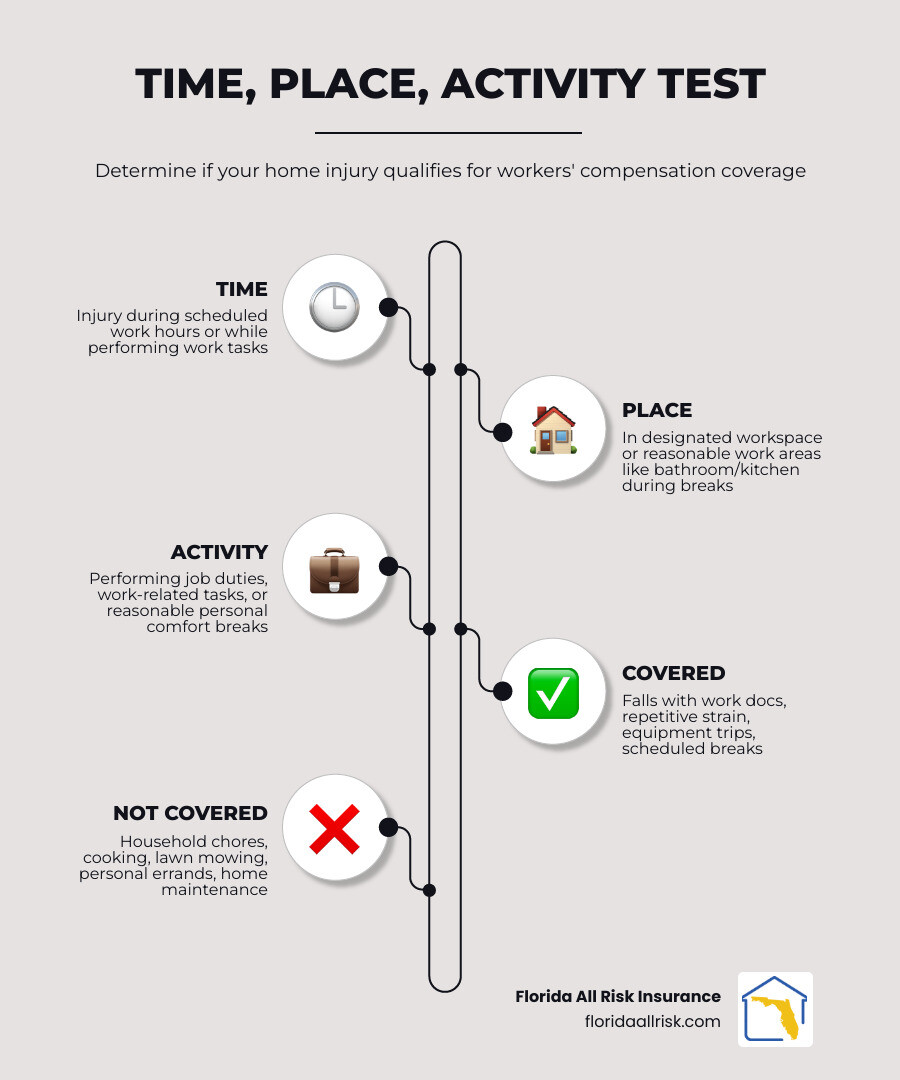
Injured while working from home vocab explained:
Determining Eligibility: Were You Injured While Working From Home?
The primary challenge in remote work injury claims is distinguishing between a work-related accident and a personal home accident. Every decision is fact-specific, and in Florida the key statutory requirement is that the injury must arise out of and in the course of employment. In practice, claims professionals and attorneys often evaluate the same three pillars used in many jurisdictions: time, place, and activity. For a comprehensive look at the legal requirements, you can review Florida Statute 440.09, which outlines the primary standards for coverage and the ‘Major Contributing Cause’ rule.
To determine if an injury is compensable, adjudicators typically look at three pillars: time, place, and activity. This is often referred to as the “course of employment” test. In Florida, Statute 440.09 mandates that an injury must arise out of and in the course of employment to be covered. This means the work must be the major contributing cause of the injury. The ‘Major Contributing Cause’ (MCC) standard is particularly strict in Florida; it requires that the work-related event must be more than 50% responsible for the injury as compared to all other causes combined. This is a higher bar than in many other states, making documentation of the work activity even more vital.
Time: Did the injury occur during the employee’s established work hours? If an employee has a flexible schedule, this becomes more complex, but the focus remains on whether the worker was “on the clock” or performing a task at the employer’s request. For example, if you are answering emails at 9:00 PM and trip over your laptop charger, the “time” element might be satisfied if your employer expects after-hours responsiveness. Conversely, an injury occurring during a mid-day personal errand would likely fail this test.
Place: Did the injury happen in a designated workspace? While a formal remote work agreement that defines a specific home office area is not strictly required for a claim to succeed, it provides significant clarity. If an injury occurs in the kitchen while the employee is supposed to be at their desk, the “place” element may be contested. The ‘Premises Rule’ in Florida generally extends to the area where the employee is expected to work, even if that premises is a private residence.
Activity: This is often the most critical factor. Was the employee performing a task that furthered the employer’s business? For example, if a worker drops a box of work documents on their foot, the activity is clearly work-related. Conversely, if they trip over a family pet while heading to the kitchen to start dinner, the activity is personal. The distinction between a “personal deviation” and a “work-related task” is the battleground for most remote work claims.
The “Personal Comfort Doctrine” also plays a role. This legal principle suggests that brief interludes for basic needs, such as getting a glass of water or using the bathroom, are incidental to employment. However, the application of this doctrine at home can be narrower and more fact-dependent than in a traditional office setting, because the home includes many personal risks and activities that are not work-related. For general background on how some systems analyze work-relatedness, see the WSIB Policy on Work-Relatedness.
Proving You Were Injured While Working From Home
Proving a claim when there are no witnesses requires meticulous documentation. Because an employer cannot physically see the accident occur, the burden of proof often rests heavily on the employee’s ability to provide a consistent narrative. In Florida, the ‘Increased Risk’ doctrine is often applied: did the employment place the worker in a position that increased the risk of the injury beyond what they would face in their normal non-work life?
If you are injured while working from home, be prepared to show you were genuinely engaged in work at the time of the incident. Helpful documentation can include digital login records, calendars, messages or emails sent near the time of injury, and photographs of the workspace condition that allegedly contributed to the injury. For more on reducing risk in a home work environment, you can read our guide on how to safeguard your home-based business. Consistency matters: discrepancies between an initial report and later statements can lead to delays or denials.
The Legal Framework: Case Law and Jurisdictional Differences
The legal treatment of remote work injuries varies significantly across borders, though the underlying concepts often overlap. In the United States, the Occupational Safety and Health Administration (OSHA) has stated it will not inspect home offices or hold employers liable for the home environment itself. However, employers may still have recording obligations for certain work-related injuries.
According to the OSHA guidance on recordkeeping for injuries and illnesses, employers must record work-related injuries and illnesses if they meet OSHA’s general recording criteria. OSHA has also addressed telecommuting in interpretive guidance, explaining that an injury is work-related if it occurs while the employee is performing work for pay or compensation and the injury is directly related to the performance of the work rather than the general home environment. See the OSHA telecommuting interpretation letter.
Canada and Australia have also considered how “course of employment” principles apply when the worksite is a residence. For example, the Quebec matter often cited as Air Canada et Gentile-Patti (2021) involved a fall on home stairs around a scheduled break. In Ontario, Workplace Safety and Insurance Appeals Tribunal decisions have discussed when breaks (such as bathroom breaks) are incidental to employment, while still excluding clearly personal activities like cooking supper, shoveling snow, or taking out the garbage.
Australia’s Comcare and Safe Work Australia similarly emphasize that a home can be a “place of work” during agreed hours, and that “ordinary recesses” may be treated as part of work time when they are reasonable and not a significant personal deviation. Florida employers and employees should understand that while these are not Florida authorities, they illustrate the kinds of fact patterns and reasoning that can come up when evaluating whether someone was truly injured while working from home.
In Florida, the central question remains whether the injury arose out of and in the course of employment, and whether work was the major contributing cause. Because remote work removes direct on-site supervision, clear remote work agreements, well-defined schedules, and consistent reporting procedures often become important practical tools for reducing disputes.
Common Remote Work Injuries and Coverage
Not all injuries are the result of a sudden fall. Cumulative injuries, such as carpal tunnel syndrome or chronic back pain, are increasingly common among remote workers who may lack ergonomic setups. In 2019 ONWSIAT 1873, a customer service worker who performed her job entirely from home was granted compensation for carpal tunnel syndrome. The tribunal found that her increased workload and repetitive typing were significant contributing factors to her condition. This highlights the importance of having proper Workers’ Compensation Insurance that covers occupational diseases as well as acute accidents.
Repetitive Strain Injuries (RSIs) are particularly insidious in the remote world. Without the natural interruptions of an office environment—walking to a conference room, stopping by a colleague’s desk, or heading to the breakroom—remote workers often sit for longer periods in static positions. If your home office consists of a laptop on a kitchen counter, you are at a significantly higher risk for neck strain (often called “tech neck”) and lower back issues. These conditions are compensable in Florida if it can be proven that the work duties were the major contributing cause.
Mental health is another evolving area of workers’ compensation. The isolation of remote work, combined with the “always-on” culture, can lead to burnout, anxiety, and depression. While psychological claims are traditionally harder to prove, many jurisdictions now recognize “chronic stress” or “mental-mental” claims if the worker can demonstrate that specific workplace factors (like excessive monitoring or harassment) were the predominant cause of the deterioration. In Florida, mental health claims usually require an accompanying physical injury to be compensable, but the legal conversation is rapidly changing as the psychological toll of isolation becomes better understood.
Exclusions remain a vital part of the conversation. Generally, injuries are not covered if they result from:
- Household Chores: Shoveling the driveway, doing laundry, or cleaning the house during a conference call.
- Personal Deviations: Leaving the home office to run a personal errand or pick up a child from school.
- Home Maintenance: Injuries caused by faulty home wiring, a leaking roof, or a broken step that the employer had no control over (unless the employer provided the specific equipment that caused the hazard).
- Acts of Nature: If a hurricane damages your home while you are working, the resulting injury is typically a homeowners insurance matter, not workers’ comp, unless the work itself placed you in a position of increased risk.
Employer Responsibilities and Liability Mitigation
Employers have a “duty to accommodate” employees under human rights legislation, even if the injury was not work-related. If an employee is injured at home while gardening on a Sunday, the employer may still be legally required to modify their remote work duties or provide specialized equipment to allow them to continue working, up to the point of “undue hardship.” You can find more details in the Human Rights at Work guide.
Beyond accommodation, health and safety laws require employers to take every precaution reasonable in the circumstances for the protection of a worker. In a remote context, this does not mean the employer must physically inspect every home in Florida, but it does mean they should be proactive. Negligence in providing a safe “virtual” environment can lead to increased premiums and legal headaches.
To mitigate liability, Florida employers should:
- Provide Guidelines: Issue clear, written policies on ergonomic workstation setups and home safety. This should include diagrams of proper chair height, monitor placement, and lighting requirements.
- Conduct Virtual Assessments: Use photos or video calls to help employees identify hazards like trailing cables, unstable furniture, or poor lighting. A simple 10-minute video walkthrough can prevent a multi-thousand dollar claim.
- Supply Equipment: Provide or subsidize ergonomic chairs, monitors, and keyboards. Investing in a $300 chair is far more cost-effective than paying for a $30,000 back surgery.
- Establish Reporting Protocols: Ensure employees know exactly how and when to report a safety concern or an injury. The faster an injury is reported, the faster the insurance carrier can begin the investigation and medical management process.
- Implement Remote Work Agreements: A signed agreement that defines work hours and the designated workspace can be a powerful piece of evidence if a claim arises from an injury sustained outside those parameters.
Furthermore, Florida courts have occasionally explored the ‘Non-Delegable Duty’ doctrine. While typically applied to physical premises owned by the employer, the shift to remote work raises questions about whether an employer’s duty to provide a safe workplace can ever be fully delegated to the employee. While current Florida law generally protects employers from being responsible for the structural integrity of an employee’s home, the duty to provide safe equipment (like laptops and monitors) remains absolute. If an employer provides a laptop with a faulty battery that explodes, the employer is liable regardless of where the employee was sitting.
The concept of ‘Vicarious Liability’ also takes on new dimensions in a remote setting. If a remote employee, while acting within the scope of their employment, causes harm to a third party (for example, during a work-related delivery or a home-based client meeting), the employer may still be held liable. This underscores the importance of not only workers’ compensation but also comprehensive general liability insurance that accounts for remote operations. Employers should consult with their insurance advisors to ensure that their policies do not contain ‘residential premises’ exclusions that could leave them vulnerable. Failure to take these steps could open an employer to negligence claims beyond the scope of workers’ compensation, particularly if they were aware of a hazard and failed to act. In the competitive Florida job market, demonstrating a commitment to remote worker safety is also a powerful tool for talent retention and recruitment.
Steps to Take After Being Injured While Working From Home
If you are injured while working from home, the actions you take in the first hour are critical for your claim’s success. Because you are in a private residence, the “scene of the accident” can be easily disturbed or cleaned up, leading to questions about the validity of your claim. The goal is to protect your health first and preserve accurate information second.
Immediate Steps After Being Injured While Working From Home
Seek Medical Attention: Your first priority is health. If you need urgent care or emergency care, get it right away. If you are able, tell the provider the injury occurred while you were working from home so it is reflected accurately in the medical record.
Report to Your Supervisor: Report the injury as soon as possible and do it in writing (email or an internal messaging system) so there is a timestamped record. Florida law generally requires timely notice, and immediate reporting helps reduce disputes.
Document the Scene: Take clear photos of your workspace, the specific hazard (for example, a frayed cord, a slipped rug, or a broken chair), and any visible injuries. If you can, record a short video explaining what happened while details are fresh.
Preserve Evidence: If equipment failed, do not discard it. Store it safely in the condition it was in after the incident, in case the carrier or adjuster needs to inspect it.
Identify Witnesses: Remote accidents often happen alone, but witnesses can still exist. Were you on a call when it happened? Did someone hear you fall? Capture names and brief statements while memories are fresh.
Keep a Log: Keep a simple record of symptoms, appointments, work restrictions, and how the injury affects daily activities. This can help you stay consistent and organized if questions arise later.
Employers should also have a response plan. Once a report is received, the employer should document what was reported, provide the appropriate next steps for medical direction and claims reporting, and maintain communication with the employee to support a safe return to work when appropriate.
Frequently Asked Questions
Are injuries during lunch breaks covered at home?
Yes, in many jurisdictions, injuries during scheduled breaks are covered under the “Personal Comfort Doctrine” or as activities incidental to employment. The key is whether the break was taken during employer-sanctioned hours and whether the activity (like walking to the kitchen for a glass of water) was a reasonable transition. If you are making a full three-course meal and burn yourself on the stove, the claim will likely be denied because cooking is considered a personal activity that increases risk beyond what is reasonable for work.
Can I claim workers’ comp for carpal tunnel if I work from home?
Yes. Cumulative strain injuries like carpal tunnel or tendonitis are compensable if you can prove that your work duties—such as repetitive typing or mouse use—were a “significant contributing factor” to the condition. An ergonomic assessment of your home office can help support this claim by showing that the work environment necessitated the strain. In Florida, you will likely need a medical expert to testify that your work was the major contributing cause.
What if my employer didn’t provide my desk or chair?
You may still be eligible for workers’ compensation. Eligibility is based on whether the injury arose out of employment, not necessarily who owns the furniture. However, if the injury was caused by a defect in your personal furniture that the employer had no control over, the claim may be more difficult to prove than if the employer had provided the equipment. This is why many employers now provide stipends for ergonomic furniture.
Does my homeowners insurance cover me if I am injured while working from home?
Typically, no. Homeowners insurance is designed to cover personal liability and property damage, but it almost universally excludes work-related injuries. This is why having a dedicated workers’ compensation policy is essential for business owners with remote staff. If a client visits your home office and gets injured, that might fall under homeowners insurance, but your own injuries as an employee will not.
What if I am a 1099 contractor working from home?
Independent contractors are generally not covered by an employer’s workers’ compensation policy. However, many contractors in Florida choose to purchase their own workers’ comp coverage to protect their income. If you are misclassified as a contractor but perform the duties of an employee, you may still be eligible for benefits. You can read more about this in our guide to 1099 workers comp.
Can my employer fire me for filing a workers’ comp claim?
In Florida, it is illegal for an employer to discharge, threaten to discharge, or discipline an employee for validly claiming or attempting to claim workers’ compensation benefits. This protection applies to remote workers just as it does to on-site employees. If you feel you are facing retaliation, you should consult with a legal professional immediately.
Conclusion
Remote work has changed where work happens, but it has not eliminated the need for safety or the importance of clear documentation. As we’ve covered, being injured while working from home often comes down to time, place, and activity, along with whether the work was the major contributing cause of the injury under Florida workers’ compensation rules.
For employers, the most effective approach is proactive: written remote work expectations, basic home-office safety guidance, ergonomic support where feasible, and a clear reporting process. For employees, prompt reporting, accurate medical documentation, and preserving evidence can make the difference between a smooth claim and a disputed one.
Calls to Action (Conclusion Only):
Get a Workers’ Comp Quote: If you employ remote team members in Florida and want to confirm your workers’ compensation coverage is structured correctly, start here: Get a Workers’ Comp Quote Today
Reduce Risk in Your Home-Work Setup: For practical steps and insurance considerations for working from home, read: Learn How to Safeguard Your Home-Based Business
Contact Us
Florida All Risk Insurance
Address: 100 2nd Ave S, Suite 101, Saint Petersburg, FL 33701
Phone: (727) 471-0082
Email: [email protected]

