

Product Liability Insurance Rate: What Drives Your Premium and How to Control It
Why Every Product Carries a Price Tag of Risk
The product liability insurance rate you pay depends on far more than just your business size or location. Whether you’re selling handmade candles or importing electronics, every product carries inherent risks that insurers carefully evaluate when setting your premium. Once your product enters the market, you become part of the legal “chain of distribution” that can be held responsible if something goes wrong.
Quick Answer: Product Liability Insurance Rate Factors
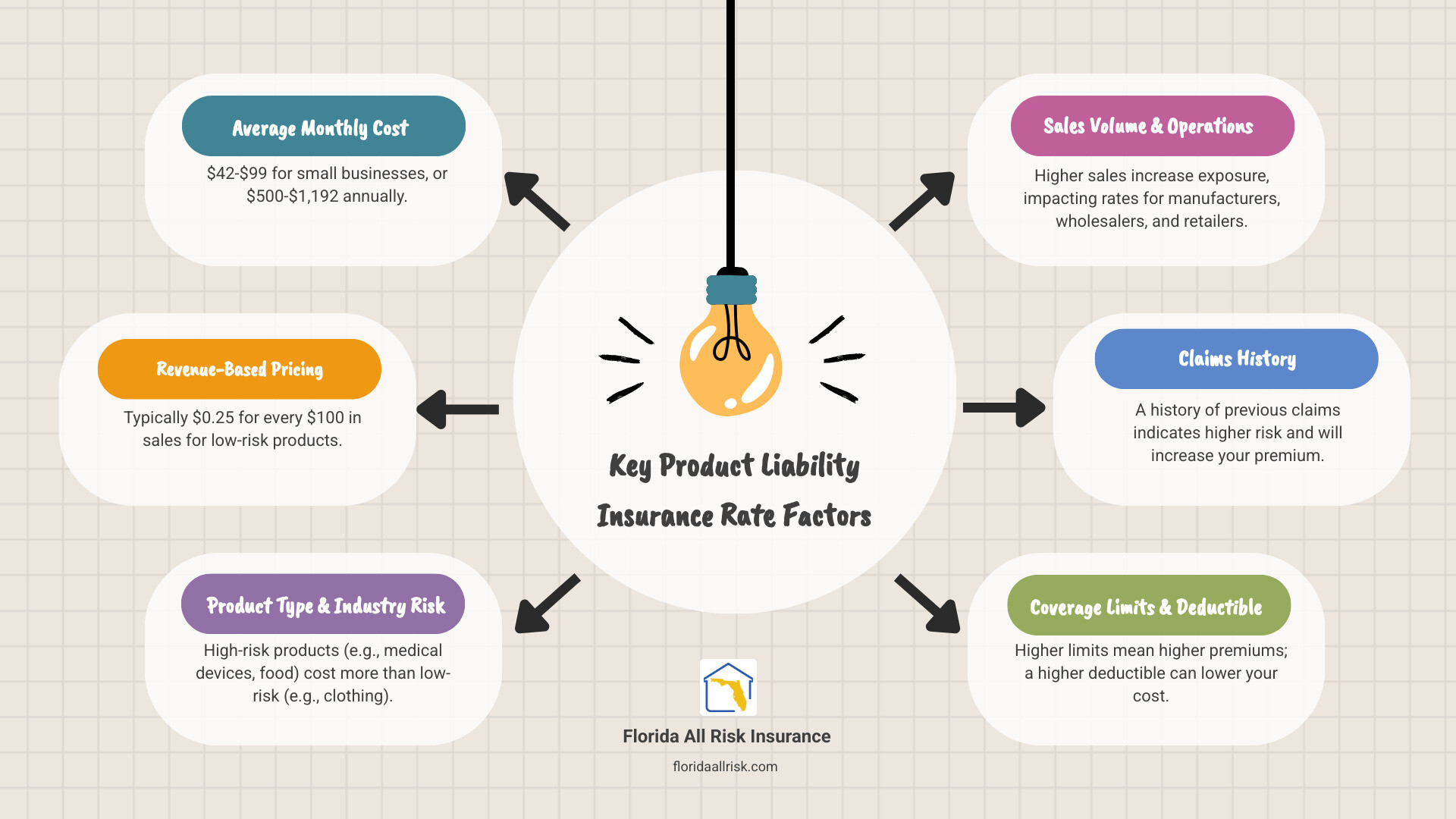
- Average Cost: $42–$99 per month ($500–$1,192 annually) for most small businesses
- Revenue-Based Pricing: Typically $0.25 per $100 in sales for low-risk products
- Key Rate Factors: Product type, industry risk, sales volume, claims history, coverage limits
- High-Risk Industries: Food/beverage, children’s products, electronics, medical devices
- Low-Risk Industries: Clothing, professional services, media/advertising
The stakes are high. In 1944, a Coca-Cola bottle exploded in a worker’s hand, and her lawsuit helped shape modern product liability law. Today, that legal framework can lead to average jury awards of $7.4 million for product-related injuries, with defense costs alone averaging over $700,000. Without proper coverage, a single defective product can threaten—even end—a business.
As an insurance professional with over 20 years of experience helping Florida businesses, I’ve seen how understanding your product liability insurance rate can be the difference between affordable protection and financial catastrophe. My expertise in Florida’s commercial insurance landscape has helped thousands of companies secure the right coverage at competitive rates.
How to Use This Guide
- If you’re new to the topic, start with what product liability insurance covers and why it matters.
- Already insured? Jump to the sections on rate drivers and cost reduction to pressure-test your current policy.
- Manufacturers and importers should pay special attention to coverage limits and documentation practices.
This guide uses plain language and real-world examples, linking to helpful resources and relevant pages on our website for deeper dives. Throughout, you’ll find practical steps you can implement immediately to improve your risk profile—and, over time, your rates.
What Is Product Liability Insurance and Why Is It Essential?
Imagine a lawsuit claiming your product injured someone. The legal fees alone could be devastating, even before a settlement. This scenario is exactly why product liability insurance exists. It’s a specialized form of protection, often included in your broader Business Liability Insurance, that acts as your financial bodyguard against product-related claims. The moment a product leaves your control—whether you manufactured, imported, or sold it—you become part of the “chain of distribution,” where every entity can be named in a lawsuit.
Think of your product liability insurance rate as the price of peace of mind. Without this coverage, a single defective product could trigger defense costs averaging hundreds of thousands of dollars and settlements or verdicts that reach into the millions.
How Product Liability Insurance Works
When a customer is harmed by your product, product liability insurance acts as your financial shield. Your insurer provides a legal defense, handling investigations, expert witnesses, and settlement negotiations. If a case goes to trial, the policy covers judgments against you, up to your coverage limits. This protection is crucial for the entire supply chain—from manufacturer to retailer—as anyone can be named in a lawsuit.
Behind the scenes, insurers also help coordinate claims handling and, where appropriate, subrogation against negligent suppliers or component providers. This can reduce the net cost of a claim and minimize the long-term premium impact.
What’s Covered: The Scope of Your Shield
Policies are designed to handle three main types of product defects, each affecting your insurance rate and claims exposure:
- Manufacturing defects occur when an error during production makes a product unsafe—think a batch of chairs with weak joints or a contaminated food product.
- Design defects mean the product is dangerous even when made correctly, such as a space heater that overheats or a toy with small, detachable parts that present a choking hazard. These can render products unreasonably dangerous under standards from agencies like the U.S. Consumer Product Safety Commission (CPSC).
- Marketing defects involve a failure to provide proper warnings or instructions—for example, a cleaning chemical without adequate safety guidance or a supplement missing adverse effect warnings.
Beyond these defects, your policy provides comprehensive financial protection. It covers legal defense costs (even for baseless claims), settlements, judgments, and medical bills for injured parties. For instance, if a restaurant’s sauce causes food poisoning or an imported charger overheats and damages property, product liability insurance turns a potential crisis into a manageable claim.
What’s Typically Not Covered
Understanding what’s not covered helps you avoid dangerous gaps:
- Product recalls are a major exclusion. The costs to pull products from the market, notify customers, and manage returns require separate Product Recall Insurance.
- Employee injuries fall under Workers’ Compensation, not product liability. Similarly, damage to your own product is excluded.
- Intentional acts or fraud are not covered. If you knowingly sell a dangerous product, claims arising from that knowledge won’t be covered.
- Professional errors that cause financial loss rather than physical injury require General Liability Errors and Omissions Insurance.
- Cyber incidents (e.g., data breaches involving connected devices) need separate Cyber Liability coverage.
A Quick Note on Legal Theories
Product claims can be brought under negligence, strict liability, or breach of warranty. Strict liability is particularly significant: a claimant doesn’t have to prove you were careless—only that the product was defective and caused harm. That’s a key reason product liability insurance is essential, even for careful businesses with strong quality control.
Where Product Liability Fits in Your Policy Stack
Most small businesses get product liability protection packaged with General Liability Insurance or a Business Owner’s Policy (BOP). Manufacturers, importers, and higher-hazard sectors often need endorsements or standalone policies with higher limits and specialized terms. An experienced agent can help you determine whether a bundled approach or a dedicated policy under a Commercial General Liability Insurance framework makes more sense for your operations.
Decoding the Product Liability Insurance Rate
The key question for any business owner is, “How much will this cost?” Your product liability insurance rate isn’t a simple average; it’s a custom price based on a detailed risk assessment. An insurer evaluates your unique business, recognizing that a soap maker at a local market has different risks than an electronics importer selling nationwide.
What Is the Average Cost of Product Liability Insurance?
Most small businesses obtain product liability coverage bundled into their General Liability Insurance or BOP, making it cost-effective.
- Average Costs: For many small Florida businesses, this runs $42–$99 per month ($500–$1,192 annually). Florida averages often hover around $45 monthly for lower-risk operations.
- Revenue-Based Calculation: For low-risk products, a common figure is $0.25 for every $100 in sales. A business with $500,000 in revenue might pay around $1,250 annually under this structure.
To put those premiums in context, the average jury award for a product liability injury reached $7.4 million in 2019, and defense costs often exceed $700,000, according to the Insurance Information Institute. Insurance transforms that tail risk into a predictable, budgetable expense.
The Core Pricing Algorithm: What Underwriters Weigh Most
Insurers typically assess several variables—some you can influence directly and some you can’t. The weightings aren’t identical across carriers, but the key themes are consistent:
- Product type and industry risk: The inherent hazard of what you sell is the single largest driver. Medical devices, nutraceuticals, automotive components, and children’s products carry materially higher exposure than apparel or home decor.
- Role in the chain of commerce: Manufacturers and importers face more exposure than retailers, installers, or distributors. Importers are treated like manufacturers for liability purposes.
- Annual revenue and unit sales: More products in the market increase the statistical chance of a claim. Insurers may also consider average selling price and units per SKU.
- Claims history and loss trends: A clean record reduces pricing. If you’ve had claims, carriers will look closely at root causes and corrective actions.
- Coverage limits and deductibles: Higher limits cost more. Higher deductibles can lower your premium but increase out-of-pocket risk.
- Jurisdiction and venue: State law, jury trends, and local legal climate matter. Florida businesses benefit from working with local agents who understand venue-specific dynamics and contractual norms.
How Industries Compare: Illustrative Scenarios
- High-risk industries: Pharmaceuticals, medical devices, children’s products, food and beverage manufacturers, and automotive parts often need specialized terms, higher limits, and sometimes surplus lines carriers. Many in this group pursue High Risk General Liability Insurance with robust risk controls.
- Moderate-risk industries: Cosmetics, fitness equipment, electronics accessories, and multi-category e-commerce retailers tend to pay mid-tier rates with underwriting attention on labeling, supply chain vetting, and testing.
- Low-risk industries: Clothing and apparel, professional services with minimal product exposure, and media companies often see lower rates and broader availability of bundled options.
Rate differentials can be dramatic: a medical device firm may pay 5–10x what a clothing retailer pays for similar limits. These multipliers reflect potential injury severity and regulatory oversight levels.
Real-World Pricing Examples (Hypothetical)
- A small apparel brand with $350,000 in annual sales, clean claims history, and bundled coverage may pay $600–$900 annually for product liability within a general liability policy.
- A specialty food producer with $1.2 million in sales and robust HACCP plans might see $3,000–$7,500 annually, depending on distribution and past incidents.
- An importer of smart-home devices with $2 million in revenue and UL-listed components could pay $8,000–$15,000 annually, influenced by device category, battery risks, and supplier controls.
These aren’t quotes; they’re directional ranges illustrating how risk profiles map to cost.
Contractual Requirements That Influence Limits
Retailers, marketplaces, and distributors may require minimum limits and additional insured status. For example, some platforms require $1 million per occurrence and $2 million aggregate, plus primary and non-contributory wording. Meeting these obligations can raise premiums but unlocks distribution—and revenue—opportunities.

Common Misconceptions That Skew Budgeting
- “If I’m just a retailer, I’m safe.” Retailers can be named in suits and may need to defend themselves until the manufacturer is identified and accepts responsibility.
- “I can rely on supplier indemnity.” Supplier contracts are helpful, but if the supplier is overseas, underinsured, or insolvent, your policy becomes the backstop.
- “Small batch means small risk.” Even limited runs can cause significant injuries. Severity, not just frequency, drives pricing for many categories.
Understanding these realities keeps expectations grounded and helps you select appropriate coverage without overpaying.
Managing Your Policy and Reducing Costs
While some cost factors are fixed, you can take proactive steps to manage your insurance expenses. The goal is to balance affordable premiums with adequate protection for your Florida business. Strategic documentation and consistent safety practices do more than reduce losses—they strengthen your underwriting profile at renewal.
Standalone Policy vs. General Liability Endorsement
The structure of your policy can impact your product liability insurance rate. Most small businesses get this coverage bundled within a Commercial General Liability Insurance policy or a Business Owner’s Policy (BOP).
- Bundled coverage is the most common and cost-effective option for low-to-moderate risk businesses. It simplifies your insurance by combining product liability with other protections, like premises liability for slip-and-fall incidents.
- Standalone policies are often necessary for high-risk businesses, such as manufacturers or importers, that need higher limits and specialized terms. In some high-hazard industries, a standalone policy is the only viable option due to capacity and wording requirements.
An independent agent can help you compare total cost, terms, exclusions, and claims support across bundled and standalone options.
How to Reduce Your Product Liability Insurance Costs
Insurers often reward businesses that actively manage risk with better product liability insurance rates. Consider these practical steps:
- Implement Quality Control: Use documented production checks, incoming inspections for components, and end-of-line testing. For food and beverage, formalize HACCP procedures and temperature logs. For electronics, emphasize certification (e.g., UL/ETL) and battery safety protocols.
- Provide Clear Instructions & Warnings: Make user guides unambiguous and easy to follow. Prominent warning labels, pictograms, and multilingual instructions reduce misuse and claims.
- Maintain Meticulous Records: Keep supplier agreements, lot numbers, test results, and distribution data. If a claim arises, documentation demonstrates due diligence and speeds root-cause analysis.
- Choose a Higher Deductible: If cash flow allows, increasing the deductible can lower premiums. Evaluate your loss history and reserve strategy before making this change.
- Pay Annually: Many carriers offer discounts for paying in a single installment.
- Vet Your Supply Chain: Verify your suppliers’ certifications, insurance, and compliance practices. Build in audit rights and indemnification in contracts.
- Bundle Policies Thoughtfully: Combining general liability with property or cyber in a BOP can create pricing efficiencies.
Product Safety and Compliance Frameworks
Aligning with recognized standards can favorably influence underwriting. For example, documented quality systems that mirror ISO 9001 principles, or adherence to category-specific standards (such as ASTM or ANSI guidelines), signal a mature safety culture. For consumer products, staying current with recalls and safety alerts from the U.S. Consumer Product Safety Commission (CPSC) helps you anticipate and mitigate emerging hazards.
Understanding Coverage Limits
Choosing the right coverage limits is a balance between cost and protection. Opting for low limits to save money can be a false economy if you operate in higher-severity categories.
- Per-occurrence limits: The maximum your insurer pays for a single incident, commonly $1 million. This figure includes legal fees, settlements, and judgments for that claim.
- Aggregate limits: The total maximum your insurer pays for all claims during the policy period, often $2 million.
Consider contract requirements, your sales volume, product hazard, and distribution footprint when setting limits. Because lawsuit costs can escalate quickly, many Florida businesses elect higher limits or umbrella policies. For more guidance on limit selection across exposures, see How Much General Liability Insurance Do I Need?.
Claims Handling: What to Do If Something Goes Wrong
- Preserve evidence: Retain the product, packaging, and any associated materials.
- Document thoroughly: Record batch/lot numbers, QC records, and customer communications.
- Notify your carrier promptly: Early notice helps control costs and shapes the defense strategy.
- Communicate professionally: Avoid admissions of fault; stick to facts and defer to your insurer and counsel.
A timely, organized response can materially affect claim outcomes and the long-term impact on your rates.
Frequently Asked Questions about Product Liability Insurance Rates
Business owners often have questions about product liability insurance rates. Here are straightforward answers to the most common ones.
Who needs product liability insurance?
If your business is part of a product’s journey to the consumer, you need this coverage. This includes manufacturers, importers, wholesalers, distributors, and retailers (both online and brick-and-mortar). Even businesses that assemble, install, or repair products are exposed. Under the legal principle of “strict liability,” any business in the supply chain can be held responsible if a product causes harm, making coverage essential for all.
Can I get product liability insurance if I sell products online?
Absolutely, and it is strongly recommended. Online sellers face the same liability risks as traditional retailers. In fact, many large online marketplaces require third-party sellers to carry liability coverage. Your product liability insurance rate is based on your product type and sales volume, not whether you sell online or in a physical store.
What is the difference between product liability and professional liability?
This distinction is simple: product liability insurance covers bodily injury or property damage caused by a physical product. Think of a faulty appliance that starts a fire.
Professional liability insurance (Errors & Omissions) covers financial losses caused by your professional services or advice—for example, a consultant making a costly mistake. Many Florida businesses need both. A software company might need product liability for physical components and professional liability for its consulting services. Understanding this difference ensures you get the right protection at the right product liability insurance rate. The key takeaway is that product liability covers things, while professional liability covers services. Learn more about E&O here: General Liability Errors and Omissions Insurance.
Are product recalls covered under product liability insurance?
Generally, no. Standard policies exclude the costs to pull products from the market, notify customers, and manage returns. If recall risk is a concern, ask your agent about adding recall-specific coverage and how it would integrate with your general liability and product liability protections.
How do coverage limits affect my rate?
Higher limits mean the insurer is taking on more risk, which increases premiums. The most common baseline is $1 million per occurrence and $2 million aggregate, but contracts or product hazards may justify more. If you need higher limits, consider whether an umbrella policy can deliver cost-effective excess coverage across multiple lines.
If my supplier is insured, do I still need my own policy?
Yes. Supplier insurance and indemnification are helpful, but they’re not a replacement for your own policy. You may still be named in a lawsuit and need to defend yourself. Moreover, supplier policies might have exclusions, insufficient limits, or foreign jurisdiction complications. Your own coverage ensures you have a defense and dedicated limits.
Will a single claim make my rates skyrocket?
Not necessarily. Underwriters look at the nature of the claim, severity, fault, and what corrective actions you implemented. A minor claim followed by strong remediation may have a limited impact. Multiple, similar claims with no corrective measures will be viewed more harshly.
How can I estimate my premium before I apply?
You can ballpark pricing using revenue-based benchmarks for your industry risk level. For low-risk products, a simple starting point is $0.25 per $100 in sales. Pair this with your target limits to set budgeting expectations. Because underwriting varies by carrier and product category, a tailored quote is the only way to confirm pricing. Explore options via General Liability Insurance or request guidance through our Business Liability Insurance page.
Do I need product liability if I only sell locally at markets?
Yes. Even local, low-volume sellers face exposure if a product causes an injury or property damage. Jurisdiction doesn’t eliminate risk. The upside is that well-run, low-risk crafts or apparel sellers often obtain affordable coverage bundled with general liability.
Where can I learn more about product safety expectations?
The CPSC offers consumer product safety standards, recall information, and educational resources for businesses. Their site is a valuable reference point for manufacturers and importers seeking to align with best practices: Consumer Product Safety Commission. For broader context on claim trends and severity, consult the Insurance Information Institute’s product liability statistics.
Secure Your Business’s Future Today
Understanding your product liability insurance rate is the first step toward building a comprehensive, cost-effective risk strategy. No matter your role in the chain of distribution—maker, importer, wholesaler, or retailer—the right coverage turns an unpredictable, potentially business-ending threat into a manageable cost of doing business. Combined with thoughtful quality controls, supplier oversight, and clear instructions, insurance helps you protect customers and your bottom line.
At Florida All Risk Insurance in St. Petersburg, Florida, we specialize in helping Florida businesses navigate the complexities of commercial insurance. Our independent agents assess your unique risks, compare multiple carriers, and structure coverage that aligns with your operations, contracts, and growth plans. Whether you need a bundled approach through Business Liability Insurance or a specialized solution for higher-risk products—such as High Risk General Liability Insurance—we’re here to help you secure protection at a competitive rate.
When the stakes involve consumer safety, brand reputation, and long-term viability, waiting is the riskiest option. If a claim happens tomorrow, will you have the coverage and documentation to respond confidently? A brief conversation now can prevent costly surprises later.
Ready to make an informed decision and put a durable safety net in place?
- Get your personalized product liability quote now: Request a Business Liability Insurance quote.
- Speak with a Florida-based commercial insurance specialist today: Connect with our team.
We look forward to helping you protect the business you’ve worked so hard to build—so you can focus on innovation, growth, and serving your customers with confidence.
Contact Us
Ready to protect your Florida business with the right product liability insurance rate? At Florida All Risk Insurance, we specialize in finding coverage that fits your unique needs and budget.
Our independent agents work with multiple carriers across Florida, allowing us to shop on your behalf for competitive rates. We have the expertise to assess your specific risks, whether you’re a manufacturer in Tampa, an importer in Miami, or an e-commerce seller in Jacksonville. Don’t wait for a claim to find gaps in your coverage.
Florida All Risk Insurance
Address: 7000 4th St N, Saint Petersburg, FL 33702
Phone: (727) 522-7777
Email: [email protected]

