

Personal Injury Protection Insurance: Secure 2025
Why Personal Injury Protection Insurance Matters for Florida Drivers
Personal injury protection insurance provides essential coverage for you and your passengers after a car accident, regardless of who caused it. This no-fault insurance acts as your financial safety net, covering medical bills, lost wages, and essential services when you need help most.
Key benefits of Personal Injury Protection include:
- Medical expenses: Covers hospital bills, doctor visits, surgery, and rehabilitation.
- Lost wages: Replaces a percentage of your income while you recover.
- Essential services: Helps pay for childcare or household help if you’re unable to perform these tasks.
- Funeral expenses: Provides death benefits to surviving family members.
Florida law requires all drivers to carry a minimum of $10,000 in PIP coverage. This mandatory protection ensures you have immediate access to benefits without waiting for fault determination or lengthy legal battles. Unlike other insurance types that cover damage to others, PIP is first-party coverage that protects you directly. Your own insurance company pays your claims, making the process faster and more straightforward.
At Florida All Risk Insurance, our team specializes in explaining complex coverage options in simple terms. We’ve seen how personal injury protection provides crucial financial support during difficult times and are here to ensure you understand exactly what protection you’re getting.
Why this matters in Florida: medical costs after even minor accidents can escalate quickly. A single emergency room visit with imaging and follow-up therapy can approach the $10,000 minimum, especially if you miss work. PIP bridges that immediate financial gap so you can focus on recovery, not paperwork or court timelines. It also travels with you in many everyday scenarios—whether you’re a passenger in a friend’s car or a pedestrian struck by a vehicle—offering a broad safety net for you and your household.
In short, PIP helps keep your life on track when the unexpected happens. It’s a core part of a well-built auto policy and the foundation for protecting your financial future on Florida’s roads.
What is Personal Injury Protection (PIP) Insurance?
When you’re driving in Florida, personal injury protection insurance acts as your financial first responder after an accident. At Florida All Risk Insurance, we see it as the coverage that has your back when life takes an unexpected turn.
Personal injury protection insurance is a special type of auto insurance that operates on a “no-fault” system. Unlike traditional insurance that points fingers to assign blame, PIP means your own insurance company steps up to help you immediately, regardless of whether you caused the crash or were an innocent victim.
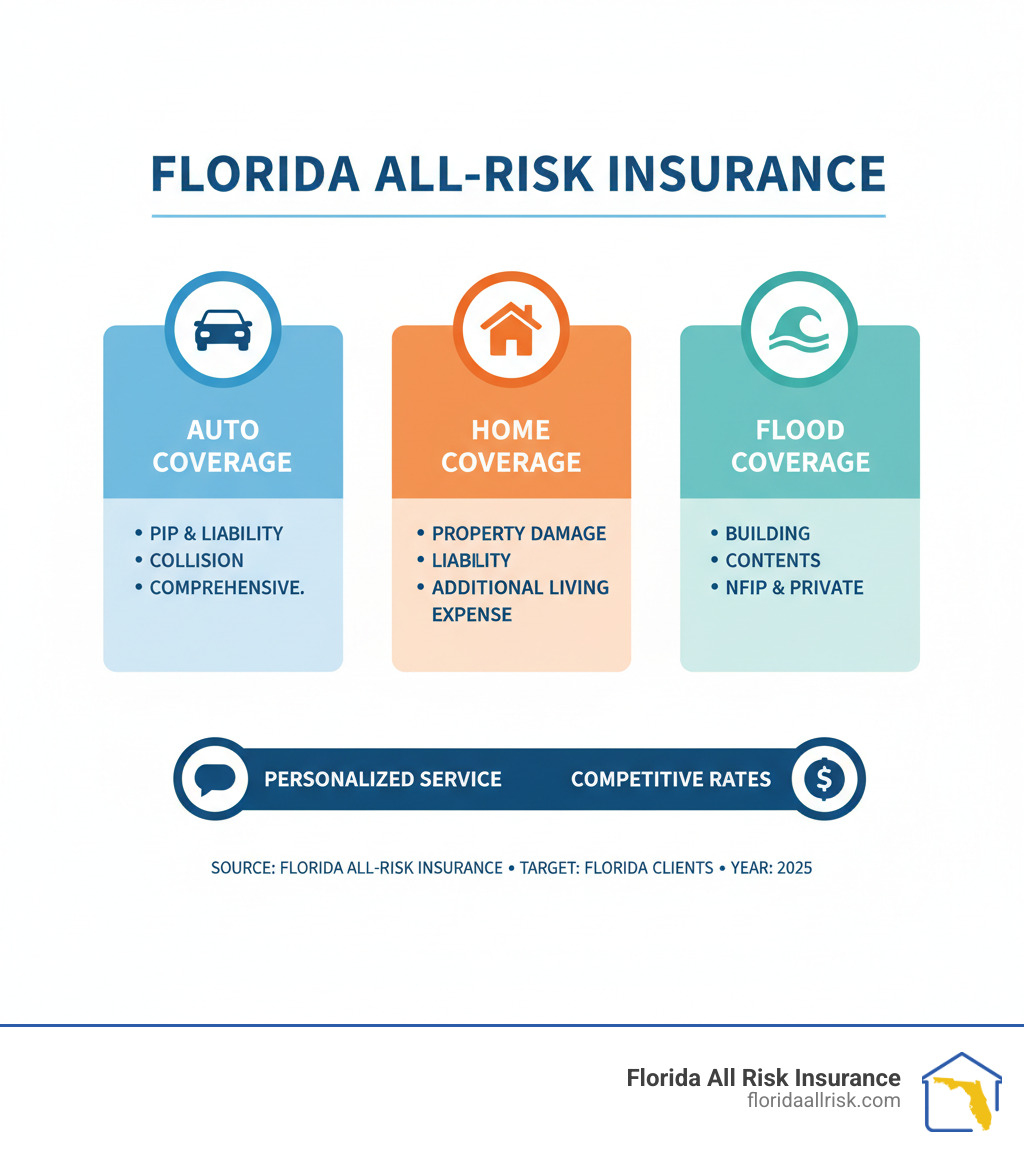
Think of PIP as first-party coverage—it’s all about protecting you, your passengers, and even resident family members if they’re hurt as pedestrians or cyclists in a vehicle-related incident. The beauty of PIP lies in its immediacy. Instead of waiting weeks or months for fault to be determined, PIP kicks in right away so you can focus on what matters most—getting better.
PIP serves as your primary coverage for accident-related injuries. This means it’s the first insurance to respond when you need medical care, often before your regular health insurance even enters the picture. This primary status ensures you’re not left scrambling to pay upfront costs while different insurance companies sort things out.
For drivers in no-fault states like Florida, PIP isn’t just a good idea—it’s the law. This mandatory coverage ensures that everyone on the road has immediate access to essential benefits. To better understand how PIP fits into your complete auto insurance picture, explore our comprehensive Auto Insurance Coverage Options designed specifically for Florida drivers.
Who is covered and when PIP applies
While policy language can vary, PIP generally follows the named insured and resident relatives in several common scenarios:
- You are driving your own car and are injured in a crash.
- You are a passenger in someone else’s vehicle and are injured.
- You are a pedestrian or cyclist struck by a motor vehicle and sustain injuries.
- Your resident family members are injured in vehicle-related incidents, even if they weren’t riding with you.
If you do not have your own PIP, coverage may come from the PIP policy on the vehicle you occupied. Because rules about priority of coverage can be nuanced—especially if multiple policies could apply—having an agent who will walk you through your specific situation is invaluable.
A few important nuances:
- PIP is designed for motor-vehicle-related injuries and pairs with other coverages for property damage and liability. It does not replace health insurance, but it typically pays first for accident-related care.
- In Florida, PIP requirements apply to vehicles with four or more wheels. Motorcycles are not covered by Florida PIP, so riders should explore alternative medical coverage options.
- Out-of-state scenarios can be complex. Some protections may extend beyond Florida depending on your policy, the vehicle involved, and your residency. If you travel often, review how your policy responds before you go.
Understanding these basics helps you build a complete plan: PIP for immediate, essential benefits; liability coverages for your legal responsibilities; and optional protections to round out your safety net.
How PIP Works in a “No-Fault” System
Understanding how personal injury protection insurance works in a “no-fault” state like Florida is simpler than it sounds. The system is designed to get you help quickly after an accident.
In a “no-fault” state, instead of waiting to determine who caused an accident before medical bills are paid, your own PIP coverage kicks in immediately. This is a major contrast to “tort” or “at-fault” states, where victims may have to wait for lengthy investigations or even file a lawsuit before receiving compensation from the at-fault driver’s insurance. Florida’s system cuts through that red tape.
Your PIP acts as your primary coverage, paying out before your health insurance. Once PIP benefits are exhausted, your health insurance can act as secondary coverage. Florida is one of several jurisdictions with this system. Fifteen states plus Puerto Rico require PIP coverage: Delaware, Florida, Hawaii, Kansas, Kentucky, Maryland, Massachusetts, Michigan, Minnesota, New Jersey, New York, North Dakota, Oregon, Pennsylvania, and Utah. For a detailed breakdown of state laws, the Insurance Information Institute offers a resource on Automobile Financial Responsibility Laws By State.
For a consumer-friendly overview of how Florida auto coverages work together, see the Florida Department of Financial Services’ guide to auto insurance.
The Claims Process After an Accident
The PIP claims process is designed to be as stress-free as possible. After an accident:
- Report the accident: Once everyone is safe, contact your insurance company promptly to start the claims process.
- Seek medical treatment promptly: Florida’s PIP law requires that you obtain initial services and care within 14 days of the crash to be eligible for benefits.
- Submit documentation: As you receive medical care, submit bills and receipts to your insurer. If you’re missing work, gather documentation of your lost wages.
- Claim review: In Florida, your insurance company has 30 days to review your claim and pay or deny it once they have all the necessary documents. This is significantly faster than traditional liability claims.
- Benefit disbursement: Payments go directly toward your covered expenses, and medical providers may even bill your insurer directly, reducing your administrative burden.
Practical tips during the process:
- Keep a simple log of providers you see, dates of treatment, and any out-of-pocket costs. It makes reimbursement straightforward.
- Ask your providers to send bills directly to your insurer when possible to minimize back-and-forth.
- If your injuries impact your ability to work, request a wage verification letter from your employer and save pay stubs.
Why “No-Fault” Doesn’t Mean No Consequences
The term “no-fault” applies only to how injury claims are initially paid; it does not mean no one is held responsible. Fault determination still occurs and has significant consequences. If you are found to have caused the accident, you should expect your insurance premiums to increase at renewal time. Insurers track at-fault accidents to price policies accordingly.
Furthermore, Florida’s no-fault system places limits on lawsuits. You generally cannot sue an at-fault driver for non-economic damages like pain and suffering unless your injuries meet a “serious injury threshold.” This typically involves permanent injury, significant and permanent scarring or disfigurement, or death. For most everyday crashes that do not cross this threshold, PIP will be the primary source of compensation.
Finally, keep in mind that every policy has limits. When PIP benefits are exhausted, your health insurance and other coverages (such as Uninsured/Underinsured Motorist) become essential. That’s why right-sizing your limits and choosing complementary coverages is so important.
What Expenses Does Personal Injury Protection Insurance Cover?

Personal injury protection insurance is surprisingly comprehensive, covering many expenses that arise after an accident. It’s important to understand both what it includes and what it excludes.
Medical and Rehabilitation Costs
The primary function of PIP is to cover your medical expenses. In Florida, it covers up to 80% of reasonable and necessary medical costs up to your policy limit. This includes a wide range of treatments:
- Emergency Care: Ambulance fees, emergency room treatment, and hospital stays.
- Medical Treatments: Doctor visits, surgical procedures, and prescription drugs.
- Rehabilitation: Physical therapy, occupational therapy, and other rehabilitative services to help you regain mobility and function.
- Other Costs: Dental treatment if your teeth are damaged in the accident.
What does that look like in practice? If you have a $10,000 PIP limit and receive a $5,000 eligible hospital bill, PIP would typically pay 80% ($4,000). If you also miss work and qualify for lost wage benefits (see below), those payments are in addition to the medical reimbursement—both counting toward your overall limit.
Lost Wages and Earning Capacity
An accident can significantly impact your finances if you’re unable to work. PIP provides an income replacement benefit to ease this burden. In Florida, PIP typically covers 60% of your lost wages up to your policy limit. You will need to provide proof of income, such as pay stubs or tax returns. This benefit is also available to self-employed individuals who can document their loss of earning capacity with business records.
If you’re temporarily sidelined from your job, PIP’s partial wage replacement can help cover essentials like rent, utilities, or groceries during the recovery window. For many households, this is the difference between a manageable setback and a financial spiral.
Essential Services and Other Benefits
PIP recognizes that an injury affects your ability to manage daily life. It helps cover the cost of replacement services for tasks you can no longer perform, such as:
- Childcare costs if you are too injured to care for your children.
- Household maintenance like cleaning or yard work.
- In-home assistance with daily activities like bathing or meal preparation.
In the tragic event of a fatality, PIP provides up to $5,000 for funeral and burial expenses and includes death benefits for survivors.
What PIP Doesn’t Cover
While comprehensive, PIP is not a catch-all policy. It’s crucial to know its limitations:
- Damage to your vehicle: This is covered by Collision coverage.
- Damage to other people’s property: This falls under your Property Damage Liability coverage.
- Injuries to the other driver: Their injuries are covered by their own PIP or your Bodily Injury Liability if you are at fault.
- Pain and suffering: These non-economic damages are not covered by PIP and typically require a lawsuit against the at-fault driver.
- Injuries sustained while committing a crime: Benefits will likely be denied in this scenario.
- Motorcycles: Florida’s PIP law does not apply to motorcycles, so riders should secure alternative medical coverage.
To fully protect yourself, you need to pair PIP with other coverages. Learn more in our guide to Liability Car Insurance Florida.
How PIP coordinates with health insurance
PIP generally pays first for accident-related injuries. Once your PIP limit is reached, health insurance can step in. If you have a high-deductible health plan, increasing your PIP limits may reduce your out-of-pocket burden after a crash. That both PIP and health insurers have networks and billing rules; working with providers who bill your PIP carrier directly often makes the process smoother.
PIP vs. Other Key Auto Insurance Coverages
An auto insurance policy is a collection of different coverages, each with a specific job. Understanding how personal injury protection insurance works alongside other key coverages is essential for ensuring you don’t have any gaps in your protection.
| Feature | Personal Injury Protection (PIP) | Bodily Injury Liability (BIL) | Medical Payments (MedPay) |
|---|---|---|---|
| Who is Covered | You, your passengers, and household members (pedestrians/cyclists) | Others (third parties) injured by you | You, your passengers, and household members |
| What is Covered | Medical bills, lost wages, essential services, funeral costs (economic damages) | Medical bills, lost wages, pain & suffering of others (economic and non-economic damages) | Medical bills, funeral costs (often limited to direct medical expenses) |
| When it Applies | After an accident, regardless of fault (primary coverage in no-fault states) | If you are at fault for causing injuries to others | After an accident, regardless of fault (usually secondary to PIP or health insurance) |
| Availability | Mandatory in some states (e.g., Florida), optional in others, not available everywhere | Mandatory in almost all states | Optional in most states where PIP isn’t required or offered |
| Lost Wages | Yes (percentage varies by state) | Yes (for the injured third party) | No |
| Essential Services | Yes (childcare, household help) | No | No |
| Funeral Costs | Yes | Yes (for the injured third party) | Yes |
| Pain & Suffering | No (generally) | Yes (for the injured third party) | No |
PIP vs. Bodily Injury Liability
The core difference between PIP and Bodily Injury Liability (BIL) is who they protect. Personal injury protection insurance is first-party coverage; it protects you and your passengers. Bodily Injury Liability is third-party coverage; it protects you financially by paying for injuries and related damages you cause to others. In Florida, PIP is mandatory to ensure you have immediate access to funds for your own injuries, while BIL is also crucial for covering your legal responsibility to others. For a deeper dive, check out our guide on Bodily Injury Liability.
Consider an example: you rear-end another car at an intersection. Your PIP helps pay your medical bills and lost wages. The other driver’s injuries are addressed under your Bodily Injury Liability (up to your BIL limits), potentially including pain and suffering—something PIP never covers for you.
PIP vs. Medical Payments (MedPay)
Medical Payments coverage, or MedPay, is often confused with PIP. Both cover medical expenses for you and your passengers regardless of fault. However, MedPay is much more limited. It only covers medical and funeral expenses and does not include benefits for lost wages or essential services, which are key components of personal injury protection insurance. Think of MedPay as a supplemental coverage that can help with health insurance deductibles or co-pays after PIP is exhausted, whereas PIP is a broader form of protection.
Typical use case: drivers with low health insurance deductibles might opt for a small MedPay limit to help with co-pays after PIP pays its share. Drivers with high-deductible plans often prefer higher PIP limits for more immediate help after a crash.
PIP vs. Uninsured/Underinsured Motorist Coverage
This is a critical pairing. While PIP provides your immediate medical and wage loss benefits, Uninsured/Underinsured Motorist (UM/UIM) coverage protects you from at-fault drivers who lack adequate insurance. If your injuries are severe and costs exceed your PIP limit, UM/UIM steps in. Most importantly, UM/UIM can compensate you for pain and suffering, something PIP does not cover. In a state like Florida with many uninsured drivers, UM/UIM is an essential layer of protection. Learn more in our guide on Uninsured Motorist Coverage Florida.
Real-world scenario: you’re hit by a driver who carries minimal limits. Your PIP addresses your initial medical care and a portion of lost wages. If your injuries are serious, your UM/UIM may cover additional medical costs and non-economic damages, helping you move forward without bearing the full financial burden of someone else’s mistake.
Navigating PIP Insurance in Florida
As a “no-fault” state, Florida has specific laws regarding personal injury protection insurance that every driver must understand. At Florida All Risk Insurance, we help St. Petersburg residents steer these requirements every day.
Every driver in Florida is legally required to carry a minimum of $10,000 in PIP coverage, alongside $10,000 in Property Damage Liability (PDL). You can find official details on the state’s requirements at Florida Insurance Requirements.
Under Florida’s PIP law, your policy covers 80% of medically necessary expenses and 60% of lost wages, up to your $10,000 limit. A critical detail many overlook is the Emergency Medical Condition (EMC) rule. To access the full $10,000 in medical benefits, a qualified medical professional must determine that you have an “emergency medical condition” within 14 days of the accident. If not, your medical benefits may be capped at $2,500.
Two practical implications of Florida’s rules:
- Timely care matters. Even if you feel fine, seek an evaluation within the 14-day window. Some injuries surface days later.
- Documentation is key. Save discharge papers, treatment plans, and any instructions from your providers. These documents support your claim and help your insurer process benefits quickly.
Factors Influencing the Cost of Your PIP Insurance
The premium for your PIP coverage can vary based on several factors:
- Coverage Limits and Deductible: Choosing limits higher than the $10,000 minimum or selecting a lower deductible will increase your premium. Conversely, a higher deductible can lower your cost.
- Driving Record: A clean driving record with no at-fault accidents or major violations will result in lower premiums.
- Geographic Location: Rates vary by location. Driving in a dense urban area like Miami typically costs more than in a quieter part of St. Petersburg due to higher accident risks.
- Vehicle Type: While less impactful on PIP than on collision coverage, the type of car you drive can still influence rates.
We can help you find ways to save with our guide to Florida Car Insurance Discounts.
Additional considerations that may affect pricing and how your coverage responds:
- Household drivers and usage: Teen drivers, long commutes, or ridesharing to work can influence overall policy pricing.
- Claims history: A history of frequent or severe claims may raise your premiums.
- Policy bundling: Combining auto with home, flood, or commercial policies through one agency may open up discounts and streamline service.
How to Choose the Right Amount of PIP Coverage
While the state mandates a $10,000 minimum, this may not be sufficient for your needs. Consider the following when deciding on your coverage amount:
- Your Health Insurance: Review your health insurance policy. If you have a high-deductible health plan (HDHP), higher PIP limits can cover your initial medical costs without you having to meet that large deductible out-of-pocket.
- Income and Job Security: If you are the primary earner for your family or your job is physically demanding, a serious injury could be financially devastating. Higher PIP limits provide a larger cushion for lost wage replacement.
- Family Needs: Consider your dependents. Greater PIP coverage offers more peace of mind, ensuring your family’s financial stability is protected.
Choosing the right amount is about balancing cost with adequate protection. We can help you evaluate your options, from Basic Auto Insurance Florida plans to more comprehensive policies.
Putting it together: a quick example
Imagine a collision results in $8,000 in eligible medical bills and two weeks away from work with $2,000 in lost income. With minimum PIP limits, you’d typically see:
- Medical: 80% of $8,000 = $6,400 paid by PIP
- Wages: 60% of $2,000 = $1,200 paid by PIP
Together, that’s $7,600 of immediate help toward your recovery, plus potential benefits for essential services. If your costs exceed PIP limits, your health insurance and optional coverages (like UM/UIM) become important next layers.
Conclusion: Securing Your Financial Future on the Road
Personal injury protection insurance is more than just a legal requirement in Florida; it’s your financial first line of defense after an accident. As no-fault, first-party coverage, it ensures you, your family, and your passengers receive immediate medical care and partial wage replacement, regardless of who is at fault. This provides critical peace of mind and stability when you need it most.
At Florida All Risk Insurance, we specialize in helping St. Petersburg residents and drivers across the state navigate these important decisions. As an independent agency, we work with multiple carriers to find coverage that fits your budget and needs, explaining your options in plain English. Whether you’re a new resident, adjusting your policy, or exploring options like non-owner car insurance options in Florida, we are here to help you make an informed choice.
Ready to take the next step? PIP is the foundation—pairing it with the right liability and optional protections completes your plan. A brief coverage review now can prevent big headaches later and keep your household on solid financial footing after a crash.
Ready to secure your financial future on the road? Get a free auto insurance quote online today and discover how the right PIP coverage can give you confidence behind the wheel.
Don’t wait until an accident happens. Contact our experienced team to review your current policy and ensure you have the protection you need for whatever Florida’s roads may bring.
Contact Us
Florida All Risk Insurance
123 Main Street, Saint Petersburg, FL 33701
Phone: (727) 555-0123
Email: [email protected]

