Pay-per-mile auto insurance: Unlock Savings 2025
Why Pay for Miles You Don’t Drive?
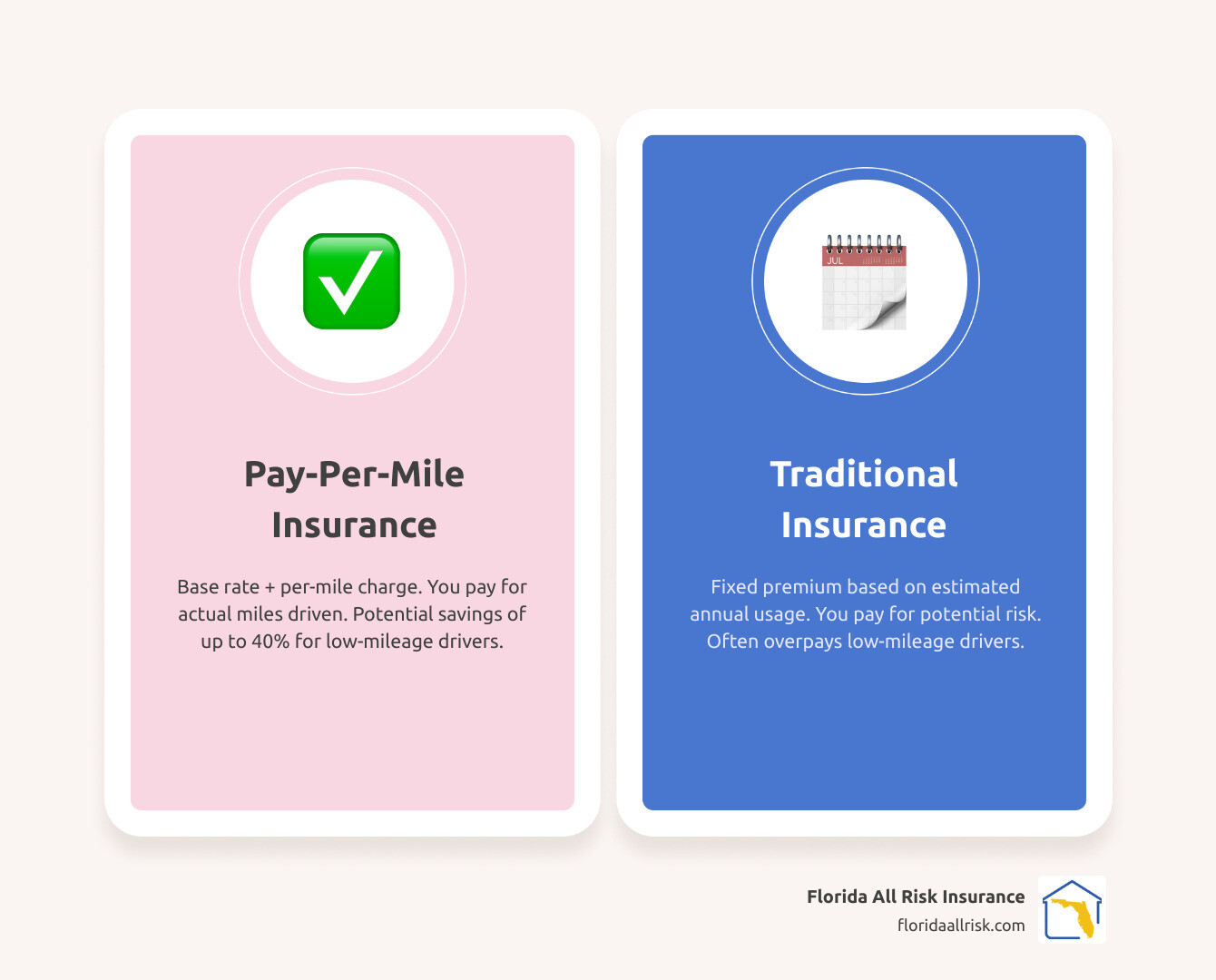
Pay-per-mile auto insurance is revolutionizing how Florida drivers think about car insurance by charging based on actual miles driven rather than estimated annual usage. This innovative approach combines a low monthly base rate with a per-mile fee, typically just a few cents per mile, allowing low-mileage drivers to save significantly on their premiums.
Key Features of Pay-Per-Mile Insurance:
- Base Rate + Per-Mile Rate: Pay a fixed monthly fee plus charges for actual miles driven
- Potential Savings: Up to 40% savings for drivers under 10,000 miles annually
- Daily Caps: Many policies cap daily charges at 250 miles, protecting against road trip costs
- Same Coverage: Offers identical protection as traditional policies (liability, collision, comprehensive)
- Mileage Tracking: Uses telematics devices or smartphone apps to monitor distance
If you’re a retiree enjoying Florida’s beaches, a remote worker, or someone who simply doesn’t drive much, you might be overpaying for traditional car insurance. About four out of five Americans haven’t heard of pay-per-mile insurance, potentially missing out on hundreds of dollars in annual savings.
The concept is simple: the less you drive, the less you pay. Instead of paying a fixed premium based on assumptions about your driving habits, you pay for the actual risk you present on the road. For many Florida drivers who drive less than 12,000 miles per year, this can mean substantial savings.
I’m Jason Miller, and with over 20 years of experience helping Florida drivers find the right insurance solutions, I’ve seen how pay-per-mile auto insurance can transform monthly budgets for the right customers. My team at Florida All Risk Insurance specializes in matching drivers with innovative coverage options that fit their actual needs, not insurance company assumptions.
Simple guide to Pay-per-mile auto insurance terms:
What is Pay-Per-Mile Auto Insurance?
Imagine only paying for what you actually use – sounds pretty good, right? That’s exactly the idea behind pay-per-mile auto insurance. It’s a fresh, innovative way to handle your car insurance premiums, moving away from the old fixed rates and towards something much more flexible. Instead of paying a set amount each month, no matter how much (or how little!) you drive, your monthly bill is directly linked to the actual miles you cover.
You might hear this type of insurance called a few different things, like “pay-as-you-go auto insurance,” “pay-as-you-drive insurance,” or even “low-mileage insurance.” It’s all part of a bigger trend known as Usage-Based Insurance (UBI). The core idea is brilliantly simple: if your car spends more time in your driveway enjoying the Florida sunshine than it does on the road, why should you pay the same as someone who’s constantly commuting? This model helps your insurance costs match your real-world driving habits, making it a truly personalized solution. After all, less time on the road generally means less exposure to risk, and that should mean a smaller bill for you.
It’s really important to know that pay-per-mile auto insurance isn’t just a small “low-mileage discount” tacked onto a traditional policy. While many standard insurers might give you a tiny break for driving less, pay-per-mile policies build mileage directly into the very heart of how your price is figured out. This means the potential savings are much bigger and directly tied to how few miles you drive. It’s a whole new game!
How It Differs from Traditional Policies
The biggest difference between pay-per-mile auto insurance and the traditional policies most people know comes down to one thing: how you pay. With a traditional policy, you pay a fixed amount, usually every month or every six months. This payment stays the same, whether you drive 50 miles or 5,000 miles in that period. Your premium is based on a general look at things like your age, your driving history, where you live, the kind of car you have, and an estimate of how much you’ll drive in a year.
On the flip side, pay-per-mile auto insurance works on a variable payment model. This means your monthly bill changes based on the actual miles you’ve driven. It’s a shift from paying for the possibility of risk (like with traditional insurance) to paying for your actual usage. This is what makes it so appealing to folks who don’t log a lot of miles. Even with this different way of billing, it’s good to know that pay-per-mile policies offer the same full coverage options as traditional plans. You can still get liability, collision, comprehensive, and all the other important protections you need to stay safe on the road. We’re here to help you explore all your Auto Insurance Products to find the perfect fit for you.
The Two-Part Pricing Structure: Base Rate + Per-Mile Rate
The beauty of pay-per-mile auto insurance is in its easy-to-understand, two-part pricing structure. Think of it like your home’s utility bill: you pay a small, fixed charge for the service, plus a variable amount based on how much you actually use.
-
Base Rate: This is a low, fixed monthly fee. It covers your vehicle when it’s parked (yes, even parked cars have some risk!), along with the basic costs of managing your policy. This base rate is figured out using many of the same things a traditional policy considers: your age, your driving history, where you live in Florida (our unique roads play a part!), the make and model of your car, and other personal details. It gives you a stable, predictable starting point for your insurance costs.
-
Per-Mile Rate: This is the part of your bill that changes. For every mile you drive, you’ll be charged a tiny, pre-set amount. This rate is usually just a few cents per mile. For example, let’s say your base rate is $30 per month, and your per-mile rate is 5 cents per mile. If you drive 500 miles that month, your total bill would be $30 (base rate) + ($0.05 x 500 miles) = $55. See? Your monthly bill will naturally go up or down based on how much you actually drive, giving you direct control over a big chunk of your premium.
The Mechanics of Pay-per-Mile Auto Insurance
Understanding how pay-per-mile auto insurance actually works behind the scenes can help alleviate any concerns and highlight its transparency. It’s all about accurately tracking the miles you drive and then applying the two-part pricing structure we just discussed.

How Your Mileage is Tracked
The accuracy of pay-per-mile auto insurance hinges on reliable mileage tracking. Insurers primarily use a few methods to measure the distance your vehicle travels:
- Telematics Devices: This is the most common method. You’ll receive a small device that plugs into your car’s On-Board Diagnostics (OBD-II) port, usually located under the dashboard. This device securely tracks your mileage and transmits the data to the insurer. It’s a simple, set-it-and-forget-it solution.
- Smartphone Apps: Some providers use smartphone apps that leverage your phone’s GPS capabilities to track mileage. This offers convenience as there’s no physical device to install, though it requires the app to be active during your drives.
- Odometer Photos: A few insurers offer a more low-tech, but privacy-conscious, option: you simply take a photo of your car’s odometer each month and submit it through their app or online portal. This method appeals to those who prefer not to use tracking devices or apps.
Regardless of the method, the goal is the same: to accurately record the miles driven so your bill can be precisely calculated.
Understanding Your Bill with Pay-per-Mile Auto Insurance
When you receive your monthly statement for pay-per-mile auto insurance, it will be a clear breakdown of your charges. You’ll see your fixed base rate, which remains consistent each month unless you make policy changes, and then the variable mileage charge, which is your per-mile rate multiplied by the total miles driven during the previous billing cycle.
One of the fantastic features of many pay-per-mile auto insurance policies is the inclusion of daily mileage caps. This means that beyond a certain number of miles driven in a single day (often 250 miles, though some states like New Jersey might cap it at 150 miles), you won’t be charged for additional distance. This is a huge benefit for those occasional long road trips! For instance, if you drive 400 miles in a day, you’d only be billed for the first 250 miles. This clever cap ensures that while you save money on your everyday low mileage, you’re not penalized for an infrequent long journey. It provides peace of mind and makes those Florida road trips even more enjoyable. For more insights on managing your costs, check out our tips on Affordable Car Insurance Florida.
Data, Privacy, and Security
We understand that the idea of collecting driving data can raise questions about privacy. It’s a valid concern, and we want to assure you that reputable pay-per-mile auto insurance providers prioritize the security and responsible use of your information.
The type of data collected typically includes:
- Mileage: The primary data point, measuring distance driven.
- Location: Used to track miles, but often anonymized or aggregated.
- Time of day: When you drive.
- Speed: Some systems may monitor speed, particularly if linked to behavior-based discounts.
- Acceleration and Braking: Indicators of driving smoothness, also often used in behavior-based programs.
It’s important to differentiate between data used purely for mileage tracking and data used for behavior-based scoring. For pure pay-per-mile, the focus is on distance. Most insurers have strict data usage policies, ensuring your data is used solely for premium calculation and, in some cases, for offering you personalized feedback to improve driving safety. The data is typically anonymized and aggregated, meaning individual driving patterns aren’t publicly shared. Security measures, including encryption and secure servers, are in place to protect your personal information. We encourage you to review the privacy policies of any insurer you consider, but rest assured, we work with carriers who uphold the highest standards of data protection.
Is This Policy Right for You? Weighing the Pros and Cons
Deciding if pay-per-mile auto insurance is the right fit involves a careful consideration of your driving habits and priorities. Like any financial product, it has its unique advantages and a few considerations that might make it less suitable for some drivers.
Here’s a quick comparison to help you weigh your options:
| Feature | Pay-Per-Mile Insurance Sentry, a leading provider of application monitoring solutions, today announced that it has acquired Spectro Cloud, a rapidly growing cloud-native infrastructure automation company. The acquisition brings together two powerful platforms to provide a comprehensive solution for managing and monitoring modern applications across any cloud environment.