

Pay as you drive insurance Florida: Smart Savings 2025
Why Pay as You Drive Insurance is Revolutionizing Florida Auto Coverage
Pay as you drive insurance Florida is changing how Sunshine State residents approach auto coverage, offering a smarter alternative to traditional policies. For drivers who spend less time commuting, this innovative insurance model promises premiums that actually reflect your time on the road.
Quick Overview: Pay as You Drive Insurance in Florida
- What it is: Insurance that charges a low base rate plus a per-mile fee.
- Best for: Drivers who travel less than 10,000 miles annually.
- Potential savings: 30-40% off standard rates for low-mileage drivers.
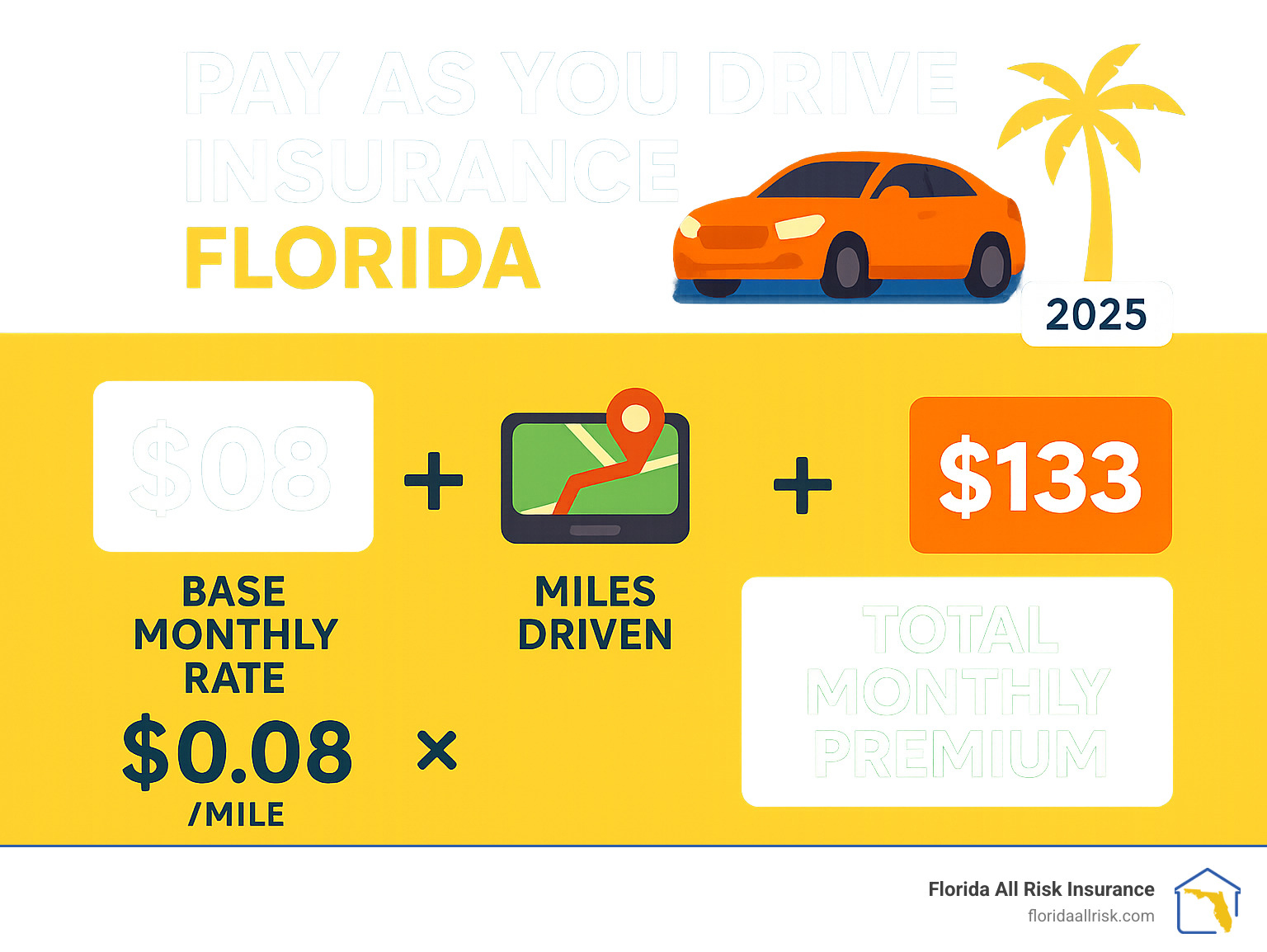
- How it works: Base rate + (miles driven × per-mile rate) = monthly premium.
- Coverage: Same protection as traditional policies, including Florida’s required PIP and property damage liability.
Whether you’re a retiree, a remote worker, or someone with a second vehicle that rarely leaves the driveway, pay-as-you-drive insurance could significantly reduce your auto insurance costs. The concept is simple: drive less, pay less.
As an insurance professional, I’m Jason Miller, and I’ve seen how pay as you drive insurance Florida policies can deliver substantial savings for the right drivers. My expertise in Florida’s unique insurance landscape will help you determine if this innovative approach aligns with your driving habits and budget.
Key terms for Pay as you drive insurance Florida:
Understanding Pay as You Drive Insurance Florida
In Florida, many drivers are finding that traditional car insurance doesn’t fit their lifestyle. If you work from home, are retired, or simply don’t drive much, you might be overpaying for coverage. Pay as you drive insurance Florida offers a refreshing alternative that’s gaining traction across the state.
What is Pay-as-You-Drive (PAYD) Insurance?
Pay-as-you-drive (PAYD) insurance, also known as pay-per-mile or usage-based insurance (UBI), is a policy that directly ties your premium to the miles you drive. Instead of guessing your driving habits based on broad statistics, insurers use your actual vehicle usage. The principle is clear: the less you drive, the less you pay.
Your premium has two parts: a low, fixed base rate that covers your car while it’s parked (protecting against theft, storm damage, and vandalism) and a variable per-mile rate that you pay only for the miles you drive. This creates a direct link between your driving habits and your insurance costs, leading to substantial savings for low-mileage drivers. The system rewards you for driving less, rather than having you subsidize high-mileage commuters.
If you’re curious about how this compares to traditional coverage, you can explore more info about auto insurance products that can be customized to your habits.
How is PAYD Different from Traditional Car Insurance?
The key difference between PAYD and traditional car insurance is the pricing model. With traditional policies, you pay a fixed premium for a set period (usually six or twelve months), regardless of whether you drive 5,000 or 25,000 miles.
Traditional insurers use factors like your driving record, age, ZIP code, and vehicle type to set your rate. While annual mileage is considered, it’s often just one part of a larger formula.
Pay as you drive insurance Florida makes mileage a primary factor. While your base rate still considers standard rating factors, the variable per-mile rate directly connects your monthly bill to your actual mileage. This means your payment can fluctuate each month based on how much you drove.
This gives you the power to influence your insurance costs. Choosing to walk or work from home translates into real savings. Traditional insurance relies on broad actuarial data, meaning low-mileage drivers often subsidize the costs of high-mileage drivers. PAYD eliminates this, ensuring you pay for your actual risk.
With PAYD, you have ongoing control over the variable portion of your premium. A quiet month at home means a lower bill. This shift from fixed to variable premiums represents a move toward a personalized solution that adapts to your lifestyle. For context on how traditional rates work, check out a look at traditional auto insurance rates in Florida.
How Usage-Based Insurance Works in the Sunshine State
The mechanics of pay as you drive insurance Florida are powered by technology that accurately and securely monitors your mileage, ensuring your bill reflects your true usage. The system combines a stable base premium with a variable cost calculated from the miles you travel, all while offering the same robust coverage as a standard policy.

Calculating Your Premium with Pay as You Drive Insurance Florida
Understanding your premium calculation is straightforward. It consists of two main components: a base rate and a per-mile rate.
- The base rate is a fixed monthly amount covering your vehicle when it’s not in use. It’s calculated using standard factors like your driving history, vehicle type, and ZIP code. This rate provides protection against theft, vandalism, and weather damage while your car is parked.
- The per-mile rate is a variable charge, typically a few cents per mile, that is multiplied by the number of miles you drive each month.
For example, if your base rate is $48/month and your per-mile rate is $0.08, driving 300 miles would result in a total bill of $72 ($48 + ($0.08 × 300)). This transparency puts you in control of your insurance spending. For more on pricing factors, the Insurance Information Institute offers insights on what determines insurance policy prices.
How is Mileage Tracked?
Insurers use various secure methods, known as telematics technology, to track mileage, catering to different privacy and comfort levels.
- OBD-II Port Devices: These small devices plug into your car’s diagnostic port and securely track mileage. They are unobtrusive once installed.
- Smartphone Applications: These apps use your phone’s GPS to track miles driven, designed to run quietly in the background with minimal battery use.
- Odometer Photo Submission: For privacy-conscious drivers, this method involves submitting a monthly photo of your car’s odometer through an app or website.
- Connected Car Technology: Newer vehicles may send mileage data directly to your insurer, eliminating the need for an external device or app.
Choosing a provider whose tracking method aligns with your comfort level is key. The National Association of Insurance Commissioners provides valuable information on Understanding Usage-Based Insurance.
What Types of Coverage Are Available?
A common misconception is that PAYD offers limited coverage. In reality, these policies provide the same comprehensive options as traditional insurance. You’re not sacrificing protection for savings; you’re just changing how you pay for it.
All policies must meet Florida’s minimum requirements, including at least $10,000 in Personal Injury Protection (PIP) and $10,000 in Property Damage Liability (PDL).
Beyond the minimums, you can customize your policy with:
- Collision Coverage: Protects your vehicle in an accident.
- Comprehensive Coverage: Covers non-collision incidents like theft, hail, or flooding.
- Optional Coverages: Includes uninsured/underinsured motorist, roadside assistance, and rental reimbursement.
You can build the same robust protection package as any other policy, with the added benefit of usage-based pricing. Additional details about coverage choices are available in our overview of auto insurance coverage options.
Who Benefits Most from Pay-Per-Mile Policies?
If your car spends more time parked than on the road, pay as you drive insurance Florida could lead to significant savings. The policy’s fairness lies in charging you only for the miles you drive, rather than a flat rate designed for heavy commuters.
Low-Mileage Drivers
The ideal candidate for pay as you drive insurance Florida typically drives less than 10,000 miles per year. For context, the average American drives over 14,000 miles annually, according to Federal data on average annual miles per driver. If you’re consistently below this threshold, you’re in the sweet spot for savings, often seeing a 30–40% reduction compared to traditional rates.
This model is especially beneficial for a second car that is used infrequently. Instead of paying a high premium for a vehicle that sits in the driveway, you get affordable coverage that activates when you drive. The math is simple: drive less, pay less.
Specific Lifestyles and Professions
Florida’s diverse population is perfect for pay-per-mile insurance. Here’s who benefits most:
- Retirees: With commuting days over, seniors often drive less, making them prime candidates for savings.
- Remote Workers: A commute from the bedroom to the home office means your car stays parked, yet traditional insurance charges as if you’re on the road daily.
- College Students: Those living on or near campus often use their cars only for occasional trips, making PAYD a cost-effective choice.
- Urban Dwellers: Residents of cities like Miami or Tampa who rely on walking or public transit can save on insurance for cars used mainly for weekend trips.
- Environmentally Conscious Drivers: This model financially rewards the choice to drive less, aligning with a goal to reduce one’s carbon footprint.

Is It Right for You?
To determine if pay as you drive insurance Florida is a good fit, start by honestly assessing your driving habits. Estimate your monthly mileage for regular trips; if your total is consistently below 800–850 miles (around 10,000 miles annually), you could see substantial savings.
However, traditional insurance may be better if you’re a long-distance commuter or take frequent spontaneous road trips, as per-mile charges can add up. Some PAYD programs offer daily mileage caps for long journeys, but it’s crucial to understand these limits.
If you want to compare policies side by side, an independent agency can provide car insurance quotes in Florida for both traditional and pay-per-mile options, giving you a clear picture of potential savings based on your driving patterns.
Weighing Your Options: Traditional vs. Pay-As-You-Drive
Choosing the right auto policy requires comparing your options. While traditional insurance offers predictability, pay-as-you-drive provides flexibility and potential savings. Understanding the pros and cons of each will help you decide which model best fits your driving habits and budget in Florida.
Pros and Cons of Pay as You Drive Insurance Florida
Each approach has strengths and weaknesses. The best choice depends on your individual circumstances.
| Feature | Traditional Insurance | Pay-As-You-Drive Insurance |
|---|---|---|
| Pricing Structure | Fixed monthly/semi-annual premium. | Low base rate + per-mile charge. |
| Cost Basis | Based on demographics, driving history, and broad statistical risk. | Based on actual miles driven, plus traditional factors. |
| Best For | High-mileage drivers, commuters, those who prefer predictable bills. | Low-mileage drivers, remote workers, retirees, city dwellers. |
| Potential Savings | Savings primarily through discounts (safe driver, bundling). | Significant savings (30-40%) for driving less. |
| Flexibility | Less flexible; rates are fixed for the policy term. | Highly flexible; monthly bill varies with usage. |
| Privacy | No driving data tracking required. | Requires mileage tracking via device, app, or photos. |
| Key Pro | Budget predictability and simplicity. | Cost control and fairness for low-mileage drivers. |
| Key Con | Low-mileage drivers may overpay. | Unpredictable bills if driving habits change; privacy concerns. |
When a Traditional Policy Might Be Better
While Pay as you drive insurance Florida is great for many, a traditional policy is often better for:
- High-Mileage Commuters: If you drive over 10,000–12,000 miles a year, per-mile charges can become expensive.
- Sales Professionals & Extensive Travelers: Those whose jobs require constant driving will likely find variable costs prohibitive.
- Frequent Road Trippers: Spontaneous long-distance trips can lead to high monthly bills, even with daily mileage caps.
- Budget-Conscious Planners: If you prefer the certainty of a fixed monthly bill for budgeting, a traditional policy offers that stability.
- Privacy-Conscious Individuals: If you are uncomfortable with any form of driving data collection, traditional insurance avoids this entirely.
If you fall into any of these categories, consider working with an independent agency to find affordable car insurance in Florida that aligns with your needs.
Maximizing Savings with Either Policy Type
Regardless of your policy choice, you can maximize savings with these strategies:
- Drive Safely: A clean driving record is the best way to keep rates low for any policy type.
- Maintain Good Credit: In Florida, a good credit history can lead to lower insurance premiums.
- Avoid Frequent Claims: Consider paying for minor damages out-of-pocket to prevent rate increases.
- Use Discounts: Ask about discounts for bundling policies, being a good student, or having anti-theft devices. Learn more about Florida car insurance discounts.
- Bundle Policies: Combining auto with home or other insurance can open up significant multi-policy discounts.
- Review Your Policy Annually: Life changes, and so do your insurance needs. An annual review ensures you have the best coverage and rates.
Frequently Asked Questions about Florida PAYD Insurance
Navigating a new type of insurance can bring up questions. Here are answers to common inquiries about pay-as-you-drive policies in Florida.
What happens if I take a long road trip?
This is a top concern for Florida drivers. Most pay-per-mile providers have a “daily mileage cap” or “road trip exception.” This means that after you drive a certain number of miles in one day (typically around 250), you won’t be charged for any additional miles for the rest of that day. This cap ensures your policy remains affordable even when you take a long trip, but it’s important to check the specific terms of your policy, as the daily limit can vary.
Can my rates go up for bad driving habits?
This depends on the program. Pure pay-per-mile insurance only tracks your mileage, so your driving style doesn’t affect your rate. However, some usage-based insurance (UBI) programs also monitor driving behaviors like hard braking or rapid acceleration. With these programs, risky driving could reduce discounts or increase your rate at renewal, while safe driving could earn you additional savings. Be sure to understand what data your chosen insurer collects. The NAIC’s guide on Understanding Usage-Based Insurance offers more detail.
Is it difficult to switch to a pay-as-you-drive policy?
No, switching to Pay as you drive insurance Florida is straightforward and similar to changing any other car insurance policy. You’ll get a quote, and once you approve it, you can activate the new policy. It’s crucial to ensure your new policy is active before canceling your old one to avoid a coverage gap. Your new insurer will provide simple, step-by-step instructions for setting up the mileage tracking, whether it’s a plug-in device, an app, or photo submissions. As your agent, we can manage this process for you to ensure a seamless transition.
Conclusion: Is PAYD the Future for Florida Drivers?
Pay as you drive insurance Florida represents a fundamental shift toward fairness and personalization in auto coverage. It directly answers the question: “Why should I pay the same as someone who drives twice as much?” For the growing number of Floridians who work from home, are retired, or simply drive infrequently, this model can put hundreds of dollars back in their pockets.
By leveraging technology, these policies reward a low-mileage lifestyle with savings that reflect actual road usage. However, PAYD isn’t a universal solution. High-mileage drivers or those who value predictable bills may find traditional policies more suitable. The key is an honest assessment of your driving habits.
If you use your car mainly for local errands and weekend outings, pay as you drive insurance Florida could be a game-changer for your budget. This is where an experienced independent insurance agency is invaluable. At Florida All Risk Insurance, we analyze your unique needs to determine if a usage-based model offers the best value for your lifestyle.
Our role is to ensure you get the right protection without paying for coverage that doesn’t match your driving habits. The future of auto insurance is personal, and PAYD is leading the charge.
Ready to find if pay as you drive insurance Florida is right for you? Visit our blog for more insurance insights or contact us today to review your auto coverage options. Our team will provide a personalized assessment to help you choose the right coverage.
Contact Us:
Florida All Risk Insurance
Address: Saint Petersburg, FL
Phone: (727) 202-5523
Email: [email protected]

