Non owner liability coverage: Your 1st Smart Shield
Understanding Non-Owner Liability Coverage: Your Safety Net on the Road
In today’s world, car ownership is no longer a necessity for everyone. With the rise of car-sharing platforms, convenient rental services, and the simple act of borrowing a car from a friend, more people are driving without having a vehicle registered in their name. This modern convenience, however, introduces a significant financial risk. What happens if you’re behind the wheel of someone else’s car and cause an accident? The vehicle owner’s insurance provides a primary layer of protection, but what if the damages exceed their policy limits? This is where non owner liability coverage becomes your essential financial shield. It is a specialized type of auto insurance designed specifically for drivers who don’t own a vehicle but frequently borrow, rent, or use car-sharing services. This policy acts as your personal financial safety net, protecting you from potentially devastating liability claims when you’re driving a car you don’t own.
Quick Answer: What Non-Owner Liability Coverage Includes
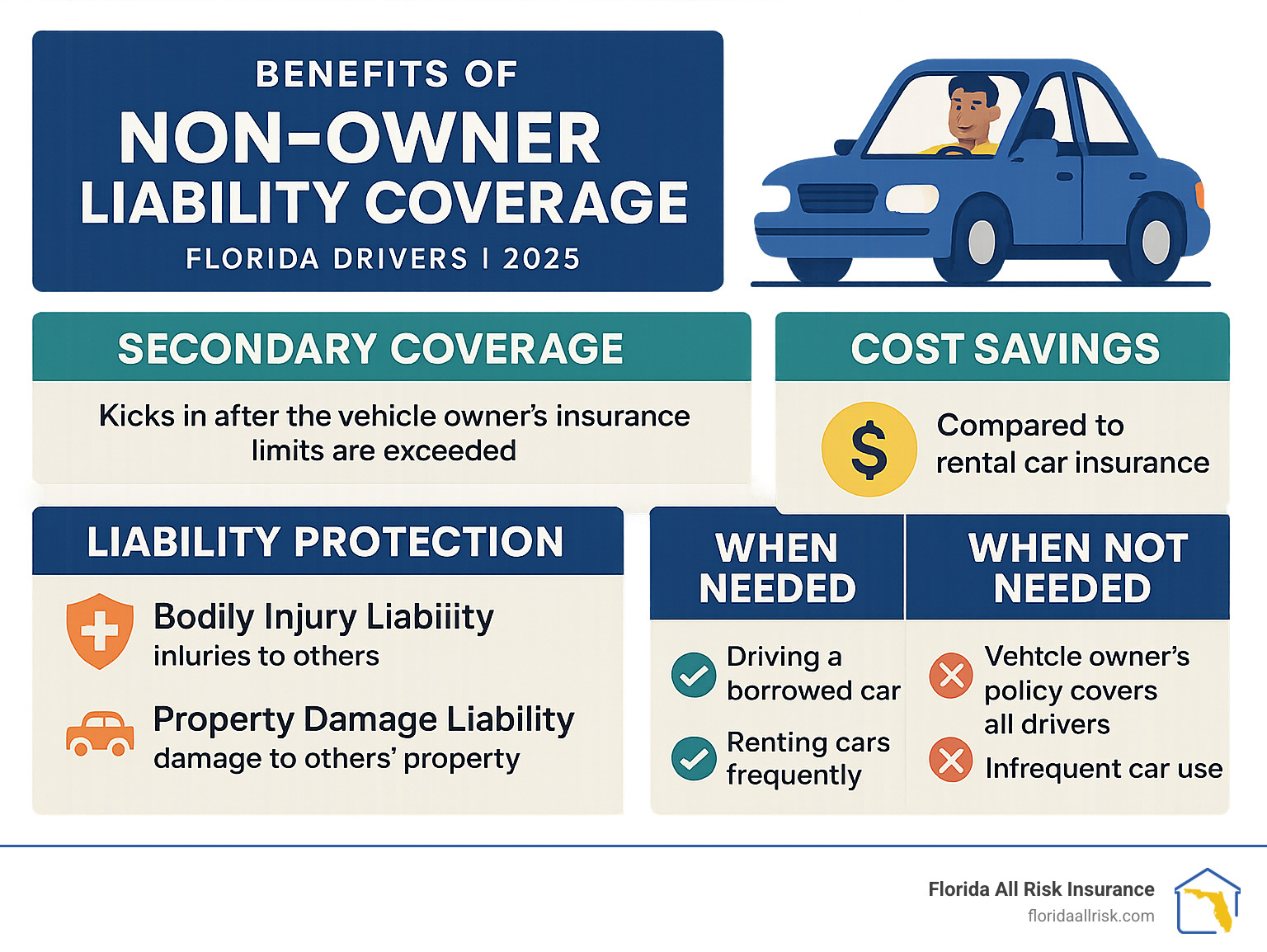
- Bodily Injury Liability: This is a cornerstone of the policy. It covers the medical expenses, lost wages, and even pain and suffering for other people injured in an accident where you are deemed at fault. This can include hospital bills, rehabilitation costs, and long-term care if necessary.
- Property Damage Liability: This component pays for the repair or replacement of other people’s property that you damage in an at-fault accident. This most commonly refers to the other driver’s vehicle, but it also covers damage to structures like fences, mailboxes, or buildings.
- Secondary Coverage: It’s crucial to understand that this policy acts as secondary insurance. It activates only after the vehicle owner’s primary insurance policy has paid out up to its limits. This supplementary role is what makes it so effective at protecting your personal assets from large claims.
- Legal Protection: If you are sued as a result of an accident you caused, your non-owner policy will cover the substantial costs of a legal defense, including attorney fees and court costs, regardless of the lawsuit’s outcome.
- Optional Add-ons: Many policies can be enhanced with valuable additions. This may include uninsured/underinsured motorist coverage (critical in a state like Florida with many uninsured drivers) and medical payments coverage to help with your own injuries.
Imagine this common scenario: you borrow a friend’s car for a weekend trip to Orlando and cause a multi-car accident on I-4. The total medical bills and property damage amount to $120,000. Your friend’s insurance policy has a liability limit of $50,000. Without non owner liability coverage, you would be personally sued for the remaining $70,000, putting your savings, assets, and future earnings at risk. As car-sharing and renting become increasingly integrated into our lives, this coverage is more vital than ever, especially navigating Florida’s notoriously busy and unpredictable traffic.
As Jason Miller, owner of Florida All Risk Insurance, I’ve spent over two decades in Florida’s complex insurance marketplace. I have repeatedly witnessed how this often-overlooked coverage can be a financial lifesaver. For the modern driver who doesn’t own a vehicle, this protection isn’t a luxury—it’s an essential component of responsible driving on our crowded roads.
What is Non-Owner Car Insurance? A Clear Definition
Think of non owner liability coverage as a portable shield of personal liability protection. Unlike traditional auto insurance that is tethered to a specific vehicle, this coverage follows you, the driver. It’s meticulously crafted for individuals who drive but do not own a car, offering profound peace of mind and financial security no matter whose vehicle they are operating. The core principle is simple yet powerful: it insures the driver’s actions, not the vehicle itself.
Let’s use an analogy. A standard auto policy is like home insurance—it covers a specific, named property (the car). A non-owner policy is more like a personal liability umbrella policy that you carry with you; it protects you from liability claims related to a specific activity (driving), regardless of where that activity takes place (i.e., in which borrowed or rented car). For instance, if you borrow your sister’s SUV for a trip to the hardware store and are found at fault in a collision, her auto insurance is the first line of defense. It will pay for the damages up to her policy’s limits. But what if the accident is severe, resulting in serious injuries and extensive property damage that far exceed her coverage limits? This is precisely when your non owner liability coverage springs into action. It covers the excess costs, shielding you from a financial catastrophe that could otherwise jeopardize your life’s savings and future financial stability. It provides robust liability protection for damages or injuries you cause to others while driving a borrowed, rented, or shared vehicle.
How Non-Owner Insurance Works
The single most important concept to grasp about non owner liability coverage is that it is secondary coverage. It does not, and is not intended to, replace the vehicle owner’s insurance; rather, it intelligently supplements it, creating a much-needed second layer of financial defense.
Here’s a step-by-step breakdown of how it functions in an at-fault accident:
- The Accident Occurs: You are driving a borrowed car and cause an accident.
- Primary Insurance Responds: The insurance policy on the vehicle you were driving is considered primary. The owner’s insurance company will handle the initial claim and pay for covered damages up to their established liability limits.
- Assessing the Shortfall: The total cost of the accident (medical bills for injured parties, property damage, legal fees) is calculated. If this total exceeds the limits of the primary policy, there is a coverage gap.
- Secondary Coverage Activates: Your non-owner policy, as the secondary coverage, then activates to pay for the remaining costs, up to the limits you selected for your own policy.
For a concrete example, imagine you borrow a car and cause an accident with $85,000 in total damages. The car owner’s policy has a bodily injury limit of $25,000 per person and a property damage limit of $25,000, for a total of $50,000 in this case. Their insurance pays that $50,000 first. Your non-owner policy, which you wisely purchased with higher limits, would then cover the remaining $35,000. This prevents the injured party from coming after you personally for that amount. This crucial interaction with the vehicle owner’s policy creates a vital safety net. A significant benefit is that most non-owner policies do not have a deductible for liability claims, so your coverage begins paying immediately once the primary insurance is exhausted, without any out-of-pocket cost to you at that stage. The claims process is professionally coordinated between the two insurance companies to ensure a seamless settlement and that all covered damages are paid.
Why It’s Different from Standard Auto Insurance
The fundamental difference lies in what is being insured. Standard auto insurance is a comprehensive package tied to a specific vehicle you own. It includes liability protection, but also crucial coverages for the vehicle itself, such as comprehensive (for theft, vandalism, weather damage) and collision (for damage to your car from an accident). In contrast, non owner liability coverage has a laser-sharp focused approach on liability only, because it’s attached to you, the driver, not a physical asset.
Since there is no physical vehicle attached to your policy, it logically does not cover any damage to the car you are driving. That responsibility always falls to the car owner’s insurance policy (specifically, their collision coverage). This streamlined focus on liability means there is a significantly lower risk profile for the insurance company. They aren’t worried about paying for expensive collision repairs, theft, or other physical damage claims for a vehicle. This reduced risk translates directly into a much more affordable premium for you compared to standard auto insurance. You get the essential liability protection you need to safeguard your assets, without paying for the extra coverages associated with car ownership.
Who Needs Non-Owner Coverage and When?

Many Florida drivers exist in a common yet risky insurance gray area: they drive regularly but don’t own a car. Non owner liability coverage is the perfect solution engineered to fill this specific gap, offering critical financial protection across a variety of modern driving situations.
Situations That Call for a Non-Owner Policy
This specialized coverage is an ideal, and often essential, tool for several types of drivers:
- Frequent Renters: If you often rent cars for business trips, vacations, or even just weekend getaways, a non-owner policy is a financial game-changer. The liability insurance sold at the rental counter is notoriously expensive, often costing $15-$30 per day. If you rent for just 20 days a year, you could spend over $400 on their limited coverage. A non-owner policy, which provides superior coverage for an entire year, is often available for a similar or even lower price, offering far greater value and peace of mind every time you rent.
- Car-Sharing Service Users: The convenience of services popular in cities like Miami, Tampa, and Orlando is undeniable. However, the insurance included with these services often provides only the bare minimum state-required liability coverage. In a serious accident, these low limits can be exhausted almost instantly, leaving you exposed. A non-owner policy adds a crucial layer of secondary protection, boosting your liability limits to a much safer level.
- Regular Borrowers: Do you frequently drive a friend’s, partner’s, or family member’s car? Relying solely on their insurance is a risky proposition for both of you. If you cause an accident, their policy will take the hit, which will likely cause their insurance rates to skyrocket for years. Even worse, if the damages exceed their limits, your relationship could be strained as you become personally liable for the difference. Having your own policy protects you financially and preserves your important personal relationships.
- Drivers Between Vehicles: If you’ve recently sold your car and plan to buy a new one in the coming months, a non-owner policy is a strategic move. It helps you maintain continuous insurance history. Insurance companies view any lapse in coverage, even a short one, as an indicator of higher risk. Maintaining coverage with an affordable non-owner policy can prevent this, potentially saving you hundreds of dollars in higher premiums when you do purchase your next vehicle.
- License Reinstatement: In Florida, certain driving violations can lead to a suspended license. To get it reinstated, the state may require you to file an SR-22 or FR-44 form, which proves you have active auto insurance. If you don’t own a vehicle, a non-owner policy is the state-approved method to satisfy this requirement and get you legally back on the road.
When You Probably Don’t Need It
While incredibly useful, non-owner coverage isn’t a one-size-fits-all solution. You likely don’t need it in these specific circumstances:
- You Own a Car: If you own a vehicle and have a standard auto insurance policy, your liability coverage typically extends to you when you occasionally drive other cars, such as a rental or a friend’s vehicle. Check your policy’s terms for “permissive use” to be sure.
- You’re on Someone Else’s Policy: If you live with a family member or partner and are officially listed as a “named driver” or “rated driver” on their auto policy, you are already covered by their liability insurance when you drive their car or even a rental. This is different from just having permission to drive the car occasionally.
- You Drive Infrequently: If you only borrow or rent a car once a year for a short trip, the cost of a year-round non-owner policy may not be justified. In this case, purchasing the rental company’s liability coverage for that short period might be more cost-effective.
- You Use a Company Car for Business: If you drive a vehicle provided by your employer strictly for business purposes, you should be covered under your employer’s commercial auto policy. A personal non-owner policy would not apply to this type of use.
How Your Non-Owner Liability Coverage Works
To truly leverage its benefits, it’s essential to understand precisely what non owner liability coverage includes—and just as importantly, what it excludes. This coverage is your personal financial shield, meticulously designed to protect you from the staggering costs associated with an at-fault accident in a car you don’t own.
What It Covers: Your Financial Shield
Your policy is structured to protect your assets and future earnings from the financial fallout of an accident. The core coverages are focused on third-party damages:
- Bodily Injury Liability: This pays for the costs related to injuries or death that you cause to other people in an accident. It’s typically broken down into two limits: a per-person limit (the maximum amount paid for one person’s injuries) and a per-accident limit (the total maximum paid for all injuries in a single accident). This covers everything from ambulance rides and emergency room care to ongoing physical therapy and compensation for lost income.
- Property Damage Liability: This covers the cost to repair or replace property you damage. While this most often means the other driver’s vehicle, it also applies to other structures you might hit, such as a guardrail, a storefront, a fence, or a telephone pole. Given the high cost of modern vehicles with advanced safety features, having a robust property damage limit is critical.
- Uninsured/Underinsured Motorist (UM/UIM) Coverage: Often available as an essential add-on, this coverage protects you. UM/UIM steps in if you are injured in an accident caused by a driver who has no insurance (uninsured) or not enough insurance to cover your medical bills (underinsured). In Florida, where a significant percentage of drivers are on the road illegally without insurance, this is an incredibly valuable protection for your own health and finances.
- Medical Payments (MedPay) or Personal Injury Protection (PIP): In Florida, PIP is a required coverage. When added to a non-owner policy, it helps cover your own medical expenses and lost wages after an accident, up to your policy limit, regardless of who was at fault. This is part of Florida’s “no-fault” system and ensures you can get immediate medical care without waiting for a fault determination.
- Legal Defense: This is an often-underestimated benefit. If you are sued following an accident, your policy covers the hiring of an attorney and all associated court costs and legal fees. These expenses can quickly run into the tens of thousands of dollars, even if the lawsuit against you is ultimately dismissed as frivolous. This coverage protects you from the financial burden of simply defending yourself.
What It Doesn’t Cover: Understanding the Limitations of Non-Owner Liability Coverage
Knowing the boundaries of your policy is key to avoiding unexpected gaps in coverage:
- Damage to the Car You’re Driving: This is the most critical exclusion. Your non-owner policy will not pay for collision damage to the borrowed or rented vehicle. The responsibility for repairing the car you were driving falls to the vehicle owner’s insurance policy (if they have collision coverage) or the Collision Damage Waiver (CDW) if you purchased it from a rental agency.
- Theft or Other Damage: It does not include comprehensive coverage. This means it provides no protection if the car you’re borrowing is stolen, vandalized, catches fire, or is damaged by a weather event like a hailstorm or flood.
- Your Personal Belongings: If your personal items inside the car—such as a laptop, smartphone, or luggage—are damaged or stolen, a non-owner auto policy will not cover them. This type of loss is typically covered by a separate homeowners or renters insurance policy.
- Business Use: A personal non-owner policy is strictly for personal use. It excludes coverage for any driving related to work, such as making deliveries, driving for a rideshare service, or visiting clients. Commercial driving activities require a commercial auto policy.
- Household Vehicles: The policy will not provide coverage for any vehicles owned by or regularly available to someone you live with. Insurers include this exclusion to prevent individuals from using a cheaper non-owner policy as a substitute for being properly listed as a driver on the household’s standard auto policy.
The Claims Process: Primary vs. Secondary Coverage
Navigating the claims process is straightforward once you understand one key concept: primary versus secondary coverage.
When you have an accident in someone else’s car, the vehicle owner’s insurance is always primary. Their policy is the first to respond and is responsible for paying for all covered damages up to the liability limits they selected.
Your non owner liability coverage functions as secondary coverage. It is a supplemental policy that only activates if the total costs of the accident exceed the limits of the primary (owner’s) policy. Let’s walk through a more severe scenario: You cause a major highway accident in a borrowed car. The damages are extensive: two people are seriously injured, and their medical bills total $120,000. The car you hit is totaled, valued at $30,000. The total liability is $150,000. The car owner’s policy has liability limits of $50,000 per person and $100,000 per accident for bodily injury, and $50,000 for property damage. Their policy pays out its maximum of $100,000 for the injuries and $30,000 for the property damage. This leaves a shortfall of $20,000 for the remaining medical bills. This is where your non-owner policy, with its own high limits, steps in to cover that remaining $20,000. Without it, you would be personally responsible for that amount, potentially facing wage garnishment or asset seizure. This layered approach provides robust, comprehensive protection and perfectly highlights the immense value of having adequate liability limits on both policies.
Comparing Policies: Non-Owner vs. Standard vs. HNOA
Choosing the right insurance policy is like selecting the right tool for a specific job. Using the wrong one can leave you unprotected. A standard auto policy is the comprehensive tool for car owners, while non owner liability coverage is the specialized instrument for drivers who aren’t. To make an informed decision, let’s compare them and also introduce a related but distinct policy for businesses.
| Feature | Non-Owner Insurance | Standard Auto Insurance |
|---|---|---|
| Who/What is Covered | The driver (you) | The vehicle (and authorized drivers) |
| Primary Focus | Liability protection only (bodily injury/property) | Liability, Comprehensive, Collision, & more |
| Covers Damage to Driven Car? | No | Yes (with Collision coverage) |
| Cost | Generally much cheaper | Generally more expensive |
| Maintains Continuous History? | Yes | Yes |
| SR-22/FR-44 Filing? | Yes, ideal for non-owners | Yes, for car owners |
| Ideal User | Non-car owners, frequent renters/borrowers | Car owners, primary drivers of a specific vehicle |
As the table illustrates, standard auto insurance is built for the risks of car ownership. It bundles liability with physical damage coverages (Comprehensive and Collision) to protect the vehicle itself, which is a significant financial asset. Non owner liability coverage is a streamlined, unbundled product. It strips away the coverages related to a physical car and focuses purely on liability—protecting your assets if you cause an accident in someone else’s car. This singular focus is the primary reason it costs significantly less. The underwriting process is simpler because the insurer doesn’t have to calculate the risk of damage or theft for a specific, and often expensive, vehicle.
For Businesses: An Introduction to Hired and Non-Owned Auto (HNOA) Insurance
Now, let’s shift from personal to commercial risk. What happens when your employees use their personal cars for work errands, like visiting a client, making a bank deposit, or picking up supplies? This common practice creates a serious liability gap for your business. If that employee causes an accident while on the clock, your company can be held liable. This is the risk that Hired and Non-Owned Auto (HNOA) insurance is designed to cover.
HNOA is a commercial liability policy that protects your business in two specific scenarios: when employees use their own vehicles for company purposes (non-owned), or when you rent vehicles for business use (hired). For instance, if an employee using their personal car for a work-related errand causes a major accident, the damages could easily exceed their personal auto policy limits. The injured party’s attorney will almost certainly name your business in the resulting lawsuit, seeking to recover the remainder from the company’s deeper pockets. HNOA coverage protects your company’s assets in this exact scenario. According to the National Safety Council, vehicle crashes are a leading cause of work-related fatalities and injuries, making HNOA coverage an essential part of any business’s risk management strategy.
Key Differences Between Personal Non-Owner and Business HNOA
While their names sound similar, these policies serve fundamentally different needs and protect different entities:
- Policyholder: Personal non-owner insurance is purchased by an individual to protect their personal assets. HNOA is purchased by a business to protect the company’s assets.
- Purpose: Personal non-owner covers personal driving activities like errands, vacations, and borrowing a car from a friend. HNOA covers commercial activities performed by employees, such as sales calls, client visits, and deliveries.
- Liability Covered: A personal policy protects the individual driver from being sued. An HNOA policy protects the business from vicarious liability (the legal doctrine of respondeat superior), where an employer is responsible for the actions of its employees during their employment.
- Integration: Personal non-owner is typically a standalone policy. HNOA is almost always added as an endorsement to a company’s Commercial General Liability (CGL) policy or a Business Auto Policy (BAP).
- Risk Management: For an individual, a non-owner policy is about personal financial safety. For a business, HNOA is a critical component of a comprehensive corporate risk management program, safeguarding company assets from potentially bankrupting liability claims arising from employee driving.
Navigating Non-Owner Insurance in Florida
Florida’s driving landscape presents a unique combination of challenges, from some of the nation’s most congested highways to unpredictable severe weather and a high volume of tourists unfamiliar with local roads. For drivers in Saint Petersburg and across the state, non owner liability coverage is not just a convenience but a highly intelligent strategy to stay protected on the road without the expense of owning a vehicle.
The Cost of Non-Owner Liability Coverage in the Sunshine State
While national averages for non-owner insurance can be quite low, the cost in Florida is influenced by the state’s higher-risk environment. Florida drivers can typically expect to pay between $400 and $700 annually, with an average around $545 per year for non owner liability coverage. This reflects the state’s higher-than-average accident rates, significant insurance fraud, and costly litigation environment. Your specific premium will be a personalized calculation based on several key factors:
- Your Driving Record: A clean record free of accidents and violations is the number one way to secure lower rates.
- Coverage Limits: Choosing higher liability limits (e.g., $100,000/$300,000/$50,000 vs. the state minimum) will cost more but offers vastly superior protection for your assets.
- Age and Location: Younger, less experienced drivers will pay more. Likewise, premiums in dense urban areas like Miami-Dade or Broward County will be higher than in more rural parts of the state due to increased traffic and accident frequency.
- Credit History: Insurers in Florida may use an insurance-based credit score to help determine rates, as studies show a correlation between credit management and driving risk.
One of the most significant long-term financial benefits is that maintaining continuous coverage with a non-owner policy prevents a lapse in your insurance history. When you eventually purchase a standard auto policy, insurers will see this uninterrupted record and reward you with loyalty discounts and lower base premiums, potentially saving you a substantial amount of money.
Special Cases in Florida: SR-22 and FR-44 Filings
Florida’s Department of Highway Safety and Motor Vehicles (FLHSMV) requires some drivers to prove they have sufficient insurance to reinstate a suspended license. A non-owner policy is an affordable and effective way to meet these legal requirements if you don’t own a car.
- SR-22 Filings: An SR-22 is a certificate of financial responsibility, typically required for violations like accumulating too many points on your license, driving without insurance, or at-fault accidents. A non-owner SR-22 policy proves you carry Florida’s minimum required liability coverage (currently 10/20/10: $10,000 for bodily injury per person, $20,000 per accident, and $10,000 for property damage) and allows for license reinstatement.
- FR-44 Filings: An FR-44 is required for more severe violations, most commonly a DUI conviction. It is similar to an SR-22 but mandates significantly higher liability limits. To satisfy an FR-44 requirement, a non-owner policy must carry limits of at least 100/300/50 ($100,000 for bodily injury per person, $300,000 per accident, and $50,000 for property damage). A non-owner policy can be structured to meet these strict requirements, making it a crucial tool for those seeking to legally reinstate their driving privileges after a serious offense.
How to Get a Non-Owner Policy in Florida
Securing non owner liability coverage is a straightforward process, especially when working with an expert. As an independent insurance agency, we simplify the entire experience. Instead of you having to call dozens of different companies, we do the heavy lifting by shopping your policy across multiple top-rated carriers to find the optimal blend of coverage and price for your specific needs and budget. To get a quote, you’ll simply need to provide basic information like your name, address, date of birth, and driver’s license number. Our team takes the guesswork out of comparing complex quotes and confusing insurance jargon. We work for you, not the insurance company, to find competitive pricing and ensure you get the right balance of protection and affordability for Florida’s unique roads.
Key Takeaways and Your Next Steps
In a world of evolving transportation habits, non owner liability coverage stands out as a smart, modern, and affordable insurance solution. It provides essential liability protection for individuals who drive but don’t own a car, filling a critical and often overlooked gap in the vehicle owner’s primary policy. Whether you frequently rent, borrow vehicles from friends, or need to file an SR-22 to reinstate your license, this policy offers peace of mind and robust financial security. For businesses, the related HNOA coverage serves a similarly vital role in protecting company assets from employee-related driving risks.
Here’s a quick summary of what you need to know:
- It’s For You, The Driver: This policy follows you and protects your assets, not the car you’re driving.
- It’s Secondary Coverage: It works in tandem with the car owner’s insurance, kicking in after their limits are met.
- It’s Affordable: By focusing only on liability, it’s significantly cheaper than standard auto insurance.
- It’s Essential for Many: Ideal for frequent renters, car-sharers, regular borrowers, and those needing SR-22/FR-44 filings.
- It Has Limitations: It does not cover damage to the car you’re driving or your personal belongings.
At Florida All Risk Insurance, we specialize in navigating the unique insurance landscape of Florida to find the right policy for your unique situation. Don’t leave your financial future to chance the next time you get behind the wheel of a car you don’t own.
Ready to drive with confidence? Get the protection you need today. Request your personalized non-owner car insurance quote and discover just how affordable true peace of mind can be.
Have more questions? Our expert team is here to provide clear, straightforward answers. Contact us to discuss your non-owner liability coverage options and ensure you’re fully and properly protected on the road.
Contact Us
Getting the right non owner liability coverage doesn’t have to be a complicated or frustrating experience. As a premier independent agency based in St. Petersburg, Florida All Risk Insurance is dedicated to helping drivers across the entire state find perfect, personalized insurance solutions. Our independence is your advantage; we aren’t tied to a single provider. We shop multiple A-rated carriers to find you the best possible combination of comprehensive coverage and competitive pricing.
We believe in building relationships based on trust and clear communication. When you contact us, you’ll get honest, professional advice tailored to your specific circumstances. Let us help you secure your financial future on the road.
Florida All Risk Insurance
Address: 1234 Central Avenue, Saint Petersburg, FL 33701
Phone: (727) 894-3100
Email: [email protected]
You can reach out by phone for immediate assistance and a free consultation, or email us with your questions at your convenience. We’re always happy to discuss your non owner liability coverage options in detail and provide a no-obligation quote.