

Why Non-Owner Car Insurance Florida Is Essential for Modern Drivers
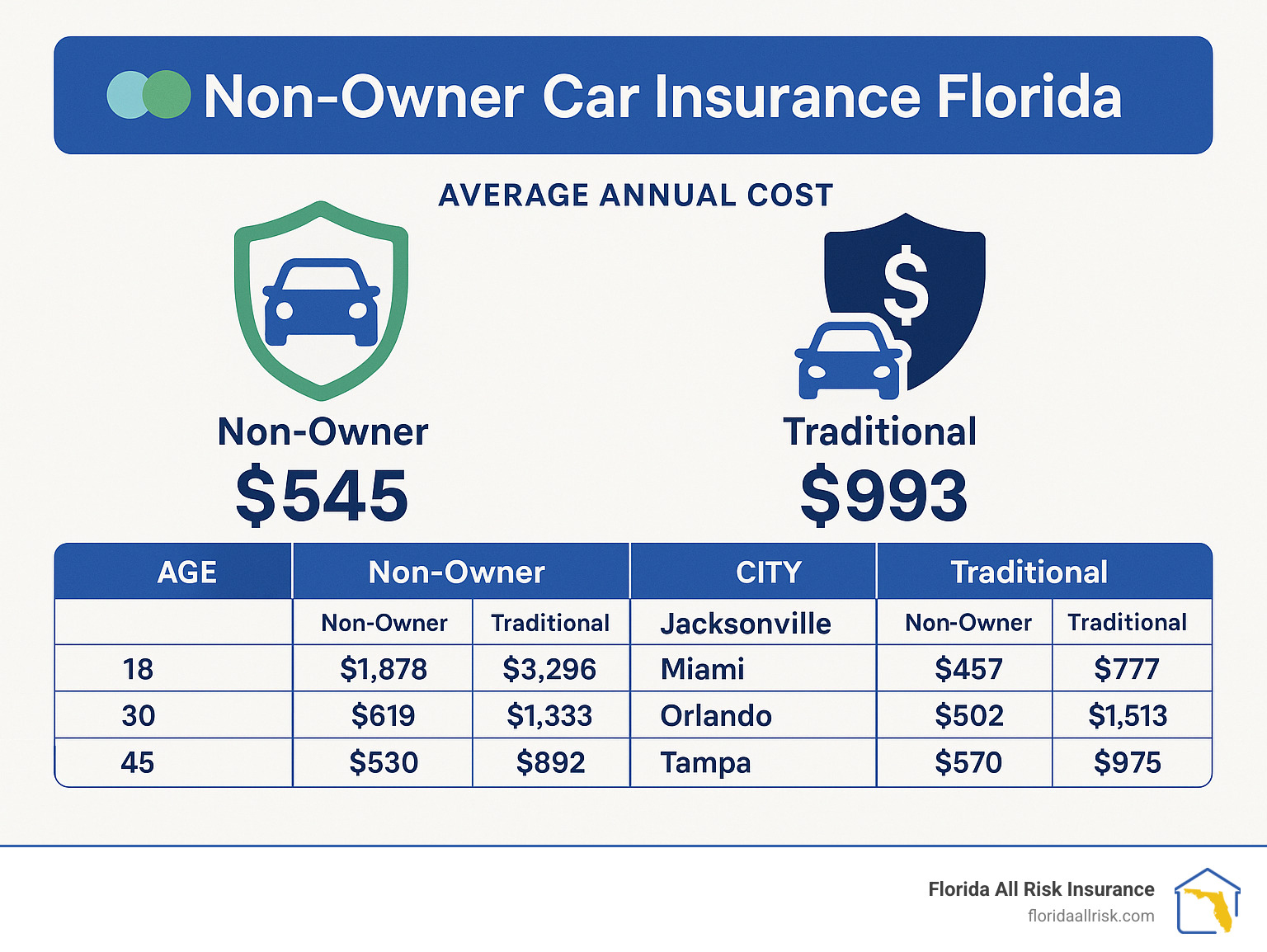
Non-owner car insurance Florida provides liability coverage for drivers who don’t own a vehicle but regularly drive borrowed or rental cars. This specialized policy costs an average of $545 annually in Florida – about 45% less than traditional auto insurance.
Quick Answer for Florida Drivers:
– Who needs it: Frequent car borrowers, rental users, drivers between vehicles, SR-22/FR-44 filers
– What it covers: Liability for injuries and property damage you cause (minimum $10,000/$20,000/$10,000)
– What it excludes: Damage to the car you’re driving, comprehensive, collision
– Average cost: $545/year (varies by age, location, driving record)
– Where to buy: Most major insurers offer it – call an agent directly
Picture this: You borrow your friend’s car for a weekend trip to the Keys. On the way back, you rear-end another vehicle at a red light. Without proper coverage, you could face thousands in medical bills and property damage costs. Non-owner insurance protects you in exactly these situations.
Florida law requires all drivers to carry minimum liability coverage, even when driving someone else’s car. While the owner’s policy provides primary coverage, it might not be enough – or you might not be covered at all if you’re not listed on their policy.
I’m Jason Miller, and I’ve helped Florida drivers steer complex insurance situations for over 20 years. Non-owner car insurance Florida has become increasingly important as more people choose ridesharing, car-sharing, and urban living without vehicle ownership.

Non-owner car insurance Florida definitions:
– Temporary car insurance Florida
– Florida car insurance discounts
– Florida classic car insurance
What Exactly Is Non-Owner Car Insurance?
Non-owner car insurance Florida is liability-only coverage that travels with you whether you’re behind the wheel of your friend’s SUV, a weekend rental, or a car-sharing vehicle. Unlike traditional auto insurance tied to a specific vehicle, this coverage follows you wherever you drive.
Your non-owner policy acts as secondary coverage. The vehicle owner’s insurance takes the first hit, but your policy provides crucial gap protection when their coverage falls short. Think of it like a safety net beneath another safety net – you’re covered even if the owner’s liability limits are too low or their policy doesn’t extend to permissive users like you.
Florida’s minimum requirements apply to non-owner policies: $10,000 bodily injury liability per person, $20,000 per accident, and $10,000 property damage liability – those famous 10/20/10 limits. Plus, Florida mandates $10,000 in Personal Injury Protection (PIP) coverage because the state wants every driver protected, regardless of who owns the car.
One of the smartest benefits is maintaining continuous coverage. Insurance companies treat coverage gaps like red flags, often hiking your rates when you eventually buy a standard policy. Your non-owner policy keeps your insurance history clean, potentially saving you hundreds down the road.
Consider adding uninsured motorist coverage to your non-owner policy – it’s optional but wise. With Florida’s high rates of uninsured drivers, this add-on protects you when someone without adequate coverage causes an accident.
Key Features & Exclusions
Your non-owner policy covers bodily injury and property damage liability – the financial chaos you might cause to others. Rear-end someone while borrowing a car? Your policy handles their medical bills, lost wages, and vehicle repairs up to your chosen limits.
But here’s the reality: no comprehensive or collision coverage means damage to the vehicle you’re driving comes out of someone else’s pocket (likely the owner’s insurance or your own wallet). Total your buddy’s car? Don’t expect your non-owner policy to write that replacement check.
Vehicle theft protection is also off the table. Medical payments coverage is optional on non-owner policies, so consider adding it if you want protection for your own injuries after an accident.
Rental car interaction gets tricky. Some non-owner policies work with rental cars, others don’t. Always double-check before waving off that collision damage waiver at the rental counter.
Car-sharing services like Zipcar and Turo typically provide their own insurance, but gaps can appear. Review both your non-owner policy and the car-sharing company’s coverage to avoid surprises.
Here’s a big exclusion: business use is typically forbidden. Using a borrowed car for food delivery, client meetings, or work errands? Your non-owner policy likely won’t cover you.
How Non-Owner Coverage Works & Who Should Buy It
Non-owner car insurance Florida works like a safety net that follows you wherever you drive. When you get behind the wheel of someone else’s car, your coverage kicks in as secondary protection – working alongside the vehicle owner’s insurance.
Frequent car borrowers find it invaluable because it protects them beyond what the owner’s policy might offer. Rental car enthusiasts often find that a non-owner policy saves them serious money. If you rent cars more than a few times per year, you’re probably spending $15-30 per day on the rental company’s collision damage waiver. A $545 annual non-owner policy quickly pays for itself.
Car-sharing members who use Zipcar, Turo, or similar services should consider non-owner coverage. While these companies provide insurance, their policies often come with high deductibles and coverage gaps.
Drivers between cars benefit significantly. Maybe you’re waiting for your new vehicle to arrive or going through a temporary situation where you can’t afford a vehicle. Non-owner insurance keeps your coverage history intact, which matters more than you might think. Insurance companies view coverage gaps as red flags and often charge higher premiums to drivers who’ve been uninsured.
High-risk drivers needing SR-22 or FR-44 filings find non-owner policies particularly helpful. Court-ordered insurance requirements can be satisfied without owning a vehicle, creating a path to license reinstatement.
Students and military personnel represent another group that benefits significantly. College students who only drive family cars during breaks, or military members stationed where they don’t need personal vehicles, can maintain insurance protection with a non-owner policy.
One important rule: household resident restrictions. If you live with someone who owns a car, insurance companies typically require you to be listed on their policy rather than buying separate non-owner coverage.
For more information about protecting yourself from uninsured drivers, check out our guide on Uninsured Motorist Coverage Florida.
Non-Owner Car Insurance Florida vs. Being Added to an Owner’s Policy
When you’re added as a driver to an owner’s policy, you get straightforward coverage under their liability limits. This works well for household members or people who regularly drive the same vehicle.
But permissive use under someone else’s policy gets tricky. Many policies restrict coverage for non-household members or exclude drivers with certain violations. If you’re not specifically listed and have an accident, the insurance company might deny your claim.
Premium impact protection is a huge advantage of non-owner coverage. Adding a high-risk driver to a standard policy can spike premiums by hundreds of dollars annually. With non-owner coverage, your driving record doesn’t affect the owner’s rates.
Policy portability gives non-owner coverage another edge. Your protection follows you regardless of whose car you drive, while being listed on someone else’s policy only covers you in their specific vehicle.
Non-Owner Car Insurance Florida and SR-22 / FR-44 Compliance
High-risk drivers in Florida often face SR-22 or FR-44 filing requirements after serious violations like DUI or driving without insurance. These aren’t insurance policies themselves but certificates proving you maintain minimum coverage.
An SR-22 requires standard state minimum liability coverage ($10,000/$20,000/$10,000), while an FR-44 demands much higher limits: $100,000 per person, $300,000 per accident for bodily injury, and $50,000 for property damage. Non-owner policies can satisfy both requirements.
License reinstatement through non-owner insurance typically costs less than purchasing a standard policy just to meet filing requirements. Filing fees add $25-50 for the initial SR-22 or FR-44 filing.
The mandatory higher limits for FR-44 filings significantly increase premiums. While a standard non-owner policy might cost $545 annually, an FR-44 non-owner policy could run $1,000-1,500 per year.
For more information about uninsured motorist statistics and risks, see this scientific research on uninsured motorists.
Dollars & Sense: Costs, Discounts, and Coverage Levels
Non-owner car insurance Florida costs significantly less than traditional auto coverage. Florida drivers pay an average of $545 annually for non-owner policies – roughly 45% cheaper than standard auto insurance with the same liability limits.
Your age plays a huge role in what you’ll pay. Teen drivers often pay $1,800-1,900 annually for non-owner coverage, while drivers in their 40s typically see premiums around $530 per year. Those over 55 often qualify for mature driver discounts.
Where you live in Florida creates dramatic rate swings. Miami drivers deal with some of the highest premiums due to heavy traffic and frequent accidents. Rural Florida offers much gentler rates, while cities like Tampa and Orlando fall somewhere in the middle.
Your credit score significantly impacts your insurance costs. Florida allows insurers to use credit-based insurance scores when setting rates, so maintaining good credit can save you serious money. Poor credit might increase your premiums by 50% or more.
Your driving record remains the biggest factor in determining costs. A clean record qualifies you for the lowest rates, while violations like speeding tickets, accidents, or DUI convictions can double or triple your premiums.
Smart shoppers can find several ways to reduce their premiums. Bundling your non-owner policy with renters or homeowners insurance often triggers multi-policy discounts. Pay-in-full discounts can save 5-10% annually, while autopay discounts reward customers who set up automatic payments.
For more money-saving strategies, explore our Cheap Auto Insurance Quotes Florida guide.
Saving Strategies & Common Pitfalls
Multi-policy bundling represents your easiest win. Even if you don’t own a home, renters insurance costs just $100-200 annually and often triggers auto insurance discounts that exceed the renters policy cost.
Be honest about your mileage when applying for coverage. Non-owner policies typically ask about driving frequency. Accurately reporting low mileage can qualify you for usage-based discounts.
The rental car waiver overlap confuses many drivers. If you have non-owner insurance, you might not need the rental company’s expensive collision damage waiver – but always verify your coverage first. A quick call to your agent can save you $20-30 per rental day.
Beware the one-day insurance myth. Some companies advertise temporary coverage for single days, but legitimate insurance requires minimum policy periods in Florida.
The continuous coverage strategy can save you significant money long-term. Maintaining a non-owner policy between vehicle ownership periods preserves your insurance history and prevents coverage gap penalties. These penalties can increase future premiums by 20-50%.
Our discount eligibility checklist includes: good student discounts for drivers under 25 with strong grades, mature driver discounts for those over 55, defensive driving course completion certificates, and loyalty discounts for long-term customers.
How to Get and Use Non-Owner Car Insurance in Florida
Getting non-owner car insurance Florida coverage requires speaking directly with an agent for these specialized policies. The process typically takes just 15-30 minutes from start to finish, and you can often get coverage that starts the same day.
Eligibility requirements are simple. You need a valid driver’s license and you must not own a vehicle. Some insurers also check that you don’t have regular access to a household vehicle.
Before calling for quotes, gather your required information: driver’s license number, Social Security number, your driving history for the past 3-5 years, your desired coverage limits, and a payment method.
You can get same-day proof of insurance with most companies. Once you pay your premium, you’ll receive digital insurance cards via email, usually within hours. Digital ID cards are completely legal in Florida, so you don’t need to wait for physical cards in the mail.
When you need to file a claim, the claims process works similarly to standard auto insurance, with one key difference. Your non-owner coverage is secondary to the vehicle owner’s insurance, so both companies may be involved in resolving your claim.
Switching back to an owner policy becomes easy when you eventually purchase a vehicle. Your non-owner policy can typically be converted to a standard policy with the same insurer, preserving your coverage history.
For more detailed information about liability coverage requirements, check out our Liability Car Insurance Florida guide.
City-by-City Snapshot: What You Might Pay
Where you live in Florida dramatically affects your non-owner car insurance Florida premiums, sometimes by hundreds of dollars annually.
Miami represents the expensive end of Florida’s insurance market, with non-owner policies averaging $650-700 annually. The city’s traffic congestion, high accident rates, and expensive litigation environment create perfect storm conditions for lifted insurance costs.
Tampa offers middle-ground pricing, with most drivers paying $500-600 per year for non-owner coverage. St. Petersburg provides excellent value for non-owner insurance, with policies often available for $450-550 annually. Lower crime rates and less congested streets contribute to more favorable pricing.
Rural areas throughout Florida offer the lowest non-owner insurance rates, sometimes 20-30% below urban pricing. Counties like Levy, Dixie, and Glades see the most competitive rates due to fewer accidents, lower crime, and reduced litigation costs.

Rental Cars, Car-Sharing & Ride-Hailing
The intersection of non-owner car insurance Florida and rental cars creates confusing coverage scenarios. Your non-owner policy might provide liability coverage when driving rental cars, but physical damage to the rental vehicle typically isn’t covered.
This gap makes collision damage waiver (CDW) decisions more complex. The rental company’s CDW fills the physical damage gap but costs $15-30 per day. For frequent renters, this expense can quickly exceed your annual non-owner premium.
Credit card coverage adds another layer of complexity. Premium credit cards often provide rental car insurance, but coverage details vary dramatically between cards. Some only cover damage to the rental vehicle, while others include liability protection.
Car-sharing services like Turo and Zipcar operate under their own insurance rules. These companies provide coverage, but with varying deductibles and protection levels. However, coverage gaps can still exist, especially for liability protection that exceeds their policy limits.
Business use creates significant caveats when renting cars for work purposes. Most non-owner policies exclude business use entirely, and rental company insurance often has similar exclusions.
The key to navigating these scenarios successfully is understanding exactly what each insurance source covers and where gaps might exist.
Frequently Asked Questions about Non-Owner Policies (3 fast answers!)
Do I need a policy if I only drive a friend’s car once a month?
It depends on your comfort level with risk and your financial situation. When you drive your friend’s car occasionally, their insurance policy might cover you through permissive use – their policy extends to people they give permission to drive their car.
But that coverage isn’t bulletproof. Your friend’s policy might have low liability limits that won’t fully protect you if you cause a serious accident. Some policies specifically exclude certain types of drivers or limit coverage for non-household members.
At $545 annually, non-owner car insurance Florida breaks down to about $45 per month. If you’re driving borrowed cars once a month or more, and especially if you have assets to protect, that small monthly cost can save you from potentially devastating financial consequences.
Can a non-owner policy cover my personal injuries?
Yes, every non-owner car insurance Florida policy automatically includes $10,000 in Personal Injury Protection (PIP) – it’s required by state law. This coverage pays for your medical expenses, a portion of lost wages, and essential services regardless of who caused the accident.
But $10,000 doesn’t go very far in today’s medical world. That’s why smart drivers often add medical payments coverage to their non-owner policies. This optional coverage kicks in after PIP is exhausted.
Another coverage worth considering: uninsured motorist protection. Florida has one of the highest rates of uninsured drivers in the country, so there’s a real chance you could be hit by someone with no insurance at all.
How long does Non-Owner Car Insurance Florida need to stay active after an FR-44?
If you’re dealing with an FR-44 requirement, you’re looking at three full years of continuous coverage. The Florida Department of Highway Safety and Motor Vehicles doesn’t mess around with this requirement. Let your policy lapse for even one day, and your license gets suspended automatically.
The three-year clock starts ticking from your license reinstatement date, not from when you first bought the policy. This isn’t just a suggestion – it’s strictly enforced. The state’s computer systems automatically monitor your insurance status.
Once those three years are up, you’re free to reduce your coverage limits back to state minimums. However, many drivers choose to keep some level of coverage active to maintain continuous insurance history.
The key is setting up automatic payments and calendar reminders well before your policy renewal dates.
Conclusion
Non-owner car insurance Florida makes perfect sense for today’s drivers who need flexibility without vehicle ownership. At just $545 per year on average, you’re getting robust protection that costs nearly half what traditional auto insurance would run you.
One accident without proper coverage could easily cost you $20,000, $50,000, or even more in medical bills and property damage. That annual premium suddenly looks like the bargain it really is.
Your coverage travels with you, whether you’re borrowing your neighbor’s pickup truck, renting a car for vacation, or using a Zipcar for errands. No more wondering if you’re covered – you have your own safety net that follows you everywhere.
Florida’s insurance requirements don’t take a day off just because you don’t own a car. The state expects every driver to carry minimum coverage, and non-owner car insurance Florida keeps you on the right side of the law while protecting your financial future.
We’ve seen too many Florida drivers learn the hard way that borrowing cars without proper insurance is like playing financial Russian roulette. Don’t let that be your story.
At Florida All Risk Insurance, we’ve spent years helping St. Petersburg area drivers find the right coverage for their unique situations. Non-owner insurance often surprises people with how affordable and comprehensive it can be. As an independent agency, we work with multiple carriers to find you the best combination of coverage and price.
Ready to get protected? Check out our full range of Auto Insurance Coverage Options and get your personalized quote today. Our team will walk you through your options and help you find coverage that fits both your needs and your budget.


