

Navigating Florida’s Roads: Essential Minimum Auto Insurance Explained
Why Florida’s Unique Auto Insurance Laws Matter to Every Driver
Navigating the roads in the Sunshine State involves more than just watching out for traffic and tourists; it requires understanding a unique and often confusing set of auto insurance laws. The Minimum auto insurance Florida requires is fundamentally different from most other states. Florida operates under a “no-fault” system, a concept that dramatically alters how insurance claims are handled after an accident. Instead of immediately determining who was wrong, your own policy is the first line of defense for your injuries, regardless of who caused the crash. This system was designed to speed up payments for medical care but creates a complex landscape for drivers.
Quick Answer: Florida’s Minimum Auto Insurance Requirements
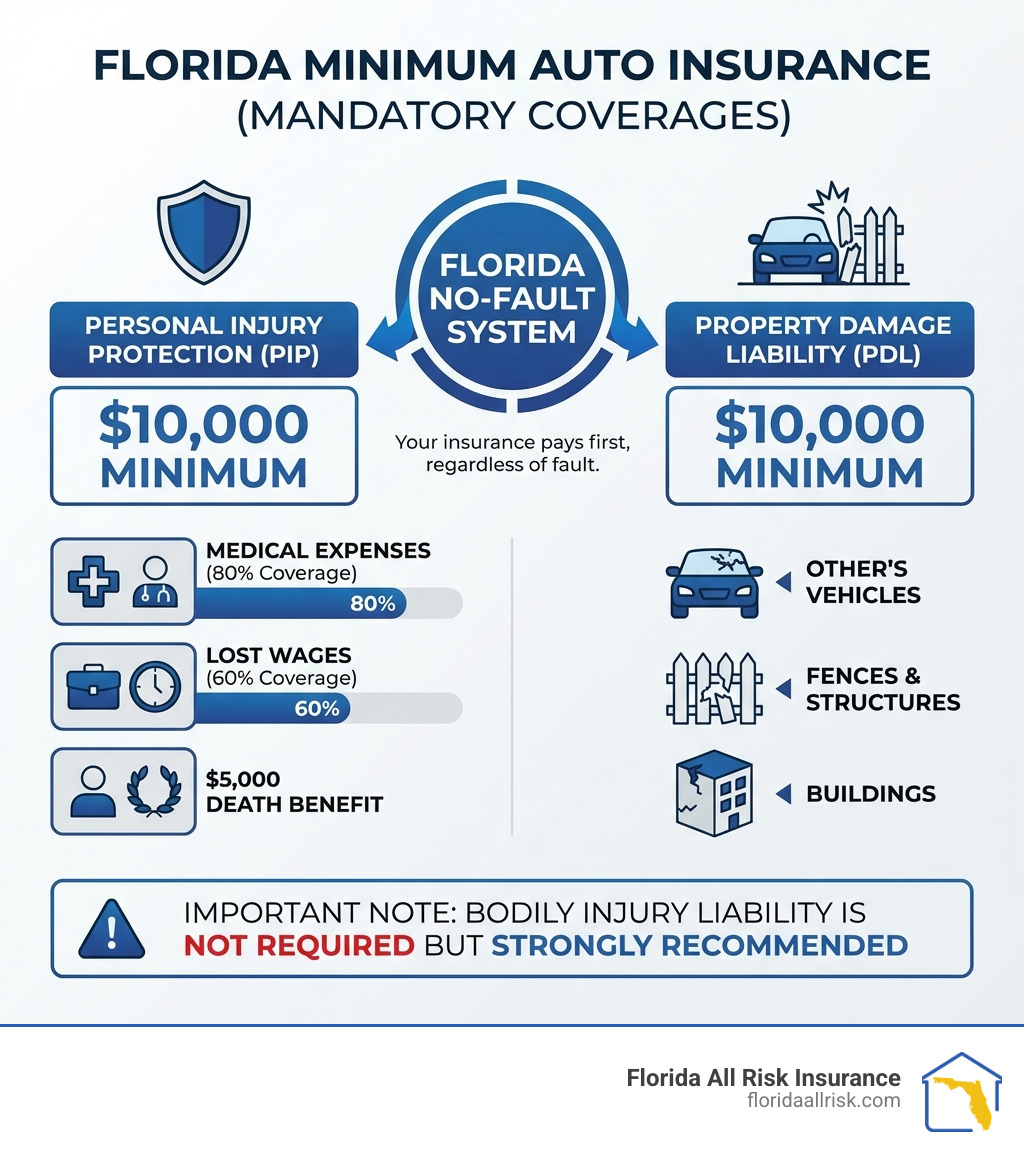
To legally register and drive a vehicle in Florida, you must carry continuous coverage of two specific types of insurance:
- $10,000 in Personal Injury Protection (PIP): This is the core of the no-fault system. It covers 80% of your eligible medical expenses and 60% of your lost wages, up to the $10,000 limit, for you and your passengers after an accident, no matter who was at fault.
- $10,000 in Property Damage Liability (PDL): This coverage pays for the damages you cause to another person’s property in an accident. This includes their vehicle, but also things like fences, mailboxes, or buildings.
Crucial Distinction: Florida is one of only two states that does not mandate Bodily Injury (BI) Liability coverage for most drivers. This glaring omission in the required coverage is a major reason why the state minimums are often dangerously inadequate.
While these minimums will keep you legally compliant, they offer a false sense of security. In today’s world, medical bills from a minor accident can easily surpass $10,000, and the cost to replace even a standard new car far exceeds the $10,000 PDL limit. A single accident could leave you personally liable for tens or even hundreds of thousands of dollars. Understanding the vast difference between what is legally required and what is financially prudent is the key to protecting your assets.
This comprehensive guide will deconstruct Florida’s mandatory auto insurance, explain the critical nuances of the no-fault system (including its limitations), and illuminate why the legal minimum is rarely enough. With over two decades of dedicated experience in the Florida insurance market, we are committed to helping you navigate these complexities to ensure you are not just legal, but genuinely protected on Florida’s busy roads.
Key terms for Minimum auto insurance Florida:
Understanding Florida’s Mandatory Minimum Auto Insurance
Florida’s “no-fault” principle is the driving force behind its unique insurance requirements. Before you can register a vehicle with four or more wheels, you must provide proof of these specific coverages to the state. This isn’t a one-time check. The Florida Department of Highway Safety and Motor Vehicles (FLHSMV) requires you to maintain continuous coverage throughout the entire registration period. The state operates a sophisticated electronic insurance verification system. Your insurance company is required by law to notify the FLHSMV immediately if your policy is canceled or lapses for any reason. This triggers an automatic process that can lead to the suspension of your license and registration. You can find more details directly from the source on Florida Insurance Requirements.
What are the legal requirements for Minimum auto insurance Florida?
To drive legally in Florida, state law mandates two primary coverages with specific minimum limits:
- Personal Injury Protection (PIP): You must have a minimum of $10,000 in PIP coverage. This is the coverage that pays for your own injuries after an accident, regardless of fault.
- Property Damage Liability (PDL): You must have a minimum of $10,000 in PDL coverage. This covers the cost of damages you cause to another person’s property with your vehicle.
While these are the only two required coverages for most drivers, it’s critically important to understand their limitations and what they don’t cover. For a deeper dive, explore our guide on Basic Auto Insurance Florida.
How Florida’s “No-Fault” System and PIP Work
Florida is a “no-fault” state, which means you turn to your own insurance company first for injury claims after an accident. The primary goal of this system is to provide quick access to funds for medical treatment and reduce the number of lawsuits for minor injuries. Your Personal Injury Protection (PIP) is the foundation of this system.
With a mandatory $10,000 minimum, PIP is designed to provide immediate financial support without the delay of determining who was at fault in the accident. This coverage applies to you, relatives living in your household, and your passengers who don’t have their own PIP. It can even cover you if you’re a pedestrian or bicyclist injured in an accident involving a motor vehicle.
Here’s a breakdown of what your standard PIP coverage includes:
- Medical Expenses: Covers 80% of necessary and reasonable medical bills up to your $10,000 limit. This includes services like doctors’ visits, hospital bills, surgery, rehabilitation, and ambulance fees. You are responsible for the remaining 20% and any amount over the $10,000 limit.
- Lost Wages: Reimburses 60% of your documented lost income if your injuries prevent you from working. This is also subject to the $10,000 total PIP limit.
- Death Benefit: Provides a $5,000 death benefit, which is in addition to the $10,000 medical and disability limit.
The Critical PIP Limitation (EMC Rule): A crucial and often misunderstood aspect of Florida PIP is the “Emergency Medical Condition” (EMC) rule. To access your full $10,000 in benefits, you must seek initial medical treatment within 14 days of the accident, and a qualified medical professional must diagnose you with an EMC. If you fail to get an EMC diagnosis, your PIP medical benefits are capped at just $2,500. This makes seeking prompt and proper medical evaluation essential.
Furthermore, the no-fault system restricts your ability to sue an at-fault driver for non-economic damages like “pain and suffering.” You can only step outside this system and pursue such a claim if your injuries meet a “serious injury threshold,” such as permanent injury, significant disfigurement, or death. For more on this essential coverage, see our PIP Insurance Florida Complete Guide.
A Closer Look at Property Damage Liability (PDL)
While PIP handles your own injuries, Property Damage Liability (PDL) addresses the damage you cause to someone else’s tangible property. Florida law requires a minimum of $10,000 in PDL coverage.
If you are deemed at fault for an accident, your PDL coverage will pay for the repair or replacement of the other party’s property up to your $10,000 limit. This most commonly applies to the other driver’s vehicle, but it also covers damage to structures like fences, mailboxes, light poles, or even buildings. It is important to remember that PDL does not cover damage to your own vehicle. To cover your car, you need to purchase optional Collision coverage. With the average cost of a new car now exceeding $48,000, a $10,000 PDL limit is alarmingly low. A single accident involving a newer car or a multi-vehicle pile-up could easily exhaust your coverage, leaving you to pay the rest out of pocket. Learn more in our Liability Car Insurance Florida guide.
Why the State Minimum May Not Be Enough: Recommended Coverages

Meeting the Minimum auto insurance Florida requirements is simply checking a legal box. It is not a sound financial strategy. This bare-bones approach leaves you dangerously exposed to catastrophic financial loss. The $10,000 limits for PIP and PDL were established decades ago and are grossly inadequate in the face of modern medical costs and vehicle repair expenses.
Consider this scenario: You’re in a minor fender-bender. The other driver complains of neck pain. An ambulance ride, ER visit with a CT scan, and a few follow-up appointments can easily exceed $12,500. Your PIP covers 80% of that, meaning it pays $10,000, and you’re still left with a $2,500 bill, not to mention the 20% co-pay on the first $10,000. Now, imagine the accident was more serious. Meanwhile, let’s say you rear-ended a brand-new SUV, causing $25,000 in damage. Your $10,000 PDL coverage pays its limit, and the other driver’s insurance company will then sue you for the remaining $15,000. Without sufficient coverage, your personal assets—your savings, your home, and even your future wages—are at risk. This is why we strongly advocate for coverage that goes far beyond the state minimums.
Bodily Injury Liability (BIL): A Crucial Optional Coverage
Florida is one of only two states that does not require Bodily Injury Liability (BIL) insurance for most drivers. Choosing to forgo this coverage is one of the biggest financial gambles you can take. BIL protects you if you cause an accident that injures or kills someone else. It is designed to pay for their medical expenses that exceed their own PIP, their lost wages, and their non-economic damages like pain and suffering, up to your policy limits.
Without BIL, if you are at fault for a serious accident, the injured party can and will sue you directly for their damages. A court judgment against you could lead to wage garnishment, liens placed on your property, and financial ruin. Most lenders and leasing companies recognize this risk and will require you to carry BIL coverage if you have a car loan or lease. We recommend a minimum of $100,000 per person and $300,000 per accident in BIL coverage ($100k/$300k) for adequate protection.
Uninsured/Underinsured Motorist (UM/UIM) Coverage
According to the Insurance Research Council, Florida has one of the highest rates of uninsured drivers in the nation, with some estimates suggesting that 1 in 5 drivers on the road lack insurance. This puts you at immense risk. Uninsured/Underinsured Motorist (UM/UIM) coverage is your financial shield against these irresponsible drivers. We consider it an absolutely essential coverage in Florida.
UM/UIM pays for your medical bills, lost wages, and pain and suffering if you are hit by an at-fault driver who has no insurance or not enough insurance to cover your costs. It also applies in hit-and-run situations. Florida law requires insurers to offer you UM coverage in an amount equal to your BIL limits. You can only reject it by signing a specific form. Insurers must also offer “stacking” for UM coverage. Stacking allows you to combine the UM limits from multiple vehicles on your policy. For example, if you have two cars with $50,000 in stacked UM coverage, you would have a total of $100,000 in coverage available if you were injured in an accident. For more details, see our Uninsured Motorist Coverage Florida guide and the Florida statute on UM/UIM coverage.
Other Valuable Coverages for Full Protection
To build a truly comprehensive policy that provides peace of mind, consider these additional valuable coverages:
- Collision Coverage: Pays for repairs to your own car after a collision with another object or vehicle, regardless of who is at fault. This is typically required by lenders for financed vehicles.
- Comprehensive Coverage: Protects your vehicle from non-collision events such as theft, vandalism, fire, falling objects, and natural disasters like hurricanes and floods—a must-have in Florida. With this coverage, your deductible for windshield replacement is typically waived by law.
- Medical Payments (MedPay): An excellent supplement to PIP, MedPay can be used to cover the 20% of medical bills that PIP doesn’t pay, as well as your PIP deductible and medical expenses that exceed your PIP limit.
- Rental Reimbursement: Helps pay for a rental car while your vehicle is being repaired after a covered claim, ensuring your life isn’t disrupted.
- Roadside Assistance: Provides coverage for common inconveniences like towing, flat tires, dead batteries, or locking your keys in your car.
Penalties, Filings, and Special Insurance Rules in Florida
Maintaining the required insurance is a non-negotiable legal mandate in Florida. The Florida Department of Highway Safety and Motor Vehicles uses an electronic database to actively monitor insurance status and enforce compliance. The consequences for failing to maintain coverage, especially for drivers deemed high-risk, are severe and designed to be a strong deterrent.
The High Cost of Driving Without Insurance
The penalties for driving without the required Minimum auto insurance Florida are not just a slap on the wrist; they can have a lasting and costly impact on your driving privileges and personal finances.
Here’s a detailed look at what you could face if caught driving without insurance or if your policy lapses:
- License and Registration Suspension: The FLHSMV will suspend your driving privilege, vehicle registration, and license plate for up to three years or until you provide proof of new insurance.
- Hefty Reinstatement Fees: To get your license and registration reinstated, you must pay a fee that escalates with each offense. The fee is $150 for a first offense, $250 for a second offense within three years, and a staggering $500 for a third offense within three years.
- No Hardship License: A critical point to understand is that for an insurance-related suspension, you are not eligible for a temporary or hardship license. This means you will have no legal way to drive to work, school, or anywhere else, which can have devastating personal and professional consequences.
Continuous coverage is the only way to avoid these penalties. If you plan to cancel your policy because you are selling your car or will not be driving it for an extended period, you must first surrender your license plate to a driver license office or tax collector’s office to avoid suspension. For a full overview, see our Driving Without Insurance Florida Guide.
How do SR-22 and FR-44 filings affect Minimum auto insurance Florida?
For drivers convicted of certain serious driving infractions, Florida requires a special filing known as an SR-22 or FR-44. These are not insurance policies themselves, but rather a certificate that your insurance company files with the state to prove you are carrying the required coverage. These filings designate you as a high-risk driver, leading to significantly higher insurance premiums.
- SR-22 (Certificate of Financial Responsibility): This is typically required for violations such as driving without insurance, being at fault in an accident without insurance, or having your license suspended for accumulating too many points. An SR-22 requires you to carry Bodily Injury Liability coverage (which is not normally required) of at least $10,000 per person / $20,000 per accident, in addition to the standard $10,000 PDL and PIP.
- FR-44 (Certificate of Financial Responsibility for DUI): This is a more stringent requirement mandated after a DUI or DWI conviction. It demands much higher liability limits: $100,000 per person / $300,000 per accident for Bodily Injury Liability and $50,000 for Property Damage Liability, plus PIP. These high limits can make insurance prohibitively expensive, and not all companies are willing to issue FR-44 policies.
Both filings are generally required to be maintained for three consecutive years without any lapse in coverage. Learn more in our What is SR22 Florida guide.
Special Rules for Other Vehicles and Situations
Florida’s insurance laws extend beyond private passenger cars, with much higher requirements for vehicles used for commercial purposes or in other specific situations:
- Taxis and Commercial Vehicles: Taxis are required to carry Bodily Injury Liability of $125,000 per person / $250,000 per accident and PDL of $50,000. Other commercial vehicles, depending on their weight, usage, and whether they transport hazardous materials, can face federal requirements for liability coverage in the millions of dollars.
- Loaned and Leased Vehicles: Under Florida’s “dangerous instrumentality doctrine,” a vehicle’s owner can be held liable for damages caused by someone they permit to drive their car. This makes it crucial to ensure anyone you loan your car to is a safe and insured driver. These complex rules are detailed in the Florida Statutes on financial responsibility.
- New Residents and Self-Insurers: If you move to Florida and establish residency by starting a job, enrolling children in school, or registering to vote, you have just 10 days to register your vehicle in Florida and obtain the required insurance. On the other end of the spectrum, individuals or companies with a net worth of at least $40,000 can apply with the state to become a self-insurer, which involves posting a bond to cover potential claims instead of buying a traditional policy.
Navigating Claims and Legal Rights After a Florida Accident
Being involved in an auto accident is a stressful and disorienting experience. In the aftermath, knowing how to navigate the claims process and understanding your legal rights is essential to protecting your financial and physical well-being. Your insurance policy is a legal contract, and understanding its terms, along with Florida’s specific legal thresholds, can make all the difference in your recovery.
Can You Sue for Pain and Suffering in Florida?
This is one of the most common questions after an accident. Florida’s no-fault system is designed to limit lawsuits for minor injuries. While your PIP coverage acts as the primary source for your initial medical bills and lost wages, your ability to sue the at-fault driver for non-economic damages—such as pain, suffering, mental anguish, and inconvenience—is restricted. You can only step outside the no-fault system and pursue such a claim if your injuries meet a specific “serious injury threshold” as defined by Florida law.
According to The Florida Bar Consumer Pamphlet: Automobile Insurance, this threshold is met if the accident caused:
- A permanent injury within a reasonable degree of medical probability.
- Significant and permanent scarring or disfigurement.
- Significant and permanent loss of an important bodily function.
- Death.
If a medical professional determines your injuries meet one of these criteria, you may then file a liability claim or lawsuit against the at-fault driver for damages that go beyond what your PIP policy covered, including the full scope of your medical bills and compensation for pain and suffering.
Florida as a “Diminished Value” State
Even after your vehicle has been expertly repaired following an accident, it will likely have a lower resale value than a similar vehicle that has never been in a crash. This loss in market value is known as “diminished value.” Florida law recognizes your right to be compensated for this loss. As a “diminished value” state, you are entitled to file a claim to recover this loss from the at-fault party’s insurance company.
Proving the amount of diminished value can be complex. It typically involves getting an independent appraisal from a qualified expert who can document the vehicle’s value before the accident and its value after repairs. This is a third-party claim, meaning you can only collect it from the other driver’s insurance if they were at fault; you cannot claim it from your own collision policy. It’s a right that can help you recover your full financial loss from an accident.
Key Insurance Terms Defined
Understanding insurance vocabulary is key to being an informed consumer. Here are some important terms:
- Bodily Injury Liability (BIL): Optional but critical coverage that pays for injuries or death you cause to others in an at-fault accident, including their medical bills and pain and suffering.
- Personal Injury Protection (PIP): Your mandatory no-fault coverage for your own medical costs (80%) and lost wages (60%) up to your policy limit.
- Property Damage Liability (PDL): Mandatory coverage that pays for damage you cause to another person’s property.
- Uninsured/Underinsured Motorist (UM/UIM): Optional coverage that pays for your injuries and damages if you’re hit by a driver with no insurance or not enough insurance.
- Actual Cash Value (ACV): The standard by which insurance companies pay for a totaled vehicle. It is the replacement cost of the vehicle minus depreciation for age, wear and tear, and other factors.
- Comparative Negligence: The legal doctrine in Florida that allows fault to be shared in an accident. Your ability to recover damages is reduced by your percentage of fault. For example, if you are deemed 20% at fault, you can only collect 80% of your damages from the other party.
- Subrogation: The process by which your insurance company, after paying a claim, seeks to recover the amount from the party who was at fault.
- Deductible: The amount of money you must pay out-of-pocket for a collision or comprehensive claim before your insurance coverage begins to pay.
Frequently Asked Questions about Minimum Auto Insurance Florida
Florida’s auto insurance laws are filled with unique terms and rules that can be confusing. Here are clear, detailed answers to some of the most common questions we receive.
Why is Florida a “No-Fault” state and what does it really mean for me?
Florida adopted the “no-fault” system in the 1970s with the goals of speeding up payments for medical care after an accident and reducing the number of lawsuits over minor injuries. In practice, it means your own Personal Injury Protection (PIP) coverage is your first and primary source for covering your initial medical bills and a portion of your lost wages, regardless of who was legally at fault for the crash. It does not mean that fault is irrelevant. Fault is still determined to decide who pays for property damage and to allow for lawsuits in cases of serious injury. For you, it means you must use your PIP benefits first, and it limits your right to sue the other driver for “pain and suffering” unless your injuries meet a legally defined threshold of severity.
If Bodily Injury Liability (BIL) isn’t required, why should I buy it?
While not mandated by the Minimum auto insurance Florida law for most drivers, purchasing Bodily Injury Liability (BIL) is one of the most important financial decisions you can make. Here’s why it’s considered essential by nearly all insurance professionals:
- It Protects Your Assets: If you cause an accident that seriously injures someone, their medical bills can quickly run into the hundreds of thousands of dollars. Without BIL, you are personally responsible for paying those costs. The injured party can sue you, and a court can issue a judgment that allows them to garnish your wages, place a lien on your home, and seize your savings.
- It Covers Severe Injuries: PIP’s $10,000 limit is exhausted almost immediately in a serious accident. BIL steps in to cover the extensive medical costs, lost income, and pain and suffering for the other party, protecting you from financial ruin.
- It’s Often Required Anyway: If you have a loan or lease on your vehicle, your lender will almost certainly require you to carry BIL. It is also mandatory if you are required to file an SR-22 or FR-44.
What happens if the damage I cause is more than my $10,000 PDL coverage?
If you are at fault in an accident and the damage to the other person’s property exceeds your $10,000 Property Damage Liability (PDL) limit, you are personally and legally responsible for paying the difference. For example, if you cause an accident that results in $35,000 of damage to a new luxury car, your insurance company will pay its limit of $10,000. The other driver’s insurance company will then come after you to collect the remaining $25,000. They can sue you, obtain a judgment, and pursue your assets. This is a primary reason why carrying only the state minimum PDL is incredibly risky.
What is the Emergency Medical Condition (EMC) rule for PIP?
The EMC rule is a critical part of Florida’s PIP law. To access your full $10,000 of PIP medical benefits, you must not only seek treatment within 14 days of your accident, but a qualified medical professional (like a physician, osteopathic physician, dentist, or physician assistant) must also certify that you have an “Emergency Medical Condition.” If you are not diagnosed with an EMC, or if you are treated only by a chiropractor, your PIP medical benefits are capped at just $2,500. This makes it vital to see a doctor promptly after an accident.
How can I lower my insurance costs without sacrificing coverage?
While it’s dangerous to skimp on coverage limits, there are smart ways to manage your premiums. Ask your agent about discounts for being a safe driver, bundling your auto and home policies, being a good student, or taking a defensive driving course. You can also consider raising your deductibles for Collision and Comprehensive coverage, which lowers your premium. However, make sure you choose a deductible amount you can comfortably afford to pay out-of-pocket. The best strategy is to shop your policy with an independent agent who can compare quotes from multiple carriers to find the best value for the robust coverage you need.
Secure the Right Coverage for Your Florida Journey
Understanding the Minimum auto insurance Florida requires is the first step, but true financial security on the road demands moving far beyond that baseline. We’ve detailed the mandatory $10,000 in Personal Injury Protection (PIP) and $10,000 in Property Damage Liability (PDL) that satisfy state law. More importantly, we’ve illustrated how these decades-old limits are dangerously insufficient in today’s world, potentially exposing you and your family to devastating financial risks from medical bills, property damage claims, and personal lawsuits.
The penalties for a coverage lapse are severe, including license suspension without the possibility of a hardship permit and escalating fines. For high-risk drivers, special filings like the SR-22 and FR-44 impose even stricter and more costly requirements. The message from the state is clear: continuous, compliant insurance is non-negotiable.
However, compliance is not the same as protection. A policy built only on minimums is a gamble you cannot afford to lose. The real goal is to craft a comprehensive insurance plan with robust liability limits, essential Uninsured Motorist protection, and tailored optional coverages that create a genuine financial safety net.
At Florida All Risk Insurance, based in St. Petersburg, we believe in empowering our clients with knowledge. As an independent agency, we are not beholden to a single carrier. We partner with a wide range of A-rated insurance companies to find the best combination of coverage, service, and price for your unique situation. We’re here to ensure you’re not just legal, but truly secure.
If you are ready to move beyond the minimum and see what true protection looks like, get a personalized auto insurance quote today from our local team in Saint Petersburg: Get a personalized auto insurance quote today.
For a more holistic approach, let us help you see the full picture. Schedule a full coverage review of your auto, home, and other policies so you can make confident, informed choices about protecting everything you’ve worked for: explore our complete auto insurance products and services.
Contact Us
Florida All Risk Insurance
St. Petersburg, FL
Contact Us Online or review our auto insurance products and services.

