Mixed Commercial and Residential Building Insurance: A Complete Guide for Mixed-Use Properties
Image metadata: Subject — mixed-use (commercial + residential) building; Context — risk and insurance; Credit — Bannerbear composite; Purpose — header image for educational article.
Mixed commercial and residential building insurance is one of the most nuanced areas in property risk management. These “mixed-use” buildings combine homes and businesses—think apartments or condos above retail, restaurants, or professional offices—concentrating multiple risk categories into a single location. The result is both a compelling investment model and an insurance puzzle that standard policies rarely solve well.
What to know at a glance:
- Blended risks: residential exposures (water damage, tenant-caused fires) and commercial exposures (customer liability, operations, equipment) often interact—not just add up.
- Narrower carrier appetite: many admitted carriers have tightened guidelines; surplus lines and specialty insurers fill the gap at higher cost and stricter terms.
- Policy design matters: you’ll likely need a custom combination of property, general liability, loss of rents/business interruption, ordinance or law, and selected endorsements (e.g., equipment breakdown, assault and battery where relevant).
- Cost drivers: tenant mix (restaurants and bars rate highest), construction details, building age/updates, location (wind, flood, crime), and loss history are major factors.
- Market reality: it’s a challenging market cycle for mixed-use placements; proactive risk management and clean documentation materially improve insurability.
America’s urban population continues to grow and densify, increasing demand for integrated living/working neighborhoods and the mixed-use buildings that support them. Recent U.S. Census reporting reflects this trajectory of urbanization and its development implications. For context, see U.S. Census Bureau coverage of urban and rural populations for data-backed perspective on how housing and commercial footprints are evolving.
Why it’s complex: losses rarely respect unit boundaries. A single water claim in a residential unit can damage a downstairs boutique’s inventory and trigger a business interruption claim. Conversely, a small commercial kitchen fire can displace residential tenants and create additional loss of rents exposure. This interdependence is precisely why mixed-use insurance demands specialized structuring.
Key terms as you read:
- Commercial property insurance — protects your building and fixtures against covered perils. Learn more: https://floridaallrisk.com/commercial-property-insurance/
- Building insurance in commercial leases — best practices for who insures what: https://floridaallrisk.com/building-insurance-commercial-lease/
- All-risk commercial property insurance — scope and exclusions: https://floridaallrisk.com/all-risk-commercial-property-insurance/
Throughout this guide, we’ll unpack the blended risk profile, core and specialty coverages, premium drivers and underwriting expectations, and practical tactics to keep your property well-insured in a hard market—without turning the discussion into jargon or sales speak.
Why Mixed-Use Properties Have Unique Insurance Needs
Protecting a building that functions as both a residence and a business hub is fundamentally different from insuring a single-use property. That’s the central challenge of mixed commercial and residential building insurance: the building’s risk environment is constantly shaped by residents, customers, employees, deliveries, vendors, and contractors.
Consider two common scenarios:
- A bathtub overflow on the third floor floods a ground-floor specialty retailer. The resulting claim might involve water remediation, tenant improvements, business personal property (inventory), and business interruption.
- A small grease fire in a restaurant triggers sprinklers throughout a section of the building. Several residential units become temporarily uninhabitable, and multiple commercial tenants lose operating days.
These events show why single-purpose policies usually leave gaps. A residential policy won’t contemplate retail liability and business income. A basic commercial package often excludes or restricts residential exposures. Mixed-use requires both breadth and careful coordination of limits, deductibles, and responsibilities among owners, property managers, and tenants.
The Blended Risk Profile: How Exposures Interact
Residential exposures typically include:
- Tenant negligence (unattended cooking, candles, space heaters)
- Water damage (plumbing failures, appliance leaks)
- Premises liability (guests injured in corridors, stairwells, or common areas)
Commercial exposures add:
- Customer and vendor foot traffic (slip-and-fall risk)
- Operational hazards (cooking, heating equipment, electrical load)
- Business personal property and time-element losses (e.g., business interruption)
In a mixed-use building, these exposures interact. Small incidents can cascade into multi-party losses with complex claim handling. This is why mixed-use policies often carry endorsements, sublimits, and carefully drafted exclusions to manage how an event is adjusted across different insured interests.
How Foot Traffic and Public Access Affect Liability
Foot traffic multiplies in mixed-use properties, especially when restaurants or popular retailers draw the general public into common areas. Corridors, lobbies, elevators, and parking areas become shared liability zones. Routine housekeeping, snow/ice removal (where applicable), clear signage, and lighting are essential loss controls.
Slip-and-fall claims remain among the most frequent for commercial premises. Responsibilities can be shared or disputed between property owners and tenants depending on lease terms and where an incident occurs. A strong Commercial General Liability Insurance program with clear additional insured wording and well-documented maintenance protocols helps keep loss outcomes predictable. For basics on general liability scope: https://floridaallrisk.com/commercial-general-liability-insurance/
Multiple Stakeholders, Shared Responsibilities
Well-structured leases and house rules help align responsibilities. Typical elements include:
- Tenant maintenance duties (e.g., regular hood/duct cleaning for restaurants, documented by certified vendors)
- Insurance requirements (limits, additional insured status, waiver of subrogation, primary and non-contributory wording)
- Incident reporting protocols (timely notice, photos/video, vendor dispatch)
The more you can standardize and document expectations across residential and commercial occupants, the smoother your underwriting and claims experience tends to be.
Core Coverages for a Mixed Commercial and Residential Building Insurance Program
There is no single “mixed-use policy” that fits every building. Most placements are a customized blend of core coverages and targeted endorsements. Getting the fundamentals right—and then closing known gaps—is the key to long-term insurability.
Foundational Property and Liability
- Commercial Property Insurance: Protects the building, permanently installed fixtures, and often landlord-owned improvements against covered perils like fire, wind, and vandalism. Details and options: https://floridaallrisk.com/commercial-property-and-business-interruption-insurance/
- Commercial General Liability (CGL): Responds to bodily injury and property damage claims arising from premises liability. This is particularly important where public access and shared spaces are significant. Coverage basics: https://floridaallrisk.com/what-does-general-liability-insurance-cover/
- Business Interruption and Loss of Rents: Two related but distinct protections. Business interruption applies to a business that cannot operate after a covered loss. Loss of rents replaces the landlord’s rental income while units are uninhabitable or spaces are unusable due to a covered peril. When a single event affects both residential and commercial occupants, these coverages become the financial stabilizers.
- Ordinance or Law: After a major loss, building code upgrades can materially increase rebuild costs. Ordinance or law coverage (often split into Coverage A—loss to the undamaged portion, Coverage B—demolition cost, and Coverage C—increased cost of construction) can bridge the gap between “like kind and quality” and code-compliant reconstruction.
High-Value Endorsements for Mixed-Use
- Equipment Breakdown: Covers sudden, accidental mechanical or electrical breakdowns (elevators, HVAC, boilers, pumps, electrical panels) that are not caused by external perils. For mixed-use buildings with elevators and centralized systems, this coverage is often cost-effective relative to risk.
- Assault and Battery Liability: If your tenant mix includes bars, nightclubs, or late-hours restaurants, many standard liability forms exclude or sublimit claims arising from altercations. A specific assault and battery endorsement (or a specialized policy) may be necessary to avoid catastrophic out-of-pocket exposure.
- Cyber Liability/Privacy: Landlords increasingly handle resident and tenant data (applications, IDs, ACH/credit card payments) and may provide Wi-Fi. A breach can trigger notification, credit monitoring, and liability costs. Consider modular cyber coverage. For broader business policy context: https://floridaallrisk.com/business-insurance-for-llc/
- Flood Insurance: Flood is typically excluded under standard property forms. Florida properties—even those outside designated high-risk zones—experience flood events. Explore options here: https://floridaallrisk.com/flood-insurance-florida/
Authoritative resources:
- For national restaurant fire trends and causes, see the National Fire Protection Association’s research on restaurant and cooking fires at nfpa.org for data-driven risk insights.
- To understand flood risk mapping and zones, consult FEMA’s Flood Map Service Center at msc.fema.gov, which provides official flood maps and tools.
Additional Considerations
- Valuation: Confirm that the building’s replacement cost valuation reflects current labor and materials. Underinsurance can trigger co-insurance penalties and shortfalls even when a loss is covered.
- Deductible structure: In wind-prone regions, separate wind/hail deductibles (percentage-based) are common. Align your reserve planning and tenant communication accordingly.
- Tenant Improvements and Betterments (TIBs): Clarify who insures TIBs—landlord or tenant—based on lease language. Misalignment can delay claims and reconstruction.
- Named insureds and additional insureds: Ensure all ownership entities, property management companies, and lender requirements are accurately listed and supported by endorsements.
A clear, current schedule of values, diagrams/site plans, life-safety equipment specs, and preventive maintenance records help underwriters price the true risk instead of defaulting to worst-case assumptions.
Key Factors That Influence Premiums for Mixed-Use Buildings
Premiums are underwriter opinion expressed in dollars. To influence that opinion, understand the data points, demonstrate control over them, and document your efforts. Mixed-use underwriting weighs the following heavily:
Infographic: The Premium Puzzle for Mixed-Use Properties
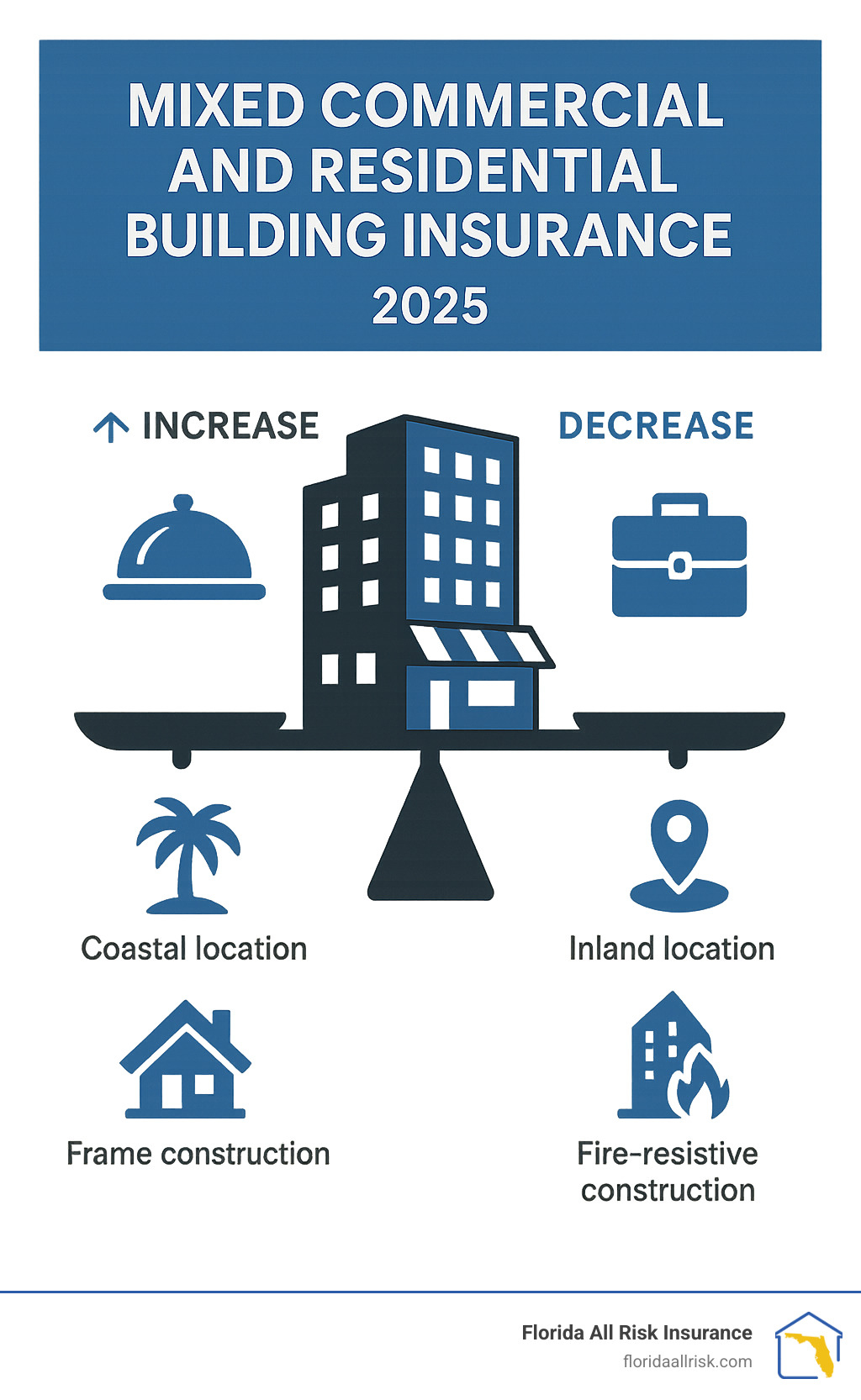
Image metadata:
- Subject: Infographic on factors affecting mixed-use property insurance premiums.
- Content: Visualizes risk factors like tenant mix, location, construction, and risk management.
- Credit: Bannerbear Composite
- Purpose: To provide a quick, visual summary of premium drivers for property owners.
Tenant Mix and Operational Hazards
- Restaurants/bars: Highest risk due to open flames, fryers, grease accumulation, late hours, alcohol-related incidents, and increased foot traffic. According to the National Fire Protection Association (NFPA), cooking equipment is a leading cause of nonresidential fires—one reason these occupancies carry stricter underwriting and pricing.
- Fitness studios, professional services, boutique retail: Typically lower hazard profiles with fewer ignition sources and moderate foot traffic.
- Medical or lab uses: May introduce specialized equipment, biohazards, or storage concerns that require additional controls.
Leasing strategy can influence insurability. Requiring appropriate tenant insurance and naming the landlord as an additional insured on tenant liability policies pushes losses arising from the tenant’s operations to the tenant’s insurer first—protecting the building owner’s loss history.
Location, Construction, and Age
- Geography: Coastal wind zones, hail corridors, wildfire interfaces, and high-crime neighborhoods bring higher base rates and stricter deductibles. Florida properties near the coast, for example, often face percentage wind deductibles and separate wind placement.
- Construction type: Fire-resistive (concrete/steel) construction typically earns better pricing than frame construction. Roof shape, covering, and attachment methods matter in wind underwriting.
- Age and updates: Older buildings without modernized electrical, plumbing, or roofs are red flags. Evidence of proactive upgrades improves pricing—and sometimes availability.
For properties that fall outside most standard appetites, specialty markets and high-risk programs exist and may still provide options: https://floridaallrisk.com/high-risk-commercial-property-insurance/
Loss History and Documentation
- Prior claims: Frequency can be as damaging as severity. Multiple small water losses suggest systemic issues (supply lines, aging valves, or resident education gaps). A well-documented corrective action plan is critical after any patterned loss type.
- Loss runs: Obtain and review multi-year loss runs before acquisition to avoid surprises. Underwriters scrutinize paid and reserved amounts, causes of loss, and remedial steps taken.
Risk Management That Moves the Needle
Insurers respond to credible proof of control:
- Life-safety systems: Annual inspections of sprinklers, alarms, extinguishers, hood/duct systems, and documented remediation of deficiencies.
- Water control: Leak detection sensors, automatic shutoff valves in risers or critical areas, braided steel supply lines in units, and scheduled replacement of aging components.
- Housekeeping and vendor controls: Cleaning logs, snow/ice protocols (where applicable), slip-resistant mats in high-traffic zones, and vendor COIs (Certificates of Insurance) on file.
- Security measures: Lighting, camera coverage of entrances/exits, controlled access for residential areas, and clear delineation between public and private spaces.
In this market, many carriers will not just ask what you’re doing; they’ll want proof. Organized documentation—photos, inspection reports, service contracts, logs—can markedly improve outcomes.
Navigating the Hard Market for Mixed-Use Insurance
Property insurance cycles between “soft” markets (more capacity, lower rates) and “hard” markets (reduced capacity, stricter underwriting, higher rates). Mixed-use properties are feeling the hard market more acutely due to compounding exposures and several years of catastrophe and severity trends.
What Owners Are Seeing
- Non-renewals: Even well-managed buildings may face non-renewal due to carrier strategy changes rather than property-level performance.
- Large pricing jumps: Quotes 2x–5x initial expectations are not unusual when transitioning from an admitted market to surplus lines or when tenant mix changes to higher-hazard classes.
- Tighter terms: Higher deductibles (especially wind), sublimits for water damage, exclusions for certain operations, and stricter warranty conditions (e.g., mandatory hood/duct cleaning intervals).
This is frustrating—but it’s not arbitrary. Carriers have to calibrate capital to volatility, and mixed-use volatility is inherently higher when a single event can touch many insured interests at once.
Practical Steps to Improve Insurability and Control Cost
- Consider higher deductibles strategically: Increasing deductibles for attritional losses can make pricing more palatable, while maintaining catastrophe preparedness for larger events.
- Invest in upgrades: Electrical panel replacements, modern plumbing materials, roof improvements, floodproofing measures, and UL-listed suppression systems in commercial kitchens reduce both frequency and severity.
- Formalize tenant requirements: Standardize lease language for COIs, additional insured status, primary/non-contributory wording, waiver of subrogation, and evidence of specialty coverages (e.g., liquor liability where applicable).
- Build a property data room: Keep accessible digital files with inspection reports, service agreements (elevator, HVAC, alarms, sprinklers, hoods/ducts), maintenance logs, and photos. Share succinct summaries with underwriters.
- Right-size limits and values: Revisit replacement cost and business income/loss of rents calculations annually to reflect inflation and occupancy changes.
Authoritative, non-commercial references that can help with planning and risk awareness include:
- Insurance Information Institute (Triple-I) resources on commercial property risk trends and mitigation at iii.org
- FEMA preparedness and floodplain management tools via fema.gov
Keep communications with lenders, investors, and tenants transparent. Setting expectations early about deductibles, coverage changes, and potential operating impacts preserves trust and prevents surprises.
Frequently Asked Questions About Mixed-Use Building Insurance
What’s the main difference between standard commercial insurance and mixed-use coverage?
Standard commercial policies are written for business-only premises, while mixed-use programs must account for both residential and commercial exposures in the same building. Mixed-use policies coordinate property coverage, liability protections for shared spaces, and time-element coverages (loss of rents/business interruption) when an event affects multiple occupancy types at once. Residential-only or commercial-only policies typically leave gaps in a mixed-use setting.
Why is it so difficult to place mixed-use insurance right now?
Hard market conditions, catastrophe losses, construction inflation, and increased severity trends have made carriers selective. Mixed-use is complex to underwrite because one incident can affect multiple tenants and coverage parts. Some carriers have exited or capped this class, pushing more placements into specialty markets with higher pricing and stricter terms.
Can requiring tenant insurance help lower my costs?
Yes, and it’s a best practice. For residential, require renters insurance with personal liability and evidence of coverage at renewal. For commercial tenants, require general liability and property coverage appropriate to the occupancy, name the landlord as an additional insured, and request a waiver of subrogation and primary/non-contributory wording where appropriate. Collect COIs annually and upon any change in operations.
What special considerations apply if I lease to restaurants or bars?
Expect improved fire controls and documentation: UL-listed hood suppression, quarterly hood/duct cleaning (or as required by local code and insurer), grease management procedures, and fire-rated separation as applicable. Verify liquor liability coverage when alcohol is served, and consider assault and battery coverage where late hours or entertainment are involved. Underwriters will often request proof of service contracts and inspections.
Do I need flood insurance if I’m not in a high-risk zone?
Flood isn’t covered by most standard property policies, and “low risk” doesn’t mean “no risk.” Urban drainage patterns, storm surge, and extreme rainfall can still cause flood losses. Evaluate flood options for your exact location and building profile. Learn more about flood options here: https://floridaallrisk.com/flood-insurance-florida/ and explore official mapping tools via FEMA’s Flood Map Service Center at msc.fema.gov.
How should I think about loss of rents versus business interruption?
- Loss of rents: Protects the landlord’s expected rental income when units are uninhabitable due to a covered loss.
- Business interruption: Protects a tenant’s or owner-operator’s net income plus continuing expenses when operations are suspended due to a covered loss.
In mixed-use buildings, both can be triggered by the same event. Ensure appropriate periods of indemnity (e.g., 12, 18, or 24 months) based on realistic rebuild timelines and supply chain conditions.
What documentation makes underwriting smoother?
Loss runs (5 years), replacement cost estimates, floor plans, photos, inspection reports (sprinklers, alarms, hood/duct), maintenance logs, contractor/vendor agreements, proof of tenant insurance, and any recent upgrade documentation (electrical, plumbing, roof). Well-organized materials reduce assumptions and can produce better terms.
Secure Your Investment With a Thoughtful, Well-Structured Insurance Program
Mixed-use properties are vibrant, valuable assets precisely because they serve two communities at once: residents and businesses. That vitality creates a complex risk landscape—but with the right coverage structure, maintenance discipline, and documentation, you can protect cash flow and asset value through the market cycle.
If you’re navigating a non-renewal, facing higher-than-expected quotes, adding a new restaurant tenant, or simply want an experienced review of your coverage, we’re ready to help you compare options and implement practical, cost-conscious improvements.
Call to action:
- Request a comprehensive review of your commercial property insurance program: https://floridaallrisk.com/coverage/commercial-property/
- Explore related coverages and risk strategies for Florida properties: https://floridaallrisk.com/
Contact Us
Florida All Risk Insurance
Address: Saint Petersburg, FL
Email: [email protected]
Website: https://floridaallrisk.com/
Phone: (888) 880-9200
We look forward to helping you protect your mixed-use property with clarity, diligence, and straightforward guidance.