Medicare Workers Compensation: Essential 2025
Understanding the Relationship: Medicare and Workers’ Compensation
When you’re injured at work and have Medicare, understanding how medicare workers compensation coordination works is critical for protecting your healthcare coverage. These two systems have a clearly defined relationship designed to ensure the correct party pays for medical care, but navigating the rules can be complex.
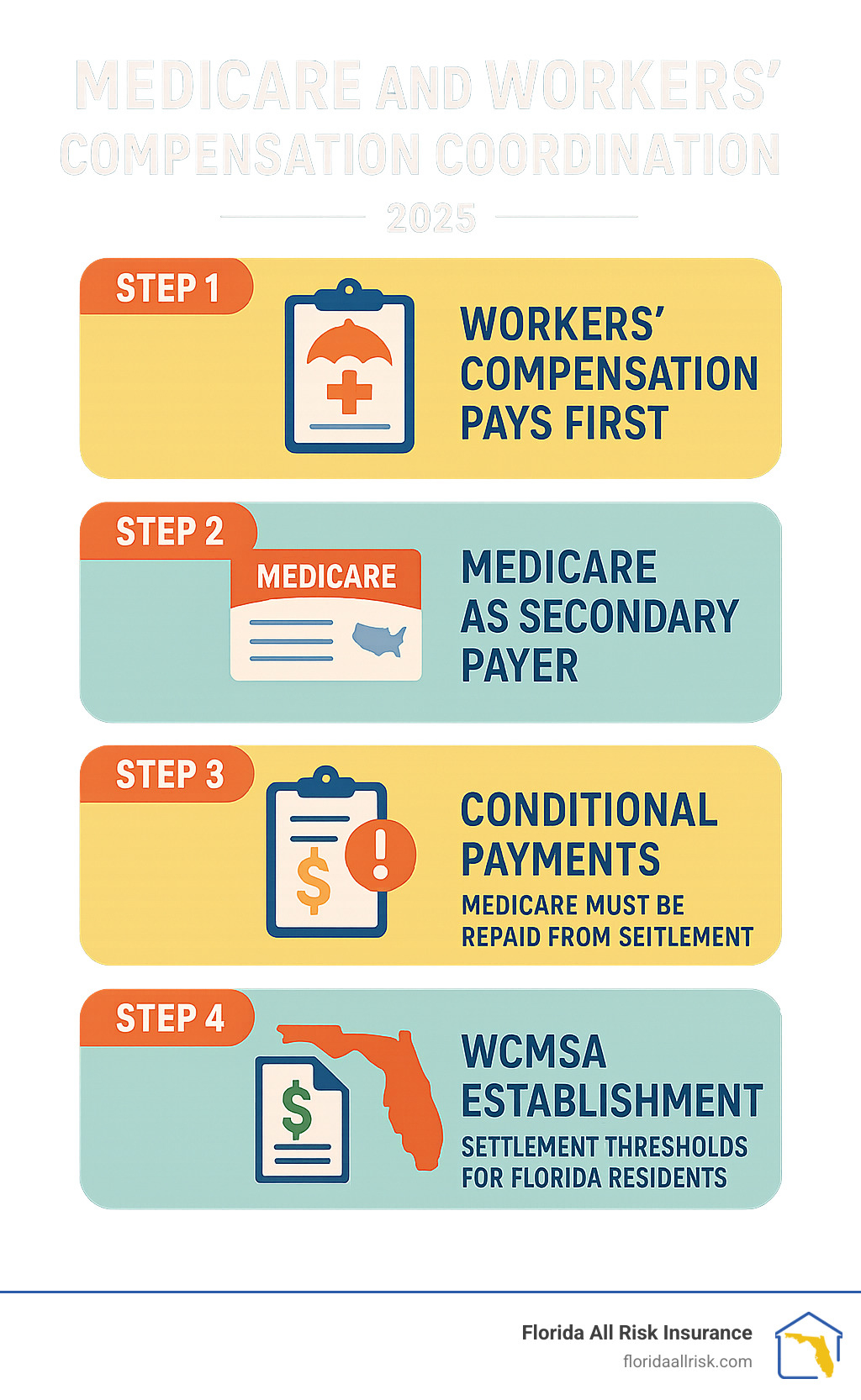
The core principle is that workers’ compensation is the primary payer for all medical expenses related to a work injury. Medicare acts as the secondary payer, meaning it will only cover costs that workers’ compensation doesn’t. This hierarchy is mandated by the Medicare Secondary Payer (MSP) provisions, which prevent Medicare from paying for expenses that should be covered by other insurance.
If your workers’ compensation insurer doesn’t pay promptly (within 120 days), Medicare may make a “conditional payment” to cover your bills. However, Medicare expects to be repaid from any workers’ compensation settlement you receive. The most complex part often involves Workers’ Compensation Medicare Set-Aside Arrangements (WCMSAs), which are special accounts funded by your settlement to pay for future medical expenses. Without proper planning, you could face denied Medicare claims or significant financial liability.
The Medicare Secondary Payer (MSP) Rule
The MSP rule is the foundation of how Medicare interacts with other insurance, including workers’ compensation. It ensures Medicare is not the primary payer when another entity has the responsibility to pay. For job-related injuries, federal law designates workers’ compensation insurance as the primary payer. This means your workers’ comp policy must pay first for any treatment, medication, or service related to your work injury. This structure prevents cost-shifting from private insurance systems to the taxpayer-funded Medicare program. To learn more about the legal basis, you can review the official CMS page on Medicare secondary payer provisions explained.
How Medicare Handles Payments for Work-Related Injuries
While workers’ compensation is expected to pay promptly, delays or disputes can occur. If the workers’ compensation insurer does not pay your healthcare bills within 120 days, Medicare may step in and make a “conditional payment.” This ensures you receive necessary care without facing out-of-pocket costs while the claim is processed. However, this payment is essentially a loan. Medicare expects full repayment for these conditional payments once your workers’ compensation claim is settled.
This repayment process is handled by Medicare’s Benefits Coordination & Recovery Center (BCRC). Providers should always bill workers’ compensation first for services related to a work injury. If they mistakenly bill Medicare and Medicare pays, that payment becomes a conditional payment that must be recovered. For businesses, understanding how various health insurance plans coordinate with workers’ compensation is essential. Explore our resources on business health insurance to learn more.
What Happens When Workers’ Compensation Denies a Claim?
If workers’ compensation denies coverage for a specific service related to your work injury, and that service is normally covered by Medicare, Medicare should then pay for your care on a “non-conditional” basis. This means that if Medicare pays, you will not have to pay Medicare back. The key is that the denial must be legitimate, and you must provide Medicare with proof of the denial.
Appealing a workers’ compensation denial can be a lengthy process. In the interim, Medicare’s non-conditional payment ensures you continue to receive necessary medical care. It’s also important to note how this applies to pre-existing conditions. If a work injury aggravates a pre-existing condition, workers’ compensation might only cover the portion of treatment directly caused by the work injury. In these cases, Medicare should pay for any Medicare-covered services not paid for by workers’ compensation, effectively covering the portion related to the pre-existing condition.
What is a Workers’ Compensation Medicare Set-Aside (WCMSA)?

A Workers’ Compensation Medicare Set-Aside Arrangement (WCMSA) is a financial agreement that carves out a specific portion of a workers’ compensation settlement to pay for future medical care related to the work injury. This includes costs for both medical services and prescription drugs (Part D). The primary purpose of a WCMSA is to protect Medicare’s interests by ensuring that settlement funds designated for future medical care are used for that purpose before Medicare is asked to pay.
The money is placed in a dedicated account and must be spent down on approved, injury-related medical expenses. Once the funds are properly exhausted, Medicare will begin to pay for injury-related care as the primary payer. A WCMSA can be funded either with a lump-sum payment or a structured settlement that makes regular payments into the account. Without a proper WCMSA, you risk having Medicare deny future claims and could face recovery actions from Medicare against you, your attorney, and the insurer.
Why is a WCMSA Important?
Failing to establish a WCMSA when one is needed can have serious financial consequences. This arrangement is not just administrative paperwork; it is a critical component of complying with federal law and securing your future medical coverage.
- Ensuring Future Coverage: The most practical reason for a WCMSA is to guarantee future medical care. Imagine receiving a settlement and spending it, only to need injury-related surgery two years later. Without a WCMSA, Medicare can legally refuse to pay for that surgery, leaving you with a massive bill. The WCMSA ensures funds are available for your future care.
- Complying with Federal Law: The Medicare Secondary Payer Act creates specific responsibilities for all parties involved in a settlement. Ignoring these requirements can lead to significant legal and financial liability.
- Consequences of Non-Compliance: If Medicare’s interests are not protected, the agency can deny future claims for any medical care related to the work injury. Furthermore, Medicare can pursue legal liability against all parties involved in the settlement, including seeking double damages from the primary payer.
For businesses, understanding how different insurance policies, such as group health insurance plans, coordinate with workers’ compensation is crucial for protecting both the company and its employees.
How a WCMSA Works After a Settlement
Once your settlement is finalized and the WCMSA is funded, you must manage the account according to strict rules. The fundamental rule is that you must deplete your WCMSA funds on appropriate medical care before Medicare will resume paying for injury-related treatments.
You have two choices for administering the account:
- Self-Administration: You are responsible for keeping detailed records, paying medical bills from the account, and submitting an annual attestation to Medicare detailing how the funds were spent. This requires organization and attention to detail.
- Professional Administration: You can hire a professional administrator to manage payments, keep records, and handle all reporting requirements. While this service has a fee, it offers peace of mind and ensures compliance.
The golden rule for spending is to use funds only for Medicare-covered, injury-related expenses. Once the funds are legitimately exhausted and you have submitted your final report, Medicare will become the primary payer for your future injury-related medical care. For guidance on managing your own account, Medicare provides a Self-Administration Toolkit for WCMSAs.
Navigating the WCMSA Process and CMS Review
The process of establishing a WCMSA often involves review and approval by the Centers for Medicare & Medicaid Services (CMS). While submitting a WCMSA proposal to CMS is technically voluntary, it is highly recommended to protect Medicare’s interests and avoid future coverage issues. CMS reviews proposals to ensure the set-aside amount adequately covers projected future medical expenses related to the work injury.
Calculating the appropriate set-aside amount is a complex process. It typically involves a detailed review of your medical records, a projection of future medical needs and associated costs, and consideration of your life expectancy. This analysis is often performed by specialists to ensure accuracy and compliance with CMS guidelines.
When is it Necessary to Submit a WCMSA for CMS Review?
CMS has specific thresholds that, if met, indicate a strong need to submit a WCMSA proposal for review. The goal is to prevent Medicare from paying for medical care that should be covered by the settlement. The key factors are your Medicare beneficiary status and the total settlement amount.
CMS review is highly recommended when:
- The claimant is a current Medicare beneficiary at the time of settlement, and the total settlement amount is greater than $25,000.
- The claimant has a reasonable expectation of Medicare enrollment within 30 months of the settlement date, and the total settlement amount is greater than $250,000.
The “total settlement amount” is comprehensive, including all payments for medical care (past and future), lost wages, and attorney’s fees. A “reasonable expectation” of enrollment typically applies if you have applied for Social Security Disability benefits, are 62 years and 6 months old, or have End-Stage Renal Disease. Understanding these thresholds is key to navigating your medicare workers compensation case. For the most authoritative guidelines, consult the Official CMS guidelines on WCMSA arrangements.
How to Submit a WCMSA Proposal
Once you determine that a CMS review is appropriate, the next step is the submission process. CMS offers two methods for submitting proposals: electronically or via mail.
The recommended and most efficient approach is electronic submission through the WCMSA Portal (WCMSAP). This online portal streamlines the process, allowing for quicker processing and better tracking. Alternatively, proposals can be mailed, but this method is significantly slower.
Regardless of the method, you must provide comprehensive documentation, including:
- A copy of the settlement agreement.
- Detailed medical records related to the work injury.
- A physician’s report or life care plan outlining future medical needs.
- A proposed WCMSA amount and its detailed calculation.
Once submitted, CMS reviews the proposal and provides a decision. Approval signifies that CMS agrees the set-aside amount is adequate to protect Medicare’s interests. You can access the electronic submission system via the Link to the WCMSA Portal.
Key Responsibilities and Reporting in Medicare Workers Compensation Cases
When dealing with a medicare workers compensation settlement, every party involved—the injured worker, employer, insurer, and attorney—has specific responsibilities to protect Medicare’s interests. This includes coordinating benefits, repaying conditional payments, and reporting the settlement accurately.
Medicare’s Benefits Coordination & Recovery Center (BCRC) serves as the central point for managing these situations. In addition, Section 111 Reporting is a federal requirement that mandates workers’ compensation insurers to report settlements and ongoing payments to Medicare. This ensures Medicare is informed about who should be paying for what. For business owners, understanding these complexities is crucial when deciding on coverage, such as learning how to choose a group health insurance plan that works effectively with workers’ compensation.
The Role of the Benefits Coordination & Recovery Center (BCRC)
The BCRC is Medicare’s command center for MSP cases. It is your primary contact for sorting out issues related to Medicare payments and your work injury.
The BCRC’s key responsibilities include:
- Serving as the primary contact for all MSP cases and coordination questions.
- Tracking conditional payments that Medicare makes while a workers’ compensation claim is pending.
- Issuing recovery demands after a settlement to ensure Medicare is reimbursed for any conditional payments.
- Providing information on Medicare’s lien against your settlement, which is its legal claim to a portion of the settlement money.
It is highly recommended to contact the BCRC early in the process at 1-855-798-2627 to establish communication and prevent potential issues.
How Medicare Recovers Conditional Payments
Medicare’s recovery process is systematic and designed to ensure it is repaid for expenses that workers’ compensation should have covered.
- Identification of Payments: The BCRC identifies conditional payments related to your work injury through its tracking systems or reports from the involved parties.
- Conditional Payment Notice (CPN): Medicare sends a CPN, which is an itemized receipt of payments it believes are related to your injury. This is your opportunity to review the list and dispute any charges that are not related to your work injury.
- Demand Letter: After your case settles, the BCRC issues a formal demand letter requesting repayment of the final conditional payment amount. It is important to address this demand promptly, as interest may begin to accrue on unpaid balances.
- Resolution: You can pay the full amount or, in some cases, negotiate a compromise or request a waiver if specific hardship conditions are met. The SMART Act has helped make this process more transparent and efficient for all parties.
Reporting Your Case and Settlement to Medicare
Reporting your medicare workers compensation case to Medicare is essential for protecting your future benefits. Failure to report can lead to claim denials and other penalties.
The report must include specific information for Medicare to properly track your case:
- Beneficiary Information: Your full name, Medicare Health Insurance Claim Number (HICN) or Medicare Beneficiary Identifier (MBI), gender, date of birth, and address.
- Case Details: The type of claim (workers’ compensation), a description of the injury, the date of the injury, the workers’ compensation insurer’s name, and the claim number.
- Attorney Information: The name and contact information for your legal representative, if you have one.
- Total Payment Obligation to Claimant (TPOC): The complete value of your settlement, which is used to determine if a WCMSA is needed.
Proactive reporting helps prevent future complications. For detailed instructions, Medicare provides a comprehensive guide on How to report a case to Medicare.
Frequently Asked Questions about Medicare and Workers’ Comp
Navigating the intersection of medicare workers compensation can be confusing. Here are answers to some of the most common questions.
Can you collect Social Security Disability (SSDI) and workers’ compensation benefits at the same time?
Yes, you can receive both SSDI and workers’ compensation benefits simultaneously. However, the Social Security Administration (SSA) applies an “offset” rule. Your total combined benefits from workers’ compensation and SSDI cannot exceed 80% of your average earnings before you became disabled. If your benefits exceed this threshold, your SSDI payments will be reduced to bring the total down to the 80% limit. Some states have “reverse offset” laws, which allow your workers’ compensation benefits to be reduced instead. It is crucial to understand this rule before settling, as it directly impacts your monthly income. The SSA provides detailed information in its publication on disability benefits.
What are the consequences of not notifying Medicare about a workers’ compensation settlement?
Forgetting or choosing not to report a settlement to Medicare can lead to severe consequences.
- Denial of Future Medical Care: Medicare can refuse to pay for any future medical services related to your work injury, potentially for the rest of your life. This could leave you responsible for all future medical costs.
- Legal Action and Financial Liability: Medicare has the right to sue you, your attorney, and the workers’ compensation insurer for reimbursement of any payments it made that should have been covered by the settlement.
- Double Damages Penalties: Medicare can pursue double damages from the primary payer. For example, if Medicare paid $10,000 for services that should have been covered by the settlement, it could demand $20,000 in reimbursement.
Transparency and proper reporting are always the best course of action to avoid these penalties.
What is not covered by workers’ compensation benefits?
While workers’ compensation provides essential support, it is not designed to cover all losses from a work injury. Understanding its limitations is important for financial planning.
- Pain and Suffering: Unlike personal injury lawsuits, workers’ compensation does not provide compensation for emotional distress or loss of enjoyment of life.
- Full Lost Wages: Temporary disability benefits typically cover only a portion of your average weekly wage, usually about two-thirds, not your full salary.
- Retraining Costs: While some systems offer vocational rehabilitation, the availability and scope of these benefits vary significantly by state.
- State-Specific Variations: Benefit rules, such as duration or age limits, can differ dramatically from one state to another.
These gaps highlight why comprehensive employee benefits are so valuable. For businesses, providing additional support beyond basic workers’ compensation can make a real difference. We offer insights into creating comprehensive coverage for small business employee benefits.
Securing Your Future with the Right Guidance
Navigating the complexities of medicare workers compensation coordination requires careful planning and a clear understanding of your obligations. From understanding the role of the Medicare Secondary Payer rule to properly establishing and managing a Workers’ Compensation Medicare Set-Aside (WCMSA), every step is crucial to protecting your future healthcare coverage and financial stability. Failing to account for Medicare’s interests can lead to significant penalties and the denial of future medical benefits. By staying informed and working with knowledgeable professionals, you can ensure compliance and peace of mind.
For Florida businesses, protecting your employees starts with having the right workers’ compensation coverage in place. At Florida All Risk Insurance, we understand that every business is unique, and we work closely with you to design coverage that meets your specific needs. Our team has helped countless Florida employers secure comprehensive workers’ compensation policies that not only comply with state requirements but also provide robust protection for their most valuable asset – their employees.
The time to act is now, while you can make informed decisions about your workers’ compensation insurance without the pressure of an active claim. Understanding how Medicare coordinates with workers’ compensation is just one aspect of comprehensive risk management. Whether you’re a small business owner or managing a larger enterprise, having the right insurance partner makes all the difference in protecting your business and employees.
Take Action to Protect Your Business Today
Don’t wait until an injury occurs to find gaps in your coverage. Get a quote for your business’s workers’ compensation insurance today by visiting https://floridaallrisk.com/insurance_products/business/workers-comp/. Our experienced team is ready to help you navigate the complexities of workers’ compensation insurance and ensure your business is fully protected.
Contact our team to discuss your commercial insurance needs at https://floridaallrisk.com/contact-us/. We’ll work with you to create a customized insurance solution that addresses your specific risks and budget requirements.
Contact Us
Florida All Risk Insurance
Address: 7001 4th St N, Saint Petersburg, FL 33702
Phone: (727) 522-4411
Email: [email protected]
Our office is open Monday through Friday, and we’re always available to answer your questions about workers’ compensation insurance, Medicare coordination, and all your commercial insurance needs. Let us help you protect what matters most – your business and your employees.