

You just moved to Florida, found a neat electric cart for getting around the neighborhood, and the seller says it's “street legal.” That sounds simple enough until you hear three different terms in one afternoon: golf cart, neighborhood electric vehicle, and low-speed vehicle.
That's where people get tripped up.
In places like The Villages, beach towns, and master-planned communities, these vehicles are part of daily life. People use them for quick trips to a clubhouse, a friend's house, a marina, or a local café. But once the vehicle falls into the LSV category, Florida stops treating it like a casual recreational cart and starts treating it much more like a motor vehicle.
A lot of owners make the same mistake. They assume their homeowners policy, a golf cart endorsement, or an umbrella policy will take care of it. That assumption can become expensive fast if the vehicle is used on public roads.
# LSV Insurance in Florida Your Complete Guide
A new Florida resident buys a stylish cart from a local dealer. It has lights, mirrors, seatbelts, and a VIN plate. The dealer mentions it can go on neighborhood roads, and the buyer figures it works like a golf cart with a little extra paperwork.
Then registration comes up. So does insurance.
That's the moment the issue becomes real. If your vehicle is an LSV, you're not dealing with a simple off-property endorsement or a policy designed only for private use. You're dealing with a vehicle category that carries registration, titling, and insurance obligations for road use.

That distinction matters in Florida communities where these vehicles blend into normal life. You may only drive a short distance, but if that trip happens on a public road, the legal and insurance rules change. The state treats the exposure differently because the vehicle is now sharing space with cars, pedestrians, cyclists, and parked property.
Practical rule: If your cart is built or modified for road use, don't assume your old golf cart coverage still fits.
This is why lsv insurance deserves its own conversation. It isn't just about checking a legal box. It's about making sure you're properly titled, properly insured, and not relying on coverage that stops the moment you leave your driveway or private property.
People also get confused when the vehicle has been customized. Lift kits, upgraded motors, added seats, or a changed top speed can all affect how an insurer looks at it. Some carriers will write it easily. Others may hesitate, ask for more details, or decline it outright.
By the end of this guide, you should be able to answer four practical questions:
- What am I driving
- What does Florida require
- What insurance do I need beyond the minimum
- What should I do if my LSV is modified or hard to place
What Exactly Is a Low-Speed Vehicle
The cleanest way to understand an LSV is to start with speed.
A low-speed vehicle is a four-wheeled motor vehicle with a top speed of more than 20 mph but not more than 25 mph on paved surfaces, according to the IRMI definition of a low-speed vehicle. That speed band is what separates it from a standard golf cart for insurance and registration purposes.
If your vehicle stays under that threshold, it may still be treated more like a golf cart, depending on where and how you use it. Once it crosses into that range and is equipped for street use, it enters a different legal category.

The easiest way to tell the difference
Most new owners don't check the classification first. They look at appearance. That's understandable, but appearance can fool you.
A golf cart and an LSV can look almost identical from the curb. The better questions are these:
- How fast does it go: If it's designed to go above 20 mph but not above 25 mph, you may be in LSV territory.
- Does it have road equipment: Street use usually goes hand in hand with added safety equipment.
- Does it have a VIN: That's a major clue you're dealing with a titled vehicle class.
- Was it sold or converted for public-road operation: That often changes the insurance conversation completely.
What owners usually see on a street-legal setup
In Florida communities, the vehicles people call “street legal golf carts” are often LSVs in practical terms. They commonly include equipment associated with road use, such as lighting, mirrors, seatbelts, a windshield, and a VIN.
That matters because insurers don't just insure the body style. They insure the classification, use, and exposure.
A golf cart used casually on private property and an LSV used on paved public roads may look similar, but they do not create the same insurance risk.
Why the speed band changes the insurance answer
This is the part many buyers miss. Insurance follows the road-use risk.
If a vehicle is capable of that defined speed range and is being used in a way that fits LSV rules, the insurer often treats it more like a small auto exposure than a private-premises cart exposure. That affects the type of policy needed, the required liability coverages, and sometimes even the underwriting process.
A simple mental model helps:
| Vehicle type | Typical use | Insurance mindset |
|---|---|---|
| Golf cart | Course, private property, limited local use | Narrower property-based coverage may apply |
| LSV | Public-road use within permitted conditions | Auto-style liability and registration approach |
For a new resident, the takeaway is simple. Don't ask only, “Is this basically a golf cart?” Ask, “How is this vehicle legally classified, and where am I going to drive it?”
That one question prevents a lot of costly mistakes.
Florida LSV Registration and Insurance Mandates
Florida doesn't treat road-going LSVs as informal neighborhood transportation. If you want to operate one on public roads, there are specific legal steps you need to complete.
Under Florida law, LSVs must be registered, titled, and insured with a minimum of $10,000 in Personal Injury Protection and $10,000 in Property Damage Liability to operate on public roads, as described in the state guidance referenced here.
What you need before road use
Think of the process the same way you'd think about a compact car, just in a smaller format. For lawful public-road use, you should expect to handle:
Title paperwork
The vehicle needs to be properly titled in the owner's name.Registration
You'll need state registration and a plate for legal road operation.Insurance
The required policy must be in place before road use.Driver compliance
The person operating it should meet the legal requirements that apply to street operation.
If you've already gone through Florida auto registration with another vehicle, the structure will feel familiar. The names may be different, but the concept is the same. Once it's a road vehicle, the state expects documentation to match.
Why Florida requires insurance for an LSV
The reason is straightforward. An LSV isn't only moving around a golf path or inside a private garage area. It can interact with other vehicles and property on public roads.
That creates two immediate risks:
- Injury-related costs
- Damage to someone else's property
Florida's required coverages are designed to address those basic exposures. If you're comparing those requirements to ordinary car insurance, this overview of Florida minimum auto insurance requirements helps show why the state uses a similar framework.
Bottom line: If your LSV is on public roads, insurance is not a nice extra. It is part of legal operation.
A practical checklist for new owners
Before your first road trip through the neighborhood, confirm these items:
- Vehicle classification is clear: Don't rely only on what a seller called it.
- Insurance is active: Ask for proof, not just a verbal confirmation.
- Title and registration are completed: Temporary assumptions can create real problems.
- Use matches the policy: If you use it beyond private property, your coverage should say so.
This is one of those areas where a little paperwork up front can save a major headache later. The legal side is not especially complicated, but it does require treating the vehicle seriously from day one.
Essential LSV Insurance Coverage Explained
The legal minimum gets you on the road. It doesn't necessarily put you in a strong position after an accident.
That's the difference between carrying the minimum required coverage and carrying coverage that fits how you use your vehicle. If you drive through active neighborhoods, around parked cars, near pedestrians, or during seasonal traffic surges, your real-world risk can be broader than the minimum.
The market is also getting bigger. Fortune Business Insights projects the U.S. low-speed vehicle market will reach $9.15 billion by 2030 with a 12.8% CAGR, according to its U.S. low-speed vehicle market outlook. More LSVs on the road means more interaction with normal traffic and more situations where strong coverage matters.
What the required coverages do
Florida requires PIP and PDL for road use.
PIP, or Personal Injury Protection, helps with certain injury-related costs for covered occupants under the policy structure. PDL, or Property Damage Liability, helps pay for damage you cause to someone else's property.
That's a start, but it leaves obvious gaps. The state minimum may not address every injury claim against you, and it doesn't automatically repair your own LSV after a crash unless you add physical damage coverage.
Coverage options worth considering
A practical policy discussion usually includes more than the minimum. You may want to review the same kinds of choices you'd see in a regular auto policy. Florida drivers who want that broader view can compare auto insurance coverage options in Florida and apply the same logic to an LSV conversation.
Here's a clear side-by-side view.
| Coverage Type | What It Covers | Florida Requirement |
|---|---|---|
| Personal Injury Protection (PIP) | Certain injury-related expenses under the policy structure | Required |
| Property Damage Liability (PDL) | Damage you cause to another person's property | Required |
| Bodily Injury Liability | Claims by other people alleging you caused their injuries | Optional but often wise |
| Collision | Repair to your LSV after an impact | Optional |
| Comprehensive | Non-collision losses such as theft, vandalism, or weather-related damage | Optional |
| Uninsured or Underinsured Motorist | Protection if another driver causes a loss and lacks enough insurance | Optional |
How to think about limits
A lot of owners ask, “Can't I just buy the minimum and move on?” You can if it satisfies legal requirements and a carrier agrees. The better question is whether that matches your comfort level.
If your LSV is expensive, heavily used, or parked in a storm-prone area, collision and non-collision coverage may deserve serious attention. If you're concerned about liability after a serious accident, stronger liability limits may matter more than the cheapest premium.
For readers trying to understand why liability limits matter after a crash, this article on how policy limits affect efforts to maximize Texas car accident compensation gives a useful plain-English explanation of the role limits play in injury claims.
Minimum legal coverage answers the state's question. A well-built policy answers your family's question.
Securing Your LSV Insurance Policy
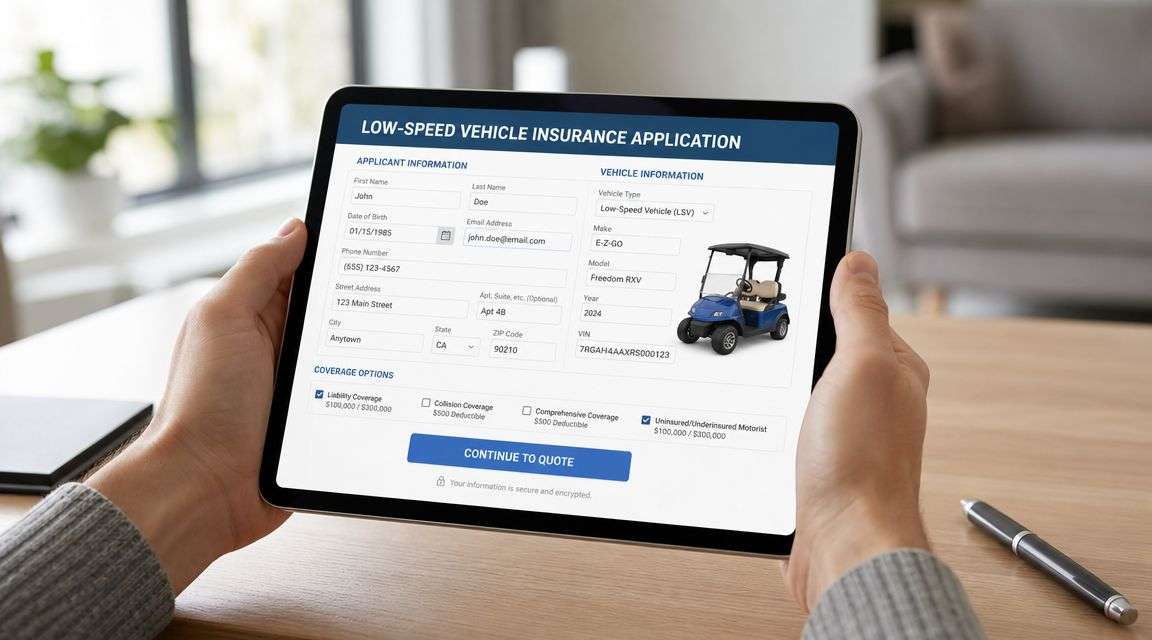
Getting an LSV policy usually goes smoothly when the vehicle is standard, the paperwork is clean, and the use is personal. Trouble starts when owners wait until the last minute, don't know whether the vehicle is classified as an LSV, or forget to mention modifications.
The insurance application itself is usually not the hard part. The hard part is making sure the facts you give the carrier match the vehicle you own and how you use it.
What to gather before you shop
Have your documents ready before you request quotes. That makes the process much cleaner.
Bring together:
- Ownership records: bill of sale, title documents, or manufacturer paperwork
- Vehicle identification details: VIN, make, model, and any conversion information
- Photos if requested: some carriers want current pictures
- Driver information: who will operate the LSV matters
- Usage details: private use, community use, commuting within a neighborhood, or something broader
If the vehicle started life as a golf cart and was later upgraded, expect more questions. Carriers may want to know what changed and whether the vehicle was properly converted for legal road use.
Two common ways to insure it
There isn't one universal path for every owner. Usually, coverage lands in one of two buckets.
Some carriers may write the LSV through an existing auto framework. That can work when the vehicle and usage fit a carrier's guidelines.
Other situations call for a standalone policy. That's often cleaner when the vehicle is distinct enough that it should be insured on its own terms.
If you're comparing costs and trying to understand how these vehicles are typically handled, this page on golf cart insurance cost considerations gives helpful context on what can influence pricing and placement.
What happens with modified or hard-to-place LSVs
This is the part most quick guides skip.
For LSVs with custom modifications, commercial use, or a problematic claims history, standard insurers may deny coverage, and specialty markets may be needed, as noted in this LSV specialty insurance discussion. That can apply to vehicles with lifts, speed-related changes, unusual seating, or use patterns that don't fit a standard personal profile.
A practical reason to use an independent agency in that situation is market access. Agencies such as Florida All Risk Insurance can check different carrier options rather than forcing every risk into one company's rules. That matters when one underwriter is comfortable with a custom build and another is not.
Some LSVs are easy to insure. Some require a fuller story, better documentation, and a carrier that understands nonstandard risks.
Common Exclusions and Key Risk Mitigation Tips
Insurance is just as much about where coverage stops as where it starts.
Many owners focus on what the policy includes and never ask what could trigger a denial. With LSVs, that's a risky habit because the line between private-use assumptions and road-use reality can be sharp.
Where people get surprised
The biggest misunderstanding involves homeowners insurance.
Many homeowners policies either exclude LSVs or cover them only while they're on your own property. Once the vehicle is operated on a public road, it generally needs an auto-style policy, as explained in this article on golf carts, low-speed vehicles, and insurance boundaries.
That means a homeowner may think, “I have an endorsement, so I'm covered,” when the answer is, “You may only be covered in a much narrower setting than you assumed.”
Other exclusions to ask about
Policy language varies, but these situations often deserve special attention:
- Business or delivery use: A personal-use policy may not fit work-related driving.
- Unapproved operators: Problems can arise if the driver doesn't meet policy or legal requirements.
- Use outside allowed areas: Road use beyond what the policy contemplates can create disputes.
- Undisclosed modifications: If the insurer wasn't told about meaningful changes, claims can get messy.
Practical habits that lower risk
A safer ownership routine helps both before and after a claim.
- Check your route: Stay mindful of where the LSV is legally operated in your area.
- Inspect the vehicle regularly: Brakes, lights, tires, and signals deserve routine attention.
- Limit who drives it: Don't treat it like a casual loaner to every visiting friend.
- Store it thoughtfully: Covered storage and anti-theft measures help protect the vehicle itself.
- Review the policy every year: A small change in use can make the old policy less accurate.
One of the simplest ways to avoid a coverage problem is to stop calling everything a golf cart. If the vehicle is legally an LSV, insure it that way and use it that way.
Frequently Asked Questions About Florida LSV Insurance
Can a teenager drive an LSV in Florida
If the vehicle is being operated as a street-legal LSV, treat the question seriously. The legal ability to drive it on public roads is not the same as casually operating a cart on private property. Before handing over the keys, confirm the driver is legally allowed to operate it and that your policy contemplates that driver.
Do I still need insurance if I only use it inside a gated community
Sometimes yes. A private community may still have rules, lender requirements, or HOA expectations that make insurance a smart or necessary move. Even if public-road rules don't apply in the same way inside every community setting, the liability risk doesn't disappear.
Will my umbrella policy cover my LSV
Don't assume it will. Umbrella policies often depend on having the right underlying coverage in place first. If the underlying LSV exposure isn't correctly insured, the umbrella may not solve the problem.
Ask whether your umbrella recognizes the LSV exposure, not just whether you have an umbrella in general.
What if I'm visiting Florida from another state
If you bring an LSV into Florida or use one while staying here for an extended period, don't guess that your home-state setup automatically fits Florida expectations. Vehicle classification, registration obligations, and insurance treatment can vary. It's worth confirming the details before operating it on local roads.
What if my LSV was converted from an older golf cart
That's common, but it often means the insurer will want more detail. A converted vehicle may raise questions about equipment, documentation, and how the unit was built or modified. Be prepared with records and current photos.
Is minimum coverage enough
It may be enough to satisfy a legal minimum. It may not be enough to protect your finances or repair your own vehicle after a loss. That answer depends on how often you drive it, where you park it, the value of the vehicle, and how much liability protection you want.
Get Expert Guidance on Your Florida LSV Insurance
If you remember one thing, make it this. An LSV is not just a golf cart with nicer accessories. For Florida road use, it needs to be treated like a regulated vehicle with the right title, registration, and insurance.
That's why the homeowners-policy shortcut causes so many problems. It feels convenient, but it often breaks down the moment the vehicle leaves private property or enters a setting the policy never meant to cover. The same goes for modified carts and unusual use cases. Those situations need honest disclosure and the right carrier fit.
For official rules, review Florida low-speed vehicle guidance from FLHSMV and general federal context on other vehicle categories from NHTSA. Then talk with a licensed agent about your exact vehicle, your community, and how you plan to use it.
Your Next Steps
If you've just bought an LSV, converted a golf cart, or realized your current coverage may only apply on private property, now is the right time to verify everything before there's an accident.
Ready to review your options and get clarity on what your LSV needs? Contact Florida All Risk Insurance to request a free, no-obligation quote at Florida All Risk Insurance.
Have a modified or hard-to-place LSV and not sure where to start? Call and speak with an agent who can help you compare carrier options and sort out the paperwork before you hit the road.
Contact Us
Florida All Risk Insurance
Address: Saint Petersburg, FL
Phone: (727) 521-4253
Email: [email protected]
If you want practical help sorting out lsv insurance, titling questions, or whether your current policy leaves a road-use gap, reach out to Florida All Risk Insurance for a straightforward review of your options.

