

Low Cost Business Insurance: 5-Step Smart Savings
Why Finding Affordable Coverage is Crucial for Florida Business Owners
Low cost business insurance doesn’t mean cutting corners—it means finding the right coverage at a price that protects both your business and your budget. For small business owners in Florida, securing adequate protection without overpaying is not just a smart financial move; it’s an essential component of long-term success and resilience.
Quick Answer: How to Find Low-Cost Business Insurance
- Assess your specific business risks to avoid paying for unnecessary coverage and identify critical vulnerabilities.
- Compare quotes from multiple providers to find the most competitive rates for your industry and location.
- Bundle policies (like a Business Owner’s Policy) to achieve significant savings, often 10-35%.
- Choose appropriate deductibles and limits to balance premium costs with your acceptable level of out-of-pocket risk.
- Implement proactive risk management practices to reduce claims and qualify for valuable discounts.
Key Facts:
- General liability insurance can start as low as $19-21 per month for low-risk businesses.
- The average cost of general liability is $42-68 per month, varying by industry and operations.
- Bundling policies can save you up to 35% compared to purchasing coverage separately.
- Workers’ compensation is required by law in Florida for most businesses with employees, with strict penalties for non-compliance.
Running a business in the Sunshine State presents a unique set of challenges that go beyond the national norm. From the ever-present threat of hurricane season and flooding to a bustling tourism industry that increases public liability exposure, Florida’s environment demands robust protection. The last thing you need is to drain your budget on overpriced insurance or, even worse, discover you’re underinsured when a disaster strikes or a lawsuit is filed. The goal is to find high-value coverage—a policy that precisely matches your actual needs, eliminating dangerous gaps without forcing you to pay for irrelevant protections. This means understanding what drives your insurance costs and learning proven strategies to reduce premiums without sacrificing the quality of your safety net.
I’m Jason Miller, and as a second-generation insurance professional and owner of Florida All Risk Insurance, I’ve spent over 20 years helping Florida businesses navigate this complex landscape. My team and I specialize in finding low cost business insurance solutions that provide real, tangible protection. This guide will walk you through everything you need to know to find affordable business insurance that maintains the robust protection your business needs to thrive.
What Drives Business Insurance Costs?
Your insurance premium isn’t an arbitrary number pulled from thin air. It’s a carefully calculated figure based on specific, measurable factors that create a detailed picture of your business’s unique risk profile. Understanding these factors is the first step toward taking control of your expenses and finding truly low cost business insurance.
Key Factors That Influence Your Premium
- Industry and Risk Level: This is one of the most significant factors. A roofing contractor who works at heights with heavy materials inherently faces more risk of accidents than a marketing consultant working from a home office. Insurers use specific industry classification codes to assess these inherent risks. Businesses involving manual labor, heavy machinery, hazardous materials, or high levels of public interaction (like restaurants or retail stores) can expect higher premiums due to the increased probability of claims.
- Location: Where you operate matters immensely, especially in Florida. Proximity to the coast dramatically increases risk from hurricanes and windstorms, leading to higher property insurance costs. Beyond weather, factors like local crime rates, the quality of local fire protection, and even regional litigation trends can influence your liability premiums. A business in a St. Petersburg flood zone will have a different risk profile and insurance rate than a similar business in inland Orlando.
- Number of Employees and Payroll: The more employees you have, the greater the potential for workers’ compensation claims. Your total payroll is a primary component in calculating your workers’ compensation premium. The type of work they perform is also critical; an administrative office staff has a much lower risk classification and cost than a construction crew or a team of delivery drivers.
- Claims History: Your track record speaks volumes to insurers. A business with a clean history—few or no claims over several years—is seen as a lower risk and often qualifies for significant discounts and preferred rates. Conversely, a history of frequent or high-cost claims signals a higher risk, which will inevitably lead to higher premiums. For workers’ compensation, this is formalized through an Experience Modification Rate (or EMR), which directly adjusts your premium up or down based on your claims history compared to the industry average.
- Business Operations: The specific nature of what you do, make, or sell directly shapes your insurance needs and costs. A bakery needs coverage for spoilage and equipment breakdown, while a retail clothing store is more concerned with theft and customer slip-and-falls. If you manufacture or sell products, you’ll need product liability coverage to protect against claims that your product caused harm, which adds another layer to your premium.
- Coverage Limits and Deductibles: This is where you have direct control. Higher coverage limits (the maximum amount your insurer will pay for a covered claim) provide more protection but also cost more. A higher deductible (the amount you pay out-of-pocket before your insurance kicks in) will lower your monthly or annual premium. Finding the right balance is key. For example, raising your deductible from $500 to $2,500 could save you 15-20% on your premium, but you must be financially prepared to cover that higher amount if a claim occurs.
Learn more about Business Insurance for LLCs
Understanding Average Costs
While your specific costs will be unique to your business, these national averages provide a useful baseline for what to expect:
- General Liability Insurance: Policies for low-risk small businesses can start as low as $17-$21 per month. The average small business, however, typically pays between $42 and $68 monthly. This wide range demonstrates how much factors like industry and operations matter—and why shopping around is so important.
- Business Owner’s Policy (BOP): This popular bundle combines general liability and commercial property insurance, with an average cost of around $141 per month. It’s almost always more cost-effective than purchasing the two policies separately, making it a cornerstone of affordable coverage for eligible businesses.
- Workers’ Compensation: The national average is about $86 per month per employee, but this is the most variable of all coverages. It’s calculated as a rate per $100 of payroll, and that rate can range from less than a dollar for clerical workers to over $20 for high-risk professions like roofers.
- Professional Liability: Also known as Errors and Omissions (E&O), this coverage averages around $62 per month. It’s essential for any business that provides advice or professional services, protecting against claims of negligence or mistakes.
See General Liability Insurance Cost
What is Considered Low-Cost Business Insurance?
Low cost business insurance is not about finding the absolute cheapest policy on the market; it’s about securing high-value coverage that is precisely tailored to your budget and your risks. For a low-risk, home-based consulting business, a legitimate and adequate policy starting at $19-$25 per month is entirely realistic. For a small restaurant, a \”low-cost\” solution might be closer to $200 per month for a comprehensive BOP, which is still a great value considering the protection it offers.
Smart, low-cost coverage provides sufficient limits to protect your business assets, has a deductible you can comfortably afford, and comes from a reputable, financially stable insurer who will be there to pay a claim when you need them most. Think of it as strategic spending, not corner-cutting. The ultimate goal is to find coverage that fits your business like a glove—protecting everything that needs protecting without wasting a single dollar on what you don’t need.
Explore Cheap Business Insurance
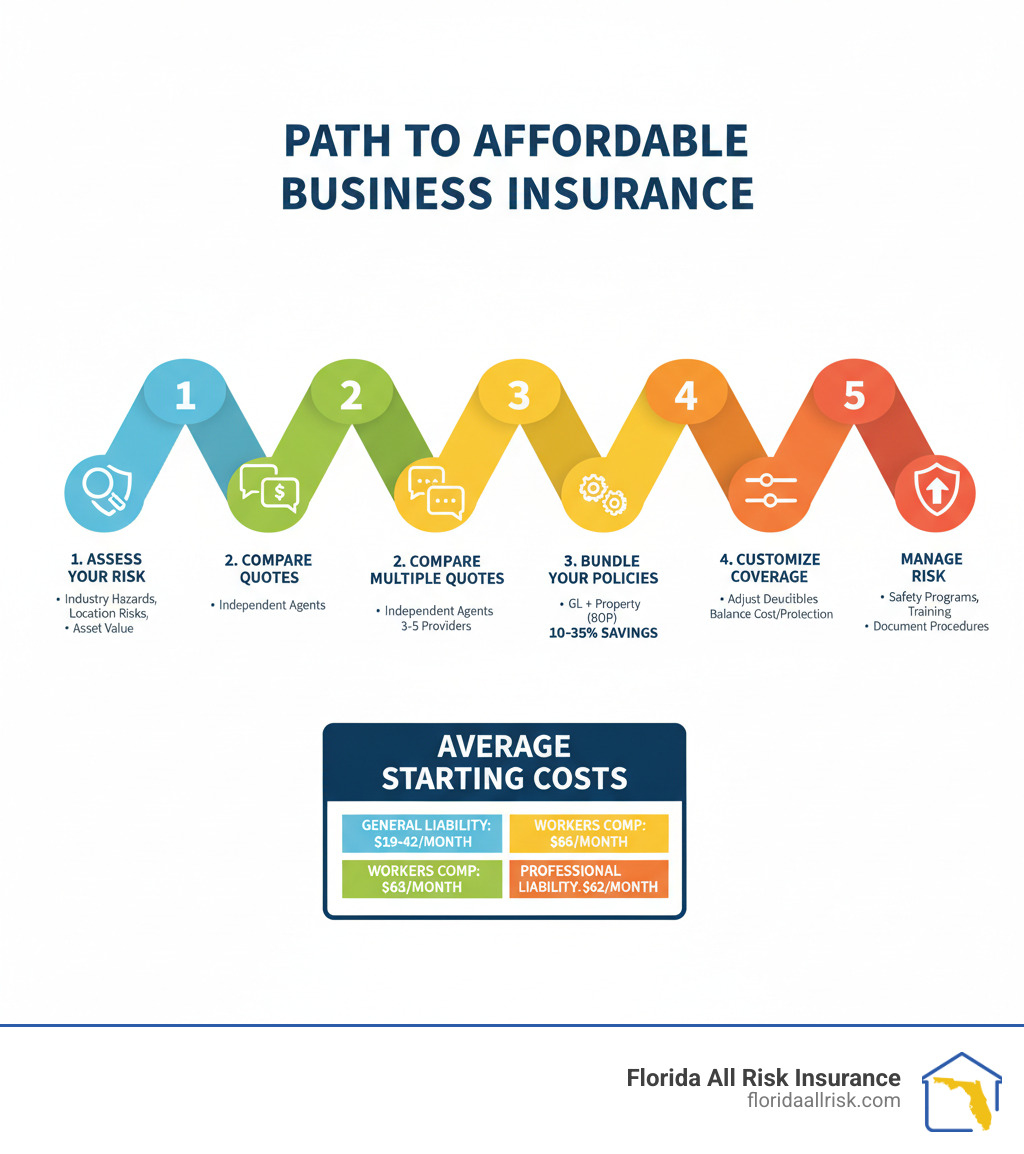
Your 5-Step Strategy for Finding Low-Cost Business Insurance
Finding the right low cost business insurance for your Florida business doesn’t have to be an overwhelming or confusing process. By following this proven, five-step strategy, you can systematically maximize your protection while keeping your premiums as affordable as possible.
Step 1: Assess Your Unique Business Risks
Before you even think about requesting quotes, you must first understand what you need to protect. A thorough risk assessment is the foundation of finding truly low cost business insurance because it ensures you buy exactly what you need—nothing more, nothing less. Ask yourself critical questions:
- Liability Risks: Do customers visit my place of business? Do I or my employees work on client property? Do I serve food or alcohol? Do I advertise my business online or in print?
- Property Risks: What is the value of my building, equipment, inventory, and tools? Do I have critical equipment that would shut down my business if it broke? Do I rely on electronic data?
- Employee Risks: Do I have employees? Are they performing physical labor or working in an office? Do they drive for business purposes?
- Professional Risks: Does my business provide advice or professional services? Could a mistake or omission on my part cause a client a financial loss?
Properly answering these questions helps you avoid wasting money on irrelevant coverage and, more importantly, prevents dangerous gaps in your protection that could prove catastrophic.
General Risk Insurance Information
Step 2: Compare Quotes from Multiple Providers
Never settle for the first quote you receive. Insurance pricing can vary dramatically between carriers, even for identical coverage on the same business. One insurer might have a competitive program for restaurants, while another offers better rates for contractors or consultants. This is where working with an independent insurance agency like Florida All Risk Insurance provides a massive advantage. We work for you, not for a single, captive insurance company. We leverage our established relationships with dozens of top-rated national and regional carriers to gather and compare customized quotes on your behalf, saving you countless hours of research and ensuring you see the best options available in the market.
Why Work With an Independent Insurance Agency
Get a Business Insurance Quote
Step 3: Bundle Policies with a Business Owner’s Policy (BOP)
Bundling is one of the simplest and most effective secrets to affordable insurance. A Business Owner’s Policy (BOP) is a package deal designed for small to medium-sized businesses that combines General Liability and Commercial Property insurance into a single, cost-effective policy. Since most eligible businesses need both types of coverage, a BOP is a natural fit. The savings are substantial, often reducing your total premium by 10% to 35% compared to buying the policies separately. A comprehensive BOP, which might average around $141 per month, is a prime example of low cost business insurance that doesn’t compromise on core protection. Many BOPs also include Business Interruption coverage, which replaces lost income if your business has to temporarily close due to a covered event like a fire.
Business Owner’s Policy Details
Step 4: Customize Your Coverage for Low-Cost Business Insurance
Cookie-cutter policies rarely offer the best value. To achieve truly low cost business insurance, your coverage must be tailored to your specific operations. Adjusting your deductible is a key strategy; a higher deductible lowers your premium, but you must ensure it’s an amount you can comfortably pay out-of-pocket if a claim occurs. Likewise, your policy limits—the maximum an insurer will pay—should align with your real-world risk exposure, not just a generic number. It’s also critical to understand policy exclusions. For example, standard property policies in Florida almost always exclude flood damage. We can help you identify these gaps and add crucial endorsements (policy add-ons) like Hired and Non-Owned Auto liability or Cyber Liability coverage to ensure you’re fully protected where it matters most.
How Much General Liability Insurance Do I Need?
Step 5: Practice Proactive Risk Management
You have the power to actively lower your insurance premiums by making your business a safer place to work and visit. Insurers reward businesses that take risk management seriously. Simple, documented actions can make a big difference:
- For a retail store: Implement regular floor inspections to prevent slip-and-falls and install a high-quality security and camera system.
- For a contractor: Enforce a mandatory safety gear policy (hard hats, safety glasses), conduct regular tool maintenance, and hold weekly “toolbox talk” safety meetings.
- For any business with employees: Create a formal safety manual and document all employee training sessions.
Documenting these efforts provides tangible evidence to insurers that you are a well-managed risk. Over time, a clean claims history is the ultimate reward, qualifying you for the best possible rates and renewal discounts. This creates a positive cycle: a strong safety culture reduces claims, which in turn lowers your insurance premiums.
Fleet Insurance Risk Management
Essential and Affordable Insurance Policies for Small Businesses
Now that we’ve covered the strategies for finding affordable coverage, let’s look at the specific policies that form the backbone of a strong insurance program. These fundamental coverages are designed to be accessible and affordable, creating a comprehensive safety net that protects your Florida business from the most common and potentially devastating risks.
General Liability Insurance: The Foundation
Often called GL, General Liability is the first line of defense against the everyday mishaps and accidents that can occur when you interact with the public. It’s frequently the most affordable and essential policy for any business, regardless of size or industry.
What it covers: GL protects your business from claims of third-party bodily injury, third-party property damage, and personal and advertising injury (like libel, slander, or copyright infringement). If a customer slips and falls in your shop, if an employee accidentally damages a client’s property during a service call, or if your marketing campaign is accused of defaming a competitor, this policy covers the legal defense costs, settlements, or judgments. With policies for low-risk businesses starting as low as $17-$21 per month, it’s truly low cost business insurance that delivers enormous value, as the legal fees from a single lawsuit could easily bankrupt an uninsured business.
What Does General Liability Insurance Cover?
Commercial Property Insurance: Protecting Your Assets
This policy is designed to ensure that a single event like a fire, theft, or storm doesn’t wipe out the physical assets you’ve worked so hard to acquire and build.
What it covers: It protects your physical assets, including your building (if you own it), equipment, tools, inventory, and furniture from a wide range of perils. It’s crucial to understand the type of policy you have: a \”named perils\” policy only covers events specifically listed in the policy, while an \”all-risk\” or \”open perils\” policy covers everything except what is specifically excluded, offering broader protection. For businesses in Florida, it is vital to remember that standard policies explicitly exclude flood damage. The most cost-effective way to purchase this coverage is typically by bundling it with General Liability in a Business Owner’s Policy (BOP), which often includes Business Interruption coverage to replace lost income after a disaster.
Cheap Commercial Property Insurance
Workers’ Compensation: A Legal Necessity
If you have employees in Florida, Workers’ Compensation is not optional—it’s required by law. Beyond mere compliance, it’s a critical policy that protects both your employees and your business.
What it covers: This policy pays for employee medical bills and a portion of their lost wages if they suffer an injury or illness as a direct result of their job. It ensures your employees get the care they need to recover without having to sue your business for damages. In return for providing this no-fault coverage, you are generally protected from employee lawsuits related to workplace injuries. Florida has specific requirements based on your industry (construction has stricter rules) and number of employees. Ignoring these laws can lead to severe fines, stop-work orders, and even criminal charges. While costs vary widely based on payroll and job risk, implementing strong safety programs is the most effective way to control and lower your premiums over time.
Federal requirements for workers’ compensation
Buy Workers Compensation Policy
Professional Liability (E&O): For Service-Based Businesses
If your business makes money by selling its expertise, advice, or professional services, this policy is an absolutely essential safety net.
What it covers: Also known as Errors and Omissions (E&O) insurance, it protects you from claims of negligence, errors, and omissions in the professional services you provide. If a client alleges that your work was substandard, that you made a mistake, or that you failed to do something you should have, causing them a financial loss, E&O covers your legal defense costs and any resulting settlements or judgments. It’s crucial for consultants, accountants, real estate agents, architects, IT professionals, and countless other service providers. For example, if an accountant’s filing error leads to IRS penalties for a client, or a marketing consultant’s campaign fails to deliver promised results, this policy responds. With an average cost of around $62 per month, it’s an incredibly affordable way to protect your professional reputation and your personal and business finances.
Liability Insurance for Consultants
The Hidden Dangers of \”Cheap\” Insurance Policies
While our entire mission is to find you low cost business insurance, we must also provide a crucial warning against the trap of choosing the absolute cheapest policy without fully understanding its limitations. A policy that looks like a bargain on paper can quickly become a financial nightmare at the moment you need it most: during a claim.

High Deductibles and Low Limits
Two of the most common ways to create a \”cheap\” premium are by setting a sky-high deductible and dangerously low coverage limits. A high deductible certainly helps with monthly cash flow, but can your business truly afford to pay that amount unexpectedly when a claim occurs? A $10,000 deductible might save you a few hundred dollars a year on your premium, but coming up with that sum after a fire or theft can be a major burden for a small business. Similarly, a policy with a low coverage limit is a ticking time bomb. Imagine a customer suffers a severe injury at your business, leading to extensive medical bills and a lawsuit. The final judgment is for $750,000. If your \”cheap\” general liability policy only had a $300,000 limit, your business is now on the hook for the remaining $450,000. That kind of gap could force you to liquidate business assets, drain personal savings, or even declare bankruptcy.
Policy Exclusions and Gaps
Every insurance policy contains exclusions—specific situations, perils, and types of damage that are not covered. These are landmines hidden in the fine print of a cheap policy that can leave you completely exposed. It is absolutely critical to understand what your policy does and, more importantly, does not cover.
A prime example for Florida businesses is flood damage. Most standard commercial property policies explicitly exclude damage from rising waters. Imagine a storm surge from a tropical storm floods your St. Petersburg shop, ruining tens of thousands of dollars in inventory and equipment. Without a separate flood insurance policy, you would have to cover 100% of those losses yourself. Other common and dangerous exclusions include:
- Mold and Fungi: Often excluded or severely limited after a water damage event.
- Earth Movement: This can include sinkholes, a known risk in parts of Florida.
- Professional Services: Your general liability policy will not cover claims of professional negligence; that’s why a separate E&O policy is needed.
- Communicable Diseases: Many policies now include exclusions for losses related to viruses or bacteria.
Working with an experienced agent helps identify these potential gaps so your low cost business insurance doesn’t leave you dangerously vulnerable.
Flood Insurance for Businesses
The Peril of Inadequate Coverage
The real danger of chasing the cheapest premium above all else is ending up critically underinsured. The potential financial consequences of inadequate coverage far outweigh any small savings you might realize on your premium. If a customer suffers a severe injury at your business and the resulting lawsuit leads to a $1.5 million judgment, a policy with a standard $1 million limit leaves your business responsible for the remaining $500,000. That kind of financial hit can force a thriving business to close its doors permanently. True value isn’t about paying the absolute least—it’s about getting the most robust protection for every dollar you spend. That’s the fundamental difference between cheap insurance and smart, affordable insurance.
Frequently Asked Questions About Finding Affordable Business Insurance
Business owners throughout Florida often have similar questions when navigating the process of finding the right insurance at the right price. Here are clear, straightforward answers to the most common questions we hear when helping clients secure effective and low cost business insurance.
How does my industry affect my insurance cost?
Your industry is one of the primary factors that determines your insurance premium. Insurers are, at their core, risk calculators, and different industries present vastly different risk profiles. High-risk industries like construction, roofing, and restaurants typically face higher premiums because the statistical likelihood of claims (e.g., worksite accidents, falls from height, kitchen fires, foodborne illness) is significantly greater. Conversely, low-risk businesses such as freelance writers, business consultants, and graphic designers generally enjoy lower premiums because their day-to-day operations present fewer opportunities for third-party property damage or bodily injury. Our job is to ensure your business is classified correctly with the insurance carrier, which is a critical step in securing the best possible rate for your specific operations.
General Liability Insurance for Contractors
Are there any discounts I can get on business insurance?
Absolutely! Many discounts are available, and a key part of our job is to identify every single one you qualify for. Taking advantage of these discounts is a major strategy for lowering your costs. Common discounts include:
- Bundling Policies: Combining General Liability and Commercial Property into a Business Owner’s Policy (BOP) is often the single biggest discount, saving you 10-35%.
- Paying Annually: Paying your full annual premium upfront instead of in monthly installments often earns a discount from the carrier, as it reduces their administrative costs.
- Claims-Free History: Insurers reward businesses that have avoided claims for several years with lower rates at renewal.
- Safety and Security Systems: Installing and maintaining monitored fire alarms, sprinkler systems, and security cameras can significantly reduce property insurance costs.
- Risk Management Programs: Having formal, documented safety procedures, a business continuity plan, and regular employee training demonstrates a commitment to prevention, which can lead to lower premiums.
- Professional Associations: Some carriers offer discounts to members of specific trade or professional organizations.
Is business insurance a tax-deductible expense?
In most cases, yes. The IRS generally considers premiums for business insurance to be ordinary and necessary business expenses, which means they are typically tax-deductible. This includes premiums for general liability, professional liability, workers’ compensation, commercial property, and commercial auto insurance. This deduction effectively reduces your business’s taxable income, which in turn makes your insurance coverage even more affordable. However, tax laws can be complex and may change. For this reason, we always recommend that you consult with a qualified tax professional or CPA to get advice specific to your situation and ensure you are taking full advantage of all available deductions for your Florida business.
IRS guidance on business expenses
Conclusion: Secure Your Business with Smart Savings
Throughout this guide, we’ve explored what it truly means to find low cost business insurance—and I hope you’ve seen that it’s never about cutting corners or accepting inadequate protection. It’s about being strategic and informed. When you assess your unique risks, take the time to compare quotes from multiple providers, bundle policies where it makes sense, customize your coverage to fit your actual needs, and actively manage your business’s risk profile, you’re not just saving money. You’re building a foundation of smart, sustainable protection that allows your business to grow with confidence.
The insurance marketplace can feel overwhelming, especially when you’re already juggling the thousand other responsibilities that come with running a business. That’s precisely why Florida All Risk Insurance exists. As an independent agency right here in St. Petersburg, we’ve spent years building relationships with top-rated carriers and developing a deep understanding of the specific challenges Florida businesses face—from hurricane season to industry-specific risks. We don’t work for the insurance companies; we work for you. Our job is to cut through the complexity, present you with clear options, and help you find low cost business insurance that delivers genuine value, not just a tempting price tag.
When you partner with us, you’re getting more than just a policy. You’re getting a team that takes the time to understand your business, anticipates your needs, and remains available when questions arise or circumstances change. We believe in building lasting relationships, not just completing transactions. Whether you’re launching a new venture, expanding your operations, or simply reviewing your existing coverage, we’re here to ensure you’re correctly covered—protected from the risks that matter without paying for coverage you don’t need.
Your business represents your hard work, your vision, and often your livelihood. Protecting it shouldn’t drain your budget or keep you up at night worrying about gaps in coverage. With the right approach and the right partner, you can have both peace of mind and affordable premiums.
Ready to find the right coverage for your business? Explore our comprehensive small business insurance solutions and find how we can help protect your passion without breaking the bank.
Don’t leave your business’s future to chance. Get a personalized, no-obligation quote today! Let’s work together to find the coverage that fits your business perfectly—robust protection at a price that makes sense.
Contact Us
Whether you’re ready to explore your low cost business insurance options or simply have questions, we’re here to help. At Florida All Risk Insurance, we believe finding the right coverage should be a conversation, not a transaction.
Our team in St. Petersburg is committed to making insurance simple, accessible, and affordable. As an independent agency, we offer honest guidance and personalized solutions. Reach out today to start a conversation about your specific needs.
Florida All Risk Insurance
Address: 4950 17th Street North, Saint Petersburg, FL 33714
Phone: (727) 822-3700
Email: [email protected]

