

Liability Insurance Policy: Your Financial Shield in a World of Risks
A liability insurance policy is an insurance product that provides protection against claims resulting from injuries and damage to other people or property. It covers legal costs and payouts for which you are found legally liable, shielding your personal and business assets from devastating financial consequences.
Key coverage areas include bodily injury, property damage, legal defense costs, and personal injury (libel, slander). Common policy types range from general liability for businesses and professional liability for service providers to personal liability found in homeowners or renters policies. A single accident can be financially crippling: the global liability insurance market is projected to reach $433 billion by 2031, highlighting the growing need for this protection.
Without proper coverage, you could face out-of-pocket expenses for legal fees and judgments that threaten your financial security. Many states require certain types of liability insurance, and clients often demand proof of coverage before doing business.
I’m Jason Miller, an insurance professional with more than 20 years of experience helping Floridians steer liability insurance policy options. At Florida All Risk Insurance, we understand the unique risks in our state and how the right liability coverage provides peace of mind.
Liability insurance policy terminology:
- what does general liability insurance cover
- general liability insurance cost
- buy business insurance online
What is a Liability Insurance Policy and What Does It Cover?
When you’re found legally responsible for causing harm to someone else or damaging their property, a liability insurance policy protects you. It’s often called “third-party insurance” because it pays the other person—the third party—rather than you. This coverage transfers the financial risk of a lawsuit from your shoulders to the insurance company, allowing you to focus on your business or life without constant worry.
For more details on what specific situations are covered, check out our guide on what does general liability insurance cover.
Specific Claims and Damages Typically Covered
A liability insurance policy protects against a wide range of situations:
-
Bodily Injury Liability: This is the most common claim type. It covers medical bills, lost wages, and pain and suffering if someone is physically hurt due to your business operations, whether on your premises or at a client’s location.
-
Property Damage Liability: This protects you when you’re responsible for damaging someone else’s property. It pays for repair or replacement costs, such as if a contractor breaks a client’s window. It can also include “completed operations coverage” for damage that appears after a job is finished.
-
Personal and Advertising Injury: This covers harm to someone’s reputation or rights, not physical injury. It includes claims of libel and slander, copyright infringement in your marketing, malicious prosecution, or wrongful eviction.
-
Medical Payments Coverage: This feature pays for immediate, minor medical expenses if someone is injured on your property, regardless of who was at fault. It’s a goodwill gesture that can help prevent a small incident from escalating into a large lawsuit.
-
Legal Defense Costs: Beyond the damages themselves, your policy covers attorney fees, court costs, and investigation expenses, even if a lawsuit is groundless. If you are found liable, it also pays the settlement or judgment up to your policy limits.
Common Exclusions: What’s Generally Not Covered
While comprehensive, a liability insurance policy has exclusions. Understanding them helps you build a complete protection plan.
- Intentional Acts: Insurance covers accidents and negligence, not deliberate harm or criminal behavior.
- Contractual Liability: Assumed liability in a contract beyond what you’d normally be responsible for is often excluded.
- Employee Injuries: These are covered by Workers’ Compensation insurance, not general liability. This state-mandated coverage for job-related employee injuries is a separate policy, and you can learn more about employer responsibilities from the U.S. Department of Labor.
- Damage to Your Own Property: This is covered by your own property insurance (commercial or homeowners).
- Professional Errors: Mistakes related to professional services (like consulting or design) require separate Professional Liability or Errors & Omissions (E&O) insurance.
- Auto Accidents: Incidents involving business vehicles require commercial auto insurance.
- Pollution: Environmental damage typically requires specialized pollution liability coverage.
- War and Terrorism: These are standard exclusions in most insurance policies.
A complete insurance strategy often involves multiple policies. For higher-risk industries, we can help you explore options like High Risk General Liability Insurance to fill any gaps.
The Main Types of Liability Insurance for Businesses and Individuals
The world of liability insurance offers specialized protection for specific risks. The policies available vary depending on whether you’re safeguarding a business or your personal assets. Each policy is like a specific tool designed for a particular job, ensuring you have the right protection.

Business Liability Insurance: Protecting Your Company
For any business, a liability insurance policy is a core part of risk management. Here are the main types:
-
General Liability Insurance: This is the foundation, protecting your business from claims of bodily injury, property damage, and advertising injury. It’s essential for any business that interacts with the public. Learn more about Commercial General Liability Insurance For Small Business.
-
Professional Liability (E&O): Also known as Errors and Omissions insurance, this is vital for businesses providing professional advice or services. It covers claims of negligence or errors that cause a client financial loss.
-
Directors and Officers (D&O) Liability Insurance: This policy protects the personal assets of a company’s directors and officers from lawsuits alleging wrongful acts in their managerial roles.
-
Employment Practices Liability Insurance (EPLI): EPLI covers claims from employees related to issues like wrongful termination, discrimination, and sexual harassment, which are often defined by regulations from bodies like the U.S. Equal Employment Opportunity Commission (EEOC).
-
Cyber Liability Insurance: This protects your business from the financial fallout of data breaches and cyberattacks, covering costs like customer notification, credit monitoring, and legal fines. Given the rising threat of cybercrime, government resources like the Cybersecurity and Infrastructure Security Agency (CISA) offer guidance for businesses.
-
Product Liability Insurance: If your business makes, distributes, or sells products, this covers claims that your product caused injury or damage due to a defect.
Personal Liability Insurance: Shielding Your Personal Assets
Individuals also face significant liability risks. A lawsuit can lead to financial disaster without the right liability insurance policy.
-
Homeowners and Renters Insurance: The liability portion of these policies protects you from claims of injury or property damage that occur on your property or are caused by your actions.
-
Auto Liability Coverage: Mandatory in most states, including Florida, this covers injury and property damage you cause to others in a car accident. For more, see Liability Car Insurance Florida.
-
Personal Umbrella Policy: This powerful tool provides additional liability coverage above the limits of your home and auto policies. It’s a cost-effective way to get millions in extra protection against catastrophic claims.
-
Watercraft Liability: If you own a boat, this specialized coverage protects you from claims of injury or property damage caused by your vessel.
Who Needs Liability Insurance and Why Is It Crucial?
Almost everyone can benefit from a liability insurance policy. We all face potential liability risks, whether running a business, owning property, or going about our daily lives. An unexpected accident can result in costly lawsuits that threaten everything you’ve built.

Liability risks touch every aspect of modern life. Small business owners, independent contractors, and freelancers face daily exposure through customer interactions and professional services. Many clients now refuse to work with contractors who can’t provide a certificate of insurance, making General Liability Insurance For Contractors a necessity. Professionals like doctors and lawyers, manufacturers, and landlords all carry significant responsibilities that create liability exposure. Even individuals with modest assets need protection, as a car accident or an incident on your property can lead to claims that exceed your ability to pay.
The importance of a liability insurance policy is clear for several reasons:
- Legal and Contractual Requirements: Many states legally require certain policies (like auto liability), and clients often contractually obligate vendors to carry specific coverage.
- Financial Solvency: Legal defense costs alone can be crippling. Insurance covers these fees and potential judgments, preventing financial ruin.
- Business Continuity: A policy allows your insurer to handle the legal complexities of a lawsuit, so you can continue running your business.
The liability landscape is constantly evolving with new risks, as highlighted by research from Swiss Re on liability claims trends, making proactive protection more important than ever.
Why a Liability Insurance Policy is Non-Negotiable for Businesses
For any Florida business, a liability insurance policy is fundamental to survival. It mitigates devastating lawsuit costs, fulfills contractual obligations required by clients, and helps attract and retain customers by demonstrating professionalism. Most importantly, it protects business assets from being seized to satisfy judgments, ensuring the long-term viability and sustainable growth of your company. For comprehensive options, explore our Business Liability Insurance solutions.
When Individuals Need More Than Standard Coverage
Standard homeowners or auto insurance provides basic liability protection, but it’s often not enough. Consider extra coverage, like a personal umbrella policy, in these situations:
- You have a high net worth, making you an attractive target for lawsuits.
- You own rental properties, which increases your liability exposure.
- You have “attractive nuisances” like a swimming pool or trampoline.
- You own certain dog breeds that may be excluded from standard policies.
- You serve on a non-profit board, which can expose your personal assets.
- You want to protect future earnings from being garnished to pay a large judgment.
How a Liability Insurance Policy Works: From Claim to Resolution
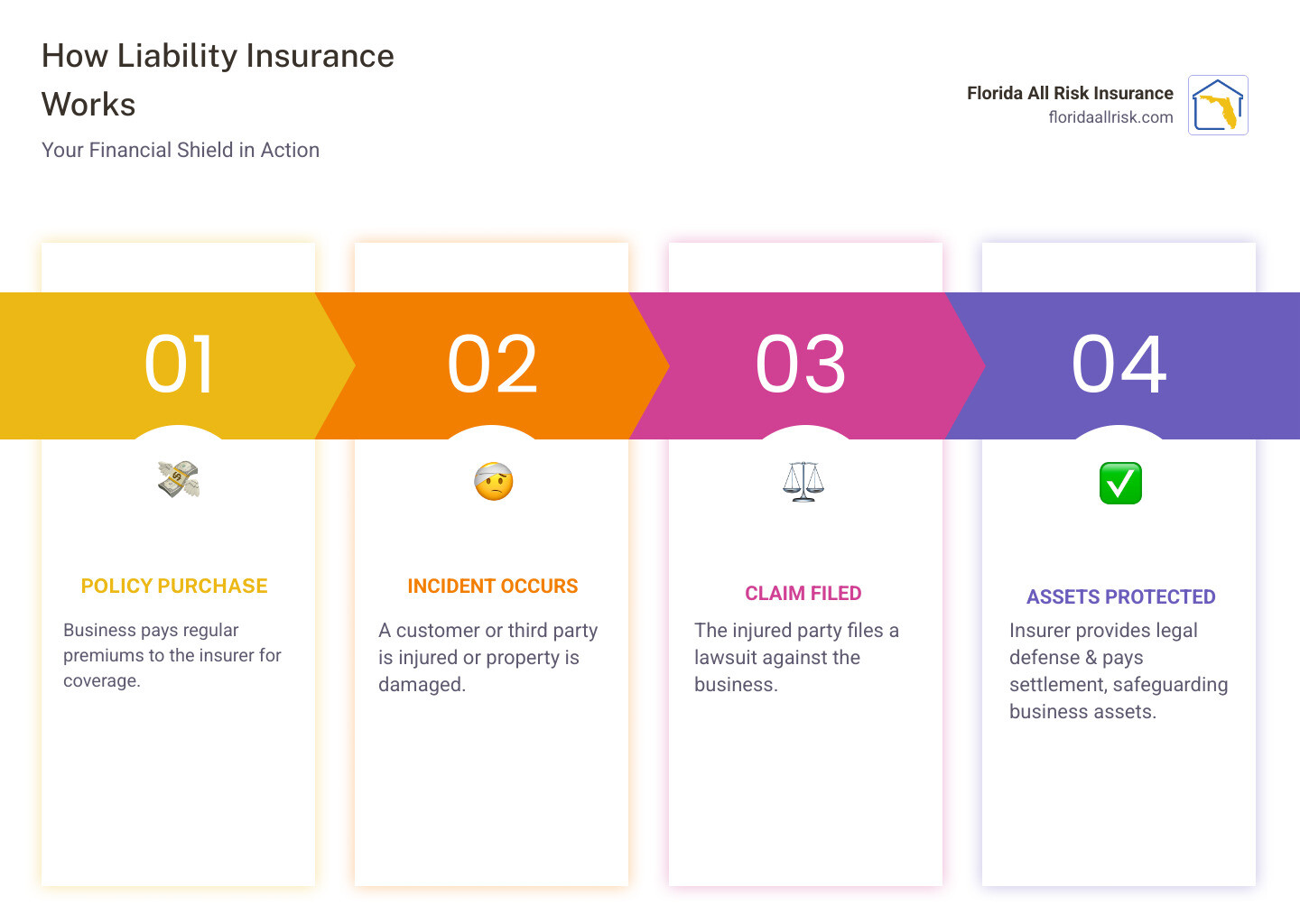
When someone files a claim against you, your liability insurance policy provides a skilled legal and financial team to protect you. The process is designed to shield your interests from the moment an incident occurs.

The process begins when an incident happens. Your first and most critical step is to notify your insurer immediately. Delaying notification can jeopardize your coverage. Once notified, your insurer investigates the claim, gathering facts and assessing whether the claim is covered. If a lawsuit is filed, your insurer appoints legal counsel to represent you and manages the entire litigation process.
Throughout the process, your insurer may negotiate a settlement. If the case goes to trial and you’re found liable, the insurer pays the covered damages, settlements, or judgments up to your policy limits, in addition to your legal defense costs.
The Insurer’s Core Duties When a Claim Is Made
When you buy a liability insurance policy, your insurer assumes three legally binding responsibilities:
- The Duty to Defend: Your insurer must hire and pay for attorneys to defend you against any lawsuit that could potentially be covered—even if the claim is groundless or fraudulent. As this detailed overview of an insurer’s duty to defend explains, legal defense costs are typically paid outside of your policy limits, so they don’t reduce the amount available for a settlement.
- The Duty to Indemnify: The insurer pays for settlements or court-ordered judgments on your behalf, up to the policy’s coverage limits.
- The Duty to Settle: Your insurer must act in good faith and consider reasonable settlement offers within your policy limits, protecting you from an “excess judgment”—a court award that exceeds your coverage.
Occurrence vs. Claims-Made: A Critical Distinction
Understanding the difference between occurrence and claims-made policies is essential, as it determines when your coverage responds.
- Occurrence Policies: Cover incidents that occur during the policy period, no matter when the claim is filed. If an incident happens in 2024, your 2024 policy will respond even if the claim isn’t filed until 2027. This structure is valuable for “long-tail” claims where harm isn’t finded for years.
- Claims-Made Policies: Cover claims that are first made against you during the policy period, for incidents that happened after a specified retroactive date. When you cancel or switch this type of policy, you may need to purchase “tail coverage” (an Extended Reporting Period) to cover future claims arising from your past work.
Claims-made policies are common for professional services—such as those protected by General Liability Errors and Omissions Insurance—where mistakes may not be finded immediately.
Determining Your Needs: Costs, Limits, and Extra Protection
Choosing the right liability insurance policy involves balancing your budget with your specific needs. The goal is to find reliable coverage that fits your unique risk profile without feeling overwhelming.

Factors That Influence the Cost of Your Liability Insurance Policy
Every liability insurance policy is priced based on risk. Key factors include:
- Industry: Higher-risk fields like construction and healthcare typically have higher premiums than office-based professions.
- Business Size and Revenue: More revenue often means more customers and projects, increasing potential exposure.
- Number of Employees: Each employee represents an additional risk exposure.
- Claims History: A clean record can lower your premiums over time, while past claims will increase them.
- Location: Operating in areas with higher litigation rates can impact costs.
- Coverage Choices: Higher coverage limits increase premiums, while higher deductibles can lower them. Deciding on How Much General Liability Insurance Do I Need? is a key step.
- Safety Measures: Demonstrating a commitment to risk management through safety protocols can lead to better rates. For more on costs, visit our detailed guide to Liability Insurance Cost.
Selecting Appropriate Policy Limits
Determining suitable limits is as much an art as a science. Start by identifying worst-case scenarios for your industry. For example, a restaurant owner must consider the possibility of a food-borne illness outbreak affecting dozens of patrons, whereas a software developer worries more about a coding error that cripples a client’s e-commerce platform. In general:
- Small, low-risk businesses often choose $1 million per occurrence / $2 million aggregate limits.
- Medium-sized firms or those with moderate risk exposures may opt for $2 million / $4 million limits.
- High-risk operations—such as roofing contractors—frequently pair $2 million primary limits with an umbrella policy that provides an additional $3–$5 million in protection.
When calculating limits, legal defense costs can easily reach six figures before a case ever gets to trial, and jury awards continue to rise. In 2023, the median U.S. liability award for bodily injury exceeded $125,000, while so-called “nuclear verdicts” (awards over $10 million) are becoming more common, according to data from the Insurance Information Institute. A higher limit today can prevent an asset-draining shortfall tomorrow.
Risk-Management Strategies That Lower Premiums
Insurance should never be your only defense. By implementing formal risk-management practices, you reduce both the frequency and severity of claims, which in turn lowers your premiums over time. Practical steps include:
- Written Safety Protocols: Documented procedures—such as ladder-safety rules for contractors or data-encryption standards for IT firms—demonstrate to underwriters that you take loss prevention seriously.
- Employee Training: Regular training sessions on topics like customer interaction, safe equipment operation, and cyber-security best practices create a culture of accountability.
- Contractual Risk Transfer: Whenever possible, use contracts to transfer certain liabilities to subcontractors or vendors who are better positioned to control those risks.
- Incident Reporting Culture: Encourage employees to report near-misses. Addressing small hazards early prevents larger, costlier claims later.
Maintaining a strong track record can earn you claims-free discounts or access to preferred-risk underwriting tiers, potentially saving thousands of dollars annually.
How Umbrella Liability Insurance Provides Additional Protection
Umbrella liability insurance is a powerful, cost-effective tool that provides an extra layer of security over your primary policies. It is your financial backup for catastrophic events.
An umbrella policy kicks in when your primary policies (like auto or general liability) reach their limits. If a lawsuit results in a $2 million judgment but your primary policy only covers $1 million, the umbrella policy would cover the remaining $1 million.
Beyond just higher limits, umbrella policies often provide broader protection, filling gaps that may exist in your underlying coverage—for instance, covering personal injury claims such as libel or slander that a basic homeowners policy may exclude. They can also provide worldwide protection, an important feature for businesses and individuals who travel or operate internationally.
Because umbrellas sit “above” existing coverage, they’re surprisingly affordable—often as little as a few hundred dollars per year for an extra $1 million in limits. For a deeper dive into over-limit protection, explore the concept of Excess Public Liability and how it integrates with a broader risk-management program.
Taking the time to match your policy’s limits, deductibles, and supplemental coverage to your actual risk profile not only safeguards your assets—it also demonstrates responsible stewardship to lenders, investors, and clients, strengthening your professional reputation.
Conclusion: Securing Your Future With the Right Liability Coverage
Understanding your liability insurance policy is the first step toward comprehensive financial security. This coverage is a fundamental part of any risk-management strategy, protecting your business and personal assets from potentially devastating lawsuits.
Think of liability insurance as your silent financial guardian. Whether you’re a small-business owner, a contractor, or a homeowner, the right coverage provides invaluable peace of mind, allowing you to focus on what matters most.
Ready to safeguard your future? Get a quote for your general liability needs today!
Contact Us
Florida All Risk Insurance
Address: Saint Petersburg, FL
Phone: (727) 341-1234
Email: [email protected]

