Liability insurance for business cost: Ultimate Guide 2025
Introduction: Protecting Your Business From Financial Risk
The liability insurance for business cost is a critical concern for any Florida business owner. Understanding what you’ll pay to protect your company from lawsuits and claims is essential for budgeting and effective risk management.
Quick Answer: What Does Business Liability Insurance Cost?
- General Liability Insurance: $400-$1,000 annually for small businesses.
- Professional Liability Insurance: $500-$2,500/year for small businesses.
- Cyber Insurance: Starts around $1,500 per year.
- Product Liability Insurance: Starts at $800 annually.
- Commercial Auto Insurance: Starts at $500 per vehicle annually.
Business liability insurance protects your company from financial losses when a third party claims your business caused them harm. This includes bodily injury (like a customer slipping in your store), property damage (an employee damaging a client’s equipment), and advertising injury (like copyright infringement).
Without this protection, a single lawsuit could drain your business savings. The average slip-and-fall claim alone costs $20,000 to settle. Every business faces these risks, from a restaurant facing a food poisoning claim to a consultant sued for advice that led to a client’s financial loss. Liability insurance covers legal defense fees, settlements, and judgments up to your policy limits, giving you peace of mind to focus on growing your business.
This guide will break down the types of coverage, average costs, and key factors influencing your premiums, along with strategies to reduce your insurance costs without sacrificing protection.
Understanding the Different Types of Business Liability Insurance
Your business faces different kinds of risks, and each requires specialized protection. A restaurant owner in St. Petersburg faces different liability issues than a Tampa consultant. Understanding the main types of liability insurance helps you choose the right protection and understand your liability insurance for business cost.

Commercial General Liability (CGL) Insurance
Think of CGL as your business’s foundational protection. It covers everyday accidents and mishaps that can occur when running a company. CGL protects you from claims that your business operations caused bodily injury or property damage to a third party (anyone not your employee).
- Bodily Injury: Covers medical expenses and legal fees if a customer is injured at your business, such as slipping on a wet floor.
- Property Damage: Pays for repairs or replacement if your business damages someone else’s property, like a landscaper breaking a client’s window.
- Personal and Advertising Injury: Protects against claims of slander, libel, or copyright infringement in your marketing materials.
CGL also includes medical payments coverage, which pays for small medical expenses if someone is hurt on your property, regardless of fault, often preventing larger lawsuits. If you have a physical storefront, visit client locations, or interact with the public, you need CGL insurance.
Professional Liability (Errors & Omissions) Insurance
While CGL covers physical damages, Professional Liability—also known as Errors & Omissions (E&O) insurance—protects you from claims of financial loss due to your professional services. The Small Business Administration explains that E&O insurance protects businesses that provide professional advice from claims of inadequate work or negligent actions.
This coverage is for claims of negligence, errors, or omissions. For example, if an accountant makes a mistake on a tax return that costs a client thousands in penalties, E&O insurance would cover the legal defense and settlement.
Who needs E&O? Any business providing professional advice or services, including:
- Consultants
- Accountants and bookkeepers
- Real estate agents
- IT professionals and designers
- Lawyers and engineers
A key distinction: CGL covers physical harm (bodily injury/property damage), while E&O covers financial harm from professional services. Many businesses need both.
Other Critical Liability Coverages
Beyond CGL and E&O, other specialized policies might be essential for your Florida business.
Product Liability Insurance is crucial if you manufacture, distribute, or sell physical products. It protects you if a product you sell causes injury or damage. This applies to manufacturers, retailers, and e-commerce sellers alike. Even if you didn’t make the defective product, you could be held liable.
Cyber Liability Insurance is essential for any business that handles customer data. It protects against the financial fallout from data breaches and cyberattacks, covering costs like customer notification, credit monitoring, regulatory fines, and data recovery. With the average cost of a small business data breach exceeding $200,000, this coverage is a modern necessity.
Commercial Auto Insurance is required if your business owns vehicles or if employees use their cars for work. Personal auto policies do not cover business use. This insurance covers liability for accidents involving business vehicles and can also include coverage for employees using their personal vehicles for business errands (non-owned auto coverage).
What is the Average Liability Insurance for Business Cost?
While the liability insurance for business cost is unique to each company, averages provide a helpful starting point for budgeting. Your final premium will depend on your specific industry, size, and risk factors.
Average Costs for Common Liability Policies
- General Liability Insurance: Most small businesses pay between $400 and $1,000 annually. A standard $1 million policy averages around $69 per month ($824 yearly).
- Professional Liability Insurance: Costs typically range from $500 to $2,500 annually. Sole proprietors often pay on the lower end, around $400 to $800 per year.
- Cyber Insurance: Premiums generally start at $1,500 per year and increase based on the volume and sensitivity of the data you handle.
- Product Liability Insurance: Starting costs are around $800 annually but vary significantly based on the product’s risk.
- Commercial Auto Insurance: Premiums begin at about $500 annually per vehicle, depending on vehicle type, usage, and driver records.
How Industry Impacts the Liability Insurance for Business Cost
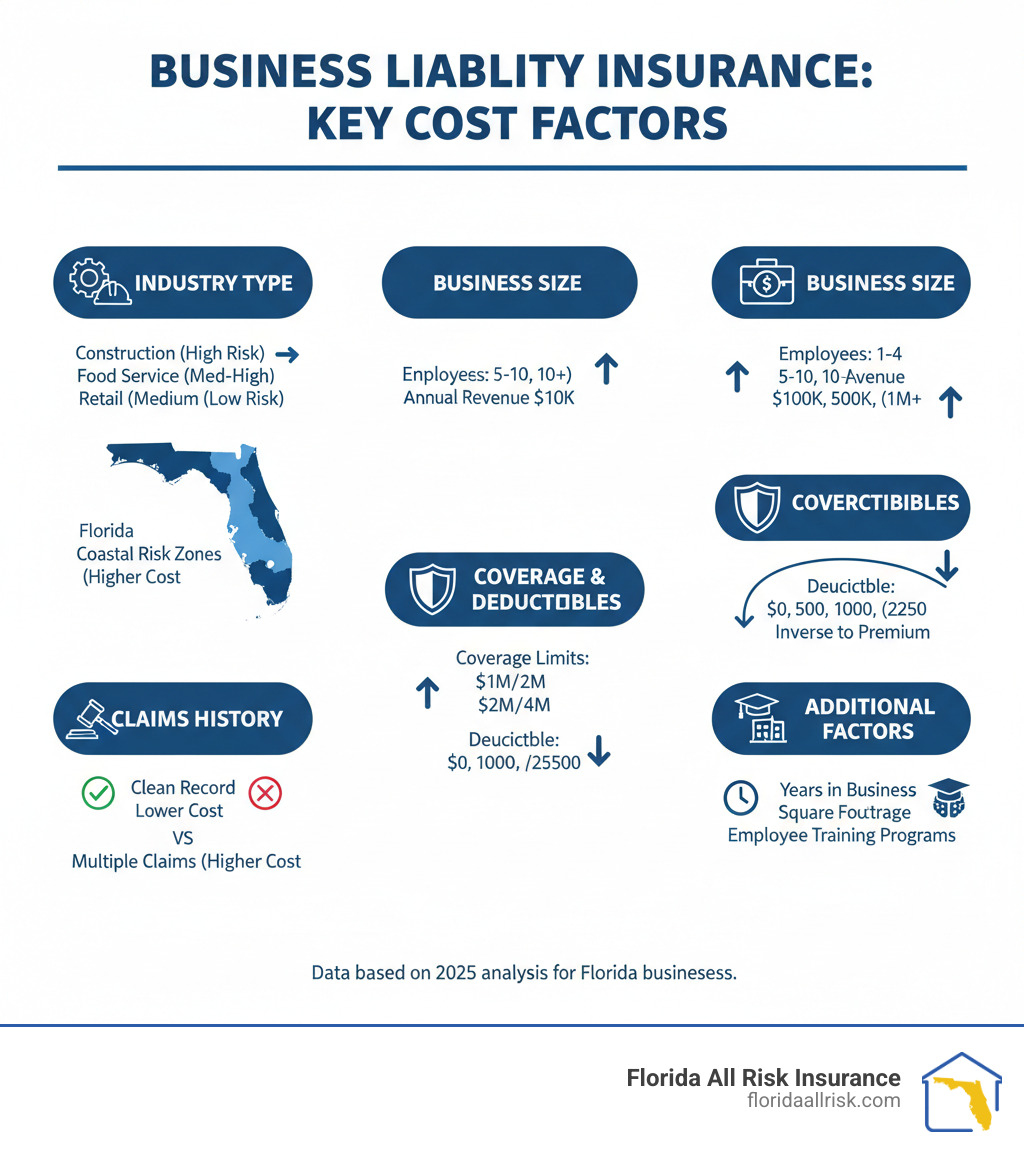
Your industry is one of the biggest factors determining your insurance cost. Insurers use historical data to assess which industries pose higher risks. A construction company’s physical work carries more inherent risk than a graphic designer working from home, and premiums reflect that.
Here’s a look at average annual general liability costs for small businesses across different sectors:
- IT/Technology: $418
- Photographers: $437
- Accountants: $675
- Retail Stores: $696
- Food & Hospitality: $776
- Landscaping: $783
- Business Consultants: $780
- Construction/Contracting: $1,076
- Restaurants: $2,408
High-risk industries like construction and restaurants face higher premiums due to the greater potential for accidents, injuries, and large claims.
How Business Size and Revenue Affect Costs
The size of your business directly influences your premium. More employees and higher revenue generally mean more operations, more customer interactions, and therefore, more opportunities for a claim to arise.
An insurer sees each employee as a potential source of a claim, whether from an accident or a mistake. Likewise, higher annual revenue often correlates with larger projects and greater potential liability. For example, a general contractor’s premium will increase significantly as their revenue grows from $250,000 to $1 million because higher revenue implies larger, riskier projects. In contrast, a financial consultant’s premium might see a more modest increase for the same revenue growth, as the nature of their risk doesn’t scale as dramatically. Insurers evaluate the scale of your operations to calculate your total risk exposure.
Key Factors That Influence Your Insurance Premiums
Insurers don’t pull your premium out of thin air; they perform a detailed risk assessment of your business. Understanding the factors they evaluate can help you manage risks and potentially lower your liability insurance for business cost.
Business Location and Operations
Where you do business plays a significant role. Businesses in dense urban areas often face higher rates due to increased litigation and more potential for claims. In Florida, specific risks like coastal weather events and high-traffic tourist zones can also influence liability costs. The nature of your operations matters, too. A busy St. Petersburg retail store with high foot traffic has a greater slip-and-fall risk than a home-based business. Insurers also consider the size and condition of your physical premises; a well-maintained property with clear safety protocols signals lower risk and can lead to better pricing.
Your Policy’s Coverage Limits and Deductibles
You have direct control over your costs through the coverage limits and deductibles you select.
- Coverage Limits: This is the maximum amount an insurer will pay for a claim. Policies have a “per-occurrence” limit (for a single incident) and an “aggregate” limit (the total for the policy period). A common choice for small businesses is a $1 million per-occurrence limit and a $2 million aggregate limit, which provides solid protection for most scenarios. Increasing your limits often costs less than you might think and can provide significant additional protection.
- Deductibles: This is the amount you pay out-of-pocket before insurance kicks in. A higher deductible typically means a lower premium, as you are taking on more of the initial risk. The key is to choose a deductible amount that your business could comfortably afford in an emergency.
Claims History and Business Experience
Your business’s track record is a crucial factor. A history of frequent or large claims signals higher risk to insurers and will likely result in higher premiums. Maintaining a clean claims record is one of the best ways to secure favorable rates. Similarly, your years in business matter. Established businesses with a proven, claims-free history are seen as lower risk than new ventures. Insurers often reward this demonstrated experience with better rates, so as your business matures and proves its commitment to safety, your insurance costs can improve.
How to Save Money on Your Business Liability Insurance
You have more control over your liability insurance for business cost than you might realize. By implementing smart strategies, you can often reduce your premiums without compromising on the protection your business needs.
Implement Practical Risk Management
Insurers favor businesses that prioritize safety. A proactive approach to risk management can lead to fewer claims and lower premiums. A strong risk management plan shows you are serious about preventing accidents. For more details, the Insurance Information Institute offers guidance on managing business risks.
Consider these practical steps:
- Formalize Safety Protocols: Create and enforce clear procedures for tasks like cleaning spills, handling customer complaints, and securing your premises.
- Conduct Employee Training: Regularly train your team on safety procedures, proper equipment use, and safe customer interaction.
- Maintain Your Premises and Equipment: Keep your property in good repair and follow a regular maintenance schedule for all equipment to prevent accidents.
- Use Clear Client Contracts: For service-based businesses, well-drafted contracts that clearly define expectations and deliverables can prevent disputes and professional liability claims.
- Install Security Systems: Surveillance cameras, alarms, and good lighting deter theft and vandalism and may qualify you for a discount.
Bundle Policies with a Business Owner’s Policy (BOP)
A Business Owner’s Policy (BOP) combines Commercial General Liability and Commercial Property insurance into a single, convenient package. This is often significantly cheaper—sometimes 15-30% less—than buying the policies separately. A BOP simplifies your insurance management with one policy, one renewal date, and one premium payment. Many BOPs also include business interruption coverage, which replaces lost income if a covered event forces you to close temporarily.
Review Your Policy and Compare Quotes Annually
Your business changes over time, and your insurance should too. An annual policy review is essential to ensure your coverage still fits your needs. The insurance market also changes, with carriers adjusting rates and offerings. Working with an independent insurance agency like Florida All Risk Insurance gives you a major advantage. We shop your coverage across multiple carriers to find the best combination of protection and price. This process helps you avoid being under-insured (leaving you exposed) or over-insured (paying for coverage you don’t need), ensuring your protection evolves with your business.
Frequently Asked Questions about Liability Insurance for Business Cost
Business owners often have questions about the cost and scope of liability insurance. Here are answers to some of the most common inquiries we receive from Florida businesses.
Is business liability insurance mandatory in Florida?
While Florida does not have a statewide law mandating general liability insurance for all businesses, it is practically essential for most. Many contracts, especially with larger clients or government agencies, require proof of insurance. Landlords almost universally require tenants to carry it as a condition of a commercial lease. Furthermore, many professional licenses, particularly for contractors, have specific liability insurance requirements. So, while not always legally mandatory, operating without it can severely limit your business opportunities and leave you financially exposed.
What is NOT covered by a standard general liability policy?
Understanding what your policy excludes is as important as knowing what it covers. A standard CGL policy typically does not cover:
- Professional Errors: Mistakes or negligence in the professional services you provide. This requires Professional Liability (E&O) insurance.
- Employee Injuries: Injuries to your employees on the job. This is covered by Workers’ Compensation insurance.
- Business Vehicle Accidents: Incidents involving vehicles used for business purposes. This requires Commercial Auto insurance.
- Damage to Your Own Property: Damage to your building, equipment, or inventory. This is covered by Commercial Property insurance (often part of a BOP).
- Intentional Acts: Deliberate harm or criminal behavior is never covered by insurance.
How do I determine the right amount of coverage for my business?
Choosing the right coverage amount is a balance between your budget and your risk exposure. It’s a critical decision that directly impacts your liability insurance for business cost and your financial security. Consider these factors:
- Risk Assessment: Evaluate the potential hazards in your daily operations. Higher-risk industries (like construction or restaurants) generally need higher limits.
- Industry Standards: A common starting point for many small businesses is a $1 million per-occurrence / $2 million aggregate limit, but check what is standard for your specific field.
- Contractual Requirements: Review your contracts with clients and your commercial lease, as they often specify minimum coverage amounts.
- Business Size and Revenue: Larger businesses with higher revenues have more to lose and greater exposure, typically requiring higher limits.
- Consult an Expert: The best way to find the right balance is to speak with an experienced insurance professional who can analyze your unique risks and recommend appropriate coverage.
Get a Clear Picture of Your Business Insurance Costs
Navigating business insurance, especially understanding the liability insurance for business cost, can feel overwhelming. But as we’ve explored, it’s a crucial investment in protecting the hard work and dreams you’ve poured into your Florida business.
We’ve seen that costs are far from uniform, varying widely based on your industry, business size, location (especially here in our beautiful but sometimes unpredictable Florida), claims history, and the specific types and amounts of coverage you choose. While average figures provide a helpful benchmark, your unique business profile will ultimately dictate your actual premiums.
The value of robust liability insurance cannot be overstated. It’s not just about compliance or avoiding fines; it’s about safeguarding your assets, maintaining your reputation, and securing the peace of mind to focus on what you do best: running and growing your business. A single unforeseen incident or lawsuit can be financially devastating without the right protection.
This is where the value of professional guidance becomes invaluable. As an independent agency based right here in St. Petersburg, Florida, Florida All Risk Insurance prides itself on offering personalized service. We understand the local market, the unique risks Florida businesses face, and we have access to a wide network of carriers. This allows us to help you steer through the options, compare competitive rates, and find custom coverage that perfectly fits your business needs and budget.
Ready to protect your business and understand your specific liability insurance for business cost? Contact Florida All Risk Insurance today for a personalized consultation.
Don’t leave your business exposed. Get a free, no-obligation quote online and see how affordable peace of mind can be.
Contact Us
Finding the right liability insurance for business cost solution for your Florida business is our priority. Whether you’re just starting out or looking to review your current coverage, our team is here to provide the personalized guidance you deserve.
At Florida All Risk Insurance, we are an independent agency proud to serve businesses throughout the Sunshine State from our office in St. Petersburg. Our loyalty is to you, our client, and we leverage our access to multiple carriers to find coverage that truly fits your needs and budget.
Contact us today for a no-obligation consultation. We look forward to helping you protect what you’ve worked so hard to build.