

Cheapest car insurance for old cars: 7 Smart Ways to Save
Why Finding the Cheapest Car Insurance for Old Cars Matters
Finding the cheapest car insurance for old cars is easier than many drivers expect—and smart choices can save you hundreds of dollars each year. If your vehicle is 10 years or older, there’s a good chance you’re still paying for coverage you no longer truly need.
Quick Answer: How to Get the Cheapest Car Insurance for Your Old Car
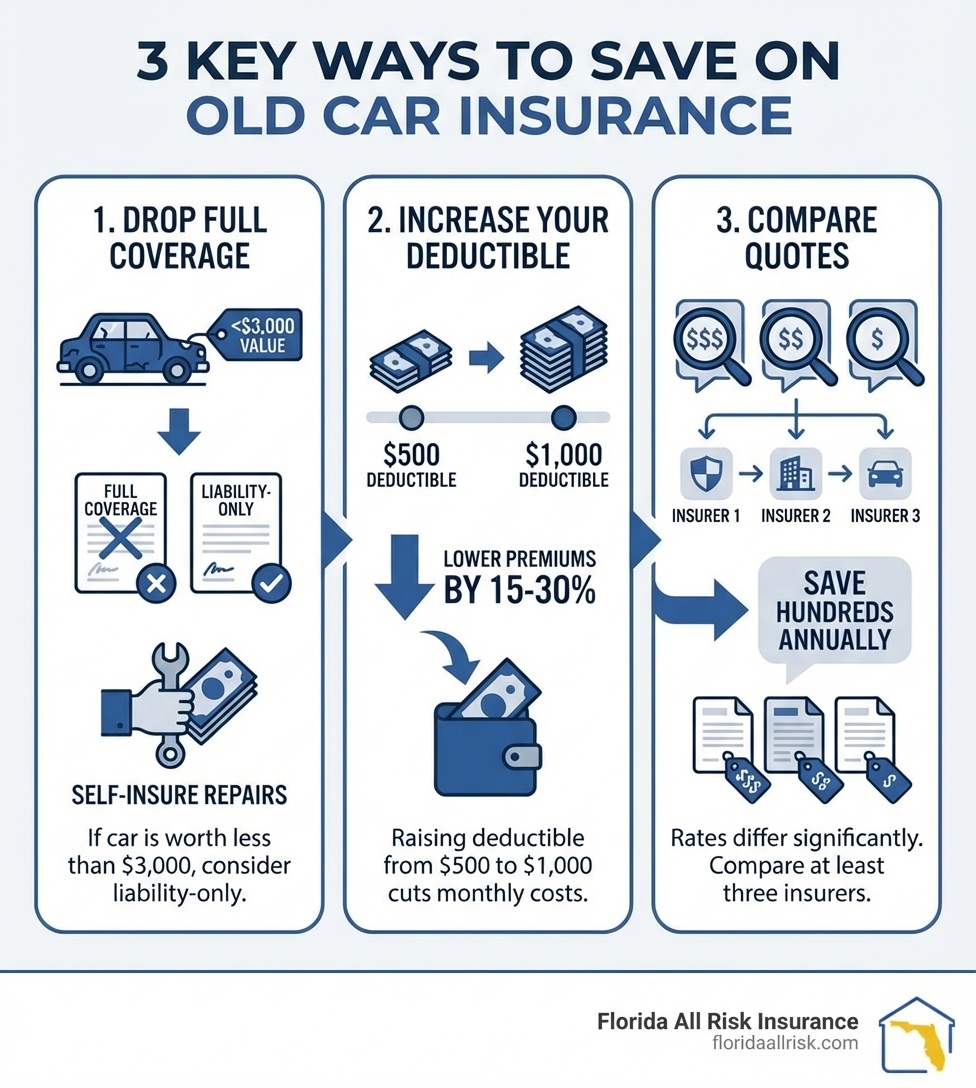
- Drop full coverage if your car’s value is low—switching to liability-only can drastically cut your premium.
- Shop around and compare quotes from multiple insurers, as rates can vary widely.
- Raise your deductible to lower your premium if you keep collision and comprehensive.
- Ask about discounts for safe driving, low mileage, bundling, or anti-theft devices.
- Review your policy annually because as your car’s value drops, your coverage needs usually change.
For example, full coverage for a 2010 model averages about $180 per month, while liability-only averages around $97 per month. Over a year, that’s a potential saving of nearly $1,000—money that could go toward maintenance, savings, or your next vehicle.
The logic is straightforward: older cars depreciate, but insurance costs do not automatically fall at the same pace. Many drivers overpay for comprehensive and collision coverage on cars worth only a few thousand dollars. When your car’s value is low, the maximum insurance payout (minus your deductible) often doesn’t justify the higher premium.
However, “old” does not always mean “cheap to insure.” Some older cars lack modern safety features, while others use rare or expensive parts that can drive up repair costs and premiums. The key is matching the right coverage to your vehicle’s actual value, your risk tolerance, and how you use the car.
I’m Jason Miller of Florida All Risk Insurance. With over 20 years of experience helping Florida drivers, I focus on finding practical, cost-effective coverage for older vehicles—whether that’s basic liability for a commuter car or specialized protection for a cherished classic.
Understanding Insurance for Older Vehicles
For insurance purposes, an “older vehicle” is typically one that is 10 years or older but not yet treated as a collectible or classic. These cars have usually experienced significant depreciation, which is the main reason insurance can be more affordable.
What Defines an “Older” Car for Insurance Companies?
Most insurers consider vehicles aged 10 years or more as “older” in rating and underwriting. This category is separate from “classic,” “antique,” or “collector” cars, which call for very different types of coverage and valuation.
For standard older cars, payouts for physical damage are based on Actual Cash Value (ACV). ACV is the vehicle’s market value at the time of the incident, after factoring in depreciation, mileage, and overall condition.
This is very different from classic or collector car policies, where the vehicle is often insured on an “agreed value” basis. With ACV, a 12-year-old sedan that was worth $20,000 new might only be worth $3,000–$5,000 today, and your coverage should reflect that.
Even with an older car, you still need to comply with Florida’s minimum insurance requirements, including Personal Injury Protection (PIP) and Property Damage Liability (PDL). If you need a refresher on what these state-mandated coverages entail and how they work in practice, you can review Florida All Risk Insurance’s guide to basic auto insurance in Florida.
Are Older Cars Always Cheaper to Insure?
While older vehicles are often cheaper to insure, it’s not guaranteed. The primary reason for potential savings is depreciation: a lower vehicle value generally means a smaller potential claim for the insurer, which can lead to lower collision and comprehensive premiums.
However, several factors can offset or even reverse those savings:
- Lack of Modern Safety Features: Older cars might not have advanced safety tech such as automatic emergency braking, lane-keeping assist, or multiple airbags.
- Repair Costs and Parts Availability: Some older models have parts that are hard to find or expensive to source.
- Vehicle Type and Risk Profile: Certain makes and models have historically higher rates of theft, vandalism, or serious accidents.
- How the Car Is Used: An older commuter vehicle driven daily in heavy traffic may actually pose more risk than a newer car driven infrequently.
Age is an important factor, but your car’s specific make, model, location, and usage all play major roles in determining your rate. The only way to know for sure what you should pay is to compare personalized quotes that reflect your real-world situation.
Choosing the Right Coverage for Your Aging Car
Insuring an older car is all about balance: you want to meet legal requirements, protect your finances, and avoid paying for coverage that no longer makes sense given the vehicle’s value.
Liability-Only: The Budget-Friendly Minimum
For many owners of low-value, paid-off vehicles, liability-only coverage is the most economical and practical choice. This type of policy covers damages you cause to other people or their property in an at-fault accident, but it does not pay to repair or replace your own car.
In Florida, a basic policy for an older car typically includes:
- Property Damage Liability (PDL) – Covers damage you cause to someone else’s vehicle or property.
- Bodily Injury Liability (BIL) – Often recommended or required by lenders or other parties, this helps pay for injuries you cause to others.
- Personal Injury Protection (PIP) – Mandatory in Florida, this helps cover your own medical expenses and certain related costs, regardless of fault.
Switching from full coverage to liability-only can dramatically lower your premium. For a 10-year-old vehicle, this change alone can cut costs by almost 50% in some cases. It’s a smart move if you can afford to repair or replace your car out-of-pocket after an accident.
To learn more about how liability works and what limits make sense in Florida, you can review Florida All Risk Insurance’s guide to liability car insurance in Florida.
Full Coverage: Is Collision and Comprehensive Worth It?
“Full coverage” is a common phrase, but it simply means a policy that includes both collision and comprehensive coverage in addition to the required liability and PIP.
- Collision Coverage: Helps pay for damage to your car from a collision with another vehicle or object, regardless of who is at fault.
- Comprehensive Coverage: Helps pay for non-collision damage caused by events like theft, vandalism, fire, hail, falling objects, or certain natural disasters.
If you still have an auto loan or lease, your lender will require collision and comprehensive until the loan is paid off. Once your car is paid off, continuing full coverage becomes a cost-benefit decision instead of a requirement.
Consider this example: if your car is worth $3,000 but your annual premium for full coverage is $1,500 and you have a $500 deductible, your maximum payout from the insurer after a total loss is about $2,500. You’re paying a large percentage of the car’s value every year just for the option of that payout. In many cases, those dollars might be better reserved in savings for future repairs or a replacement vehicle.
If you want to keep some physical damage protection while lowering costs, raising your deductible is an option. Florida All Risk Insurance’s guide on auto insurance deductible options explains how different deductibles affect your premium and out-of-pocket costs.
Essential Optional Coverages to Consider
Even if you decide on liability-only coverage for your older vehicle, a few optional coverages often provide valuable protection and peace of mind.
- Personal Injury Protection (PIP): This is mandatory in Florida and covers your medical expenses and a portion of lost wages after an accident, no matter who was at fault. For a deeper look at what PIP covers, limits, and common misunderstandings, see the PIP Insurance Florida Complete Guide.
- Uninsured/Underinsured Motorist (UM): This can be especially important in Florida, where some drivers carry minimal coverage. UM helps protect you and your passengers if you’re hit by a driver with little or no insurance. It can step in to cover medical bills, lost wages, and other losses.
- Medical Payments (MedPay): This optional coverage can supplement PIP by helping with medical costs for you and your passengers, regardless of fault. It’s particularly helpful if you want extra protection without increasing your health insurance deductibles.
- Roadside Assistance: Older cars are more prone to breakdowns, flat tires, or dead batteries. Roadside assistance can provide towing, jump-starts, fuel delivery, and lockout services, often for just a few extra dollars per month.
By combining liability, the right level of physical damage coverage, and a few key add-ons, you can build a policy that fits both your budget and your risk tolerance.
The Big Decision: When to Drop Full Coverage
For many people searching for the cheapest car insurance for old cars, the single most important financial decision is whether—and when—to drop collision and comprehensive coverage.
The guiding rule of thumb is simple: if the cost of your full coverage is a large percentage of your car’s actual value, it’s probably time to scale back.
Calculating Your Break-Even Point
Start by determining your car’s Actual Cash Value (ACV). You can use tools like Kelley Blue Book, Edmunds, or local market listings to get a realistic estimate.
Then, compare that value to the sum of your annual full coverage premium plus your deductible.
Here’s how to think about it:
- Suppose your car is worth $3,000.
- Your deductible is $1,000.
- The most your insurer would pay for a total loss is roughly $2,000 ($3,000 minus the $1,000 deductible).
- If your annual premium for collision and comprehensive is around $1,000, then in just two years you’ll have paid about as much as the maximum payout you could receive.
In that scenario, you might be better off dropping full coverage, switching to liability-only, and putting the savings into an emergency fund for repairs or your next car.
Industry experts often suggest re-evaluating full coverage on cars over 10 years old, especially once they fall below a certain value threshold (often cited around $3,000–$4,000, though this varies by household and budget).
You can soften the impact of dropping full coverage by gradually raising your deductible over time. Florida All Risk Insurance’s guide to auto insurance deductible options walks through how to do this thoughtfully.
How Much Can You Really Save?
The potential savings from dropping full coverage on an older car can be significant.
| Coverage Type | Average Monthly Cost (2010 Model Year Vehicle) | Average Annual Cost (2010 Model Year Vehicle) | Savings from Full Coverage |
|---|---|---|---|
| Full Coverage | $180 | $2,160 | – |
| Liability-Only | $97 | $1,164 | $996 (46%) |
Statistics based on average costs for 2010 model year vehicles.
As the data shows, switching from full coverage to liability-only on a 2010 model year vehicle can save an average of 46%, or about $996 annually. Over multiple years, that savings adds up to several thousand dollars, which is often more than enough to replace a typical older vehicle if it were totaled.
Those savings can be redirected into:
- A dedicated car repair fund for routine maintenance and surprise breakdowns.
- A replacement vehicle fund to upgrade when your current car reaches the end of its life.
- Other financial goals, such as debt repayment or emergency savings.
The key is to make this decision intentionally, based on your car’s value, your finances, and your comfort level with risk—not just out of habit.
Finding the Cheapest Car Insurance for Old Cars: 7 Smart Strategies
Getting the cheapest car insurance for old cars is less about finding a single “magic” company and more about taking a proactive, informed approach. The goal is to pay only for the coverage you actually need—and to make sure you’re not missing out on discounts.

1. Shop Around and Compare Quotes
This is consistently the most effective way to save. Different insurers weigh factors like age, driving record, and vehicle type in different ways. That means two companies can offer very different prices for the same coverage.
Instead of accepting the first quote you receive, request several quotes with the same coverage limits and deductibles. This will give you an apples-to-apples comparison.
As an independent agency, Florida All Risk Insurance can compare rates from multiple carriers for you and help you understand why one quote is higher or lower than another. Their detailed guide on how to compare auto insurance quotes in Florida explains what to look for in each proposal.
2. Increase Your Deductible
If you decide to keep collision and comprehensive on your older car, consider raising your deductible. A higher deductible means you agree to pay more out of pocket if you file a claim, and insurers reward that with a lower premium.
For example, moving from a $500 deductible to a $1,000 deductible can often lower your collision and comprehensive premiums by 15–30%, depending on the vehicle and insurer.
Before increasing your deductible, make sure you could realistically afford to pay it in the event of a claim. A good rule of thumb is to have at least that amount set aside in an emergency fund.
3. Ask About Discounts
Many drivers miss out on discounts simply because they don’t ask. Insurers commonly offer savings for:
- Safe Driving: A clean driving record with no recent accidents or tickets.
- Low Mileage: If you only drive your older car occasionally—say, under a certain mileage threshold per year.
- Good Student: For young drivers on your policy who maintain strong grades.
- Bundling Policies: Combining auto insurance with homeowners, renters, or other policies.
- Anti-Theft Devices: Having alarms, immobilizers, or tracking systems installed in your vehicle.
Florida All Risk Insurance maintains a helpful list of some of the best car insurance discounts and how to qualify for them in Florida.
4. Maintain a Clean Driving Record
Your driving history remains one of the biggest factors in what you pay for car insurance—no matter how old your car is. Avoiding speeding tickets, at-fault accidents, and serious violations (like DUIs) can keep your premiums lower over time.
Many insurers reward accident-free driving with tiered “good driver” discounts that grow over several years. If your record has recently improved, it may be worth asking your agent to re-shop your policy.
For more detail on how safe driving can translate into savings, Florida All Risk Insurance offers a guide to safe driver insurance discounts.
5. Bundle Your Insurance Policies
If you own a home, condo, or renters policy, you may be able to bundle that coverage with your auto insurance and earn a multi-policy discount—often in the range of 10–25%.
Bundling can simplify your bills and claims, and for many households, it’s one of the easiest ways to lower overall insurance costs without sacrificing coverage.
Because Florida All Risk Insurance offers multiple policy types through various carriers, they can help you explore which combination of auto, home, and other coverage provides the best overall value.
6. Consider Usage-Based Insurance
If your older car isn’t driven every day—maybe it’s a spare vehicle, a weekend car, or a commuter you now use less often—usage-based insurance (UBI) might fit your situation.
UBI programs use a mobile app or plug-in device to track things like:
- Total mileage
- Time of day you drive
- Braking and acceleration patterns
- Average speed
Safe, low-mileage drivers can often earn meaningful discounts, especially if they rarely drive during high-risk times (like late at night or during heavy rush-hour traffic).
Florida All Risk Insurance’s guide to pay-as-you-drive insurance in Florida explains how these programs work, what data they track, and whether they might be a good fit for your driving style.
7. Review and Adjust Your Coverage Annually
Your car’s value declines over time, but your coverage doesn’t automatically adjust. That’s why it’s important to review your policy every year.
Ask yourself:
- Has the car’s value dropped enough that collision and comprehensive no longer make sense?
- Have your driving habits changed (shorter commute, remote work, fewer miles)?
- Have you made any safety improvements, like adding an alarm or parking in a more secure location?
- Are you now eligible for new discounts, such as a better credit tier or a longer accident-free period?
An annual review with an independent agent can help you trim unnecessary costs and keep your protection in line with your actual needs.
Is It an “Old Car” or a “Classic”?
This distinction is crucial because the insurance world treats a 10-year-old daily driver very differently from a 1970s muscle car that rarely leaves the garage.
Defining a Classic, Antique, or Collector Car
While definitions can vary slightly among insurers, a vehicle may qualify as a classic, antique, or collector car if it meets several common criteria:
- Age: Often at least 25 years old, though some programs start at 20 years.
- Value: Its value is stable or appreciating, rather than depreciating like a typical commuter car.
- Limited Use: Used mainly for pleasure—such as shows, weekend drives, or club events—and not as a primary daily driver.
- Storage: Kept in a secure, enclosed garage or similar protected space.
- Condition: Well-maintained, restored, or preserved.
According to the Insurance Information Institute’s guide to insuring your classic car, vehicles that are rare, collectible, or worth more than their original sticker price are strong candidates for specialized classic car insurance.
Key Differences: Standard vs. Classic Car Insurance
Standard auto policies and classic car policies differ in a few important ways:
- Valuation: Standard policies use Actual Cash Value (ACV), which factors in depreciation. Classic car policies typically use an “agreed value”—you and the insurer agree on the car’s worth up front, and that amount is paid if the car is a total loss.
- Usage & Mileage: Classic policies usually have strict mileage limits (for example, 2,500–7,500 miles per year) and limit use to pleasure driving, events, and shows—not regular commuting.
- Specialized Coverage: Classic policies may include coverage for spare parts, restoration work, memorabilia, and even vehicle appreciation in some cases.
Florida All Risk Insurance’s guide to antique car insurance provides more detail on these policy differences and how they apply to Florida collectors.
When to Choose Classic Car Insurance
You might consider a classic car policy instead of a standard auto policy if:
- Your vehicle’s value is increasing or holding steady, not dropping.
- You drive it infrequently and mainly for leisure.
- You store it in a secure garage.
- You’ve invested significantly in restoration or customization.
Classic car insurance is often 40–50% cheaper than a standard policy for the same vehicle, chiefly because the cars are driven fewer miles and with more care.
If your vehicle has transitioned from “old car” to “prized collectible,” Florida All Risk Insurance’s guide to insurance for your collector car can help you explore whether a classic car policy is a better fit than standard coverage.
Frequently Asked Questions about Insuring Older Cars
What are the average costs for the cheapest car insurance for old cars?
Average costs vary widely based on coverage, location, and driver profile, but nationwide data provides useful benchmarks. Across the U.S., liability-only coverage for a used vehicle averages around $956 per year (roughly $80 per month), while full coverage averages about $2,345 per year (around $195 per month).
Your actual rate in Florida will depend on factors like:
- Your ZIP code and traffic conditions
- Your driving record and claims history
- The age, make, and model of your car
- Your chosen coverage limits and deductibles
- Any discounts you qualify for
Florida All Risk Insurance can provide a personalized quote that reflects your location, vehicle, and driving history.
Can I get full coverage on a car that is 15 or 20 years old?
Yes. Most major insurance companies will offer full coverage (liability, collision, and comprehensive) for cars that are 15, 20, or even more years old, as long as the car is in insurable condition.
The more important question is whether full coverage is financially wise for your specific vehicle.
Because older cars tend to have lower market values, the maximum payout for collision and comprehensive claims shrinks over time. If the annual premium plus your deductible comes close to (or exceeds) the car’s actual cash value, you may be better off switching to liability-only and saving the difference for potential repairs or a future replacement.
How does my location in Florida affect the cheapest car insurance for old cars?
Your location plays a major role in your auto insurance rate. Insurers evaluate:
- ZIP Code: Urban areas typically have higher rates than rural ones due to heavier traffic, more frequent accidents, and higher theft or vandalism risk.
- Local Claim Rates: Areas with more frequent collisions, severe weather damage, or fraud will generally see higher premiums.
- Weather Risks: In Florida, exposure to hurricanes, coastal flooding, and severe storms can affect comprehensive coverage costs.
- Repair Costs: Local labor rates, parts availability, and even medical costs influence premiums.
Florida All Risk Insurance understands the Florida market and can help you find coverage that reflects your specific risk factors and budget. You can request tailored St. Petersburg auto insurance quotes to see how your area and driving profile influence your rate.
Get the Right Coverage for Your Car, No Matter Its Age
Owning an older car can be a smart financial decision. Lower monthly payments—or no payment at all—combined with thoughtful insurance choices can free up room in your budget without sacrificing essential protection.
By understanding the difference between liability-only and full coverage, knowing when to drop collision and comprehensive, and taking advantage of discounts and smart strategies, you can significantly reduce your premiums. If your vehicle has grown into a genuine collectible, specialized classic car insurance can help you protect its true value.
Working with an experienced, independent agency like Florida All Risk Insurance can make this process easier. An agent who understands Florida’s unique risks and regulations can help you:
- Evaluate whether your older car still needs full coverage.
- Choose appropriate liability limits and optional coverages like UM and MedPay.
- Explore bundling, usage-based programs, and other discounts.
- Decide if it’s time to move a cherished vehicle onto a classic car policy.
Conclusion and Next Steps
You don’t have to guess when it comes to insuring an older vehicle. A short conversation and a few comparisons can reveal whether you’re paying for coverage you no longer need—or missing out on savings you deserve.
If you’re ready to review your current policy and see how much you could save on your older car, contact Florida All Risk Insurance today for a free, no-obligation quote and personalized coverage review.
If you own a vehicle that might qualify as a classic or collector car, reach out now to explore specialized classic car insurance options designed to protect the full value of your investment while keeping costs in check.
Contact Us
Florida All Risk Insurance
Address: 5971 66th St N, St. Petersburg, FL 33709
Phone: (727) 345-3121
Email: [email protected]
Contact Us
Florida All Risk Insurance
Address: 5971 66th St N, St. Petersburg, FL 33709
Phone: (727) 345-3121
Email: [email protected]

