

Full Coverage Auto Insurance: The 3 Crucial Pillars
Understanding What “Full Coverage” Really Means
Full coverage auto insurance is perhaps the most misunderstood term in the insurance industry. While it sounds like an all-encompassing shield that protects you from every possible mishap on the road, it is not actually a specific type of policy you can buy off the shelf. Instead, “full coverage” is a colloquialism used by agents, lenders, and drivers to describe a combination of several different insurance components bundled together to provide a higher level of financial protection.
In the state of Florida, where the driving environment is as diverse as the weather, understanding the nuances of this term is critical. From the congested highways of St. Petersburg to the scenic but storm-prone coastal roads, having the right mix of coverage can mean the difference between a minor inconvenience and a total financial catastrophe. Typically, when someone refers to full coverage auto insurance, they are talking about a policy that includes three primary layers: Liability, Collision, and Comprehensive insurance.
Many Florida drivers mistakenly believe that if they have “full coverage,” they are protected against every scenario, including mechanical breakdowns or the gap between their loan balance and the car’s value. This is a dangerous assumption. The reality is that full coverage auto insurance is industry shorthand for a policy combining liability, collision, and comprehensive insurance—three distinct protections working together to cover both your legal obligations to others and the physical integrity of your own vehicle. Florida is a “no-fault” state, which often leads to the misconception that your own insurance always covers everything. In reality, Personal Injury Protection (PIP) only covers 80% of medical bills and 60% of lost wages, up to a $10,000 limit. This is why “full coverage”—which includes collision and comprehensive—is so vital for protecting the vehicle itself, which PIP does not cover.
In Florida’s unique insurance landscape, characterized by frequent tropical storms, high rates of uninsured motorists, and dense urban traffic, understanding these coverages is essential. Without collision and comprehensive, you are essentially self-insuring your own vehicle. This means that while you might be legally compliant by protecting others on the road, you are leaving your own asset vulnerable to theft, weather damage, or at-fault accidents.
At Florida All Risk Insurance, we have spent years helping Florida families and business owners navigate the complexities of the insurance market. Our goal is to demystify terms like full coverage auto insurance so you understand exactly what you are paying for. We believe that an informed driver is a safer, more confident driver. Whether you are commuting across the Howard Frankland Bridge or taking a weekend trip to the Gulf, we want you to drive knowing you have a robust financial safety net.
You can learn more about how full coverage fits into broader car insurance options by visiting our detailed guide to Florida auto coverage at https://floridaallrisk.com/vehicle-insurance-auto/.
For an impartial, data-driven look at how auto insurance works across the U.S., including average claim costs and coverage patterns, you can review the National Association of Insurance Commissioners’ Auto Insurance Database Report. Another helpful resource is the Insurance Information Institute’s overview of auto insurance coverages, which explains common protections and terminology used nationwide.
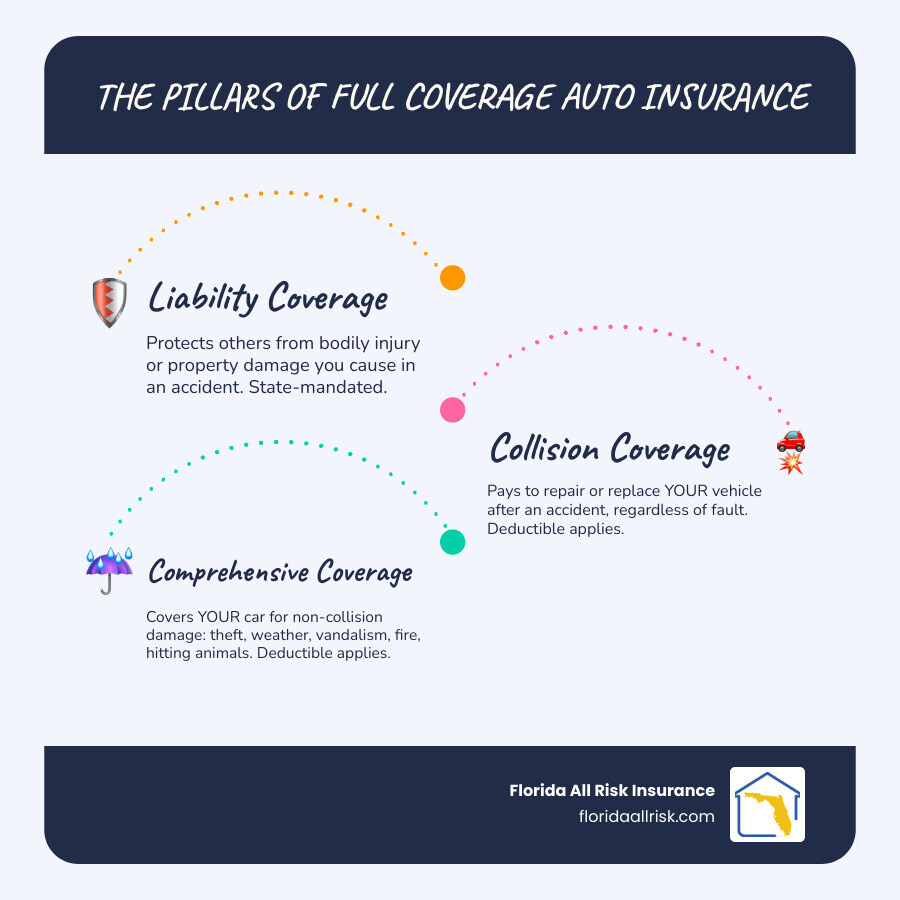
The Three Pillars of Full Coverage: What’s Actually Included?
A full coverage auto insurance policy is not a single product but a strategic package of three essential components designed for more extensive financial protection. Each plays a distinct role in safeguarding you on the road, and understanding how they interact is key to building a policy that truly meets your needs.
Liability Coverage: Your Financial Shield
Liability coverage is the foundation of any auto insurance policy. If you are found to be at fault in an accident, liability coverage is your financial shield, helping protect your personal assets—like your home, savings, and future earnings—from claims made by others. In Florida, liability is split into two main categories:
- Bodily Injury (BI) Liability: This helps pay for medical expenses, lost wages, and even legal fees for people injured in an accident you caused. For example, if you cause a multi-car accident on I-275, your BI liability would help cover the other drivers’ medical bills and rehabilitation costs. Without sufficient BI limits, you could be personally sued for hundreds of thousands of dollars in a serious injury case. In today’s litigious environment, carrying only the minimum can be a recipe for financial ruin.
- Property Damage (PD) Liability: This helps pay for repairs to other people’s vehicles or property (like a storefront, a fence, or a mailbox) that you damage in an at-fault accident. Given the rising cost of modern vehicles, even a minor fender bender with a luxury car can quickly exceed low policy limits. In the modern automotive era, a simple bumper on a high-end SUV can house thousands of dollars worth of proximity sensors and cameras. A Property Damage Liability limit of $10,000—the Florida minimum—can be exhausted in a split second. If you are found liable for a collision involving a high-tech vehicle, you could be facing out-of-pocket costs that dwarf your annual income.
Florida has specific minimum liability requirements, but they are often criticized for being too low to cover the actual costs of a serious accident. If damages exceed your policy limits, you are held personally responsible for the difference. This is why many experts recommend carrying limits far above the state minimums to provide stronger protection for your financial future. For a deeper dive into state requirements and optional upgrades, explore our article on Florida liability coverage at https://floridaallrisk.com/liability-car-insurance-florida/.
Collision Coverage: Protecting Your Own Vehicle in an Accident
While liability helps cover the costs of others, collision coverage is dedicated to your vehicle. It helps pay to repair or replace your car if it’s damaged in an accident, regardless of who is at fault. This is a critical distinction; even if you are the one who made a mistake and hit a tree, a lamppost, or another car, collision coverage ensures you aren’t left without a vehicle.
Collision coverage requires a deductible, which is the amount you agree to pay out-of-pocket before your insurance company covers the remaining balance. For example, if you have a $500 deductible and your car sustains $5,000 in damage, you pay the first $500, and your insurer pays $4,500. Choosing the right deductible is a balancing act between your monthly premium and your available emergency savings. To better understand how deductibles affect your premiums and out-of-pocket costs, visit our guide at https://floridaallrisk.com/auto-insurance-deductible-options/.
Lenders almost always require collision coverage for financed or leased vehicles. This is because the car serves as collateral for the loan, and the lender wants to ensure the asset is protected. However, even if your car is paid off, collision can be vital if you would struggle to pay for major repairs or a total loss out-of-pocket. Without it, a single mistake on a rainy afternoon could result in the total loss of your primary mode of transportation.
Comprehensive Coverage: For Life’s Unexpected Moments
Life in Florida brings a unique set of risks that have nothing to do with driving skill. Comprehensive coverage, often referred to as “other than collision,” helps protect your vehicle from damage caused by events that are outside of your control. In a state known for its volatile weather, this coverage is often considered indispensable.
Imagine waking up after a severe tropical storm to find a heavy oak branch has crushed your roof, or discovering that your car was stolen from your driveway overnight. These are the scenarios where comprehensive coverage steps in. It typically includes protection for:
- Theft and Vandalism: If your car is stolen or keyed, comprehensive helps cover the loss.
- Natural Disasters: This includes windstorms, hail, floods, and falling objects—all common occurrences during Florida’s hurricane season.
- Fire: Protection against engine fires or external fire damage.
- Animal Strikes: If you hit a deer or even a wild hog on a rural Florida road, the resulting damage is covered under comprehensive, not collision.
Like collision, comprehensive coverage has a deductible. Given Florida’s exposure to hurricanes and severe thunderstorms, comprehensive coverage is a highly recommended part of a full coverage auto insurance policy for drivers in St. Petersburg and across the state. You can see how comprehensive and collision work together in the context of Florida auto insurance by visiting https://floridaallrisk.com/vehicle-insurance-auto/.
Full Coverage vs. Liability-Only: A Head-to-Head Comparison
Choosing between full coverage auto insurance and a liability-only policy is one of the most significant financial decisions a vehicle owner will make. It is essentially the difference between maintaining basic legal compliance and investing in broader financial protection for your own property. While the price difference can be notable, the long-term implications of being underinsured can be devastating. For many middle-class families, the vehicle is one of their most valuable assets; losing it without compensation can trigger a downward financial spiral.
Liability-only insurance is designed to meet the state’s minimum legal requirements. It is intended to protect other people and their property if you cause an accident. However, it does absolutely nothing for your own car. If you are in an at-fault accident with liability-only coverage, you will be responsible for 100% of your own repair or replacement costs. In contrast, full coverage auto insurance adds collision and comprehensive layers to ensure that your vehicle is also protected from damage or loss.
Detailed Comparison Table
| Feature | Full Coverage Auto Insurance | Liability-Only Insurance |
|---|---|---|
| Protection for Your Vehicle | Yes (Collision & Comprehensive) | No |
| Protection for Others | Yes (Bodily Injury & Property Damage Liability) | Yes (Bodily Injury & Property Damage Liability) |
| Average Cost | Higher, due to the multi-layered protection for your own assets. | Lower, as it only covers the bare minimum legal requirements. |
| When Recommended | New/expensive cars, financed/leased vehicles, drivers with limited savings for repairs. | Older, low-value cars that are paid off, or drivers with high emergency funds. |
| Financial Risk Exposure | Lower; your out-of-pocket costs are limited to your chosen deductible. | Higher; you risk losing the entire value of your vehicle in an accident. |
| Lender Requirements | Almost always required for any vehicle with a lien or lease agreement. | Rarely permitted by lenders; usually only for vehicles owned outright. |
While liability-only has a lower monthly price tag, it can leave you financially vulnerable in a way that many Florida families cannot afford. If you cause an accident and only carry liability, you’ll be responsible for your own repair bills or the cost to replace your vehicle entirely. Considering that the average collision claim in recent years has risen to several thousand dollars due to advanced vehicle technology and rising labor costs, this is a sum many households would rather not pay entirely out-of-pocket. Furthermore, the opportunity cost of not having a vehicle while you save up for repairs can lead to lost wages and further financial strain. For many drivers, especially those with newer cars or those who rely on their vehicle for their livelihood, the financial security of full coverage auto insurance often outweighs the higher premium. It provides a predictable cost (the premium and deductible) rather than an unpredictable and potentially massive repair bill. To learn more about the basic requirements in Florida and how they fit into your options, you can visit our overview of essential coverages at https://floridaallrisk.com/basic-auto-insurance-florida/.
The Real Cost of Full Coverage Auto Insurance
Budget is almost always a primary factor when choosing an insurance policy. While full coverage auto insurance offers the most robust protection, its price is not fixed. It is influenced by a complex array of variables that insurers use to calculate risk. Understanding these factors can help you navigate the market and find a policy that is both effective and affordable.
Key Factors That Influence Your Premium
There is no one-size-fits-all price for full coverage auto insurance. While national averages can provide a baseline, Florida’s costs are often higher than the national average due to the state’s high litigation rates and weather-related risks. Florida’s insurance market is also heavily influenced by the “litigation tax.” The state has historically seen a disproportionately high number of lawsuits related to auto claims, which forces insurers to raise premiums across the board to cover legal defense costs. Key factors that will determine your specific rate include:
- Driving Record: This is perhaps the most significant factor. A clean record with no accidents, speeding tickets, or other violations is the best way to keep premiums low. Conversely, infractions like DUIs or at-fault accidents can cause rates to spike for three to five years.
- Geographic Location: Where you live and park your car matters immensely. Urban areas like St. Petersburg or Tampa, which have higher traffic density and higher rates of theft and vandalism, typically see higher premiums than rural areas. Additionally, living in a flood-prone or hurricane-prone zone can impact your comprehensive coverage costs. Even your specific ZIP code can influence the rate based on local crime statistics and accident frequency.
- Vehicle Make and Model: The cost to repair or replace your car is a major part of the calculation. High-end luxury vehicles, sports cars, and vehicles with expensive specialized parts (like sensors for self-driving features) are more expensive to insure. On the other hand, cars with high safety ratings and anti-theft devices may qualify for lower rates.
- Driver’s Age and Experience: Statistically, younger drivers (especially those under 25) are more likely to be involved in accidents. As a result, they face higher premiums. Rates generally stabilize and decrease as a driver gains experience and maintains a clean record.
- Credit-Based Insurance Score: In Florida, insurance companies are permitted to use a credit-based insurance score to help predict the likelihood of a claim. Maintaining a solid credit history can often lead to more favorable premiums, as insurers view financial responsibility as a proxy for responsible driving.
- Coverage Limits & Deductibles: The more protection you buy, the more you pay. Choosing higher liability limits will increase your premium, while choosing a higher deductible for collision and comprehensive will lower it.
To see how these elements can influence your rate and what you might expect as a Florida driver, visit our explanation of auto insurance pricing at https://floridaallrisk.com/auto-insurance-rates-florida/.
Smart Ways to Save on Your Full Coverage Auto Insurance Policy
Even with broad protection, there are practical, proactive ways to manage your costs without sacrificing the quality of your coverage:
- Bundling & Multi-Policy Discounts: One of the most effective ways to save is to bundle your auto insurance with other policies, such as homeowners, renters, or boat insurance. Most carriers offer significant discounts for multi-policy households.
- Safe Driver & Good Student Discounts: Many companies reward safe driving habits. Some even offer telematics programs that track your driving behavior (like braking and speed) to provide personalized discounts. While some drivers have privacy concerns, these programs can offer savings of up to 30% for those with safe habits.
- Strategic Deductible Adjustments: By increasing your deductible from $500 to $1,000, you can often see a noticeable drop in your monthly premium. However, you must ensure that you have that $1,000 set aside in an emergency fund so you aren’t caught off guard if you need to file a claim.
- Compare Quotes Regularly: Rates vary significantly between providers for the exact same coverage. As an independent agency, Florida All Risk Insurance can compare options from dozens of top-rated insurers on your behalf, ensuring you get the best value available in the Florida market.
By using these strategies, you can tailor a policy that offers meaningful protection without straining your household budget. To explore discount opportunities in more detail, visit https://floridaallrisk.com/florida-car-insurance-discounts/ and https://floridaallrisk.com/safe-driver-insurance-discounts/.
Making the Right Choice: Is Full Coverage for You?
Deciding whether to invest in full coverage auto insurance involves a careful assessment of your vehicle’s value, your current financial situation, and your personal tolerance for risk. It is not just about what you can afford today, but what you can afford to lose tomorrow.
When Is Full Coverage a Necessity?
While the state of Florida does not legally mandate “full coverage,” there are several common scenarios where it is practically or contractually required:
- Financed or Leased Vehicles: This is the most common reason drivers carry full coverage. Lenders and leasing companies own a stake in your vehicle until the final payment is made. To protect their investment, they will almost always require you to maintain both collision and comprehensive coverage. If you drop these coverages, the lender may “force-place” insurance on your behalf, which is usually much more expensive and offers less protection for you while only covering the lender’s interest.
- New or High-Value Vehicles: If you have recently purchased a new car or own a vehicle with a high market value, the financial risk of a total loss is simply too high for most people to bear. Full coverage ensures that a single mistake or a bad storm doesn’t result in the loss of a five-figure asset.
- Lack of a Financial Safety Net: If you do not have $10,000 to $20,000 sitting in a liquid savings account to replace your car tomorrow, full coverage is your safety net. It allows you to transfer the risk of a catastrophic loss to the insurance company for a predictable monthly fee.
What’s NOT Covered by a Standard Policy?
It is a common misconception that “full coverage” means “everything is covered.” Even the most robust standard policies have exclusions. Understanding these gaps is vital for total peace of mind:
- Custom Parts and Equipment: If you have added custom rims, a high-end audio system, or performance modifications, a standard policy may only cover the factory-installed parts. You may need a “Custom Parts and Equipment” (CPE) endorsement to protect these investments.
- Business and Rideshare Use: If you use your car for Uber, Lyft, or food delivery, your personal auto policy likely excludes coverage during those times. You will need a specific rideshare endorsement or a commercial policy to avoid a claim denial.
- Loan/Lease Gap: If your car is totaled and you owe $25,000 but the car is only worth $20,000, a standard policy only pays the $20,000 Actual Cash Value (ACV). Gap insurance is needed to cover the $5,000 difference, ensuring you aren’t paying for a car you can no longer drive.
- Wear and Tear: Insurance is for sudden and accidental damage. It does not cover oil changes, brake replacements, or mechanical breakdowns due to age.
When Can You Consider Dropping Full Coverage?
As a vehicle ages, its value depreciates. Eventually, the cost of the premium may exceed the potential benefit. Consider dropping collision and comprehensive if:
- The 10% Rule: If the annual cost of your collision and comprehensive coverage exceeds 10% of your car’s total value, it may be time to switch to liability-only.
- Low Market Value: If your car is worth less than $3,000, the payout after a deductible might be negligible.
- Ownership Status: Once the car is paid off, you have the flexibility to decide how much risk you want to carry yourself.

Frequently Asked Questions about Full Coverage
Navigating the world of full coverage auto insurance often leads to many questions. Here are the most frequent inquiries we handle at Florida All Risk Insurance to help you gain clarity.
Is full coverage legally required in Florida?
Technically, no. Florida law only requires $10,000 in Personal Injury Protection (PIP) and $10,000 in Property Damage Liability (PDL). However, "legal" and "smart" are two different things. Furthermore, if you have a car loan, your lender will require full coverage as part of your contract. For a more complete overview of mandatory and optional auto coverages in Florida, you can visit https://floridaallrisk.com/basic-auto-insurance-florida/.
What deductible should I choose for my policy?
This depends on your cash flow. A $1,000 deductible will lower your monthly bill, but you must be certain you can produce that $1,000 on short notice if an accident occurs. If your budget is tight, a $500 deductible offers more immediate protection at a slightly higher monthly cost. Always balance your monthly savings against your emergency fund availability.
Does full coverage include Uninsured Motorist (UM) coverage?
Not automatically. While UM is often included in “full coverage” packages by many agents because Florida has a high rate of uninsured drivers, it is technically a separate add-on. UM protects you if you are hit by someone who has no insurance or not enough insurance to cover your medical bills. We highly recommend adding this to any full coverage policy in St. Petersburg to ensure your medical recovery is funded.
Does Florida have a special rule for windshields?
Yes. Under Florida Statute 627.7288, if you have comprehensive coverage, your insurer must replace or repair your windshield with zero deductible. This is a unique benefit of having a full coverage policy in the Sunshine State, where road debris and construction are constant. This “free” glass repair only applies to the windshield, not side or rear windows.
Does full coverage automatically include a rental car?
No. Rental reimbursement is an optional endorsement. If your car is in the shop for two weeks after a covered accident, this coverage pays for a rental so you can still get to work. Without it, you would have to pay for a rental car out-of-pocket, which can easily cost $500 or more per week. If you rely on your car every day, this is a very affordable and valuable addition to your full coverage auto insurance plan.
Conclusion: Securing Your Peace of Mind on Florida Roads
Navigating the Florida roads requires more than just a reliable vehicle and good driving skills; it requires a robust financial strategy. As we have explored, “full coverage auto insurance” is not a single, magical policy, but a carefully constructed combination of liability, collision, and comprehensive protections. By bundling these coverages, you create a safety net that protects your assets, your vehicle, and your future financial stability. In a state where the unexpected is the only thing you can count on, being prepared is the best defense.
For drivers in St. Petersburg and the surrounding coastal communities, the importance of this protection cannot be overstated. Between the unpredictable tropical weather and the high density of traffic on our bridges and highways, the risks are real. Full coverage provides the peace of mind that comes from knowing that whether it’s a fallen branch during a summer storm or a multi-car pileup on the interstate, you won’t be left facing the financial burden alone. It allows you to focus on recovery rather than repair bills.
As you move forward, remember to regularly review your policy, adjust your deductibles as your savings grow, and always look for available discounts. Insurance should never be a “set it and forget it” task; it should evolve as your life and your vehicle do. Our team is here to ensure your coverage remains as dynamic as your lifestyle.
Contact Florida All Risk Insurance today to speak with a local expert who can help you tailor a full coverage policy that fits your specific needs and budget.
Request your personalized full coverage auto insurance quote online now and take the first step toward total peace of mind on the Florida roads.
Contact Us
Florida All Risk Insurance
Address: 100 2nd Ave S, Saint Petersburg, FL 33701
Phone: (727) 202-4400
Email: [email protected]

